Saturday, June 28, 2008

Friday, June 27, 2008
How I did this... [2]
Portland has a few good graffiti artists. I really enjoy seeing their work, but many times I need to rush to get photos of a scene before someone paints over it. The "authorities" tend to be very confused about what is and what is not "gang" related. So, they try to paint over everything and anything looking like streetart.
However, there is a neat place up on Belmont where the graff stays up for long periods of time. The artist(s) are wonderfully creative! So when my wife told me that some new art went up, I was excited to see what they'd come up with. If the web address on the art is any indication, the artist(s) hails from somewhere north of the US border. I like Canada. I can see that a wee-trip north to photograph their own streetart could yeild some good images.
My wife and I pulled the Prius up to the curb on the opposite side of the street. The parking space in front of the art was filled with some huge gas guzzling blob. I needed the widest angle lens I had. That wasn't too difficult as I have a 10-22mm f/3.5-4.5 EF-S Canon lens that mounts perfectly to my new 40D.
The scene had a very wide dynamic range. Shadow details were easily 20 stops lower than the exceedingly bright back-lit thin clouds. This led me to the idea of realizing the subject as a high dynamic range tone-map. I set the 40D's automatic exposure bracketing function for +/-2EV and made sure the shutter would trip multiple times at high speed. The camera was hand held and I wanted as little motion between exposures as possible.
Once captured, I imported three images (one each +/-/0 EV) into an Open Source application called Qtpfsgui. I checked the box that forced an alignment, just in case the three images needed it. The first step yielded a high dynamic range tiff format file. These files tend to be flat looking and really aren't very interesting.
To make the photo "sing", I selected Qtpfsgui's tone map funtion and used the Fattal filter to re-write the tones they way my mind's eye "saw" them when I first took the three photo stack. There are modifiable parameters in the tone mapping software that allow a user to stretch the image re-mapping in several dimensions. Since I have been working with the application for some time it was easy for me to select the parameter values that closely matched my desired output.
After saving the tone mapped image as a jpg, I opened another Open Source application called the Gimp. The Gimp is a great Photoshop-like application that you can use to edit photos. In this case, I used the Gimp to snug up the upper and lower values and to bring down the "shadow" (darker) tones.
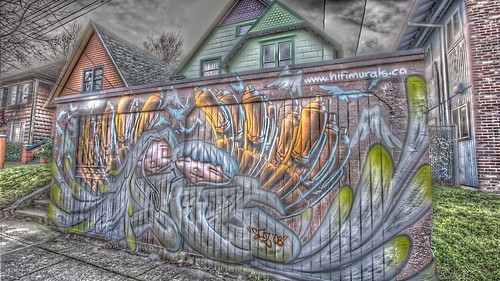
I love the way I can go from image capture to finished product in such little time. Add to this the use of Open Source (aka: free, as in no cost) image manipulation software and I'm thrilled with how my image processing has been streamlined.
However, there is a neat place up on Belmont where the graff stays up for long periods of time. The artist(s) are wonderfully creative! So when my wife told me that some new art went up, I was excited to see what they'd come up with. If the web address on the art is any indication, the artist(s) hails from somewhere north of the US border. I like Canada. I can see that a wee-trip north to photograph their own streetart could yeild some good images.
My wife and I pulled the Prius up to the curb on the opposite side of the street. The parking space in front of the art was filled with some huge gas guzzling blob. I needed the widest angle lens I had. That wasn't too difficult as I have a 10-22mm f/3.5-4.5 EF-S Canon lens that mounts perfectly to my new 40D.
The scene had a very wide dynamic range. Shadow details were easily 20 stops lower than the exceedingly bright back-lit thin clouds. This led me to the idea of realizing the subject as a high dynamic range tone-map. I set the 40D's automatic exposure bracketing function for +/-2EV and made sure the shutter would trip multiple times at high speed. The camera was hand held and I wanted as little motion between exposures as possible.
Once captured, I imported three images (one each +/-/0 EV) into an Open Source application called Qtpfsgui. I checked the box that forced an alignment, just in case the three images needed it. The first step yielded a high dynamic range tiff format file. These files tend to be flat looking and really aren't very interesting.
To make the photo "sing", I selected Qtpfsgui's tone map funtion and used the Fattal filter to re-write the tones they way my mind's eye "saw" them when I first took the three photo stack. There are modifiable parameters in the tone mapping software that allow a user to stretch the image re-mapping in several dimensions. Since I have been working with the application for some time it was easy for me to select the parameter values that closely matched my desired output.
After saving the tone mapped image as a jpg, I opened another Open Source application called the Gimp. The Gimp is a great Photoshop-like application that you can use to edit photos. In this case, I used the Gimp to snug up the upper and lower values and to bring down the "shadow" (darker) tones.
I love the way I can go from image capture to finished product in such little time. Add to this the use of Open Source (aka: free, as in no cost) image manipulation software and I'm thrilled with how my image processing has been streamlined.
Thursday, June 26, 2008
How I did this... [1]
I use Flickr as an on-line gallery space for many of my images. The site is well organized, easy to upload to, and allows the ability to receive feedback and comments from community participants. There are currently over seven million registered Flickr users.
Compare this with the number of viewers a decent photographer might get during a one month gallery showing and you can begin to understand why I like Flickr. It's a great way to have ones work viewed and reviewed by potentially hundreds of thousands of people.
In this series I would like to take five of my most viewed images posted on Flickr and share a few thoughts and comments. I would like to share how I made the image, what it meant to me at the time, and what the image has become.
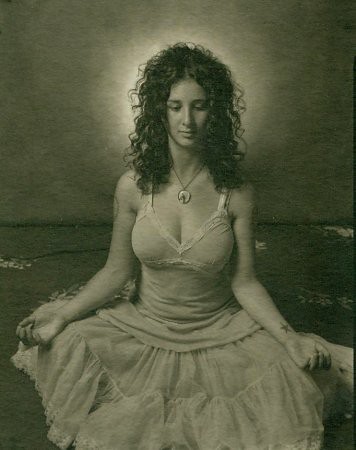
The first image I would like to talk about is rather special to me. Here's why.
My wife and I had recently moved into Portland after spending far too long living in an outlying suburb. Once in town I realized there was a large community of photographers who met on a regular basis. Some groups met to critique each others work. Others met just to enjoy a beer and conversation.
I met Ray Bidegain in one of the small gatherings that take place monthly on the east side of town. Ray, as you may already be aware, is a very fine platinum print artist. His work includes figure studies (for which he is rightfully well known) and landscape images. After seeing his work, I was hooked on the idea of making my own alternative prints. Ray's work was selling well at the time and I thought perhaps I could make and sell a few images too.
Ray was renting studio space up in the north west part of town and was looking for other photographers to share the rent. It was a nice space. A little small, but it had large west facing windows. The space also had a large hand painted backdrop. I signed up with Ray and started paying him rent to sublet the space.
I posted a call for models in the local Craigslist Artists group. This gal was the first to reply.
We set a time and date and I started to gather my materials for the shoot. At the time I was working with an 8x10 Deardorff front swing camera with a 300mm f/4.5 Schneider Xenar in number 5 Compound shutter. I also worked in 4x5 using a nice Arca Swiss Discovery, which Ray has since purchased from me. The 8x10 film was TMax400. The 4x5 film was Ilford FP4+.
The image here was produced all in camera. The Arca Swiss 4x5 had a 150mm Schneider Symmar Convertable f/5.6 in #1 Prontor shutter mounted to the fore. The model was asked to meditate, which she obviously knew how to do. The halo was such a huge bonus that I was thrilled by the very first print I ever made of the model. I used a large softbox high off camera left and placed a 7 inch coned monolight directly behind the models head pointed at the backdrop. The setup was as simple as that.
I have since sold many prints. My Flickr page has received over 1,300 views to date. People have responded positively in all respects.
This image is a 4x5 inch contact Palladium print that I made. It is window mounted to 11x14 inches, and, I have to say, it looks great.
So many things came together all at the same time. It's one of those experiences that I feel I have been working a lifetime to participate in. I feel lucky.
Compare this with the number of viewers a decent photographer might get during a one month gallery showing and you can begin to understand why I like Flickr. It's a great way to have ones work viewed and reviewed by potentially hundreds of thousands of people.
In this series I would like to take five of my most viewed images posted on Flickr and share a few thoughts and comments. I would like to share how I made the image, what it meant to me at the time, and what the image has become.
The first image I would like to talk about is rather special to me. Here's why.
My wife and I had recently moved into Portland after spending far too long living in an outlying suburb. Once in town I realized there was a large community of photographers who met on a regular basis. Some groups met to critique each others work. Others met just to enjoy a beer and conversation.
I met Ray Bidegain in one of the small gatherings that take place monthly on the east side of town. Ray, as you may already be aware, is a very fine platinum print artist. His work includes figure studies (for which he is rightfully well known) and landscape images. After seeing his work, I was hooked on the idea of making my own alternative prints. Ray's work was selling well at the time and I thought perhaps I could make and sell a few images too.
Ray was renting studio space up in the north west part of town and was looking for other photographers to share the rent. It was a nice space. A little small, but it had large west facing windows. The space also had a large hand painted backdrop. I signed up with Ray and started paying him rent to sublet the space.
I posted a call for models in the local Craigslist Artists group. This gal was the first to reply.
We set a time and date and I started to gather my materials for the shoot. At the time I was working with an 8x10 Deardorff front swing camera with a 300mm f/4.5 Schneider Xenar in number 5 Compound shutter. I also worked in 4x5 using a nice Arca Swiss Discovery, which Ray has since purchased from me. The 8x10 film was TMax400. The 4x5 film was Ilford FP4+.
The image here was produced all in camera. The Arca Swiss 4x5 had a 150mm Schneider Symmar Convertable f/5.6 in #1 Prontor shutter mounted to the fore. The model was asked to meditate, which she obviously knew how to do. The halo was such a huge bonus that I was thrilled by the very first print I ever made of the model. I used a large softbox high off camera left and placed a 7 inch coned monolight directly behind the models head pointed at the backdrop. The setup was as simple as that.
I have since sold many prints. My Flickr page has received over 1,300 views to date. People have responded positively in all respects.
This image is a 4x5 inch contact Palladium print that I made. It is window mounted to 11x14 inches, and, I have to say, it looks great.
So many things came together all at the same time. It's one of those experiences that I feel I have been working a lifetime to participate in. I feel lucky.
Wednesday, June 25, 2008
As Mel Brooks once said...
"A funny thing happened on the way to the Coliseum."
There is a group of photographers in Portland who gather on a regular basis. We critique each others work. Sometimes I don't get home until well after 10pm.
I attend several of these kinds of groups. One is devoted to casual conversations over beer and food. Another is quite serious about tools and technique. Yet another consists of artists, teachers, and professionals.

The groups have gotten to know me. When I moved into Portland from the 'burbs I was still in my large format traditional silver print phase. People saw my work and commented positively about many of the images. Later, I moved into making hand coated Palladium prints from large to ultra large format negatives. About a year after I started printing Palladium, and after several very successful gallery shows, I jumped headlong into a war over photographic fundamentalism. Like all religious battles, things got messy.
Working with new tools and modeling my processes after traditional techniques I started to create images that thrilled me. I felt free to explore just about any photographic expression that came to mind. One evening I decided to share some of the work that I had processed just the week before.
It was late. People were tired. Some folks had left already.
When it was my turn, I carefully arranged my photos for people to review.
I quickly sensed that some people were challenged by what I was sharing. As people started to comment and critique the images, it came as no surprise that they had a wide range of thoughts on the topic of photography. In short, my work was nothing like they had "expected" a "real" photograph to be.
I heard comments like "... these are not photographs...", "... I don't know what these are...", "... your images are flat... they lack depth...", "... do you realize that you are threatening illustrators by making it too easy?... they will loose their jobs over this!..."
To balance the whole charade were two photographers who came up to me afterward and said "... this is really great!", "You might be onto something... much like the Impressionists were onto something when they were tossed out of the Salons in Paris..." The last comment may be on the verge of overkill, still, my ego loved to hear it.
I learned several things from the experience. I had a chance to witness the differences in how people "see" photography. It was at first surprising to watch people make assumptions about what is and what is not photography. There seems to a very clear set of "rules" about what a photograph is.
Thinking about this a bit, I have come to the realization that two things were at play. First, people on the inside of the business of making photographs have a very different view of the art than, say, the typical lay viewers, the Great Unwashed Masses. Where I had nothing but praise from the general public for me new work, the photographic establishment was, by and large, reacting quite negatively.
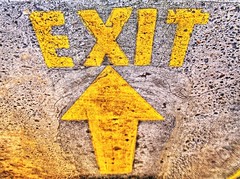
Second, I once again had the opportunity to feel the gulf between what I created, my intentions and hope for the work, and the way people actually respond. Depending on the viewer, the gap between "me" and "them", and the way people respond can be very large.
I am reminded of the unspoken responsibilities of an artist. While there are many dimensions and approaches to expressing art, I can see where it is helpful to provide context. There needs to be some way of connecting with viewers. In general, it seems to me that if an artist assumes a particular context, they may be missing an opportunity to connect with viewers. For on that night of late evening photo critique I had failed to hook my viewers in a way that was meaningful, accessible, or knowable to them.
There is a group of photographers in Portland who gather on a regular basis. We critique each others work. Sometimes I don't get home until well after 10pm.
I attend several of these kinds of groups. One is devoted to casual conversations over beer and food. Another is quite serious about tools and technique. Yet another consists of artists, teachers, and professionals.
The groups have gotten to know me. When I moved into Portland from the 'burbs I was still in my large format traditional silver print phase. People saw my work and commented positively about many of the images. Later, I moved into making hand coated Palladium prints from large to ultra large format negatives. About a year after I started printing Palladium, and after several very successful gallery shows, I jumped headlong into a war over photographic fundamentalism. Like all religious battles, things got messy.
Working with new tools and modeling my processes after traditional techniques I started to create images that thrilled me. I felt free to explore just about any photographic expression that came to mind. One evening I decided to share some of the work that I had processed just the week before.
It was late. People were tired. Some folks had left already.
When it was my turn, I carefully arranged my photos for people to review.
I quickly sensed that some people were challenged by what I was sharing. As people started to comment and critique the images, it came as no surprise that they had a wide range of thoughts on the topic of photography. In short, my work was nothing like they had "expected" a "real" photograph to be.
I heard comments like "... these are not photographs...", "... I don't know what these are...", "... your images are flat... they lack depth...", "... do you realize that you are threatening illustrators by making it too easy?... they will loose their jobs over this!..."
To balance the whole charade were two photographers who came up to me afterward and said "... this is really great!", "You might be onto something... much like the Impressionists were onto something when they were tossed out of the Salons in Paris..." The last comment may be on the verge of overkill, still, my ego loved to hear it.
I learned several things from the experience. I had a chance to witness the differences in how people "see" photography. It was at first surprising to watch people make assumptions about what is and what is not photography. There seems to a very clear set of "rules" about what a photograph is.
Thinking about this a bit, I have come to the realization that two things were at play. First, people on the inside of the business of making photographs have a very different view of the art than, say, the typical lay viewers, the Great Unwashed Masses. Where I had nothing but praise from the general public for me new work, the photographic establishment was, by and large, reacting quite negatively.
Second, I once again had the opportunity to feel the gulf between what I created, my intentions and hope for the work, and the way people actually respond. Depending on the viewer, the gap between "me" and "them", and the way people respond can be very large.
I am reminded of the unspoken responsibilities of an artist. While there are many dimensions and approaches to expressing art, I can see where it is helpful to provide context. There needs to be some way of connecting with viewers. In general, it seems to me that if an artist assumes a particular context, they may be missing an opportunity to connect with viewers. For on that night of late evening photo critique I had failed to hook my viewers in a way that was meaningful, accessible, or knowable to them.
Thursday, June 19, 2008
System Resolution - from Luminous Landscape
I have spent a lot of time with friends and alone testing resolution of MF and LF lenses as part of real world camera systems. One of the big limitations for putting anything to film has been the resolution limits of the film itself and diffraction at smaller apertures.
In their own way, if I'm reading this correctly, nothing has changed when it comes to digital photography. Check out this article and see what you think.
The optical sensor in a CCD or CMOS array becomes the limiting "airy disk" and optical diffraction limits how far you can stop down. I'm happy to see that the laws of physics remain in full effect.
In their own way, if I'm reading this correctly, nothing has changed when it comes to digital photography. Check out this article and see what you think.
The optical sensor in a CCD or CMOS array becomes the limiting "airy disk" and optical diffraction limits how far you can stop down. I'm happy to see that the laws of physics remain in full effect.
Wednesday, June 11, 2008
Monday, June 09, 2008
Tuesday, June 03, 2008
Thursday, May 22, 2008
Explorations
About six months ago I found a process for handing images with incredible dynamic ranges. In traditional silver processing, this is sometimes considered a Holy Grail - to be able to retrain sufficient detail in the shadows while at the same time retaining details in the highlights. So many approaches have, well, developed over time. One approach I ended up with was using Rodinal 150:1 to 200:1 and implementing "semi-stand" 5 inversions every 10 minutes agitation. The approach worked very well. I could clearly see a beneficial effect. However, the local contrast was still not as high as I wanted.
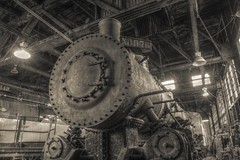
Once my transition to digital was well under way, I found a series of open source tools that might fulfill my needs. I started testing the tools on my favorite subject, steamlocomotives. Here was the most difficult subject I could find. I have shot hundreds of sheets of large format film in an attempt to capture the spirit and light of the roundhouse that the engines live in. Here in this building were incredibly deep shadows and very very bright sun bathed highlights. It's difficult to convey just how many hours I spent trying to figure out the best film/processing/printing combinations.

Shockingly, it took me all of fifteen minutes working with my newfound open source digital tools to stumble upon the exact image style that I had spent the previous decade searching for. Here, finally, was a set of tools that I could use to creatively express what my eyes saw and my heart felt.
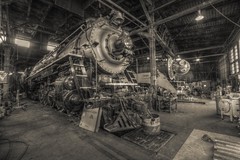
I have since spent time working out alternative approaches to achieving similar results. I have found that I'm in love with the way these tools allow me to "draw" the kinds of images you see here. To me, these are wonderful expressions of light and space.

Once my transition to digital was well under way, I found a series of open source tools that might fulfill my needs. I started testing the tools on my favorite subject, steamlocomotives. Here was the most difficult subject I could find. I have shot hundreds of sheets of large format film in an attempt to capture the spirit and light of the roundhouse that the engines live in. Here in this building were incredibly deep shadows and very very bright sun bathed highlights. It's difficult to convey just how many hours I spent trying to figure out the best film/processing/printing combinations.
Shockingly, it took me all of fifteen minutes working with my newfound open source digital tools to stumble upon the exact image style that I had spent the previous decade searching for. Here, finally, was a set of tools that I could use to creatively express what my eyes saw and my heart felt.
I have since spent time working out alternative approaches to achieving similar results. I have found that I'm in love with the way these tools allow me to "draw" the kinds of images you see here. To me, these are wonderful expressions of light and space.
Tuesday, May 13, 2008
Wednesday, May 07, 2008
Wednesday, April 30, 2008
Thursday, March 20, 2008
People and their camera equipment
I stumbled upon Ken Rockwell's thoughts on camera gear. His comments mirror my own thoughts on the subject. Namely, that people who obsess over the "best" camera equipment are missing the point.
I have been following various newsgroups, on-line forums, and trade-shows for years. Decades, actually. I used to wonder if Leica 35mm cameras were truly imbued with a special quality that their users could benefit from. I used to think that if it was good enough for St. Ansel, it was good enough for me. I used to test and test and test all manner of lenses, cameras, and systems just to see what was the "best". I have even published a great deal on the 'net on this very topic.
After reading his article, it appears to me that Ken and I arrived at similar thoughts in similar time. That is, cameras and lenses are just tools. They are tools that can be used wisely or unwisely, depending upon one's personal approach. But that cameras and lenses are no different than other kinds of tools that people use to create things.
Certainly a woodworker will haul out a hammer when the job at hand calls for it. Then they might choose a bandsaw or a tablesaw or a mitersaw when a different kind of works needs to be done. I seldom hear woodworkers become passionate about the kinds of tools they use or why they selected what they did quite like I hear "photographers" yack-on about their equipment. The same holds true for my experience in talking and participating in other fields of arts and craft.
When I came upon Luminous Landscape's rebuttal to Ken Rockwell, I was further amazed. Here, very redundantly, was a defense of all the bloviating, all the wringing of hands, all the too common commotion around camera and lens selection. I just don't "get it".
Art or craft is art or craft. Nothing more. Nothing less. The tools of one's art or craft are important in so far as they allow one to create what they desire to create. Ninety nine and one half percent of the equipment talk on-line, in the forums, over on the newgroups, in the various blogs is missing the point of art and craft entirely!
It doesn't matter a whit what you use to create your art or craft. All that I'm looking for is how does your work impact me emotionally.
There. I said it. Now it's time to get out there and make and share one's art and craft. Good luck.
The more art and craft in the world the better.
I have been following various newsgroups, on-line forums, and trade-shows for years. Decades, actually. I used to wonder if Leica 35mm cameras were truly imbued with a special quality that their users could benefit from. I used to think that if it was good enough for St. Ansel, it was good enough for me. I used to test and test and test all manner of lenses, cameras, and systems just to see what was the "best". I have even published a great deal on the 'net on this very topic.
After reading his article, it appears to me that Ken and I arrived at similar thoughts in similar time. That is, cameras and lenses are just tools. They are tools that can be used wisely or unwisely, depending upon one's personal approach. But that cameras and lenses are no different than other kinds of tools that people use to create things.
Certainly a woodworker will haul out a hammer when the job at hand calls for it. Then they might choose a bandsaw or a tablesaw or a mitersaw when a different kind of works needs to be done. I seldom hear woodworkers become passionate about the kinds of tools they use or why they selected what they did quite like I hear "photographers" yack-on about their equipment. The same holds true for my experience in talking and participating in other fields of arts and craft.
When I came upon Luminous Landscape's rebuttal to Ken Rockwell, I was further amazed. Here, very redundantly, was a defense of all the bloviating, all the wringing of hands, all the too common commotion around camera and lens selection. I just don't "get it".
Art or craft is art or craft. Nothing more. Nothing less. The tools of one's art or craft are important in so far as they allow one to create what they desire to create. Ninety nine and one half percent of the equipment talk on-line, in the forums, over on the newgroups, in the various blogs is missing the point of art and craft entirely!
It doesn't matter a whit what you use to create your art or craft. All that I'm looking for is how does your work impact me emotionally.
There. I said it. Now it's time to get out there and make and share one's art and craft. Good luck.
The more art and craft in the world the better.
Monday, February 25, 2008
Canon 100-400L in the field
After testing my new Canon 100-400 f/4.5-5.6 L I realized that it had potential for being a very sharp lens. Testing the 100-400L against my 70-200L near the close focus limits of both lenses showed the results to be equal (see prior post). Now, I wanted to see how the 100-400L behaved with subjects at distances greater than six feet.
As for the lens being sharp? Oh yes, it most certainly is sharp. Much sharper than I anticipated, in fact. After reading all the mis-leading comments over on DPReview I had to steady myself and come back to reality. The 100-400 f/4.5-5.6 L Canon lens is simply superb.
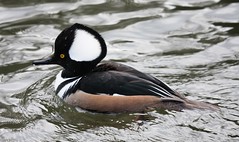
One has to be careful when using long lenses. Vibration and shake are greatly magnified.
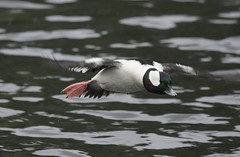
In my case, I haul out the Bogen 3033/3057 setup and strap the long super zoom to the head. For stationary subjects I can clamp the controls down tight and either trigger the shutter using the 40D's 2 second delay, or use my new 2.5foot tethered trigger.
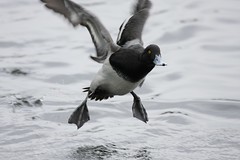
For birds in flight (BIF) I found that loosening the tripod head controls (horizontal and vertical) just enough to be able to move the camera setup is very usable. I realize it might be counter-intuitive, but using the tripod in this manner allows me to keep the focus point fairly steady on the subject. I have now shot thousands of images using this method and have better results than with trying to follow a BIF handheld (camera/lens off-tripod).
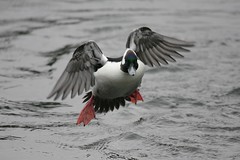
As for the lens being sharp? Oh yes, it most certainly is sharp. Much sharper than I anticipated, in fact. After reading all the mis-leading comments over on DPReview I had to steady myself and come back to reality. The 100-400 f/4.5-5.6 L Canon lens is simply superb.
Thursday, January 10, 2008
DSLR lens testing - Canon EF 100-400mm f/4.5-5.6 L
All the bird photographers I know and those I've seen on line (DPReview, Fred Miranda, etc) seem to use Canon's 100-400mm f/4.5-5.6 L series lens. And there has been quite a bit of discussion about possible variability in build quality between samples. For this reason it became very important to me to test a new sample before I put it to use in the field. I wanted to use such a test to "spot check" the example I purchased to see if it needed to be returned for another.
As in previous tests, the numbers that follow the aperture are resolution in line pairs per millimeter (aka lines per millimeter). For this lens I tested both center (at some focal lengths) as well as the edge of the frame (in selected focal lengths). As in the 70-200mm f/4 L testing, as I got to the longer lengths I started to use the Canon 40D's Live View mode with 10x magnification to carefully focus on the USAF Resolution Test Chart.
One thing to note before we get to the numbers; I strapped this lens on the heaviest tripod I own, a Bogen 3033 set of legs on a Bogen #3057 head. This rig has firmly held a Folmer and Schwing 12x20 inch view camera in the field. It easily holds an 8x10 Deardorff quite solidly. Yet when I was attempting to focus in Live View mode it was very easy to tell that the 100-400L gets "shaky" when I barely touched the lens.
This illustrated very very clearly to me the need for careful technique when using the 100-400L in the field. IS may play an important role. High shutter speeds will also play an important role. And, finally, I may need to strap this lens down to the 3033/3057 Bogen and trigger the shutter with a remote release. All this in an attempt to get the highest possible resolution out of the Canon 40D/100-400L setup.
100-400L
(100mm) AF focused - center measurement only
f/4.5 58
f/5.6 65
f/8.0 65
(200mm) AF - center measurement only
f/5.0 58
f/5.6 58
f/8.0 58
(200mm) Live View, careful 10x focusing, center + edge measurement
f/5.0 65 82
f/5.6 65 82
f/8.0 65 82
(400mm) AF - center measurement only
f/5.6 58
f/8.0 52
f/11 46
(400mm) Live View, careful 10X focusing, center measurement only
f/5.6 58
f/8.0 56
f/11 46
At 100mm, the lens appears to test "OK". It's certainly not what the 70-200 f/4L measured at the same 114 inches from the target. I wasn't entirely thrilled. But I kept going, just to see what else this lens might have in store for me.
At 200mm I tested in both AF and Live View modes. I was also able to capture edge resolution performance readings. Here again, the lens tested "OK" against the 2D test chart. But then something caught my attention. When I read the edge performance of the Live View tests I realized that 82l/mm is outstanding! performance. I had to wonder what I'd done wrong. Perhaps the Live View focusing wasn't as accurate as I'd hoped. And, of course, there's the fact that at these higher magnifications, AF and manual focusing with the wee-Canon 40D is nothing like focusing a 120 format film camera. The brightness of the display as well as the distance to the subject must come into play.
- Click on the following image to view it full size -

As in previous tests, the numbers that follow the aperture are resolution in line pairs per millimeter (aka lines per millimeter). For this lens I tested both center (at some focal lengths) as well as the edge of the frame (in selected focal lengths). As in the 70-200mm f/4 L testing, as I got to the longer lengths I started to use the Canon 40D's Live View mode with 10x magnification to carefully focus on the USAF Resolution Test Chart.
One thing to note before we get to the numbers; I strapped this lens on the heaviest tripod I own, a Bogen 3033 set of legs on a Bogen #3057 head. This rig has firmly held a Folmer and Schwing 12x20 inch view camera in the field. It easily holds an 8x10 Deardorff quite solidly. Yet when I was attempting to focus in Live View mode it was very easy to tell that the 100-400L gets "shaky" when I barely touched the lens.
This illustrated very very clearly to me the need for careful technique when using the 100-400L in the field. IS may play an important role. High shutter speeds will also play an important role. And, finally, I may need to strap this lens down to the 3033/3057 Bogen and trigger the shutter with a remote release. All this in an attempt to get the highest possible resolution out of the Canon 40D/100-400L setup.
100-400L
(100mm) AF focused - center measurement only
f/4.5 58
f/5.6 65
f/8.0 65
(200mm) AF - center measurement only
f/5.0 58
f/5.6 58
f/8.0 58
(200mm) Live View, careful 10x focusing, center + edge measurement
f/5.0 65 82
f/5.6 65 82
f/8.0 65 82
(400mm) AF - center measurement only
f/5.6 58
f/8.0 52
f/11 46
(400mm) Live View, careful 10X focusing, center measurement only
f/5.6 58
f/8.0 56
f/11 46
At 100mm, the lens appears to test "OK". It's certainly not what the 70-200 f/4L measured at the same 114 inches from the target. I wasn't entirely thrilled. But I kept going, just to see what else this lens might have in store for me.
At 200mm I tested in both AF and Live View modes. I was also able to capture edge resolution performance readings. Here again, the lens tested "OK" against the 2D test chart. But then something caught my attention. When I read the edge performance of the Live View tests I realized that 82l/mm is outstanding! performance. I had to wonder what I'd done wrong. Perhaps the Live View focusing wasn't as accurate as I'd hoped. And, of course, there's the fact that at these higher magnifications, AF and manual focusing with the wee-Canon 40D is nothing like focusing a 120 format film camera. The brightness of the display as well as the distance to the subject must come into play.
It seems that the resolution drops off on my 100-400L at 400mm. But it's not far behind the 200mm center measurements on that lens when using either AF or Live View to focus this 100-400L. I wasn't sure what this meant, even after looking at DPReview's performance tests of this lens at 400mm and comparing it against the 400mm EF f/5.6 L. There was one last test I wanted to undertake before I headed into the field.
I took the nice and sharp 70-200L, set it at 200mm, and moved the tripod to 54 inches from the target. This made the subject size the same as the 100-400L at 400mm. I then Live View focused images. Testing f/5.6 on both lenses I put the results into an image viewer (Gimp or Canon's own software worked nicely in my tests) and observed the differences in apparent resolution at 200x.
The results are really quite interesting. The 100-400L was tested at 400mm and 114 inches from the target. The 70-200L was tested at 200mm and 54 inches from the target. In the following image, take a close look at the results. Resolution is really nice on the 100-400. Looks at the test bars for both the 70-200L and 100-400L at f/5.6. They look very nearly the same, don't they? Then look at how the performance degrades from f/5.6 thru f/11 on the 100-400L. This appears consistent with a few user observations I read on DPReview.
- Click on the following image to view it full size -

What's interesting to me is that when operating near the closest focus of either lens (6 feet for the 100-400, and slight farther but still near the close focusing limits of the 70-200L at roughly 4 feet) that performance between the supposedly less sharp 100-400L and the know to be brilliant 70-200 f/4L is identical! What this leads me to believe is that close focus performance of Canon's zooms might not be as good as their ability to resolve scenes at something greater than their close focus limits.
With this in mind, could it be that the 100-400L's performance is actually quite good at greater distances from the subject? To find out, I'm headed out into the field...
Wednesday, January 09, 2008
DSLR lens testing - Canon EF 70-200mm f/4 L
Shooting a Canon 40D, mounted on a heavy tripod, looking at the smallest resolvable block of information from a USAF Resolution Test Chart, at 114 inches from the target, I took a look at a 70-200mm f/4 L (non-IS) resolution. In general, I like this lens for it's size and weight. So I was looking forward to seeing just how sharp it could be.
The numbers from left to right after the test aperture are the resolution figures noted in Lines Per Millimeter (aka line pairs per mm - they're the same thing). My comments follow.
70-200mm f/4 L (non-IS)
(70mm) AF enabled
f/4.0 65 65 58
f/5.6 74 74 65
f/8.0 93 83 74
f/5.6 73 73 73
f/8.0 73 73 73
(200mm) AF enabled, center measurement only
f/4.0 40
f/5.6 58
f/8.0 58
(200mm) Live View - careful focusing at 10x, center measurement only
f/4.0 82
f/5.6 72
f/8.0 72
For the first pass I let the camera autofocus on the USAF Resolution Test Chart. The resolution numbers you see here reflect this.
Looking at resolution at 70mm the lens performs very nicely. As some people feel, the resolution improves from f/4 through to f/8 as the lens is stopped down. At f/4 the numbers look good compared with the two previous tests of fixed focus lenses. By f/8 the 70mm resolution is the best I've seen so far. Simply brilliant.
Looking at resolution at 100mm the lens performs very consistently at all apertures all across the field. Very nice and even, but no improvement in resolution by stopping down. I measured this length specifically to compare with a soon to be acquired 100-400mm f/4.5-5.6 Canon EF-L.
Looking at the top end of the zoom range I performed two test passes. The first pass let the autofocus select the focus point. The resolution of the 2D subject (the USAF chart is flat, after all) is down from 100mm resolution. For a second pass I used the 40D's Live View and 10x magnification to hand focus the lens. I did this to see if there was any improvement to be had in the lens measured resolution performance, and there is. As you can see, the lens is just as sharp at 200mm as it is at 70mm, depending upon the aperture.
The second test pass taught me that the 40D's autofocus, while good, might not be the absolute best in all cases when shooting a 2D subject. I'm sure there are many factors which come into play with regards to the 40D's AF performance. I just happened to stumble upon on sample/observation. This is a good learning and will be applied to the 100-400L tests when I get there.
Please Note: Resolution tests should not be confused with Modulation Transfer Function testing. MTF looks at a lens' ability to preserve contrast from the original scene. Resolution tests look for the finest possible sharpness, independent of contrast. The two tests are somewhat related in that the human eye perceives resolution as contrast. But the nuance is important as many folks feel that MTF is the only valid optical test. It's not. There are many ways of looking at lens performance. These happen to be just two, and I have chosen the simpler to implement resolution test process.
The numbers from left to right after the test aperture are the resolution figures noted in Lines Per Millimeter (aka line pairs per mm - they're the same thing). My comments follow.
70-200mm f/4 L (non-IS)
(70mm) AF enabled
f/4.0 65 65 58
f/5.6 74 74 65
f/8.0 93 83 74
(100mm) AF enabled
f/4.0 73 73 65f/5.6 73 73 73
f/8.0 73 73 73
(200mm) AF enabled, center measurement only
f/4.0 40
f/5.6 58
f/8.0 58
(200mm) Live View - careful focusing at 10x, center measurement only
f/4.0 82
f/5.6 72
f/8.0 72
For the first pass I let the camera autofocus on the USAF Resolution Test Chart. The resolution numbers you see here reflect this.
Looking at resolution at 70mm the lens performs very nicely. As some people feel, the resolution improves from f/4 through to f/8 as the lens is stopped down. At f/4 the numbers look good compared with the two previous tests of fixed focus lenses. By f/8 the 70mm resolution is the best I've seen so far. Simply brilliant.
Looking at resolution at 100mm the lens performs very consistently at all apertures all across the field. Very nice and even, but no improvement in resolution by stopping down. I measured this length specifically to compare with a soon to be acquired 100-400mm f/4.5-5.6 Canon EF-L.
Looking at the top end of the zoom range I performed two test passes. The first pass let the autofocus select the focus point. The resolution of the 2D subject (the USAF chart is flat, after all) is down from 100mm resolution. For a second pass I used the 40D's Live View and 10x magnification to hand focus the lens. I did this to see if there was any improvement to be had in the lens measured resolution performance, and there is. As you can see, the lens is just as sharp at 200mm as it is at 70mm, depending upon the aperture.
The second test pass taught me that the 40D's autofocus, while good, might not be the absolute best in all cases when shooting a 2D subject. I'm sure there are many factors which come into play with regards to the 40D's AF performance. I just happened to stumble upon on sample/observation. This is a good learning and will be applied to the 100-400L tests when I get there.
Please Note: Resolution tests should not be confused with Modulation Transfer Function testing. MTF looks at a lens' ability to preserve contrast from the original scene. Resolution tests look for the finest possible sharpness, independent of contrast. The two tests are somewhat related in that the human eye perceives resolution as contrast. But the nuance is important as many folks feel that MTF is the only valid optical test. It's not. There are many ways of looking at lens performance. These happen to be just two, and I have chosen the simpler to implement resolution test process.
Tuesday, January 08, 2008
DSLR lens testing - Canon EF 50mm f/1.8
A second lens that I tested during a big weather event. It was raining like crazy around here and the wind was of Hellenic proportions. I didn't feel bad about testing instead of going outside and shooting live subjects.
To get an idea of what my optics and camera would do in my situation, and ignoring the fact that MTF measures contrast reproduction and USAF resolution test charts measure resolution - leading to vast differences in how results are to be interpreted, understood, applied... on a Canon 40D mounted to a sturdy tripod and letting the AF do it's thing, measuring line pairs per mm (same as saying lines per mm), at a target 114inches from the CMOS sensor plane...
...three numbers: Center ~ Middle ~ Edge of the frame...
EF 50mm f/1.8 II
f/1.8 46 52 52
f/2.8 52 52 58
f/4.0 73 73 65
f/5.6 73 73 65
I see that the resolution is fairly flat across the field. By f/4.0 this seems like a sharp little lens. The performance at wider apertures might actually be better than whats recorded here, but for that kind of test I would use Live View and 10X magnification to carefully focus.
For $70USD new, this is really a nice lens!
Monday, January 07, 2008
DSLR lens testing - Canon EF 28mm f/2.8
Just got out of the basement from running tests of my various optics against a USAF resolution test chart. It's raining like crazy here and the wind is of Wizard of Oz proportions, so I didn't feel bad about testing instead of going outside and shooting live subjects.
If I have time in the future, I may write up something more complete. Until then, my words and calculations will have to do.
To get an idea of what my optics and camera would do in my situation, and ignoring the fact that MTF measures contrast reproduction and USAF resolution test charts measure resolution - leading to vast differences in how results are to be interpreted, understood, applied... on a Canon 40D mounted to a sturdy tripod and letting the AF do it's thing, measuring line pairs per mm (same as saying lines per mm), at a target 114inches from the CMOS sensor plane...
...three numbers: Center ~ Middle ~ Edge of the frame...
Canon EF 28mm f/2.8f/2.8 82 65 52
f/4.0 82 65 58
f/5.6 82 65 65
Compared with other DSLR lenses I tested, this is a really nice result . The edges come up cleaner and sharper as the aperture is stopped down. This is a seemingly sharp little optic.
Subscribe to:
Comments (Atom)