Thursday, March 12, 2009

Photography

I have been exploring a whole new set of tools for going on two years now. The move from film to digital capture was the prime mover for me to learn about current tools capabilities.

My explorations included a deep look into multiple exposure high dynamic range with tone mapping. The results of that learning led to the LensWork publication of a 35 image portfolio title In The Rail Yard. I continue to be thrilled by the results.

Another exploration has been to capture waterfowl in flight. The latest tools offer capabilities I only dreamed of back when I shot film. So image capture has been much easier. This has freed me to work on lighting and location. Much of that work has been posted on my Flickr pages and continues to receive positive feedback from around the world.

Just below this posting you can see yet another exploration. I am now learning about digital cinema. The process of thinking through scenes and scripts and staging and lighting brings back experiences I had thirty years ago when I worked as a still photographer on a small number of AFI projects down in Los Angeles.

Imagine my surprise when I came upon an image that nearly knocked my eyeballs out of their sockets. I haven't dealt in straight image capture for years and yet here was something completely unexpected; a beautiful image coming very nearly straight out of the camera.

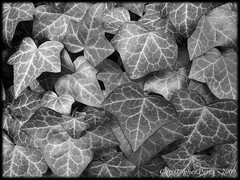
My daily life usually sees me carrying a small Canon G10 point and shoot camera. I use it to "sketch" ideas and to try and capture fleeting moments where a DSLR or film camera might be cumbersome. Recently my wife and I were walking up the street after buying a few loaves of bread. I happened to look down and spied a rather nice grouping of ivy leaves. Out came the camera and within seconds I had four or five images to work from.

Ivy


Much later (like two weeks later) I browsed my image files to see if there might be something worth processing. I rendered a few images in color and then switched to applying a quad-tone tint. As I de-saturated the image my mouth dropped open. The effect impressed me beyond my imagination.

I watch the video linked to from this blog about James Ravilious. He liked uncoated pre-war optics for the way they opened the shadow areas and gave the highlight regions a beautiful creamy effect. That's one of the things about coming from 40+ years of tradition film photography. I'm able to take a moment and think about what actually happens when something like an un-coated optic is used to make an image. I can then attempt to re-create the effect using my current digital tools.

In the case of this image, I knew the shadow areas would've been open and quite details if shot with an uncoated Leica M39 lens. I also knew that the highlight areas would've either been "blown out" or rendered just on the edge of detail. Working the curves to achieve that effect on the file I was working with was quick, easy, and straight-forward.

There was a nice print in here just waiting for me to press the button.

Out came Hanemuhle's latest photo rag smooth (from their new factory in France).

Down came the special feed tray on the HP B9180 printer.

Press went the print button on the computer.

Out came what may very well be one of the finest prints I have ever made.

The highlights are perfectly placed. The shadow areas are gorgeous. The edges of the leaves returned an incredible micro-contrast in the way they overlay each other. The edges of the frame gave the effect that this was shot with an old Leica III-series film camera. The entire effect is one of incredible luminosity and brilliance.

This one is a "keeper".

Portland

News FLASH! - My In the Railyard work will be shown at ProPhoto Supply's entryway gallery during the month of September 2009.

Yea!!!

Awakening


Exploring the edges and limits of my new tools I continue to learn the craft of digital cinema.

Tuesday, March 10, 2009

Thursday, March 05, 2009

Spain


This gives such inspiration, direction, ideas, and hope. Wow. This was shot in Seville.

Wednesday, March 04, 2009

Utilikilts


Another video effort. This was shot in 2 hours. In some ways, I wish I had a different setting. But I think it works in spite of the tight quarters.

With all the poor comments over on DPReview and various forums and groups about the Canon 5D MkII's lack of video controls, I was expecting production to be a challenge. Its not. The 5D MkII is a brilliant tool for creative expression.

Wednesday, February 25, 2009

A New Beginning...


An illustration of where I'm headed next? Only time will tell. Be sure to watch this in high quality too. I'm not sure how you get that without going to YouTube to see it thru their web engines.

Wednesday, February 11, 2009

How I did this...


Alternative History - Age of Dystopic Victoria


The last time I spoke with my father we talked a bit about the current state of photography and art.

My father is a traditionalist. He learned the basics of photography from his father. He still uses film for his more serious work and enjoyed tinkering with different ideas and styles as the mood hits him.


Alternative History - Age of Witches


I sent along a DVD of my LensWork published work and interview. My father must've given it a listen and it might have left him somewhat bewildered.

In less than two years I have transitioned from large and medium format film systems and silver and palladium printing methods. Nowadays I use the latest generation digital tools and techniques. I have worked hard to leverage my knowledge of computer science to learn as much as I can about digital tools and techniques for image making. Until I spoke with my father I had no idea just how far and fast the movement has been.


Alternative History - Age of Tribal Steam


I had to laugh when he started talking about Richard Feinman. My father heard a story about Richard and his father. It went something like this: In the early days, Richard and his dad would talk about science and physics. Richard obviously enjoyed the subject. After years of research, Richard tried to talk with his dad about his latest findings and his dad had to tell him he couldn't understand a word he'd said.

Now I'm no Richard Feinman, so I had to laugh when my father shared this story with me and then told me he'd not understood a word I'd said in the interview. After I stopped laughing at the ludicrous comparison I had to think a moment to realize what my father was saying. It wasn't that I was some genius. I'm not. But rather that I have applied myself to a new set of tools and techniques that my father has little to no knowledge of, let alone how to manipulate and use them.


Steampunk Age


Is this an example of the growing gulf between the new and old ways of image making?

Monday, January 05, 2009

Canon

My new Super Toy arrived and what a 'beaut it is. Amazing how good a full frame DSLR can be and Canon has hit the target spot on with its new 5D MkII. This, in my NSHO.

I wanted to see what various lenses would resolve at on this big sensor'd camera. So I put a Canon 28mm f/2.8 EF, a 35mm f/2 EF, a Nikkor 28mm f/2.8 PC (perspective control), a Sigma 20mm f/1.8 EX and a Sigma 24mm f/1.8 EX before the torture chart and took a look at how the system of lenses and camera did, in USAF terms. I will post the results first and then provide a bit of commentary.

Canon 5D MkII + Canon 28mm f/2.8, measured in line pairs per mm (center/edge/f-stop)
missing data - f/2.8
68 34 - f/4
68 43 - f/5.6
68 54 - f/8

Canon 5D MkII + Canon 35mm f/2, measured in line pairs per mm (center/edge/f-stop)
62 20 - f/2
69 22 - f/2.8
69 30 - f/4
69 38 - f/5.6
69 55 - f/8

Canon 5D MkII + Nikkor 28mm f/3.5 PC, measured in line pairs per mm (center/edge/f-stop)
60 33 - f/3.5
67 38 - f/4
67 47 - f/5.6
67 47 - f/8

Canon 5D MkII + Sigma 20mm f/1.8, measured in line pairs per mm (center/edge/f-stop)
73 33 - f/1.8
73 33 - f/2
73 37 - f/2.8
73 46 - f/4
73 52 - f/5.6
73 57 - f/8


Canon 5D MkII + Sigma 24mm f/1.8, measured in line pairs per mm (center/edge/f-stop)
70 39 - f/1.8
70 39 - f/2
78 39 - f/2.8
78 44 - f/4
78 48 - f/5.6
78 57 - f/8

I found these results to be very interesting. First, the Canon and Nikon lenses are very fine. Every image I have ever shot with them have been sharp and contrasty. I was pleased with the Nikkor results as that lens provides enormous coverage that allows a full 11mm offset/rise/fall/shift. However, the real shock is the Sigma findings.

If you read DPReview and other forum sites devoted to slandering, slamming, and flaming everything and anything, one might be led to believe that Sigma could not build a fine lens to save their lives. Alas, nothing could be further from the truth.

Doing a little math, I found that the Canon 5D MkII's sensor is capable of giving 156 lines of information per millimeter. Switching the calculation around to line pairs per millimeter, the math says the sensor should give 78 line pair per millimeter. And that's just what the Sigma optics resolved at!!!

What's even more fun is that the 24mm Sig set me back less than 270USD as a demo unit picked up from Adorama. Better yet? The 20mm Sig set me back less than 260USD in LN condition from KEH. In short: SHOCKINGLY incredible optics for bargain prices!

Tuesday, December 02, 2008

Lenswork Magazine

A few weeks ago LensWork Magazine issue #79 arrived. It sat nicely on the nightstand next to the bed waiting to be looked at.

There wasn't interest in it for me. I couldn't understand why since I've devoured every single issue up to this one.


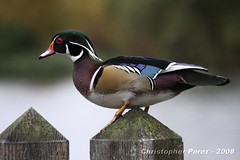
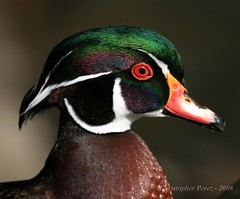
Wood Duck - 2008


So I let the issue rest.

Last weekend I started to wonder about my response to the unread magazine. At first I thought it might be that I didn't like the work in this issue. But how could I say that? I'd not even cracked open a page. So that had to be a rationalization on my part.


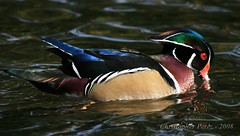
Wood Duck - 2008


Whenever I catch myself in self deception, I try to stop and dig deeper. In this case I was looking for a better reason for not reading the latest issue.

As I let my awareness wander, I found that I was uncertain about the "success" that came from my In The Railyard work that had been published in LensWork Extended #78. What did it mean to be published by one of the finest photographic arts magazines in the world? What did it mean to me and my work that someone had found something I created to be nice enough to print? Why couldn't I understand what was going on?


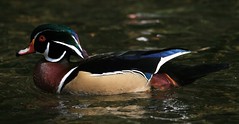
Wood Duck - 2008

Even as I write, I remain surprised at how strong the feeling is that somehow I wasn't good enough.

Where the h*ll did that feeling come from? Why don't I feel my work is good enough? Why can't my work be as good as the next guys? Or am I pushing... pushing... pushing...??? For what? ... Oh... watch the next step... here comes the drive to do something even better... even more marvelous... bigger... grander...

Yikes! I need to put on the brakes. I really like some of my own work. Or do I?


What motivates me? If I'm being truthful, it is the act of creating and the attention I receive afterward. I love the process of figuring out what to say and how to say it. I like it when people comment on my work and I get to share my feelings about an image. I like to listen to what other people have to say. I enjoy the exchange. I enjoy following on-line forums devoted to art critique. I love looking through some of the millions of photos others have created and posted on Flickr.

Wood Duck - 2008

I am a complex beast with an insatiable urge to create, participate, engage, and share. I see that I am sensitive to the thoughts and comments of others. I am buffeted by a world I have little or no control over. I see that my mind can make up all kinds of stories meant to shape my view of the world.

I finally opened the LensWork magazine and found it was interesting. Brooks has yet another insightful editorial. Bill Joy has yet another fine closing piece. In between the editorials and scribblings I found some images were better than others to me. I even teased out a few ideas that might be worth exploring.

Being human is sometimes such a strange experience.

Wednesday, November 12, 2008

Friday, October 24, 2008

Seeing


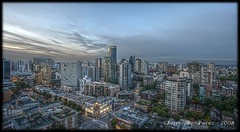
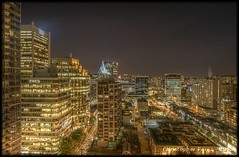
Vancouver, BC - 2008


My wife and I headed north on a rather rotten day. We were going to Vancouver, BC to visit a friend of mine who popped over from England for a convention. The day was doubly rotten. One of my wife's dear friend lost her battle with cancer. We didn't realize this until we were already in British Columbia. Sad. Very sad. Add to this that my friend has hit a patch of rotten luck, and it could have turned into a pity party. It ended up much better than that. Fortunately.


Vancouver, BC - 2008


As we visited that fine city to the north of us, I learned something about the way I see the world. It starts with the acknowledgment that I love to travel. Moving about the globe seems to enable my photographic vision. In simple terms, everything is fresh and new to me. So taking fun images is like shooting fish in a barrel. Its easy.

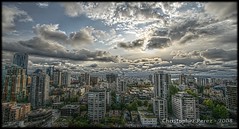
I worked several themes during the trip. From our 24th floor hotel room we were able to over look much of Vancouver's West End high rise skyline. I took the opportunity to make a few images whenever the sky and lighting looked like it might be interesting.


Vancouver, BC - 2008


Thinking back to St. Ansel and his body of work, people seem to remember his Yosemite Valley photos. Highly valued, St. Ansel had much to "say" about the valley. He photographed there for decades and came away with more than a few nice things. How on earth did the valley remain fresh and interesting to him?

After we returned home and I had the chance to process a few things I realized I just don't see my own city in the same way as I do other places. It seems that my own town is too familiar to me. So how do I awaken my photographic vision in a place where I get to see everything of "interest" nearly daily? How do I expand my ideas to include the familiar and, at the same time, seek out new and potentially good photographic ideas?


Vancouver, BC - 2008