Monday, May 18, 2009

News!!!

The Center for Fine Art Photography
400 North College Avenue
Fort Collins, CO 80524

970.224.1010
May 18, 2009
Dear Christopher,

Congratulations! Your portfolio has been accepted for the Portfolio ShowCase Volume 3: Book and Online Exhibition at The Center for Fine Art Photography. Juror, Stella Kramer had the difficult task of selecting just 15 photographers from nearly 250 artists for this unique exhibition.

To view the portfolios that were selected, please visit the Center's website at www.c4fap.org. You will find the selected images and the information form under Jury Results in the bottom left corner of the Center's home page. Please complete and return the form provided.

Once again, congratulations on being selected for this exhibition.

Sincerely,


Azarie Furlong
Exhibitions Manager


Hamidah Glasgow
Executive Director

Tuesday, May 12, 2009

Portland

News Flash! My Steampunk work will be shown thru the month of October at Paradox Cafe in Sellwood. Yea!!

Friday, April 10, 2009

Open Source Tools

Its quite strange, actually. I have a new high end HP laptop computer. It runs Vista64 with 4gig of RAM and am loading my favorite open source tools onto it.

When it came to the Gimp, I found v2.6 and v2.4 crash on a regular basis.

Gimp v2.2.17 is rock solid.

Oh well. So much for "eye candy". If the old version works? I shouldn't complain. There must be something in one of the libraries that isn't configured correctly for the systems I've tried to run v2.4 and v2.6 on.

Thursday, March 12, 2009

Photography

I have been exploring a whole new set of tools for going on two years now. The move from film to digital capture was the prime mover for me to learn about current tools capabilities.

My explorations included a deep look into multiple exposure high dynamic range with tone mapping. The results of that learning led to the LensWork publication of a 35 image portfolio title In The Rail Yard. I continue to be thrilled by the results.

Another exploration has been to capture waterfowl in flight. The latest tools offer capabilities I only dreamed of back when I shot film. So image capture has been much easier. This has freed me to work on lighting and location. Much of that work has been posted on my Flickr pages and continues to receive positive feedback from around the world.

Just below this posting you can see yet another exploration. I am now learning about digital cinema. The process of thinking through scenes and scripts and staging and lighting brings back experiences I had thirty years ago when I worked as a still photographer on a small number of AFI projects down in Los Angeles.

Imagine my surprise when I came upon an image that nearly knocked my eyeballs out of their sockets. I haven't dealt in straight image capture for years and yet here was something completely unexpected; a beautiful image coming very nearly straight out of the camera.

My daily life usually sees me carrying a small Canon G10 point and shoot camera. I use it to "sketch" ideas and to try and capture fleeting moments where a DSLR or film camera might be cumbersome. Recently my wife and I were walking up the street after buying a few loaves of bread. I happened to look down and spied a rather nice grouping of ivy leaves. Out came the camera and within seconds I had four or five images to work from.
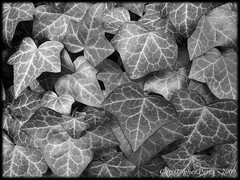

Ivy


Much later (like two weeks later) I browsed my image files to see if there might be something worth processing. I rendered a few images in color and then switched to applying a quad-tone tint. As I de-saturated the image my mouth dropped open. The effect impressed me beyond my imagination.

I watch the video linked to from this blog about James Ravilious. He liked uncoated pre-war optics for the way they opened the shadow areas and gave the highlight regions a beautiful creamy effect. That's one of the things about coming from 40+ years of tradition film photography. I'm able to take a moment and think about what actually happens when something like an un-coated optic is used to make an image. I can then attempt to re-create the effect using my current digital tools.

In the case of this image, I knew the shadow areas would've been open and quite details if shot with an uncoated Leica M39 lens. I also knew that the highlight areas would've either been "blown out" or rendered just on the edge of detail. Working the curves to achieve that effect on the file I was working with was quick, easy, and straight-forward.

There was a nice print in here just waiting for me to press the button.

Out came Hanemuhle's latest photo rag smooth (from their new factory in France).

Down came the special feed tray on the HP B9180 printer.

Press went the print button on the computer.

Out came what may very well be one of the finest prints I have ever made.

The highlights are perfectly placed. The shadow areas are gorgeous. The edges of the leaves returned an incredible micro-contrast in the way they overlay each other. The edges of the frame gave the effect that this was shot with an old Leica III-series film camera. The entire effect is one of incredible luminosity and brilliance.

This one is a "keeper".

Portland

News FLASH! - My In the Railyard work will be shown at ProPhoto Supply's entryway gallery during the month of September 2009.

Yea!!!

Awakening


Exploring the edges and limits of my new tools I continue to learn the craft of digital cinema.

Tuesday, March 10, 2009

Thursday, March 05, 2009

Spain


This gives such inspiration, direction, ideas, and hope. Wow. This was shot in Seville.

Wednesday, March 04, 2009

Utilikilts


Another video effort. This was shot in 2 hours. In some ways, I wish I had a different setting. But I think it works in spite of the tight quarters.

With all the poor comments over on DPReview and various forums and groups about the Canon 5D MkII's lack of video controls, I was expecting production to be a challenge. Its not. The 5D MkII is a brilliant tool for creative expression.

Wednesday, February 25, 2009

A New Beginning...


An illustration of where I'm headed next? Only time will tell. Be sure to watch this in high quality too. I'm not sure how you get that without going to YouTube to see it thru their web engines.

Wednesday, February 11, 2009

How I did this...


Alternative History - Age of Dystopic Victoria


The last time I spoke with my father we talked a bit about the current state of photography and art.

My father is a traditionalist. He learned the basics of photography from his father. He still uses film for his more serious work and enjoyed tinkering with different ideas and styles as the mood hits him.


Alternative History - Age of Witches


I sent along a DVD of my LensWork published work and interview. My father must've given it a listen and it might have left him somewhat bewildered.

In less than two years I have transitioned from large and medium format film systems and silver and palladium printing methods. Nowadays I use the latest generation digital tools and techniques. I have worked hard to leverage my knowledge of computer science to learn as much as I can about digital tools and techniques for image making. Until I spoke with my father I had no idea just how far and fast the movement has been.


Alternative History - Age of Tribal Steam


I had to laugh when he started talking about Richard Feinman. My father heard a story about Richard and his father. It went something like this: In the early days, Richard and his dad would talk about science and physics. Richard obviously enjoyed the subject. After years of research, Richard tried to talk with his dad about his latest findings and his dad had to tell him he couldn't understand a word he'd said.

Now I'm no Richard Feinman, so I had to laugh when my father shared this story with me and then told me he'd not understood a word I'd said in the interview. After I stopped laughing at the ludicrous comparison I had to think a moment to realize what my father was saying. It wasn't that I was some genius. I'm not. But rather that I have applied myself to a new set of tools and techniques that my father has little to no knowledge of, let alone how to manipulate and use them.


Steampunk Age


Is this an example of the growing gulf between the new and old ways of image making?

Monday, January 05, 2009

Canon

My new Super Toy arrived and what a 'beaut it is. Amazing how good a full frame DSLR can be and Canon has hit the target spot on with its new 5D MkII. This, in my NSHO.

I wanted to see what various lenses would resolve at on this big sensor'd camera. So I put a Canon 28mm f/2.8 EF, a 35mm f/2 EF, a Nikkor 28mm f/2.8 PC (perspective control), a Sigma 20mm f/1.8 EX and a Sigma 24mm f/1.8 EX before the torture chart and took a look at how the system of lenses and camera did, in USAF terms. I will post the results first and then provide a bit of commentary.

Canon 5D MkII + Canon 28mm f/2.8, measured in line pairs per mm (center/edge/f-stop)
missing data - f/2.8
68 34 - f/4
68 43 - f/5.6
68 54 - f/8

Canon 5D MkII + Canon 35mm f/2, measured in line pairs per mm (center/edge/f-stop)
62 20 - f/2
69 22 - f/2.8
69 30 - f/4
69 38 - f/5.6
69 55 - f/8

Canon 5D MkII + Nikkor 28mm f/3.5 PC, measured in line pairs per mm (center/edge/f-stop)
60 33 - f/3.5
67 38 - f/4
67 47 - f/5.6
67 47 - f/8

Canon 5D MkII + Sigma 20mm f/1.8, measured in line pairs per mm (center/edge/f-stop)
73 33 - f/1.8
73 33 - f/2
73 37 - f/2.8
73 46 - f/4
73 52 - f/5.6
73 57 - f/8


Canon 5D MkII + Sigma 24mm f/1.8, measured in line pairs per mm (center/edge/f-stop)
70 39 - f/1.8
70 39 - f/2
78 39 - f/2.8
78 44 - f/4
78 48 - f/5.6
78 57 - f/8

I found these results to be very interesting. First, the Canon and Nikon lenses are very fine. Every image I have ever shot with them have been sharp and contrasty. I was pleased with the Nikkor results as that lens provides enormous coverage that allows a full 11mm offset/rise/fall/shift. However, the real shock is the Sigma findings.

If you read DPReview and other forum sites devoted to slandering, slamming, and flaming everything and anything, one might be led to believe that Sigma could not build a fine lens to save their lives. Alas, nothing could be further from the truth.

Doing a little math, I found that the Canon 5D MkII's sensor is capable of giving 156 lines of information per millimeter. Switching the calculation around to line pairs per millimeter, the math says the sensor should give 78 line pair per millimeter. And that's just what the Sigma optics resolved at!!!

What's even more fun is that the 24mm Sig set me back less than 270USD as a demo unit picked up from Adorama. Better yet? The 20mm Sig set me back less than 260USD in LN condition from KEH. In short: SHOCKINGLY incredible optics for bargain prices!