Tuesday, August 23, 2016

Front Ends of Old Cars - a two part image distribution

Following on the heels of the good news from Lenswork Magazine and my inclusion in their "Seeing in Sixes" book project, I thought it could be fun celebration to release another mini-project or two.

With this post I'm releasing "Front Ends of Old Cars" parts one and two.  As you will see, I'm somewhat taken with the six image approach to project sharing.  It hones my mind and forces me to say what I really want to say in a concise manner.

I love automobiles and have ever since my uncle used to give me his Road and Track after he'd read them back in the 1960's and 1970's.  Many of the vintage vehicles I've encountered in Paris are examples of the very cars I used to read about.  The experience of reliving my youth is a powerful one.  Every chance I get I head out the door with cameras in hand to watch my early dreams come true.

Here is "Front Ends of Old Cars" part one.

Here is "Front Ends of Old Cars" part two.

If you have any feedback for me, please feel free to drop me a line.  I'd enjoy hearing from you.

Wednesday, August 10, 2016

Good News... le deuxieme part

As I mentioned in a post from a couple days ago, one of my submissions to Lenswork "Seeing in Sixes" has been picked up and will be published. Here's what one of their editors had to say.

"Hello Christopher… Congratulations (again!) on having your work selected for “Seeing In Sixes.” This is a HUGE accomplishment, as we received nearly 1,900 entries. It was very difficult to whittle down from the 125 finalists; the caliber of work was that good. In the end, less than 3% of the entries – with a tremendous amount of photographic vision and diversity -- will make up the book."

 You can only imagine how thrilled I am to be published alongside 49 other photographic artists.  This is an honor and I can't wait to see everyone's work in print.


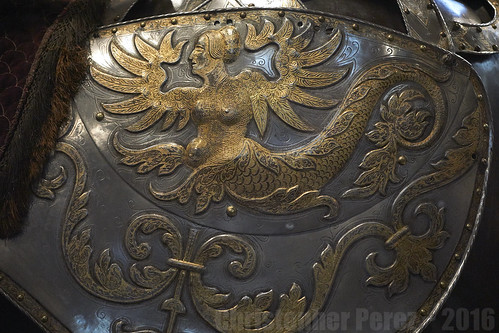
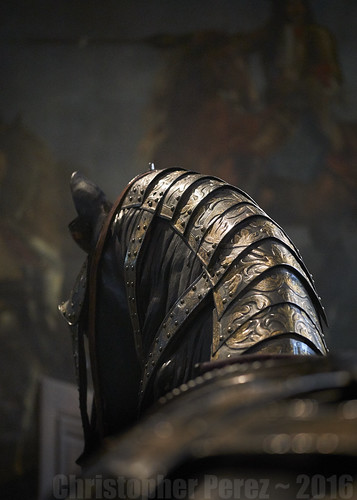
Medieval Armor ~ Musée de l'Armée

Monday, August 08, 2016

An interesting bit of history...

I came across this video on Nikon Rumors today.  It's a wartime film made late in the conflict from January to April, 1944.  Setting aside the film's script, I find it interesting to see how lenses are (or were) ground.  According to the comments under the video the factory was destroyed in 1945 when the Allies bombed the area.


Tuesday, August 02, 2016

Good news...

Finally, something to celebrate.

This morning I received news that Lenswork Magazine selected my Medieval Steel entry to be published as part of their "Seeing in Sixes" book.  50 photographer's work has been selected and of course I'm thrilled to be included.  It's always a pleasure to work with Brooks Jensen and his fine staff.


Medieval Armor ~ Musée de l'Armée

Wednesday, June 08, 2016

How things are changing... deuxieme part

Is there trouble in River City?

In my last post I looked at the changing environment of photography from the perspective of camera equipment as it meets changing consumer demands and imaging habits.  For this post, I'd like to comment on the changing environment of photography from the perspective of what people actually produce with their imaging gear.

There was a time when photography strived to imitate accepted standards of art.  For example and as part of a global art "secessionist movement" in the late 1800's photographers strove to create "painterly" works of a specific style.  Early issues of Camera Work magazine were filled with photo secessionist "art".

Not long after, one of the leading proponents who was, in fact, the editor himself of Camera Work magazine declared the "photo secessionist" movement to be dead.  It was declared that henceforth good and proper photography would no longer re-interpret the world through heavy image manipulation post shutter click.  Rather, photography would now be the domain of capturing and interpreting the "real".

Photo-realism became the norm.  Yet it was an all too often overlooked fact that photo-realism was completely dependant on imaging materials that themselves selectively interpreted the world _for_ the photographer.  Imaging materials, for example, were limited to certain spectrums of light.  Later when color films became widely available, there were certain color shifts that, well, narrowly interpreted the world based on the manufacturers film production formulas.

Increasingly, the materials we used to create images became more sophisticated.  Dry plate replaced wet plate materials.  Celluloid backed "film" replaced glass backed dry plate.  Synthetic backed film replaced celluloid film.  Smaller cameras joined old large format cameras as potential tools of choice for an artist.  Small cameras added exposure reading capabilities, followed by automated application of these readings, followed by automatic focusing of lenses, followed by the replacement of film with digital sensors, followed by the integration of all these automated imaging capabilities into, of all things, telephones.  Et voila!  How's that for a compressed history of photography?

Yet none of these things prevented imaging artists from interpreting the world around them and presenting ideas with skill and training that was based on or in response to classic art concepts.  Lighting and composition in photography were always serious topics.  I strongly suspect there was a reason for this.

When I look at what this marvelous automation has brought, I expected to see serious artists freed from the constraints of learning distracting imaging technologies and and camera control techniques.  I expected that the freedom to create would lead to a large number of talented serious working artists producing amazing images to the delight and wonderment of the rest of us.

Much to my disappointment I'm not sure that's how things turned out.

Instead, I'm shocked by the award winning drivel and dreck that passes for photography these days.  Just look at your Facebook feed or Instagram stream or (and this really hurts as these folks should really know better) your updated daily Flickr "Explore."

If you're an Old Fart like me, you might soon be depressed at the current State of Things.  To (sadly and terribly) drive the point home, have a look at what passes for winners in the British Journal of Photography.  Mind you, this is supposedly "breakthrough" work.  What does any of it mean?  What does any of it say?  To me it says some people have not the faintest clue that composition and lighting can, and dare I say should, be controlled.

If I didn't know artists like Ted Mashima and Ray Bidegain or know of Sally de Witt, Tim Rudman, Beth Moon, Kerik Kouklis, John Wimberly and Sandy King I would think photography was incapable of any and all artistic expression.  If I didn't read Lenswork Magazine on a regular basis I'd think all photographers were lazy "selfie" snapping slobs or expensive camera carrying posers who had no sense of what was possible and what was theirs to compose, manage and create.

Riddle me this, Batman: Where are we as viewers and where, exactly, is photography headed?

Seriously.  I'd like to know.

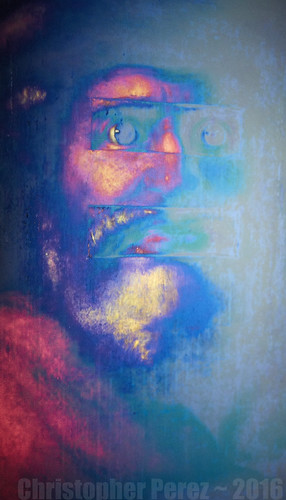
Carambolages ~ Grand Palais

Monday, June 06, 2016

How things are changing...

For several years I've written about how important I felt the integration of imaging is into the broader range of electronic networked capabilities and applications.  After seeing the following video, I realize I hadn't gone far enough.

While it was easy for anyone who pays attention to such things to see the rise of cell phones as the death of traditional snapshot cameras, and while it was easy to see how pervasive real-time image sharing would become, I missed/completely overlooked the possibilities of real-time video distribution as _the_ way of sharing the intimate details of one's life.


Which seriously and deeply begs the question about future value of stand-alone stills for, well, nearly anything and everything.

For years there has been the question of where to hang all these great prints a person could make quickly, easily, and with wonderful color accuracy.  Simply, there isn't enough wall space in our homes and, perhaps more importantly for those who used to make their livings this way, not enough photographic image buyers.  Where is the demand?

I've also written about how image making has transitioned to the mode of experience sharing.  The value of an individual image quickly is lost in a sea of billions of uploaded images and videos each and every day.  Fundamentally, _how_ we as humans consume images and their relative "importance" in our lives has changed.

We seem to have changed from looking at the works of others as a form of pleasure to looking at people looking at us.  In short: I believe we are witnessing an incredible rise in narcissism.  People seem to be saying "Look! Here I am in front of the Eiffel Tower.  Look!  Here I am next some famous person.  Look!  Look!  Look at _me_!!  I'm wonderful!!!"

It seems natural, then, that if we want to see ourselves and have the world around us respond/react to who we project ourselves to be, that products will be built and sold that fill this demand.  From this perspective I agree with Mr. and Mrs Tony N and their predictions of the future.

What this means for camera manufacturers is that demand for weighty stand-alone non-networkable photography equipment will continue to decline, or dare I say collapse.  If there is sufficient demand for "professional" image making tools (for things like old-style advertising) a few of the current manufacturers may survive, though in a greatly diminished state.  

The on-line fan-boy wars over mirrorless vs DLSR will quickly become irrelevant.  The nit-picking pixel-peeping discussions over lens quality of Canon vs Nikon vs Fuji vs Sony vs Olympus will go away.

To me these are the "easy calls" on the present and near-future state of the photography markets.

What's much harder to predict is what, if any, value there will be for beautiful works of "art" in our lives.  Will there remain enough people who appreciate wonderfully crafted wet-plate collodion, or platinum palladium, or carefully crafted composited photographs that there will be a demand for such things?

I can't even imagine where we're headed.  What do you think?


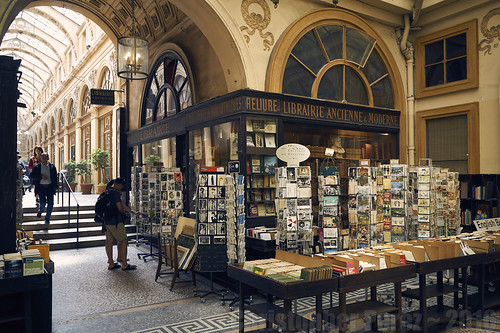
Passages ~ Paris

Sunday, May 29, 2016

... while awaiting an update, here is something rather good...

This interested me very much and I think it's well worth a look, particularly for those who consider themselves to be "gearheads" or people adamantly interested in camera equipment...

... and if this isn't inspirational, I don't know what would be.  :-)


... au niveau du premier etage...

Sunday, May 08, 2016

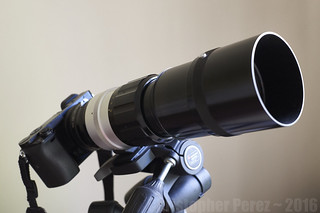
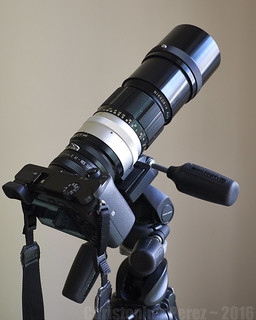
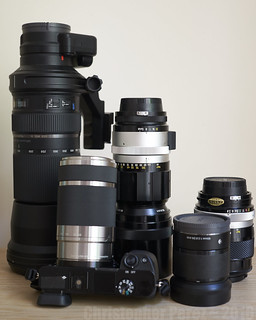
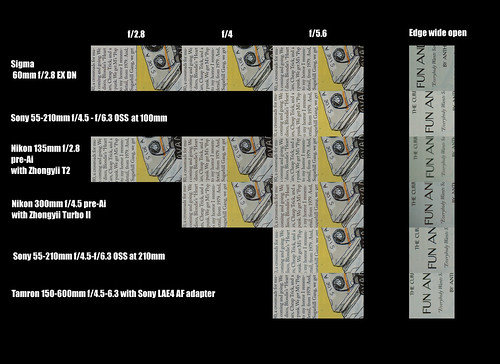
60 to 300mm lens comparison ~ 2 Nikkors with Zhongyi Lens Turbo II, 1 Sigma, 1 Sony, 1 Tamron

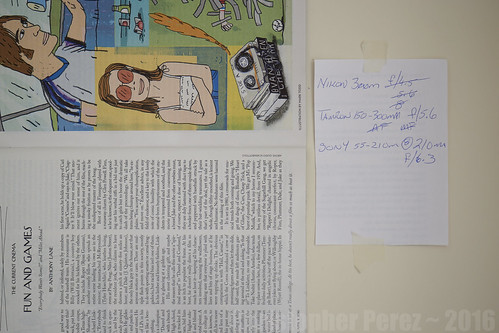
I'm still in a creative funk.  I'm not inspired by much.  Maybe it's the fact I'm embroiled in trying to gain a new drivers license and it's eating all my time and all my mental space.  So, I hauled out another pair of magazine pages, taped them to a wall and compared another bunch of lenses.

Here is the (by now standard) comparison setup -
  • Sony A6000, 100 ISO, AWR converted in Sony's software
  • Big Beefy Manfrotto tripod
  • Sigma 60mm f/2.8 EX DN E as the control optic - it's sharp sharp sharp
  • Old Nikon manual focus lenses with Zhongyi Lens Turbo II
    • 135mm f/2.8 pre-Ai
    • 300mm f/4.5 pre-Ai
  • Sony 55-210mm f/4.5-6.3 OSS E-mount
  • Tamron 150-600mm f/4.5-6.3 at 257mm (according to the EXIF data)
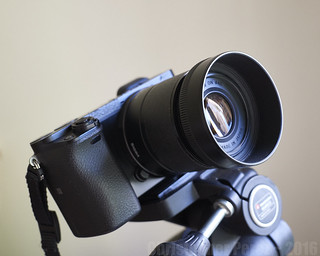
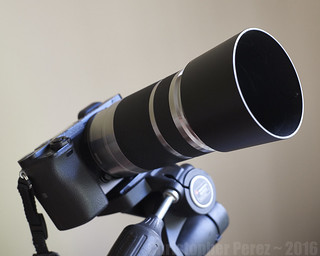
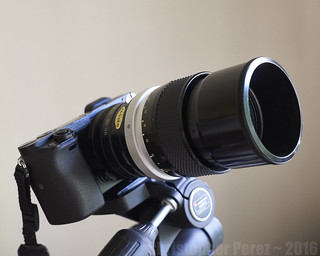
Here are the lenses mounted on a Sony A6000:

Sony A6000 + Sigma 60mm f/2.8 EX DN ~ Lens Comparison Sony A6000 + Sony 55-210mm f/4.5-6.3 OSS ~ Lens Comparison Sony A6000 + Nikon 135mm f/2.8 pre-Ai ~ Lens Comparison Sony A6000 + Nikon 300mm f/4.5 pre-Ai ~ Lens Comparison Sony A6000 + Nikon 300mm f/4.5 pre-Ai ~ Lens Comparison The Gang ~ Lens Comparison
The goal was to see under normal contrast conditions how the new and old lenses compared.  Here is the scene:

Test Subject ~ Lens Comparison

 Here are the comparison results (look at this image at full resolution to inspect the various subtle differences):
Lens Comparison ~ Long Lenses + Sony A6000

 The Sony 55-210mm lens did not focus correctly.  I used the camera's AF and something is not correct.  Look at the edges of the frame.  They're sharper than the center.  That is very typical of a lens that's mis-focused.

I did a little digging on the 'net and see other people can experience similar issues with this lens/camera combination.  I'm not sure what's going on here as the phase detection system of the A6000 supposedly operates straight off the sensor.  Furthermore, in my case at least, this condition is not persistent.  Many times when I turn on the camera the AF system works correctly with this combination (see earlier comparisons that I've performed).

All things being equal, the lenses compared here show subtle differences.  The Nikkors shot wide open aren't quite as "tack sharp" as the modern Sigma and Tamron.  In the case of the 135mm f/2.8 Nikkor, the edges of the scene are down-right fuzzy.  However, by f/5.6 it's really very difficult to tell any difference between any of them.

Wednesday, April 13, 2016

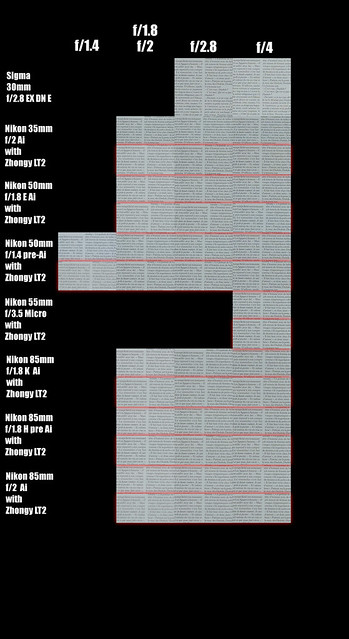
30 to 85mm lens comparison ~ with and without Zhongyi Lens Turbo II

After returning from Lisbon I found I've not be inspired by much.  So, I hauled out another page of newsprint, taped it a wall and compared another bunch of lenses.

The setup -
  • Sony A6000, 100ISO, AWR converted in Sony's software
  • Big Beefy Manfrotto tripod
  • Sigma 30mm f/2.8 EX DN E as the control optic - it's sharp sharp sharp
  • Old Nikon manual focus lenses
    • 35mm f/2 Ai
    • 50mm f/1.8 E-series
    • 50mm f/1.4 pre-Ai (Ai adapted)
    • 55mm Micro-Nikkor f/3.5
    • 85mm f/1.8 K Ai (multi-coated)
    • 85mm f/1.8 H pre-Ai (Ai adapted)
    • 85mm f/2 Ai
  • Zhongyi Lens Turbo II focal reducer
The goal is to see under normal contrast conditions what effect the Lens Turbo II had on optical performance.  I'd shot a comparison along similar lines about a year ago, but that was in a low contrast situation and I was at that time really just looking at the rendition of out of focus areas.

Look at the following at 100 percent to see the differences in performance.  The rows surrounded by red fuzzy bands are the lenses shot without the Zhongyi Lens Turbo II (even though the wording next to these rows says Zhongyi) - the Zhongyi row is the one above the red fuzzy outlined row.  The distance to the target was adjusted by 1.5x to keep the image size equal to those shot with the focal reducer.


Zhongyi LensTurbo II compared to native optics
Observations -
The Zhongyi Lens Turbo II neither improves nor degrades the optical performance of the Nikkor lenses I compared.  If a lens suffers from spherical aberrations when shot wide open, then images made with and without the focal reducer appear equally soft.  Similarly, once an image becomes sharp, both images are equally sharp.

There's one thing that is underscored by performing this comparison and that is that by f/4 every lens performs equally well.  Said another way, my super sharp Sigma 30mm f/2.8 EX DN E is really no better than any of the old, and in some cases very old, Nikon manual focus lenses after f/4.

Friday, April 01, 2016

... so... you spend a month in Lisbon...

I take photography perhaps a little too seriously.

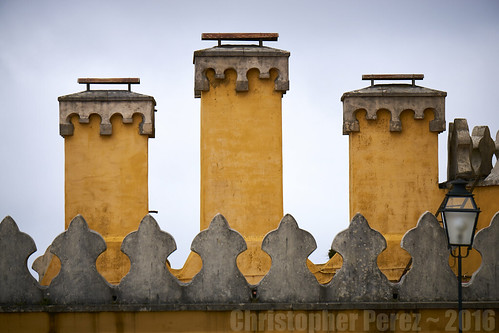
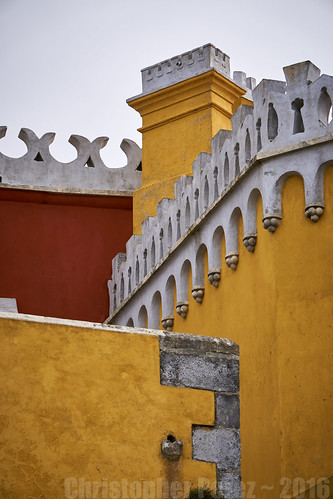
Sintra ~ Palácio Nacional da Pena

It's a non-paying gig. I have no Big Name "clients."  I'm not all over YouTube promoting the latest equipment review.  No journal lists me on their masthead.  By all accepted measures of "success", I must be an abject failure.

Or so it would seem.

But this begs the obvious answer, which is I take this craft and art very seriously because it gives me pleasure.

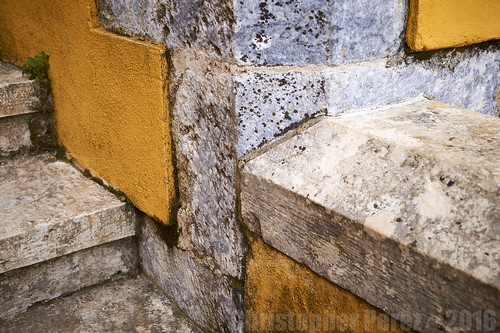
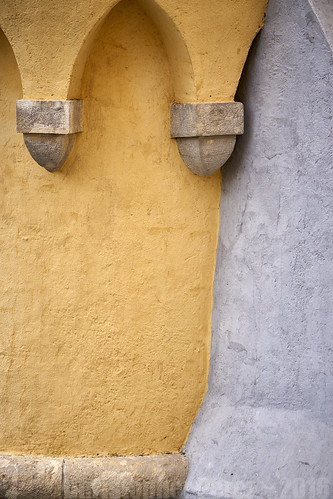
Sintra ~ Palácio Nacional da Pena

So it is from this perspective and this perspective only that I look back at the month my wife and I spent in Lisbon.

I would like to share a few observations.

Prior to heading south to escape the typically cold, gray, wet winters of Paris for a bit of sun and warmth in Portugal I added Phase One's Capture One to my toolkit.  The Sony only version of the application was cheap enough that I bought it to see what could be done.

Sintra ~ Palácio Nacional da Pena

Two things came with the addition of the new software.  The First was the instant realization that the Capture One RAW engine is visibly superior to Sony's and anyone else's.  The workflow allows me to crunch a vast number of files while using the exact same recipe settings.  Gone are the days of subtle file to file variations in cases where I'm looking for more consistency.

The second is the disappointing application instability in versions 9.0.3 and 9.1.  These versions of Capture One suffers from serious memory leaks.  I worked with their support staff to gain a modicum of stability where I can process perhaps 20 or 30 files before the system runs out of memory or crashes CP1.

Sintra ~ Palácio Nacional da Pena

While we were in Lisbon CP1 released an update to their software.  The signature text size no longer changes, but the memory leaks persist.  My love/hate experiences with paid-for software is renewed.  I came to hate Microsoft for their bug-ridden OS and avoid Apple products at all cost because they're trendy and now world dominating with no clear advantage to me, a lone simple consumer.

Artistically, our time away from Paris allowed me to generate and share 1103 images from our Lisbon experience.  No, not all of this would be considered "art."  Yes, I've started sharing more of the "experience."

Yet in terms of "pure art" I was able to realize and share three complete mini-projects.  The first two projects are devoted to what I saw and felt about the Prazeres Cemetery.

Here is my Prazeres project number one.

Here is my Prazeres project number two.

Sintra ~ Palácio Nacional da Pena

The third project is, for me, something completely new.  After stumbling on the work of Cyril Berthault-Jacquier I was moved to create another work, this one titled "Fractured Spaces - Organized N x 3 - Where N= [1,2,3]"  Cyril's influence on me should be obvious, but already I can see where I've made this approach my own.  Just as importantly to me, I can see where the style can lead and I'm very excited to see what I can do over the next couple months.

Looked at from a short distant this is a massive amount of work generated in just 31 days.  To what end?  For what purpose?  Fame?  Fortune?  What???

The effort came simply from the inspiration I found by unexpectedly living a series of experiences in a warm sunny place.  It gives me true deep contentment to create and share these images.  Every single one of them.  For me there is no other goal than to recreate this feeling.

That's it.

All of it.

Sintra ~ Palácio Nacional da Pena

Friday, March 25, 2016

If you're in Lille...

Arthur Morgan is a strong champion of Steampunk here in France.  This month in Lille they've declared it Steampunk Month.  And at the local library, photographs we created for the Fiction journal are being shown.

Check it out.  Some of the photographs are seen starting at 1:03 into the video.


Monday, March 14, 2016

Mini Projects ~ troisieme part

Making our escape out from under the gray, damp, cold Paris weather, my wife and I installed ourselves in Lisbon.  It's a new city to us and we're enchanted.  It's an utterly charming place.

The Lisboans are warm, open hearted, and happy.  The food is extremely reasonably priced and quite good (it's certainly better than the common twice to three times more expensive Parisian faire).  The sights are outstanding.  There are over 40 museums here, numerous parks, and interesting shops.

And, of course, where there's a cemetery, that's where you'll find me.  I love haunting such places, camera in hand.

The Lisbon Prazeres Cemetery simply knocked my socks off.  What better reason do I need to release two new mini-projects containing 6 images in each?

I'm sure after looking at these you'll know immediately why I am so attracted to this place.

Here is mini-project Cemitério dos Prazeres.

Here is mini-project Cemitério dos Prazeres II.


Lisbon ~ Cemitério dos Prazeres

Sunday, February 28, 2016

Mini Projects ~ part deux...

For myself I feel I can not share a theme or an idea in a single image.  I simply can't.  It's not in my nature.  My nature is more rococo and baroque.  I am attracted to large, complex stories and project.  Therein lay a small problem.  I all too often want to share a lot of material and I tend to struggle in guiding viewers.

In my posting about creating mini-projects in a style proposed by Lenswork Magazine I complained about the size of three projects that have been in limbo for months.  Two projects involve street-art and the third has to do with alchemy and it's place in the medieval Catholic framework of belief.  There are simply too many images to select from and I wasn't sure how to "say" what I wanted to "say."  I was feeling overwhelmed.

By contrast, the Medieval Steel and Avion III projects were small and quick to implement.  They "said" what I wanted to "say" and that was that.  I see that paring down the number of images in a project to just the core things I have to share concentrates me, concentrates the theme, and concentrates the viewer in a laser beam like manner.  The approach might now work well for everything I do, but in these cases it worked the treat.

The Lenswork idea of Seeing in 6's has a certain simplicity to it, a certain directness.  This seems to be what I currently need to "get off the dime" and complete a few more projects.

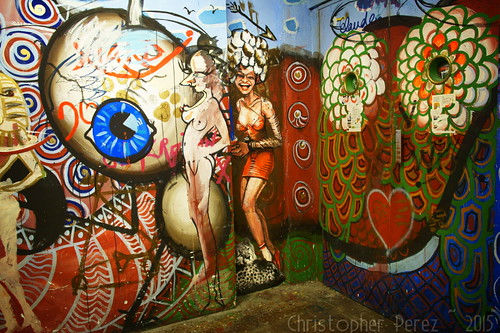
It's in this spirit that I release three mini-projects on Paris street-art.  The idea was to pay a visit to two locations, photograph the areas in the states they were found on just that day, and to record for posterity some of the things that attracted me the most.  It's in the nature of street-art to disappear after a short period of time and to be forever lost under future layers of paint or to the wash wands of city cleaning crews.

As in many places, it is illegal to create graffiti here.  If an artist is caught the fines can be steep and the legal actions harsh.  I understand the desire to limit the amount of graffiti.  I would be rather upset if, for instance, someone tagged la tour Eiffel or the exterior of the Louvre.

Yet there are spaces that seem to have little social or cultural value.  I've found two places in Paris where street-artists seem to congregate and work.  Les Frigos is a huge old cold storage meat locker.  It's been converted into expensive artists "lofts."  Art creation spills out into the surrounding parking lot.  Les Frigos is surrounded by new glass and steel high-rises and I like the idea of a bit of "grittiness" standing off against ugly modernity.

The second location is rue Denoyez.  For many years it was an important center of street-art in this city.  Last year the authorities reclaimed the street by refurbishing the buildings starting on the south end of the street.  New businesses have started to come in and I'm affraid that the entire street will be "cleaned up" and handed over to businesses.  Street artists have been evicted and their art galleries have all been closed.

My Street-Art mini-project series is currently organized in two ways.  The first is by location and the second is by color palette.

Here is les Frigos (viewed on a tablet as you would a book)

Here is rue Denoyez (viewed on a tablet as you would a book)

Here is rue Denoyez 2 (viewed by laying it flat and spinning the tablet horizontally)


Les Frigos ~ Paris

Friday, February 26, 2016

Mini-Projects...

LensWork Magazine is sponsoring a short image essay challenge.  It's something they call Seeing in Sixes.

After a few Full Strength Belgium Quadruples I sat and thought a bit about the approach of setting the size of a project to 6 images.  I have three projects that have yet to be completed.  Two are related to street art and the third is devoted to the role of Alchemy in Catholicism.  Alas, these are rather large efforts and I just don't seem to find the time to concentrate on them to bring them completion.

A mini-project, on the other hand, would allow me to select a few images that fit a theme and for me to quickly complete a work and make it available for distribution.

If I read between the lines, the folks at LensWork Magazine are attracted by the quiet, reclusive, spiritual aspects of the Japanese culture.  Perhaps this is why the idea of a shorter, more succinct imaging effort appeals to them.  The approach seems to offer: Cut out all the fluff and get down to the very core of what you want to say.

Recently my wife and I visited two museums in Paris that don't usually get Top Billing on anyone's Must See list.  These kinds of places attract me for the lack of crowds, poor light, yet potentially interesting subjects.

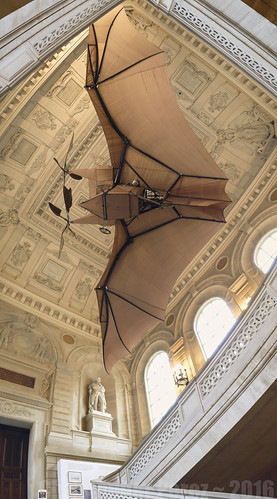
At the Musee des Arts et Metiers we paid close attention to their exhibits of pre-1900's aircraft.  One example seemed to lend itself to setting the basis of a short image essay.  Clement Ader's 1897 steam-powered Avion III is an engineering marvel.

Here is my short image essay of Avion III

Avion III ~ Clement Ader

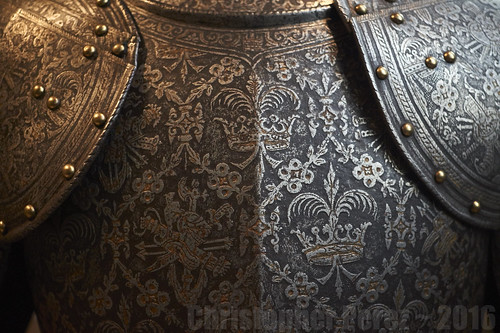
The very next day we visited la musee de l'Armee at Invalides.  The light was low and indirect, and the exhibits felt old and musty.  And yet... and... yet... the way the light bounced, shimmered, wriggled, and slide off ancient steel... there had to be short story in there, too.

Here is my short image essay on Medieval Steel

Medieval Armor ~ Musée de l'Armée

I was able to process, collate, edit, and distribute these in less than four days.  While the approach might not be appropriate for everything I do, I'm happy to have read LensWork to pick up on an interesting idea.

Monday, February 15, 2016

Beast of Turin

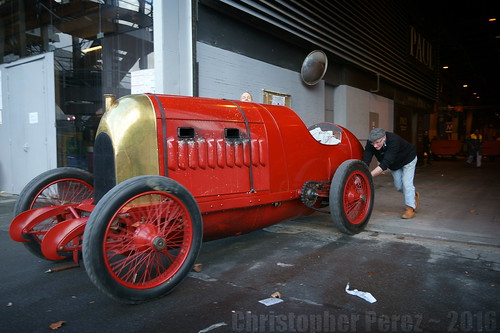
I wrote an entry to one of my other blogs about the Beast of Turin.  It was quite the adventure.  What I didn't stress was how much my father and I wanted to see it run at Goodwood in 2015.  He was sick and my wife and I were hunkered down trying to get our state-sponsored health insurance.  Needless to say, I was pretty happy to get to see the 1911 Fiat S76 right here in my hometown.

My encounter with the Beast yielded some interesting images, so I collected a few of them into a short visual story.

Readers can download the Beast of Turin image essay.  I hope this pleases others half as much as it does me.


Beast of Turin ~ 1911 Fiat S76

Thursday, February 04, 2016

Getting to satisfied...

I know I'm not "marketable", in the traditional photographic sense.  No gallery would ever have me.  My work is simply far too varied.

I enjoy working with creative costumers, dancers, and circus performers.  Some of my most pleasing work has been with other creative people.  Yet other subjects call to me.  For instance, if I see a steam locomotive, out comes the camera.  Or when early Spring arrives and I know the birds are nesting, I'll haul out the Big Bird lens and head to a pond, river, or lake.

Recently, one of my favorite subjects has been to photograph old automobiles.  Paris seems to bring them and their drivers out in droves.  Early in January it was la traversee de Paris (hivernal).  This week it's the annual Retromobile show down at la porte de Versailles.

I enjoy visiting the Retromobile venue before the show opens.  It's fun to watch as the back door of a large transport drops open to reveal something tasty inside.  This year was no different and I found myself nearly jumping up and down in anticipation of what might be revealed next.

After running out of trailers to spy on, I went inside to watch as everyone was busy working to set the show up.  Cars littered the display area while waiting to be lined up properly on their stands.

Working in natural light under cloudy skies is wonderful.  Few specular highlights form on a car's bodywork.  The beautiful even light shows the car in all it's glory.  Inside an exposition building the light is nothing but one lamp after another.  Cars reflect dots of lamp "highlights" all over the surface.  I find this can be more than a little annoying, particularly when I find a wonderful automobile and want to show it's shape and color and not be distracted by irregularly placed dots.

The following Ferrari (a 330 GT Spyder? - perhaps someone can set me straight if I'm wrong) is a good example.


I worked the image as best I could in Sony's AWR to JPG conversion program, then I opened it in the Gimp.  The above is as Gimp first saw it.

Working carefully with the heal tool I removed as many highlights as I could.  Sometimes I needed to use the clone tool with a larger brush to cover certain problem areas.  I left the sides of the car as were, for the most part.  I liked the line of lights along the edge of the body as they help accentuate the Ferrari's lovely shape.

The work took perhaps 30 minutes of careful attention.


I like how many of the distractions are removed.  And I particularly like how the Ferrari is now just a beautiful Ferrari.  It's no longer a car sitting in the middle of a show hall.

As a final step I wanted to remove the overly yellow cast.  While there are a number of ways of doing this, the smoothest I found when using the Gimp is to find a nice film emulation in G'Mic.  I could do the corrections by hand (selecting channels and colors, etc), but sometimes the transitions between colors are a little harsh.  Hence my sometimes use of G'Mic film emulations.

Here is the final result.


Happiness ensues.  Out comes the Belgium beer.  Or something like happiness.  I just remembered I wanted to try a light LAB color-space correction, too.  OK.  The Belgium beer will have to wait another 30 minutes...

Monday, January 04, 2016

Technology Integration

As with many people, I've watched as electronics companies have moved into the product spaces traditionally held by film-era camera and lens manufacturers.  I'm excited by the possibilities this move presents.

Long gone are the days when artistic vision was distanced from sharing by film, processing, and printing.  I used to work in photo labs where we could turn high quality prints around from film hand-off at the front counter to final paper-based print dry in something just under an hour.  If quality wasn't as much a concern, we could get an RC print out in as little as 15 minutes starting from un-processed dry film.

Being freed up from formerly important details such as camera format, film speed, developer type, aperture setting, lighting, and paper type means, I believe, that an artist can pay much more attention to the desired outcome.  When I consider the product offerings of Canon, Nikon, and to some degree even Fuji, I see traditional cameras in traditional camera shapes and sizes, with traditional camera limitations.  These products are not well integrated into our networked world.

I feel that electronics companies have successfully replaced traditional camera and lens manufacturers with highly integrated imaging tools.  Yes, Nikon and Canon still sell millions of cameras a year.  But market conditions have changed.  Apple's, Google's (with the Android OS), Sony's and, Samsung's total market share in imaging have already begun to eclipse that of Canon and Nikon.

As with film camera systems, the desire for DSLR technologies may never fully die off.  Someone somewhere will be able to use the technologies to good effect.  The pace of change in these products has already slowed to the point that Canon didn't update it's 18mpixel APS-C sensor products for four or five years, and only recently added a 20mpixel sensor to the line-up.  There is, at best, weak WiFi integration and Canon offers no in-camera applications.  They remain stuck on using ASIC hosted very very difficult to extend and integrate VxWorks based firmware.

I use Sony A5000 and A6000 cameras (and started that move with an original NEX5 - of which I still have one).  Their integration with networked devices thru WiFi and NFC interfaces is impressive.  I can take a very high quality photo, transfer it to a mobile phone or tablet, process the image using something like Snapseed, and share the image to Flickr, Facebook, Tumblr, Instagram, and any place else I might hold an account.  The entire process from shutter click to sharing across the 'net with millions upon millions of potential viewers can take place in as little as 10 seconds.

What the integration of technologies tells me is that the minor differences between traditional imaging systems are much less important than how well imaging is embedded into the overall creative process.  The following should adequately illustrate the point -


Thursday, December 24, 2015

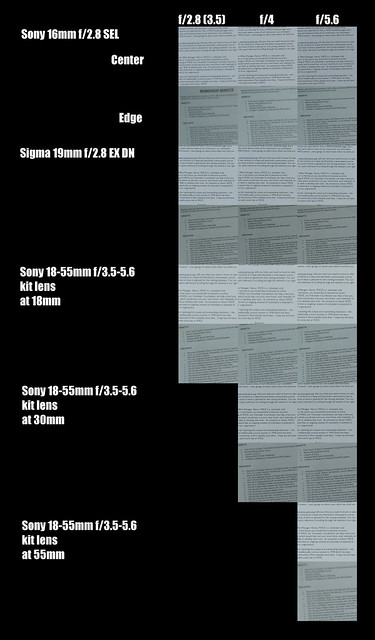
Sony SEL kit 18-55mm, Sony SEL 16mm f/2.8, Sigma 19mm f/2.8 EX DN - Comparison

I've read where the first Sony APS-C mirrorless kit lens is pretty bad.  Of course I own one.  It came with one of the first NEX5 cameras I bought.  The other NEX5 came with a 16mm f/2.8 SEL, which is also known to be a poor optic.

After a recent comparison between the Sigma 19mm and Sony 16mm, I started to wonder whether field curvature might be the culprit behind the seemingly poor corner performance.  The comparison image on my Flickr pages has recently seen a dramatic rise in viewer volume, so I'd better get this right.

In the past couple years I've acquired a Sony APS-C mirrorless that comes with software that corrects for optical performance issues (chromatic aberrations, distortions).  I wanted to see if the new software could "clean up" some of the 18-55 kit lens issues, as well as to take a closer look at the Sony 16mm to see if it really is field curvature that's the source of problems for that little pancake optic.

My standard references for image quality has become the Sigma EX DN E/Art lenses.  I own one of each and they are simply the finest optics I've ever owned, regardless of who's name is on the front ring.  After watching a recent interview with Sigma's CEO I'm even more impressed by what they've been able to achieve in the marketplace and hope they come out with more lenses for the Sony mirrorless cameras.  As a company they are certainly passionate about what they're doing and seem to understand customer desires and needs.


Comparison setup -

  • Some pages out of a recent mailing form our Anglophone group taped to the bedroom wall
  • Sony A6000 set to "A", 100ISO, 2second delay, +1EV
  • Massive Manfrotto tripod
  • Sony 16mm f/2.8 SEL - manual focused first in the center, then focused for a second photo at the extreme edge
  • Sony 18-55mm f/3.5-5.6 SEL OSS (turned off due to the use of the tripod), compared at 18mm, 30mm, and 55mm

Sony Sigma Lens Comparison

Comments -

The Sony SEL 16mm f/2.8 pancake optic I own is just OK wide open at both the center and edge.  Stopping down improves the image quality to quite nearly match the Sigma 19mm f/2.8 EX DN I also own.  By f/5.6 the 16mm Sony lens performs very adequately, indeed.  The lesson to me is that this lens _does_ exhibit field curvature.  If I'm going to photograph a wall (I don't), this is not the lens to use (the Sigma is).  In the "real world", the 16mm SEL is just fine.  All I need to do is to stop that thing down to f/5.6 (or f/8 - though that's not shown here) and let 'er rip.

The Sony SEL 18-55mm kit lens has rather strange performance.  The center of the image is really only good at f/5.6 (and f/8 - though that's not shown here).  The edges?  Well, at the short end of the zoom range image cleans up pretty well, though it's not as good as the Sigma.  At 55mm the lens exhibits rather unexpected softness in the extreme corners at f/5.6.  It's awful, in fact, even as the center is really quite sharp.  

The Sigma 19mm f/2.8 EX DN E is simply perfect.  No lens from no manufacturer will show better performance at any price than this 100Euro (used mint) lens.  Yes.  I want more small, light, utterly sharp Sigma lenses to play with.

From working with the Sony 18-55mm kit lens for 5 years (at this point) I know I can clean up an image pretty well using a bit of smart sharpening, so it's not as bad as all this might indicate.   If your goal is to make a fine image, this lens will do the job.

Still, for nearly everything I do these days in these focal length ranges, the Sigma and old manual focus Nikon lenses are my optics of choice. 

Sunday, November 08, 2015

2015 Salon de la Photo - Part Two - Images over Equipment

In Part One of  2015 Salon de la Photo I ranted and raved and swung a bat over various camera and lens systems.  I was in a very cranky mood.  


Shocking as it may seem to some people, photography is more than selecting, collecting, and talking about equipment.  As we all could/should know, the reason for all this gear is to be able to make images.

Fortunately, the Salon de la Photo was (barely?) more than just a trade show.  This year there were a couple areas devoted to the works of well known artists.


Near the entrance to the show was an exhibition of mid to late 20th century images.  All were printed in black and white to silver paper.  The imaging themes were various.  I could see that there was a certain aesthetic that I could clearly identify as being a Japanese view of the world.  I felt that some of the images "worked" well and I enjoyed seeing them.

Toward the back of the building was a second show.  This consisted of a small show of somewhat large, again, black and white silver-based prints.  A quick look confirmed for me that the street photographer was American and I could see a classic New York point of view being expressed.  I'm not sure I enjoyed what I saw.  Perhaps it was too familiar.


Nearby were several booths devoted to the works of photographers who purchased space to hang, show, and sell their images.  Browsing this area revealed to me a certain European aesthetic.  The "look", regardless of the subject or theme, felt stark and somewhat remote.  This was capped by a long wall filled with images of naked women holding strategically placed bloody organs and entrails of farm animals.  I wondered why an artist would trade purely on shock value?  Where would a person hang such images?  On the living room wall??  Certainly not in my house.

Considering current imaging practice there were at least two areas in the middle of the show which caught my attention.  They contained large prints of yet again black and white landscapes and portraits.  The processing seemed to have made liberal use of Hipstamatic's Wetplate app.  The effect wasn't bad, actually.  I really enjoyed some of the portraits.  But more than anything else I could see where cell phone image capture and processing has already taken over enormous areas of imaging responsibilities from traditional approaches.


And you would you like to know something?  The large prints made from what were likely 8 mpixel cell phone cameras were very fine, indeed.  Shocking, isn't it?  But that's the truth.  Apple and Google (Android) have done a phenomenal job at taking the place of traditional imaging tools manufacturers.  Sure, Canon and Nikon will try to sell you on "flexibility" and "image quality".  But so what?  Very few of us ever shoot sporting events nor wildlife which might require long, big, expensive, large apertured optics.  I could clearly see there is no need for such lavish tools when something so small, so light, and so readily available can do the task for Us Mere Mortals.  I can easily see why Sony's QX series, Olympus' similar product, and DxO Mark's new device are starting to attract users.

I compared my visual experiences between the traditional and the current digital.  The earlier silver-based black and white images have a certain "feel" to them.  I feel in the highest expression of the art, prints can give a scene a "creamy" somewhat soft "look."  Images like these elicit a "warm" feeling from me, regardless of the subject, content, or theme.  Even many of St. Ansel's stark, cold, carefully controlled contrasty print style can have a certain "warmth."


Current digital print technique is far more flexible than the old silver-paper process.  Digital can easily match black and white film-based imaging "warmth".  It should be obvious there are a broad range of print papers and surface textures to choose from.  Then there are the high definition book publishing (with image qualities indistinguishable from an "original" print) and network based distribution and sharing options.  Each can way of sharing an image can lead a sensitive viewer in whatever direction the artist desires.  All of which puts ever greater pressure on an artist.

Gone are the days when commercially available materials and tools narrowly defined the limits of what was possible.  The Great Yellow Father (Kodak), Fuji Film, Agfa, and Ansco no longer set the limits of image capture and print making.  Viewers are no longer constrained to poor reproduction quality books, nor are they required to visit a small number of galleries to see an original high quality print.  


With an infinite variety of digital image processing outcomes, and a wide range of image print and networked distribution options, current practitioners of the photographic arts might feel a little overwhelmed.  An artist needs a clear idea of what they want to accomplish, otherwise image making can quickly become a struggle and can be a "hit or miss" visual expression (that is, some images are "better" than others and the artist might not understand why).

Wandering the large show at Salon de la Photo, Paris left me with a better understanding of why so many "photographers" concentrate their time and energies on the tools and materials.  It seems easier to talk about tools and materials capabilities as doing do sets boundaries and limits.  A person can get lost talking about the minutia of this setting or that ISO or another lens.  It probably feels "safe" to think materials and tools providers "will take care of them" by setting limits and boundaries that could induce a feeling of comfort, knowledge, and artistic competence.  


I would like to consider the topic a little deeper in my own work.  To feel a little more fulfilled as an artist I'd like to try to see the art and craft from other perspectives than from the point of view of a commercially driven trade show.

Given such vast imaging capabilities and possibilities, where might be the words that express what is creatively possible? 

Even as it's too easy to place our faith in providers of tools and materials, how do we find a way to place faith in ourselves as artists?

Friday, November 06, 2015

2015 Salon de la Photo - Part One - Cameras and Lenses

Wherein I Pontificate in a most Pontificative Manner.  That is to say, here in image and word are my Rather Highly Opinionated views of the 2015 Salon de la Photo, Paris.

Warning: I'm more than a little cranky.

Leica


Great toys for those with money to burn and a need to impress The Great Unknowing Unwashed.

But why?  Because Leica can sell enough to keep production lines open?  Because the world economy is doing well enough that Every Man can dream of owning one and there are enough Hedge Fund Thieves and an enormous emerging Chinese Upper Class?  I can't understand what they're doing outside the context of wealth doing what wealth does.

Maybe it's the price one pays for Bragging Rights.  But to brag over what?    Images coming from these devices are virtually indistinguishable from any other imaging device.  Seriously.  Look anywhere in the world at any image and tell me "... now _that_ was made with a Leica..."  You can't.  So there.

Sigma

Sigma makes some very nice optics and sells them for nearly reasonable prices.  It was good to see my old 300-800mm f/5.6 EX HSM.  I miss that old lens, but it was impractical to use here in France.  It's long, big, and heavy.  Yet I dream of the days when I photographed Bufflehead ducks on the run.  For those dreams I've picked up a smaller and nearly as long Bigron 150-600mm SP, so life isn't all woe and pain.


Sigma had their new 24mm f/1.4 Art lens on display.  It looks like the other lenses in the family of Art optics for DSLRs.  It's big, heavy, and sharp (from what other people report).  If I could put up with the mass and size of a DSLR, one of each of Sigma's Art lenses could do the trick.


As if to prove Sigma can keep up with other players in the lens market in terms of size, weight, and Other Insanity, the team showed off their ever popular 200-500mm f/2.8 Monster.  Yep.  Just what one needs... um... when?  I have no idea, when.  Huh.  Silly, this.  Just because you can, does it mean you should?  [see Zeiss in the following section]


Zeiss


Et voila!  More True Insanity.  You can't see it here, but this lens is nearly the size of a small child.  Zeiss seems to be showing they can build the Very Best lenses commercially available.  Still, this is ludicrous.  I suspect the Very Well Heeled will be the only folks ever to buy these.  The question is, will they ever use them?  As I said, just because you can, does it mean you should?

To balance this snarky attack, I was happy to see Zeiss is still capable of building small if not still expensive lenses in various sizes and shapes.  While one must come from the Rather Well Heeled Upper Classes to be able to buy them, at least a few aforementioned persons can carry them somewhere.  This means those lenses stand a chance of actually being used to, well, photograph something.

Panasonic

It's interesting to me that Panasonic and Olympus have selected the same spec sensor, a micro 4/3rds.  It's even more interesting to me just how different the two manufacturers have approached the same format.  Panasonic feels to me much more like a video than a stills imaging company.  Their GX7 and GX8 cameras feel larger and heavier in the hand than a Canon SL1/100D DSLR.

I also checked out Panasonic's FZ300 and FZ1000 "bridge" superzoom cameras.  [shaking my head]  What's going on?  These things are as big and heavy as any of Nikon or Canon's entry-level DSLR.   Why would a person buy a "bridge" camera when the flexibility of lens interchangeability of a DSLR package is no heavier nor larger?  What's the differentiation/market placement story?  Price?  Nope.  Size/weight?  Nope.  Flexibility?  Tough call.  Bizarre, me-thinks.


Fuji

Back when men were men and cameras used film, Fuji was a great film manufacturer and offered sometimes interesting cameras in which to load their great film.  Fast forward to the Digital Era and it seems as if Fuji's old camera tooling have been pulled out of mothballs and pressed into further use.  The sizes of their cameras and lenses really haven't changed in, what?, 40 years.  From what I read, their sensors haven't changed all that much, either.

So, what do we have in Fuji?  Well, if you're an Old Fart like me, then these devices can seem familiar and I'll bet you'll know instantly how to use one.

In fact, if I didn't mind the Old Film Era camera size and if I could only own one camera for, say, the next 5 years, I might be tempted by Fuji's X100T.  But only as long as I could have the two focal length converters on offer as well.  The shutter is silent and the flash sync speed goes to the moon, which can come in handy when shooting in full, er, sun.

Canon

Where to begin?  What is the company willing to do to enter into a new century?  When are they going to wake up?  Yes, the 20D, and 5D MkII were ground breaking devices in the way they opened markets and wallets and enabled image making creativity, but times change.

Take the SL1/100D, for instance.  Indeed, it's the smallest DSLR currently available.  But that's it.  No WiFi.  No GPS (for those who don't mind the NSA and Apple tracking them).  No swivel LCD display.  No top of industry sensor (it relies on a rapidly aging-fab 18mpixel APS-C).  Why would anyone want one when they could have something at similar prices that give broader capabilities?

It was fascinating to see all the "Pros" walking the show with their "Pro" badges on lanyards around the neck and Canon 5DSR + battery grip + 24-70 f/2.8 L-glass slung over the shoulder.  When they set them on a countertop to talk "shop" with makers of smaller, more capable cameras it was obvious Canon is selling to dinosaurs.  Sure, there are a LOT of dinosaurs out there.  Yet in two years I doubt Canon will be the Pro Camera of Choice.

Sony

Everyone was swooning over Sony's new A7rII Super Toy.  It's nice.  It's feature packed.  It's heavy.  It felt like picking up a semi-pro camera from Nikon or Canon.  Where is the mirrorless size/weight advantage?  And don't give me that "big hands" argument requiring big cameras.  That's _not_ what the Mirrorless Revolution was about.  I find this camera just plain silly heavy.

I took a moment to check out Sony's RX10II "bridge" camera.  As with Panasonic's product offerings in this space I'm gob-smacked.  The camera is huge and rather heavy.  An entry-level DSLR...  um... I've already covered what I feel about that (see "Panasonic" above).


By contrast, Sony's RX1 is an absolute jewel of a photographic imaging device.  It's nice and small.  It's powerful.  It's feature packed.  The new version even comes with EVF built in.  Yes, it has a fixed focal length lens, but how many lenses do you really want and need?  Yes, it's expensive.  Um, and that's why I can't have one.  I have to put this one on the lower end of Pure Camera Bling.  It's on the same scale where I put Leica (with those German devices much nearer the upper end of the Camera As Bling Insanity).

Olympus

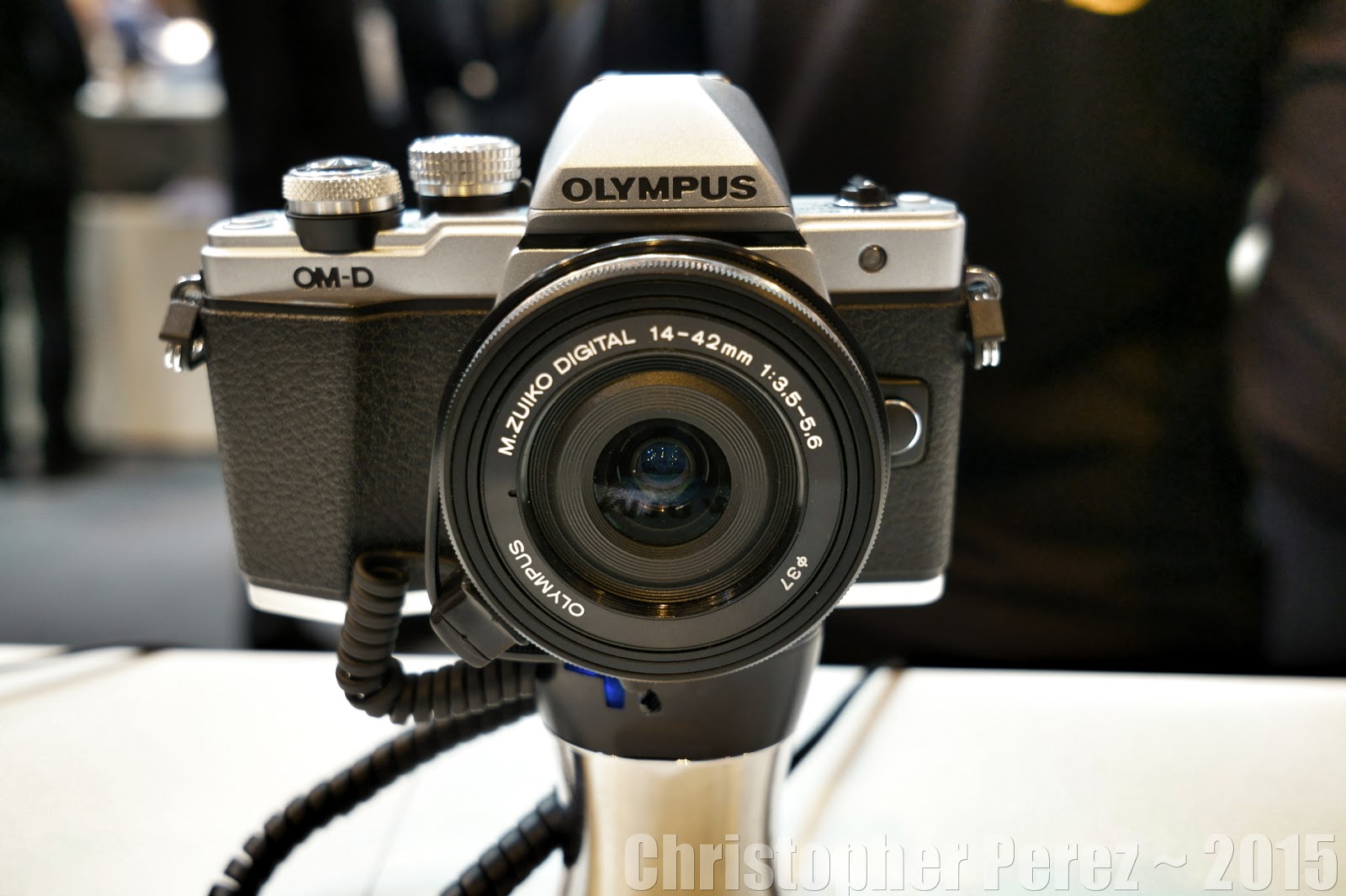
Lovely little cameras, these.  Like Fuji, Olympus seems to have dusted off their old film camera tooling when they started making these.  But in the case of Olympus, they started out with small cameras in the first place and their modern image makers remain pleasantly small and comfortable in the hand.


Last year Olympus announced a wonderful looking little lens.  It's an f/2.8 zoom that would be interesting when coupled to their 1.4x teleconverter.  The setup is small for this kind of telephoto magnification.  I'd be tempted if I wasn't already heavily invested in my Sony gear.


IMNSHO, Olympus offers wonderful gear for making stills images.  While I'm sure their video capabilities are more than adequate, it's their Old Time film camera feel that seem "right."   They're smaller than Fuji and not much larger than the Masters of Small Sony APS-C NEX.  Olympus has put an impressive level of technology into a small and supremely capable package.  If you're truly an Old Fart and want film-camera era "feel" to your gear, these guys seem to do the job the way the Photographic Gods meant it to be.

Conclusions

It's obvious that consumers of imaging/video products have many many wonderful products to choose from.  The manufacturers are doing their best to get you to separate you from you money in exchange for a nice camera and lens.  Competition is sharp.  Any of these devices is quite capable of helping a photographer achieve very high levels of image quality.

One way at looking at choosing a new imaging tool is to decide if you want a camera from a traditional gear manufacturer or if you prefer the networking interconnect capabilities provided by electronics suppliers.  I can see where Old Farts (like myself) could take the first approach and where newer generations of folks could feel more comfortable with something from an electronics company.

In this vein, I think traditionalists could be very very happy with something from Olympus.  If they don't mind a slightly larger package, Fuji makes some great things.  Watching how images are consumed leads me to believe that Canon and Nikon's pools of "pro" consumers backed by Big Wads of money for Big Telephotos with Big Apertures are living on borrowed time (even as they're loosing their high paying photography jobs at a horrific pace).

For those who grew up on electronics (or in my case, helped develop the tech in the first place), gear from someone like Sony could be a safe bet for stepping further down the road into a well networked high image quality future.  Like so many people I'm working with little APS-C mirrorless cameras to capture something, WiFi it to a tablet, process it, and then upload it directly to the 'net.  This, as far as I can see, is where image making "lives."  Present, not future, tense.