Monday, May 29, 2017

Portraiture ~ Equipment Logic

Now that I've had a chance to publish my approach to portraiture, I think it could be helpful to explain the reasoning behind some of the steps in the process.  Using the order and a bit of the format that I posted the original series in, we will start with camera equipment.
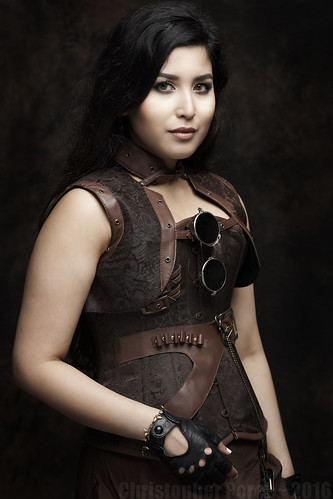

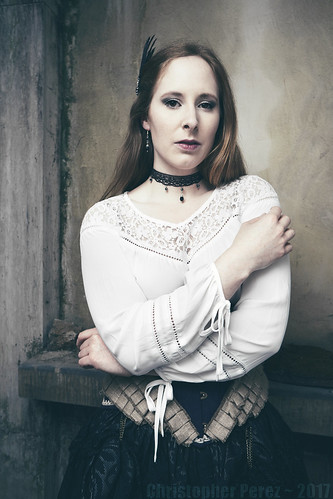
Nora.Wild ~ Steampunk

Equipment -


A camera that offers manual mode as a shooting mode option -
We need to be able to select the shutter speed, aperture, and iso so that when we find the correct flash intensity, photographs will be consistent for the duration of the flash/camera/subject positioning.

Any camera that allows for these kinds of controls can be used in portraiture.  The brand and style of camera does not matter, as long as you can control the important parameters of portraiture.

A camera that comes with a "hot shoe" or the ability to control a flash triggering device -
We need to be able to trigger the flash unit when the shutter is tripped and a hot shoe adapted remote trigger is currently the most common approach to making this happen.  You will need a place to mount the triggering device and the hot shoe is where you will mount it.

Standard focal length lens (in full frame terms, anything from 24mm to 85mm will do, including standard "kit" zoom optics) -
This is a potentially interesting point for some people to think about.  In traditional portraiture image distortions are considered rather bad form.  Yet I've looked closely at images that were made using a 24mm full-frame equivalent lens that had zero distortion.  

Usually photographers are encouraged to use 85mm full frame equivalent optics, but to me, the focal length can "flatten" the scene.   I wonder if this focal length was recommended as it was easy to avoid subject distortions and yet wasn't too long (like a 135mm lens) where framing and composition could be difficult.

If you are new to this and if all you have is the standard kit zoom that comes with many cameras (mirrorless and DSLR), my suggestion would be to try the same subject at varying focal lengths and see what you prefer.  If, OTOH, you have only a single focal length lens, don't worry.  Just use it.  As long as it's something between 24mm and 85mm, you're Good To Go (as they say).

Perhaps it would be helpful to know that some of the finest portrait photographers from back in the day of film used a single camera (a Rolleicord, a Rolleiflex, a Mamiya, or a large format view camera) that had a simple, single, fixed focal length "taking" lens.  If that's all they needed, why would we require more?

Electronic flash that is separate from the camera - often called an off-camera or remote flash -
This is your light source.  It will be the thing you move to achieve different qualities of light (from Notan to Chiaroscuro).  This need not be expensive.  One of the typical selling sites on the 'net sometimes offers their own brand for less than 30USD.  

Some flash units connect with the exposure system of a camera, and these will be more expensive.  This kind of sophistication can be helpful in situations where the light is changing from shot to shot. The approach I'm suggesting here removes changes in lighting.  You might not need a TTL enabled flash, and thus avoid its cost.

Remote flash trigger - that sits on the camera and triggers the flash remotely -
There is a separate device that sends a signal between the camera when the shutter is tripped and the flash so that the flash knows when to light off.  Many times these triggers come in two pieces.  One mounts on the camera and the other that mounts on the flash.  These need not be expensive, but you might have to pay attention to the hot-shoe specifications.  Some camera manufacturers have added things to their hot shoe interfaces.

Photo "bounce" umbrella - with "shoot thru" capabilities as an option -
We need one of these to spread the light out.  If we used just the flash itself, it would act more as a pin-point light source and the portrait lighting could be rather harsh.  What I suggest is a broad surface that spreads and softens the light on our subject.

There are many ways of spreading the light.  There are "octagons", there are "parabolas", there are "strip lights", and there are "beauty dishes."  To keep things simple, I feel a simple, collapsible photo umbrella should do the trick just nicely.  They are cost effective, too.  Besides, I have yet to meet anyone who, when looking at an image, can tell which kind of light modifier was used.

Tripod-stand to hold the flash and umbrella
This should be self explanatory.  We need to hold the light and light softener so that we don't have to try and hold it all while also trying to trigger the camera's shutter.  Sometimes you can find a tripod, umbrella, flash adapter "kit" on the usual selling sites for not much money.

In summary, I feel that camera and lighting gear are as an artist would view their brush.  They are tools to an end.  In this case, that end is to the making of fine portraits.

The next blog entry will present my logic behind the lighting setups that I recommend.

Monday, May 22, 2017

Portraiture ~ Art Considerations

Continuing my series on portraiture, we will now turn our attention to art.  Specifically, we will look at the topic of art from the perspective of history and how we might apply art principles to the photography process.  To make this as concrete as possible so we can directly apply concepts to our work, we will consider composition, backgrounds, and viewing (ie: lens) position.

I contend that if we can take at a potentially large, complex subject such as "art" and look at it in smaller, easily manageable pieces that we can begin to understand what we are doing, knowing that our knowledge will fit into the broader context.  If we can take the process of creation and move enough of it out of the realm of "feelings" and "emotions" and put them into the knowable, rational parts of our being, then we can control and perhaps create an even stronger "feeling" and "emotional" response in our viewers.

Before we begin, let's revisit my motivation for doing this (one last time).

Grand Question -  

Looking back 50 years, what would I have liked to have known that would've helped me make better progress swiftly and with more confidence?

This post will attempt to address the "touchy", "feely", "squishy", artistic part of that question. 

Art History - 

I realized it was easy to get all the camera and lighting gear as well as lighting setups "right" and still come away with something that, while pleasing on some level, might not have the impact I was hoping for.  Looking for a way to address this deficit, I found there is a lot we can learn from the Old Masters.  Their paintings are still beautiful, even after, in some cases, 500 years.  I felt it was important to take the time to look at their work and to think about what they did and to try and sort out why the did it.  Then I had to find a way to apply what I learned to my portraiture.

It took me moving to Europe to "see" and experience something that is helpful and important.  Fortunately, the internet provides access to the best paintings.  You don't need to leave the comfort of your own home to consider the things I propose in the following sections.


Subject Composition -

There are many guides to portraiture composition.  You perhaps have heard about the Rule of 1/3rd's.  It proposes a way to determine where to place the subject.  Many cameras come with guide lines laid out in this "rule" as well with perhaps 5 by 4 and square ratio "rules", too.  The Pictorialist, William Mortensen, had a more subtle, but more complex way of compositing his subjects.  Yet, when I looked at certain paintings, things like arms or hands or even portions of the head, in other words things we might consider important in photography were cropped and were lost entirely out of the frame.  So what is "right" and what is "wrong?"

For classic portraiture composition I feel a lot can be learned by looking at Dutch Masters.  Look at images of a single subject and make sure the scene includes the entire canvas out to the frame images.  What do you see?  Where is the subject placed?  How much space around the subject has the artist left?

Whatever answers you come up with, try composing your scene in exactly the same way.  It might take a bit of practice, but your efforts will be rewarded.  In my case, it's taken some 50 years of stumbling and failing, so hang in there, you're sure to get there much quicker than I.

Exercise 1: Go to Google, type in "rembrandt self portrait", and select "Images."  This is a great place to start.  Try composing your subject exactly as the portrait that most appeals to you.  Take a photo and compare it against Rembrandt's.  Study your results and make any changes you feel might be necessary.


Background Choices - 

Classic portrait paintings seem to have something in common.  Their backgrounds tend to be mostly plain and uncluttered.  Some will be dark and some backgrounds will be much lighter.  Some will contain information about the setting the subject is found in.  None of this will dominate the subject.  Your subject will have the feeling of being "brought forward" in the frame.  Nothing will compete with your subject. 

Look at a broad range of portrait paintings.  Do you find the soft hill scene behind la Joconde, Mona Lisa distracting?  Do you like Rembrandt's nearly black backgrounds of his self portraits? Do you like the light backgrounds that Renoir sometimes used?  Do you prefer the muted tones that Vigee Lebrun used behind her royal subjects?  Or do you prefer the kinds of backgrounds that explain where a subject is, such as that found in Manet's "Olympia"?  Think about what appeals to you.  

Exercise 2: Use what you've thought about as important pieces of information and find/create/buy a background that you find pleases you.  Take a photo and see how close you are to what you thought you wanted.  Make changes and try again if things don't match your original ideas.


Viewing Position -

Everything I have presented and the primary reason for sharing these blog entries is to get us to this one single point in the discussion.

Viewing Position is, perhaps, the most important feature of any portrait you will ever make.  What I mean by this is you must make a conscious decision as to exactly where you place the lens with respect to your subject. 

To get a sense of what I'm talking about, go back to Google and type in "Vigee Lebrun" and select "Images."  Study her portraits carefully.  Where was she, the painter, looking from?

Now go back to "Rembrandt self portrait" in Google Images and study his work very carefully.  Where was he looking from?  Is he looking at his subjects from eye level?  Likely not.  Is he looking at his subject's shoulder level, or somewhere else?

Taking a photographic example, search "Joel Grimes" in Google Images.  Don't be distracted by his sometimes very complex backgrounds.  Look only at his subjects.  Study these very very carefully.  Where, exactly, does he place the lens?

Exercise 3: Place the camera's lens exactly where you have learned it should be.  At first you may not know the answer to this puzzle.  So study the problem by raising or lowering the camera and the flash/umbrella (particularly if you are using Light Setup 1), taking photos as you go, studying them, and learn what the effect is.  Compare your results against the works of the Old Masters and fine tune your viewing position (ie: lens position) until it exactly matches the Old Master's. 

Guidance - Keep your camera's sensor plane parallel to your subject  (or, if it's easier to think of it this way, perpendicular to the floor) as you carry out Exercise 3.  Some cameras come with spirit levels (typically used for keeping horizons straight) and if your's is one of them, you might find it useful.  Failure to keep the sensor/subject planes parallel as you carry out this exercise will lead to undesirable image distortions, such as hands that are too big or small, or key-stoning the torso, or making the head too big or small.

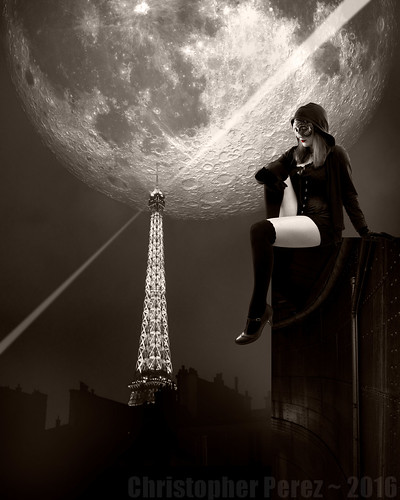
Sœur Vampire ~ Paris


Summary - 

I have attempted to present many practical aspects of making a fine portrait.  You should now have all the tools and skills required to make a good portrait.  

Think of it this way; the camera is like an artist's brush.  It's not the brush that counts, it's how you actively, in a practical manner, choose to use it.  These blog entries are my attempt to help you learn how to use your photographic tools as an artist learns how to use a brush.

Earlier in this entry I suggested that "feelings" and "emotions" are built in to an image.  These things are not a product of how a photographer "feels" nor "emotes."  Nor are these things the product of how your subject "feels" nor "emotes" at the time their photograph is made.  Rather, what a viewer of your work "feels" will be a result of the rational, cognitive choices you make throughout the photographic process, using your imaging tools as a painter uses his brushes.

Good portrait photography is, to my way of thinking, a result of making a series of well understood, well executed choices.

Thursday, May 18, 2017

Portraiture ~ lighting considerations

Continuing my series on portraiture, we will now turn our attention to lighting.  Specifically, we will look at strobe lighting.  I typically use strobes when photographing indoors under carefully controlled circumstances.

Before we begin, let's revisit my motivation for doing this.

Grand Question -  

Looking back 50 years, what would I have liked to have known that would've helped me make better progress swiftly and with more confidence?

This post will attempt to address the lighting part of that question.  Again, I would like to propose a cost effective approach that illustrates just how little investment in tools it takes to create wonderful portraiture.

I will start with a simple one light setup.  This is something I have tested over the years and is based on the ideas of William Mortensen, Robert Balcomb, and Joel Grimes.  I feel these three photographic artists have a lot of great things to say about photography and how to create art through the photographic processes.


Camera Setup - 

For the sake of consistency and controlling many of the variables that can come into play I use the following for all my work in a studio and other indoor spaces.
  • Set the Exposure by using 
    • Manual Mode (typically "M" on most cameras)
    • 1/125th of a second for the shutter speed
    • f/5.6 or f/8 for the aperture
    • 100 for the ISO (or whichever is the lowest sensor sensitivity your camera offers)
    • Daylight for the White Balance

Set the Exposure -

The following assumes you are using your flash/camera combination in the flash's manual mode.  This method for correctly setting the exposure is easy to follow.  Once the exposure is set and for as long as your camera/flash/umbrella/subject distances do not change, your exposure should not change.
  • Set the exposure by taking a photo and look at the histogram of the resulting image.  
    • In general, if the image is too dark, the histogram levels will "bunch" toward the dark end of the range.  
    • In general, if the image is too light, the histogram levels will "bunch" toward the bright end of the range.
    • Adjust the flash intensity until the histogram of your images shows information recorded in the highlights and shadow areas - making sure the skin tones are neither over-exposed nor under-exposed.  Most cameras can show you in-camera the areas that are too dark and too light when reviewing photos you've taken.
NOTE 1: Setting the exposure correctly "in-camera" will help minimize the adjustments you make to an image later in processing.

Let's get started with our first lighting setup.

Lighting Setup #1 -

This lighting setup is very useful for not only portraiture, but also fashion and pictorial representation.  I don't see this used very often these days, but it gives a very beautiful light.

Note 2: The bigger the umbrella the softer the light.  I use an umbrella that is approximately three feet/1 meter in diameter.
  • Compose your subject by looking at and moving your camera and your subject to exactly achieve what you want the final image composition to be
  • Place a single flash/umbrella set-up facing your subject at a distance of two and a half to three feet.  
  • Move light standard up or down until it is situated just outside and above the field of view of your camera.  That is, you can not see the umbrella in your camera's field of view, but the umbrella is as close as possible to coming into that field.
  • Set the exposure (see set the exposure description above)
You are now ready to photograph your subject.

Here is an example of what this lighting setup can do.

Sœur Vampire ~ Paris
Lighting Setup #2 -

This lighting setup is also very useful for portraiture, fashion and pictorial representation.  This is the kind of light you encounter most of the time in publications and advertising.  It's currently called cross light, or in former times it was known as plastic light.  The Grand Masters of paint used this light fairly often (though I have seen a surprising number of Grand Master works where the artist used the kind of light used in setup #1 above).

For this lighting setup you might want to use a black or white surface that subtracts or bounces light into your subject's shadow areas.  Using a non-reflective black surface can add drama to an image by helping create deep/dark shadows.  Using a white reflective surface can soften the subject's shadow area by bouncing a bit of light into the dark areas.  Which way you proceed will be a matter of personal taste.  There is no right nor wrong answer.  Additionally, I've easily found foam core board at our local art supply that is white on one side and black on the other.
  • Compose your subject by looking at your camera and moving your subject to exactly achieve what you want the final image composition to be
  • Place single flash/umbrella 45 to 60 degrees to the side of your camera with the umbrella facing your subject.  Set the distance between the flash/umbrella and your subject to three or four feet.  
  • Move light standard up or down until the umbrella is pointing head height at your subject.
  • (optional) Set a non-reflective or reflective surface facing your subject on the side opposite the flash/umbrella.
  • Set the exposure (see set the exposure description above)
NOTE 3: When using Lighting Setup #2, if you're not sure which side of the camera to place the flash/umbrella, take a photo and see what the effect is.  If it's not what you want, move the flash/umbrella to the other side and try again.

NOTE 4: When using Lighting Setup #2, if you're not sure of the effect of using a black or white surface on the shadow side of your subject, set your flash/umbrella placement, set your exposure, and take several images using black or white surfaces while varying the distance from the surface to your subject, and compare the results.

You are now ready to photograph your subject.

Here is an example of what this lighting setup can do.

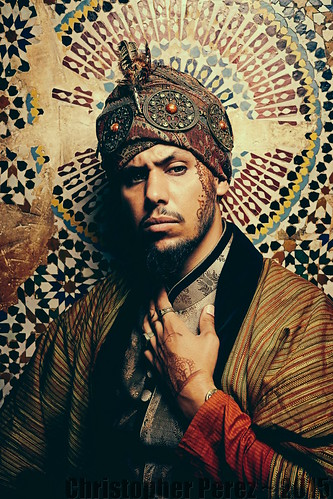
Out of Marrakesh ~ Naos Al Kymaris


Certainly there are other more complex lighting setups a photographer can implement.  They will cost more money, of course, for the additional equipment.  Such approaches fall well outside my intended scope of low-cost yet beautiful lighting.  If you are interested, Joel Grimes gives a very good description of how to use three light systems.

Notes - 

I feel it is valuable to repeat the notes that I provided above.  For portraitists new to this approach, the details of a shoot can at first be confusing.  But with repeated use (dare I say practice?) the value of these notes will be seen.

NOTE 1: Setting the exposure correctly "in-camera" will help minimize the adjustments you make to an image later in processing.

NOTE 2: The bigger the umbrella the softer the light.  I use an umbrella that is approximately three feet/1 meter in diameter.

NOTE 3:  When using Lighting Setup #2, if you're not sure which side of the camera to place the flash/umbrella, take a photo and see what the effect is.  If it's not what you want, move the flash/umbrella to the other side and try again.

NOTE 4: When using Lighting Setup #2, if you're not sure of the effect of using a black or white surface on the shadow side of your subject, set your flash/umbrella placement, set your exposure, and take several images using black or white surfaces while varying the distance from the surface to your subject, and compare the results.

In the next post I would like to talk about the art of portraiture.  It turns out buying equipment and learning how to use it is the easy part.

Sunday, May 14, 2017

Portraiture ~ equipment considerations

What I would like to do here is share a few things that I've learned.  The following posts expand on materials I've generated for portraiture classes that I teach.  This series consists of three separate blog entries; equipment, lighting, and art.

I have been photographing people for fifty years.  Yet it's only recently that I have come to feel I can understand and control the most important aspects of the craft.

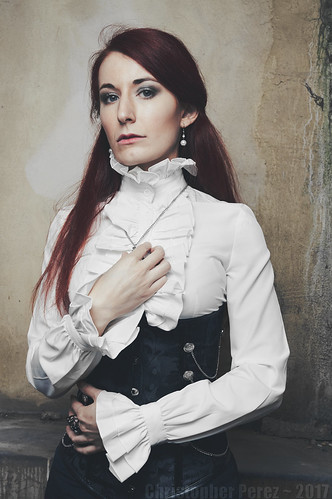
French Steampunk


The Grand Question - 

Looking back 50 years, what would I have liked to have known that would've helped me make better progress swiftly and with more confidence?

For years I have concentrated my attention on the equipment and tools of making images of people.  This has meant I've paid an inordinate amount of attention to cameras, lenses, lights, and backdrops.  These things were not enough, but one needs to begin somewhere, right?

To begin to answer this question I would like to propose a cost effective approach that illustrates just how little investment in tools it takes to create wonderful portraiture.  This approach is flexible enough that it can be expanded to include fashion and pictorial photography.


Equipment List -
  • A camera that...
    • offers manual mode as a shooting mode option
    • comes with a "hot shoe" or the ability to control a flash triggering device
  • Standard focal length lens (in full frame terms, anything from 24mm to 85mm will do, including standard "kit" zoom optics)
  • Electronic flash that is separate from the camera - often called an off-camera or remote flash
  • Remote flash trigger - that sits on the camera and triggers the flash remotely
  • Photo "bounce" umbrella - with "shoot thru" capabilities as an option
  • Tripod-stand to hold the flash and umbrella

Sensor sizes -

Given the present state of imaging technologies, how many mega-pixels a camera has may not be important.  Any camera with 12 mega-pixels will give you a print that out-resolves what your eyes are capable of up to 11x17 inches.

If your goal is to make prints larger than 11x17 inches, then perhaps a sensor with more than 12 mega-pixels would be beneficial (as well as easy to find).  Keep in mind, too, that magazine reproduction sizes typically are much smaller than 11x17 inches and reproduction technologies may or may not yet approach the resolution limits of what our eyes can resolve (depending on the printing equipment).  Computer/cell-phone/tablet displays have even less resolution than a magazine and a high quality print.

In short, mega-pixel counts are unimportant.  The final image will be the only thing that matters.

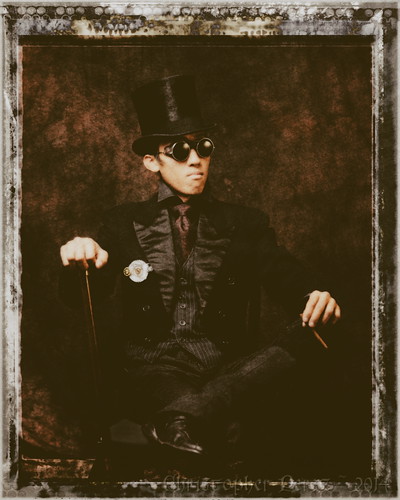
Animated Spirits - reborn

Monetary Considerations - 

At the beginning of this post I suggested that making wonderful portraits need not cost very much.  Here is an illustration of how inexpensively you to produce professional quality images.

Lighting Costs (new, not used, equipment as seen on Amazon US) -
  • $35 - Flash unit (such as Newer TT560)
  • $20 - Flash remote trigger (mounted on camera - such as Newer 16 channel triggers)
  • $20 - Photo umbrella (bounce/shoot-thru)
  • $20 - Tripod-stand
  • $10 - Flash and Umbrella to tripod-stand adapter
  • TOTAL - $105 

Camera/Lens Costs (as seen in eBay completed auctions for good, clean used equipment)
  • $250 to $400 - DSLR with kit lens - such as Canon 1200D or Nikon 3300
or...
  • $150 to $300 - Mirrorless with kit lens - such as Olympus EPL or EM, Panasonic GX, or Sony NEX
My Camera Kit -

One of the combinations I use and like is built on WiFi/NFC capable camera bodies and fixed focal length lenses.  I can transfer images to a tablet, process the images quickly, and share them directly to photo-sharing platforms and social media sites.  Since I'm retired and living on a fixed income, my money goes further buying used equipment locally off such sites as in-country eBay, Craigslist or Leboncoin. 
  • $175 - Sony NEX-5T body only (Wifi and NFC capable)
  • $90 - Sigma 30mm f/2.8 EX DN E
  • $10 - Hot shoe adapter for NEX

In Total - 

The all up costs of building a portraiture system from scratch are between $250 to $500, give or take a few pennies.  If you can tell a difference in image quality between photos taken using this low-cost approach verses images made using "pro" gear costing north of ten times more, I'll buy you a beer and take this post down.

In the next post I would like to talk about the a flexible lighting setup that is very good for portraiture. 

Thursday, April 13, 2017

OK. Reset. Explanation.

Yesterday I wrote "I've been taking photographs of people for nearly 50 years and I just realized exactly how I could've done better than I have. It's a deflating feeling, actually.  All those missed opportunities and all those wonderful people with whom I could've done so much better.  Bon.  On y va!  Thus begins a massive reset.  I hope to find wonderful people to work.  Again.  Anew."

Here is the explanation.

I've been a slow and stubborn learner.  When I was young I thought I knew everything.  When I was in middle age I thought I could buy the right gear to "get me there."  As I grow older, I realize how little I know.

The details are simple, really.

Starting with lighting, it's taken me 20 years of fiddling around with things to get to where I'm happy with what I know.  Rembrandt lighting?  Understood.  Chiaroscuro?  Understood.  William Mortensen's "Basic", "Dynamic", and "Contour" lighting.  Got it.  Know it.  Nailed it.

Moving to processing and coming into the Digital Age I've learned a lot about processing images.  I think I understand how and when to apply textures and when to manipulate a "straight shot."  I understand Edward Weston, Morley Baer, and Ansel Adam's imaging and processing techniques and can apply them at will.  I feel I can even digitally simulate wet plate collodion (which is not really all that easy to do correctly in the digital realm - Apple Apps don't really get it right).

Working with people has been difficult for me.  I'm an introvert and it really stretches me to reach out to people and to ask them if I can take their photo.  I feel a strong responsibility to them as I don't like wasting people's time (which is what I feel if I screw things up).  Yet, I have worked hard to overcome my shyness.

Looking at my portfolio I see many things that give me pleasure.  I feel I've been fortunate enough to have done things that remain perhaps uncommon.

So what's the problem?

Well, the problem simply is this.  Take a look at the following video and pay close attention to where M.Gimes places the lens.


Now Google any of the Old Masters and select "images".  Titian, Rubens, Rembrandt, and Vigee LeBrun.  Do you see what I mean?

The effect may at first seem subtle, but it makes all the difference in the world, and I feel I've missed this one single thing.  Joel Grimes does not give lens placement the emphasis I am, but he does talk about it.  He clearly understands and has understood the importance of lens placement for a rather long time.  I have him to thank for helping improve my understanding of image making.

So.  I feel the need to hike up my Big Boy Pants and get on with it.  Hopefully my images will improve.  Thanks for listening.

Wednesday, April 12, 2017

OK. Reset.

I've been taking photographs of people for nearly 50 years and I just realized exactly how I could've done better than I have.

It's a deflating feeling, actually.  All those missed opportunities and all those wonderful people with whom I could've done so much better.

Bon.  On y va!

Thus begins a massive reset.  I hope to find wonderful people to work.  Again.  Anew.

Wednesday, February 22, 2017

Going Soft ~ yet another look

In the last post I shared a few images of a wonderful bottle of wine.  I wanted to see how aperture affects the "feel" of an image and I used Sony 50mm f/1.8 SEL OSS and an old manual focus Nikon Micro-Nikkor 55mm f/3.5 to make the comparison.

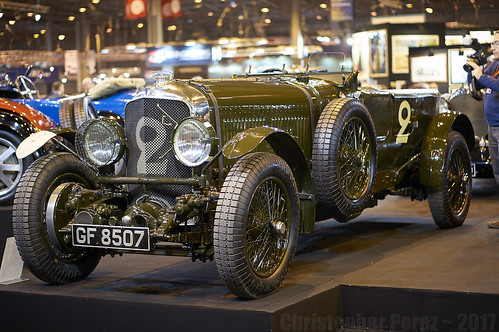
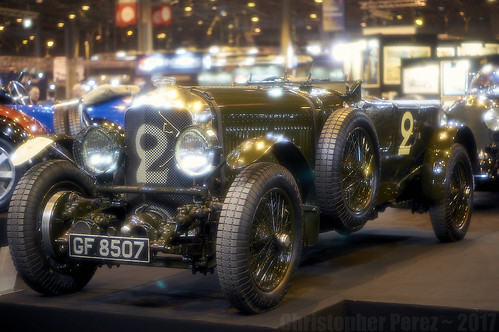
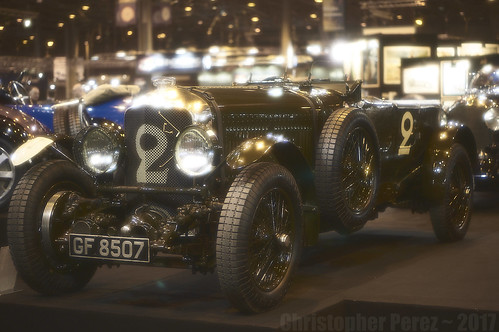
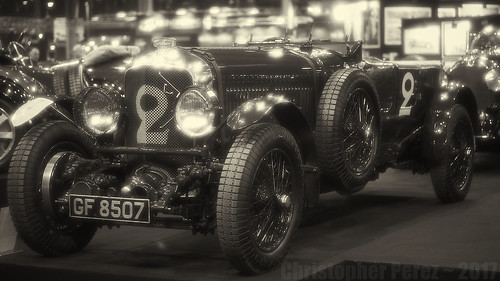
In this post I would like to share images of a different subject.  Each year in February la porte de Versailles Parc des Expositions plays host to an old car show called Retromobile.  This year I found a wonderful old Bentley and, well, I wanted to see how images of it "feel" with and without the Nikon Soft number one filter.  I also want to see how processing affects the final outcome.

Take a look at the following.  If you find something you like, please take a moment and leave a comment as to which image you like and why.  Thank you.  I appreciate the feedback.


Bentley ~ Retromobile 2017 ~ Paris, France 
#1

Bentley ~ Retromobile 2017 ~ Paris, France 
#2

Bentley ~ Retromobile 2017 ~ Paris, France 
#3

Bentley ~ Retromobile 2017 ~ Paris, France
#4

Again, thank you for your time and comments.

Tuesday, February 21, 2017

Going Soft ~ another look

I think I like the Nikon Soft filter number one.  The effect seems to achieve the right balance between softness and sharpness.  After realizing this I wanted to see what effect aperture setting had when combined with the filter.

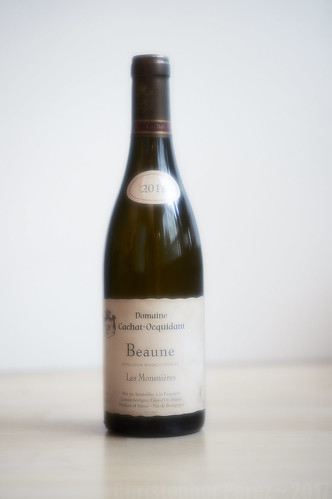
Dinner one night called for a new (to us) kind of bird and a new (to us) vineyard's wine.  Before opening the bottle I took out a couple lenses snapped a few images.  Here was the setup:
  • Sony NEX-5T
  • Sony 50mm SEL OSS f/1.8 at f/2
  • Nikon Micro-Nikkor 55mm f/3.5 at f/3.5
  • Tabletop tripod - to get as low as possible
  • Bottle of white wine (cepage chardonnay) from Beaune
Here is the test subject, which, by the way, is quite good.

Jacky (a good friend of our's) and I found this vineyard after tromping the aisles of les vignerons independent and sampling only white Burgundian wines.  If you know white wine, you know of Meursault, Chassagne-Montrachet, and Pouilly-Fuissé.  At the salon we sampled everything we could, including wines from bottles costing well north of 50Euro.  Nothing came close to this little no-nothing-name vinters products.  Follow this advice with caution since I'm a beer drinker and really can't be trusted on things wine.

Oh.  Yes.  This image was made using the Sony 50mm f/1.8 SEL OSS at f2 (I must've hit the dial by accident as I wanted this shot at f/1.8 - by the time I found the error my wife and I were well into the contents of the bottle).

The evenings libation...

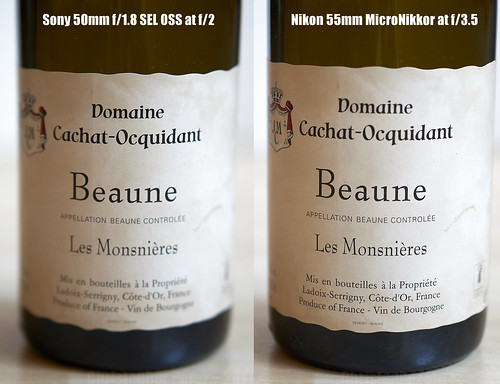
Here is a quick look at the label photographed without the Soft filter.


Sony Nikon Comparison - no filter


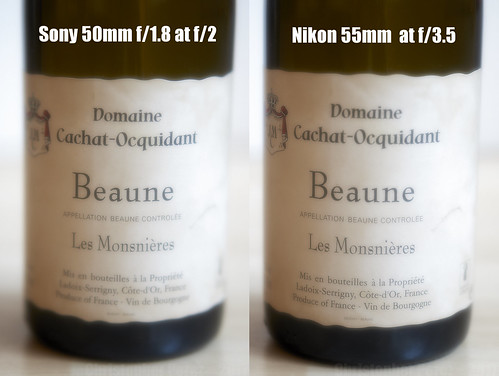
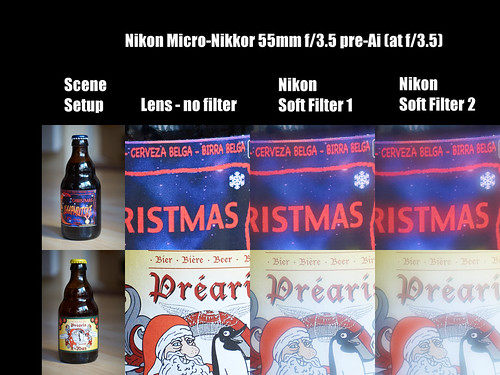
Here is the very same scene shot with the Soft filter.  I snugged up the highlights and shadows to match the scene contrast of the images made without the filter.  The Soft filter flattens the image contrast pretty dramatically.  In the future, when using the Soft filter I will try to remember to overexpose the scene and to do so without clipping the highlights.

Sony Nikon with Soft Filter 1 ~ Comparison


As you can see, the Soft filter really does the trick it's supposed to do.  There is the softness it's famous for, but there's also something else.  Looking at the light to dark transitions (such as in the lettering) the Soft filter retains a surprising amount of "sharpness."  The effect is nothing like one gets with a nylon stocking over the front of a lens, nor is it anything like a shot made with petroleum jelly over a UV filter on the front of an optic.

Looking specifically at the Sony and Nikkor images shot with the Soft filter, you can see the edges of the bottle from the Sony 50mm falls off into a blur more quickly than the Nikon 55mm.  This should be expected as the Sony lens was shot at f/2 and the Nikkor was set to f/3.5.

The Nikon Soft filter seems to provide an interesting tradeoff between sharp and soft.  It could be interesting to use when deliberately attempting to recreate a late-1800's Pictorialist style.  I feel yet another project coming on.

Saturday, January 21, 2017

Going soft...

I've been for a rather too long a time considering softer images.  I've owned a Portland, several Fuji SF large format film lenses, and enjoyed using the interesting Mamiya RB 150mm SF with softness control disks.  I'm not sure why, but I like the effect, but only when "done properly."

My wife and I visited d'Orsay Museum and had the unexpected opportunity to look at a few late-1800's, early 1900's Pictorialist style photographs.  There were three images that really caught my eye.  One was a page straight out of Stieglitz's Camera Work publication.  It was George Bernard Shaw's "Portrait of Alvin Langdon Coburn."  The online versions of this simply do not do the original justice.  The way Coburn was clearly, but softly in focus and the way the background dropped away into a subtle scene of the path overhung with branches of trees really pleased me.

Another wonderful image was a cyanotype of a woman in shadow that I'd never seen before.  The image was "Florence Peterson" by Paul Haviland.  How the photographer used light and shadow, combined with softness in transition areas was really quite nice.

However, the image that really took me by surprise as Paul Haviland's "Catherine Haviland".  The optical effects were subtle.  The depth of field was unexpected.  In current photographic practice wide aperture lenses are used to separate a very sharp in-focus subject from a very-blurred background by using exceedingly narrow depth of field.  The details of the Paul Haviland scene, again by comparison to current practice, were quite remarkable and extended across the image.  I'll say it again; online copies of these images, to me, fail to share the depth of beauty of original prints.

Back at the apartment I did (yet again) some research into soft focus effects in photography.  An article on Nikon's website told me something that I'd not carefully considered.  It was that early soft focus designs allowed for an optical effect that included sufficient depth of field to keep the important parts of the subject in focus.  This was exactly what I'd seen in the "Catherine Haviland".

I've avoided soft filters like the plague, feeling that they weren't somehow pukka to the craft.  But after reading the Nikon article I found one each Nikon Soft Filter numbers one and two on eBay.  They've arrived and, well, here's yet another comparison.

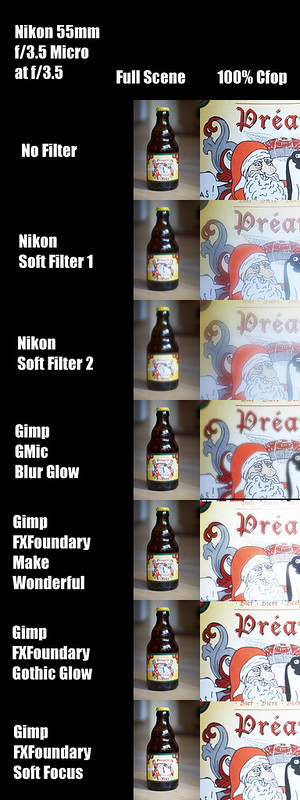
Using a subject that doesn't move very quickly on it's own, I set up a Sony NEX-5T with Nikon Micro-Nikkor 55mm f/3.5 non-AI on a tabletop tripod, set mode to "A", set the ISO to 100, set the self timer to two seconds, and took three images.  Here is the effect of the filters on one of my favorite subjects.

As always, pop on over to this image hosted on Flickr and take a look at the 100% file size version to see the subtle and not so subtle effects.


Belgium Beer ~ soft focu comparisons


Thinking a bit further I realized I'd failed to see how the current state of soft filters might act on the same subject.  So I took the sharp image and passed it through the Gimp and several different softening effects.  All filters were left at their default settings.  No attempt was made to normalize the contrast ranges between images, nor was any attempt made to get the highlight/shadow tones to match.  While  I'm not entirely sure how close I could get to the Nikkor Soft Filter effects, I'm fairly certain I could sort it out quickly enough.  Having said that, the G'Mic Blur Glow filter at it's default settings is really quite nice.

Belgium Beer ~ soft focu comparisons

Saturday, January 07, 2017

John Berger on art and how we humans see things...

I've written many many posts about cameras, lenses, and on technical details of resolution and how the human eye interprets what we call sharpness.

I've also written about how image making has moved beyond traditional methods and on how cameras have quickly disappeared from our consciousness as imaging tools have become well integrated into networked platforms.

I've been reading Sally Mann and Susan Sontag to see if I can't understand their points of view on photography.  This is quickly followed by an artist friend's sharing of John Berger's "Ways of Seeing" series of early 1970's TV broadcasts.  These are, for me, significant enough that I'd like to share them here.

Thinking deeply about these kinds of topics helps sharpen the mind and, hopefully, leads to stronger, clearer, more dynamic image creation.


Saturday, December 31, 2016

Comparison ~ Sony, Sigma, Nikon 50mm, 60mm, 85mm

I remember a great blog entry from some time back that showed the Sony 50mm f/1.8 SEL OSS to be as sharp wide open as a Leica 50mm f/2 lens.   That link is unfortunately broken.  Searching around I found another site that effectively shows the same thing.

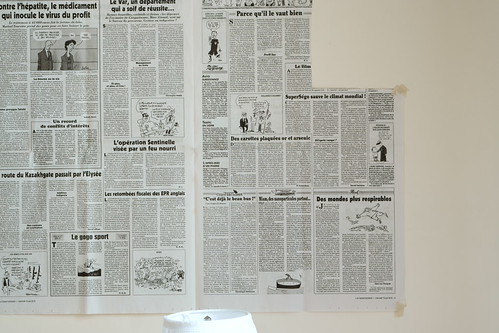
So, I couldn't help myself.  Attracted by the Sony 50mm f/1.8 SEL OSS (I'm getting old and shaky) and interested to see how it stacked up against my "reference" lens, the Sigma 60mm Art DN, I taped le Canard Enchaine to the wall and had a wee-peek at things.

My by now standard comparison setup -
  • Sony A6000, "A" mode, ISO100, 2 second delay trigger, very sturdy tripod
  • Sony 50mm f/1.8 SEL OSS - shot in AF mode
  • Sigma 60mm f/2.8 EX DN E - as my standard reference shot in AF mode
  • Nikon 85mm f/2 Ai - just because, shot obviously as a manual focus lens
Here is the scene -

Sony/Sigma/Nikon Comparison Setup

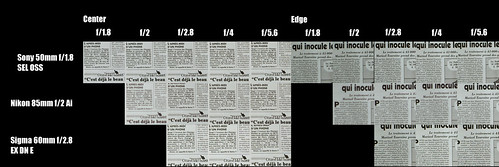
Here are the comparison results (be sure to look at these at 100% over on Flickr)


Sony/Sig/NikonComparison

My (yet again rather obvious) observations include -

The Sony 50mm f/1.8 SEL OSS appears to be a nice lens.  From wide open it controls aberrations quite nicely (particularly compared to the old Nikkor f/2).  The resolution seems adequate to just about any task.  And yet it simply doesn't match the Sigma in terms of hard resolution at f/1.8 or f/2 (apertures that the Sigma doesn't offer).  By f/2.8 the Sony and Sigma lenses are nearly indistinguishable.

Looking at the luminosity curve of the RAW files straight out of the camera reveals something interesting in the way these two lenses behave.  With the Sony I can see highlight regions spread the luminosity range more broadly than the Sigma.  The Sigma's file shows a distinctive bump toward the highlights and falls off like a cliff.  It's amazing to look at the differences between the two curves and remember how contrast is a very important element to understanding how humans perceive resolution.  And this right here is very likely why the Sigma looks to perform so brilliantly compared to other lenses.  It's how the optic passes contrast to the sensor.

The Nikon 85mm f/2 Ai is outstanding from wide open and corner to corner.  However the contrast is lower than the modern lenses due to spherical aberrations at wide apertures.  You can see the effect in this comparison.  Look carefully at the f/2 center square.  See how sharp the letters are, but how a light "fog" overlays the scene?  That's the effect of spherical aberration.  Things clean up a stop or two down from wide open and is indistinguishable from currently designed optics.

My by now standard disclaimer:
I've learned long ago that I can very nearly match image resolution between just about any lens set by making adjustments to the luminosity curve.  Rarely is a lens so bad that it's resolution would be clearly worse than a high quality modern lens.  So if all a person has or if all a person can afford is something old and manual focus, there's no need to fret.  No one will be able to walk up to a big print and say "well, gosh, you should've used a sharper lens."  Why?  Because no matter what a photographer uses, it's always Always ALWAYS the mind, the creativity, and concepts of a photographer that viewers (even "educated" fellow photographers) will respond to.  There is not a single person on Planet Earth who can tell you what lens made what image (except maybe the photographer).  It simply does not "work" that way.

Sunday, December 25, 2016

Comparison ~ Sigma, Nikon, Sony fixed focal length and zoom

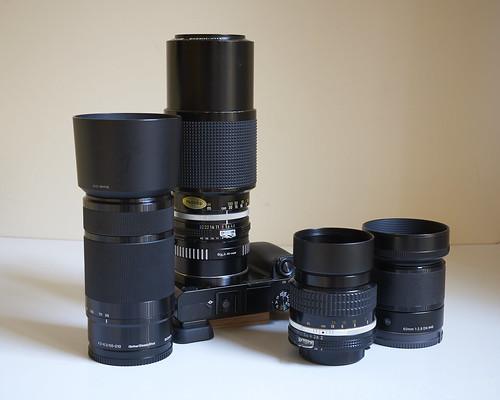
Before I sell the Nikon 80-200 f/4.5 N I wanted to see how it compared to my other optics.  Just in case I had a stellar lens on my hands and didn't realize it.

My by now standard comparison setup -
  • Sony A6000, "A" mode, ISO100, 2 second delay trigger, very sturdy tripod
  • Sigma 60mm f/2.8 EX DN E - as the standard reference shot in AF mode
  • Nikon 85mm f/2 Ai - just because, shot obviously as a manual focus lens
  • Nikon 80-200mm f/4.5 N Ai - up for sale, shot obviously as a manual focus lens
  • Sony 55-210 f/4.5-6.3 SEL OSS - the one the focuses correctly, shot in AF mode
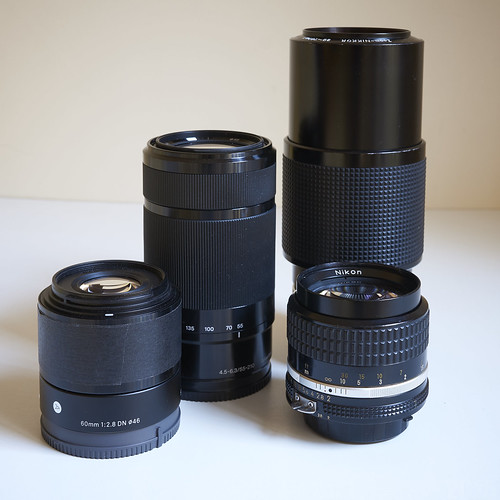
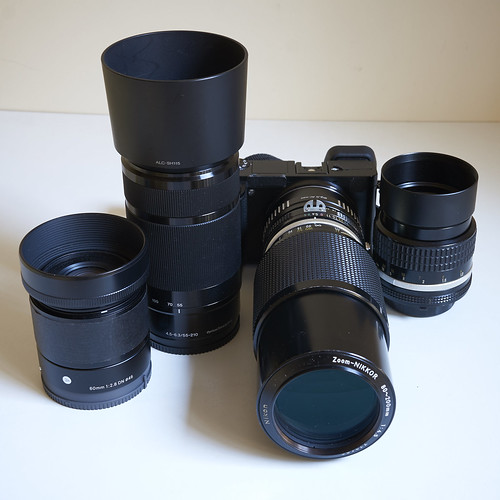
Here are a few family photos -

Comparison - Sigma, Sony, Nikon lenses 60mm to 210mm


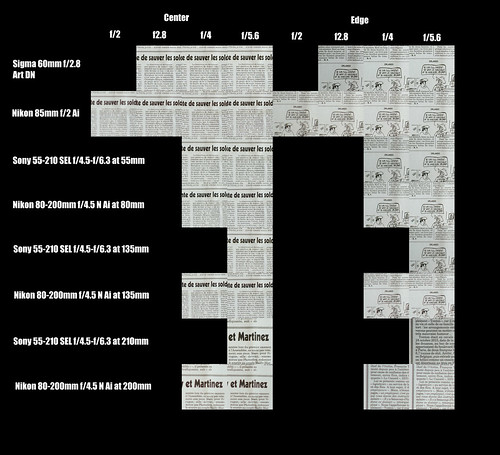
Here are the comparison results (be sure to look at these at 100% over on Flickr)


Comparison - Sigma, Sony, Nikon lenses 60mm to 210mm

My (rather obvious) observations include -

The Sigma 60mm Art DN is incredible from wide open and corner to corner.  This is why it is my reference optic.

The Nikon 85mm f/2 Ai is outstanding from wide open and corner to corner.  However the contrast is lower than the modern lenses due to spherical aberrations at wide apertures.  Things clean up a stop or two down from wide open and is indistinguishable from currently designed optics.  I want to keep one of the three 85mm lenses I own.  All are up for sale, but I can't decide between the f/2 (more modern) and f/1.8 single or multi-coated very slightly software wide open but with nice swirly bokeh early Nikon designed optics.  There's no rush as none of these have interested buyers at this point.

The Sony 55-210 f/4.5-6.3 SEL OSS that focuses correctly looks like it's OK (adequate) at 55mm and 135mm.  It's not going to knock anyone's socks off, but it looks like a decently sharp optic that can get the job done.  My sample looks brilliant at 210mm's, however.  I can't believe it.  But there you have it.  A nice, cheap lens that can do what I expect it to do. This is a "keeper."

The Nikon 80-200mm f/4.5 N Ai used to be a rather expensive optic.  Nikon did a lot of design work on the series and their effort is apparent in the results seen here.  At 80mm and 135mm it's sharper than the new Sony 55-210mm all the way into the corners (where is looks pretty darned fine, actually).  At 200mm, however, there appears to be a bit of spherical aberration (or something) that clouds the image quality.  Still, for 80Euros this isn't a 1/2 bad lens.  Not by a long shot.

I've learned long ago that I can very nearly match image resolution between just about any lens set by making adjustments to the luminosity curve.  Rarely is a lens so bad that it's resolution would be clearly worse than a high quality modern lens.  So if all a person has or if all a person can afford is something old and manual focus, there's no need to fret.  No one will be able to walk up to a big print and say "well, gosh, you should've used a sharper lens."  Why?  Because no matter what a photographer uses, it's always Always ALWAYS the mind, the creativity, and concepts of a photographer that viewers (even "educated" fellow photographers) will respond to.  There is not a single person on Planet Earth who can tell you what lens made what image.  It simply does not "work" that way.

Sunday, December 18, 2016

In the Age of Post-Photography - a few properties

I've written and rewritten this blog entry several times.  Nothing felt right.  Nothing expressed my thoughts clearly enough.  What I wanted was to expand on earlier thoughts of living in the Age of Post-Photography.

"... Post-Photography means having gone beyond traditional photographic image making.  It means the apparatus of photo creation has been subsumed and integrated into technologies in a way that the complexities of its use have been eliminated.  It means that the purpose of images in our lives has evolved to inhabit a new place.  We no longer see "cameras" as tools.  We see image making as part of a much broader, more highly integrated social experience.  We love to see ourselves..."

This description feels a little restrictive and more than a little negative.  Yes, a shocking number of photographs made these days are for narcissistic reasons.  But not all of us are in love with the image of ourselves, are we?  No, for many of us the exercise of image making remains a much broader experience.  I cast around for a way to organize my thoughts and tried to find words for my feelings on the topic.  

Casually reading Sally Mann's "Hold Still" I had to stop.  What was that I just read?  Did she really just say that?  Yes.  There it was.  The very things I failed to find words for.  There they were on page 151 of my hardbound copy.  It was a little over halfway down the page.  Written by someone I deeply admire.

"... How can a sentient person of the modern age mistake photography for reality?..."

Isn't this exactly what some critics of news and reporting photography are fighting over?  Isn't this exactly what has caused such a problem for some people when they learned that Magnum and AP photographers "improved" their images through modification?  Wasn't it exactly this mistake that some people made when they looked at my images of Catwoman?  The wailing and moaning, for what? 

"... All perception is selection, and all photographs - no matter how objectively journalistic the photographer's intent - exclude aspects of the moment's complexity..."

This brilliantly states the case against photography as reality.

If photography is not this, then what is it?  One might need to be careful as asking these kinds of questions feel like an all too slippery slope.  Some of us might end up in a place we didn't expect and certainly might not like.  Photography might no be what we want to believe.

Guy Tal wrote in Lenswork Magazine #127 "On Sacred Cows and Roosting Chickens" about how we have a basic understanding of the differences between fiction and nonfiction writing.  We understand when we read a novel that what we read is not real in the physical, historical sense.  We accept this and still find reading novels pleasurable.  We expect accuracy and truth when we read nonfiction.  We can learn things about reality, truth, and the world around us.  In writing we accept these different styles and are comfortable with various distinctions.  Yet we have no similar understanding for how to engage photographic images.  There is no way of sorting what we see into fiction and nonfiction in a way that we can be comfortable, enjoy, and appreciate both.

I find it easier to think in terms of image making than it is to think about photography.  It's such a "loaded" word, photography.  I find it nearly impossible to use the word without bumping against the wall of assumed reality.  

What if we could acknowledge that the field of image making is a continuum of experience and expression that spans a much greater space than previously agreed to?

What if there is space enough for those who choose "straight" image making?

What if there was room enough for those who modify things in a way that match their vision?

What if there was yet more than enough room to include those who choose to use image making technologies to electronically draw or paint?

What if image making could cast aside it's assumptions of reality and fully embrace photography's true nature as an expression of creativity?

I find the phrase Age of Post-Photography allows me to move beyond this wall of photographic tradition and the trap of thinking something represents reality when very clearly it does not and can not.


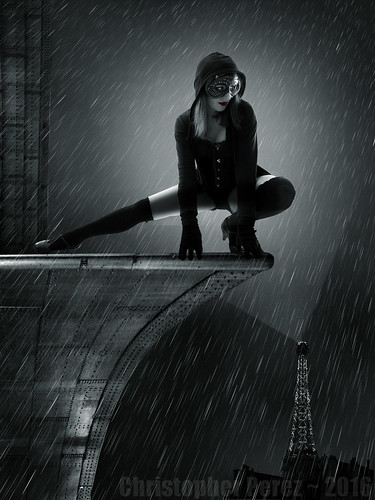
Catwoman ~ Paris, France

Wednesday, December 07, 2016

In the Age of Post-Photography - where are we now?

We have entered the age of Post-Photography.

Post-Photography means having gone beyond traditional photographic image making.  It means the apparatus of photo creation has been subsumed and integrated into technologies in a way that the complexities of its use have been eliminated.  It means that the purpose of images in our lives has evolved to inhabit a new place.  We no longer see "cameras" as tools.  We see image making as part of a much broader, more highly integrated social experience.  We love to see ourselves.

A few days after I posted my initial thoughts on finding myself living in the age of post-photography, my wife, Judith, pointed me to a series of articles which feel directly related to the topic.  Following the links and references in the first article led me down an interesting rabbit hole of thought, analysis and critique.

The article that started the descent into the rabbit hole is a review of Sally Mann's book titled "Hold Still" where she writes "... Whatever of my memories hadn’t crumbled into dust must surely by now have been altered by the passage of time..."  I read this in Proust (who is mentioned in the article).  There is a hazy, golden, glowing feeling about the past that very likely does not match the facts of the experiences at the time people lived them.  Time reliably changes what's in our unreliable minds.  Unless, that is, we find something, somewhere that acts as a repository into which we place our memories.

An idea occurred to me that is best illustrated in the form of two examples.  Romans carved statues of their leaders and sent them around their empire so their subjects could see who ruled their lives.  Some of these still exist and we can know with a fair amount of clarity and certainty what someone like Julius Caesar looked like.

Similarly, painters were called upon to make records of important events.  David's Coronation of Napoleon is one rather minor physically enormous example.  In fact, our museums are littered with painted representations of people, places, things, and events.

We tend to call these works, these statues, these paintings art.  For us, culturally, the word "art" is loaded and charged.  It has a certain weight.  So it may be hard to see what I'm talking about, unless I tilt the discussion at just the right angle.  Could it be that what we call "art" started out as little more than repositories of memory?    Aren't museums places filled with memories, or more properly, repositories of memory?  Is "art", therefore, an expression of man's battle against our reliably changing unreliable memory?

It should be obvious that this has been the primary purpose of photographic image making.  Starting in the early to mid-1800's *click* snapped the shutter  *slosh* went the chemicals *et voila!* we had a record, a representation of an actual person, place, or event.  Not unsurprisingly traditional artists were nearly instantly put out of work.  Cameras and photographers took over from paints, brushes, chisels, and artists.

Entering the age of Post-Photography it's easy with the simple gesture of a digit to point a device, capture, and share.  With this simple gesture we can see ourselves.  We can recall our experiences.  We might even sense the ghost of our feelings at the time of making the gesture.  Suddenly photographers, too, have been put out of work.

This has caused all manner of trouble in the public discourse around photography.  The loudest voices have traditionally been the "straight out of the camera" photographers.  They've demanded that "true" photography is an unaltered image.  Anything else, anything even slightly altered, to their way of thinking, could not be considered "true" nor "accurate."  In other words, only the "unaltered" could be a proper and correct repository of memory.  They felt themselves to be guardians of reality unvarnished and to be protectors of untainted truth.

I find this particularly fun and interesting.  The Guardians of True Photography, the creators of our memory repositories, they themselves have been found guilty of the very thing they publicly despised.  The problem was found to be so pervasive that the major image distributors (Magnum, AP, etc) have declared that henceforth the only images they will accept shall be in jpg format "straight out of the camera."

Some of us have always the need to push against something, even if it's a straw man of our own creation.  For this I will never forgive St. Ansel of his diatribes against William Mortensen.  Adam's letter wishing Mortensen dead is particularly foul.  While the self-appointed Guardians of Truth can't/won't see it, the old photography edifice of truth and accuracy has collapsed.  Image making has evolved to serve a different purpose, thus rendering their old arguments about what is true and real quite irrelevant.

Susan Sontag wrote "... Photographs, which cannot themselves explain anything, are inexhaustible invitations to deduction, speculation, and fantasy..."  Perhaps she uncovered an important truth.  Look at the most common use of images today.  People create themselves, their persona, not as they are (the true, the real), but as they wish to be (the fantastic, the desired).

Narcissus' Mirror is used to engender a strong emotional response to something we want to see.  We want to see and to have the world respond to us.  Social media has revealed a great many humans to be in love with themselves.  Such is the power of the phenomenon of the "selfie."

Surely that is not all that's left of the old craft of photography.

To find the part that remains less overtly narcissistic I turn to the very area of the craft that the Old Guardians of photographic truth and accuracy hated to the point of wishing it to die.  It is that part of the craft that attempts to connect us, however mysteriously or not, with our hidden worlds, our hidden thoughts, our hidden emotions, our hidden ideals, and our hidden currents of being.  In the Post-Photographic world it is not the taking of an image, it is the creation of one that interests me most.

Catwoman ~ Paris, France

Monday, November 28, 2016

In the Age of Post-Photography...

Much is being made over the hard-right populist shift in First World global politics.  First it was the BREXIT, then it was the Coming of the Donald, and now the planets are lining up for a hard right shift in France, too.  I don't intend to talk about politics here.  Rather, I would like to borrow and adapt a phrase that has some weight and meaning on the matter.

Here is the phrase I'm thinking of:  Post-Truth

When using the phrase Post-Truth we understand what people believe and what influences people is no longer the truth.  What people want is something different from formerly broadly accepted facts, figures, accuracy, and well-educated and (hopefully) deeply knowledgeable authority.  If I understand the overall trend that has lead to Post-Truth, it is at it's most basic a cry for the individual to be seen and acknowledged.  For me, these are the key words - "seen" and "acknowledged."

I wanted to find a phrase that applies to the field of images and photography, and is ideologically linked to Post-Truth.  With this I would like to propose a somewhat parallel phrase.

Here is what I would like to propose:  Post-Photography

I came to this after following a thread on Facebook where an image I created was discussed and criticised.  The image was a shared effort between myself, a model (Mona Longueville), and my wife, Judith Turano.

I posted the finished work to my two (mostly in English) Facebook pages (personal and public) that I manage here in France.  A few days later Mona shared the work to her page and that's when the fun began.  The thread started out with a few positive comments, as such things commonly do.   But then someone piped up and said (I'm paraphrasing here, as the original French was filled with nuances that don't translate well into English) they didn't like it and that they expected more from the creative team.  A reply to the critique came quickly and another person suggested they didn't like the image either and that we could've done better.

Usually before a critique is offered in France there are questions about the intellectual and artistic framework of the art.  There are usually questions about a work's place in art history and the continuation of an art movement.  Typically people try to understand the context of a work of art so they can educate themselves as to the place and purpose of the thing they are viewing.  They want to know the background so they can respond appropriately.  It is one of the (very many) things I like about living here.  Life and civility tend to extend well beyond the individual to spill into the larger commons and shared spaces (both physical and mental).

Being an American and knowing full well things I learned in the States normally don't apply here in France I simply couldn't let things rest.  I replied that it was their turn to share their art so we could have a wee-look and pass along a critique in return.  The smart-ass that I am I suggested I looked forward to telling them their work, too, could've been better.

All Holy Hell broke loose.   People quickly discarded any attempt to understand the background of the image in question, ignored any discussion photography and photographic history, and set aside intellectual curiosity and accuracy in photographic arts criticism.  People defended positions.  Others said they didn't want to hurt the creative team by saying something negative.  Still others suggested that my response was a little thin skinned and that they didn't mean to hurt me.  In short, I needed to "get over it" and take any and all criticism like a man.

In the end, what the criticism came down to was that some people simply did not like heavily photoshopped work.  They preferred "straight" photography.  Furthermore, and this is very revealing and relevant to the proposed application of the phrase, they themselves feel they create and share "unmanipulated" images, and that, therefore, must be the preferred approach.  It was a matter of simple, unabashed personal preference with a strong subtext of shifting rationalizations and responses.  Could it be what the critics were desiring was to be "seen" and "acknowledged?"

Application of the phrase Post-Photography works on many levels.  A person can shoot to share in the classic photographic tradition what they consider to be unmanipulated images.  A person can choose to create heavily manipulated images.  Or, as is now much more common than not, a person can simply ignore the technology and make images and videos of themselves and their surroundings using their mobile phone.  In each of these areas current imaging practices has moved well beyond the traditional tools, approaches, and viewing responses.

Photography is no longer a means nor an end in itself.  For the vast majority of people imaging has become (to put it rather crassly) a tool of narcissistic self promotion.  In this Post-Photography world the tools of imaging are assumed.  They are integrated into our daily lives to the point they have all but disappeared from our thinking.  The primary impetus for making images or talking about them has narrowed to the point of the individual.

The individual is the shared link in my borrowing and rewriting the phrase Post-Truth into Post-Photography.  Where the individual is the most important element of a belief system and cultural structure I have to wonder what are the roles of conversation, sharing, listening, looking, and civility?

Have we fully have entered the age of Post-Photography?  I believe we have.


Catwoman ~ Paris, France

The Facebook critiqued image
that led to this blog entry

Wednesday, November 16, 2016

Indeed...

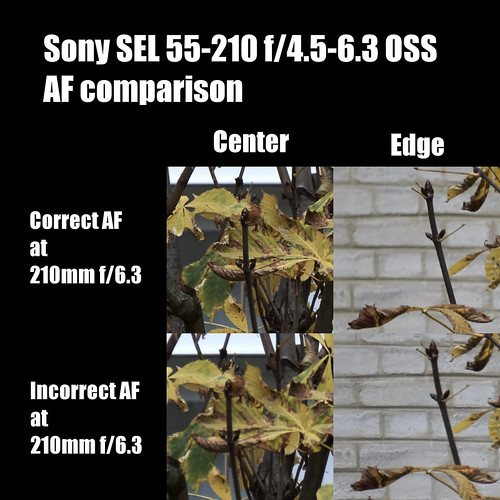
Indeed, there's something not quite right about the way my first Sony SEL 55-210mm f/4.5-6.3 OSS lens focuses.  As you may recall, I complained earlier on this blog about fuzzy dogs and racecars.

It took awhile to locate the problem.  First I tried to keep the Wide area AF points lit up over the subject and watched carefully to ensure this was the case when I had continuous AF enabled.  No joy.  My photos were sometimes obviously out of focus.  Then I tried selecting the center AF point only and found the images were no better in focus than with Wide area AF enabled.

I then photographed a static subject and found the areas behind the intended focus point(s) to be sharp, whereas the areas where the AF points lit up were obviously out of focus.  Further, this happened only at focal lengths greater than approximately 135mm.  I could replicate this behaviour on three different vintage Sony APS-C mirrorless cameras.  It was then that I drew the conclusion that the lens was at fault.


Untitled
A suitable static, not moving, can't go anywhere test subject

I took the offending lens to a local camera shop and they told me what it would cost to have Sony repair open it up just have a look and, well, I was slapped upside the head with massive sticker shock.  Normally repair facilities will give a free estimate of repairs so that you can decide whether to proceed.  At least this is what I experienced when living in the US.  But no!  Not in France.  Well, not at this (Sony) camera shop, at least.  They want 100Euro just to pry the lens open.  I could do that with a sledgehammer for a lot less than that, right?

The camera shop had a new lens they were willing to let go of for 350+Euro.  Ouch!  I wasn't about to suffer Long Lasting Post Traumatic Stress over a second round of sticker-shock, so I walked out.

Taking a quick look around the 'net I could find nothing locally to test before buying.  That left the obvious option of having something shipped to me.  In this case my next Sony SEL 55-210mm f/4.5-6.3 OSS came from Japan.  It arrived today so I set about taking a look at it's AF behaviour.  Here is what I found.


Untitled

The lens that just arrived focuses the way the gods intended.  I call this "Correct AF" performance.  That is, the portion of the subject nearest the camera is accurately in focus.  The "Incorrect AF" performance is still exhibited by the first copy of the Sony lens I have.  It's lack of AF accuracy is, even now, repeatable.

And speaking of repeatable, what you see above was repeatable in Wide area AF, Center, and with the single center "small" AF point enabled.  The new lens is behaving the way I would expect in every AF mode the Sony A6000 has.  I didn't have to spend a ton of money for my next lens, either.  It was separated from an A5000 kit ensemble, if the seller is to be believed, so it was being sold at a steep discount.  In any event, onward.  I have a sharp and properly focusing lens.  Yea!