Sunday, March 25, 2018

Quite a month!

My wife and I left Dodge for sunnier climes... only to encounter rain, rain, and more rain... followed by flooding, flooding, and more flooding... and snow in the mountains.  Lots of snow.  Could that really have been al Andalus in Spain?  It was like a bad dream.  At least the temperatures in Seville were a good 10 degrees warmer than Paris.

Early into our trip I received an email saying my px500 renewal couldn't be processed.  They couldn't find my px500 account.  I worked through the issues with their support team and realized they really couldn't find my account and were only able to refund my subscription.

Then, not two days later, I read where px500 had been sold to the Chinese.  Some of the comments I read on PetaPixel suggested people were deleting their px500 accounts and going back to Flickr.  Good thing for me as I never left Flickr in the first place.  After returning to France I removed my px500 account.  I know, they still have a bunch of my photos squirreled away somewhere on their servers.

I originally joined px500 in the hope I could sell a few images.  No joy.  Nothing sold.  So, to me, leaving them isn't such a big deal.  I just don't like the thought that the Chinese now have some of my older works.  Short of hiring a lawyer I'm not sure what to do about that.

A few weeks pass.  We experience a boatload of rain.  Not the sunny vacation we were hoping for.

Suddenly the news is awash with revelations regarding Facebook, Cambridge Analytica, Russian trolls, and the role they played in the 2016 election in the USA.  It seemed like a good time to re-consider my participation in social media platforms that use individual member data as revenue sources (Facebook sells the personal data you provide, it's the basis of their business model).

I posted a series of quotes on my personal Facebook page and put a few links on my public photography page that are critical of Facebook and their business model.  Here too, I'd hoped I could make contacts with creative people and I hoped to further my photographic explorations that might eventually lead to something, somewhere, anywhere, artistically, or commercially.  But as with my experience with 500px, nothing really ever happened.  Certainly, I met some very nice people, but one of the things I've learned in living in France is that creative contacts are best made and maintained in person, and not over the 'net. 

I'm leaving Facebook after a decade of participation.

Once I started down this path, I wanted to make certain that Facebook didn't get to benefit any longer from my giving them personal data they could sell.  What this means is that any company owned by Facebook was subject to consideration.  With this in mind, I deleted my Instagram accounts.

I'm done with Facebook.  Forever.  I'm done with Instagram.  Forever.

Where does this leave me?

I still have my Flickr account - https://www.flickr.com/photos/christophersoddsandsods/

I still have this blog account (the one you are reading right now).

I still run a couple Tumblrs, which are subject to review and reconsideration.  I'm not quite sure what I'm getting from Tumblr that I can't get elsewhere.  It's difficult to measure just how much positive exposure I get from it.  We'll see.  Maybe I'll keep them.  Maybe I won't.

In any event, I am reducing the number of platforms I have to manage and maintain.  Perhaps this will free me up to spend more time doing what I really enjoy - making photos.
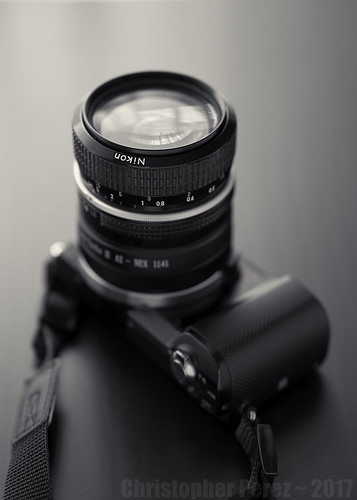

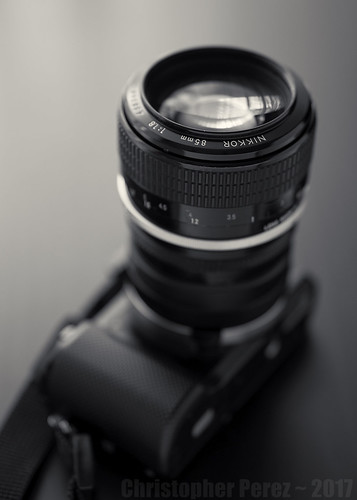
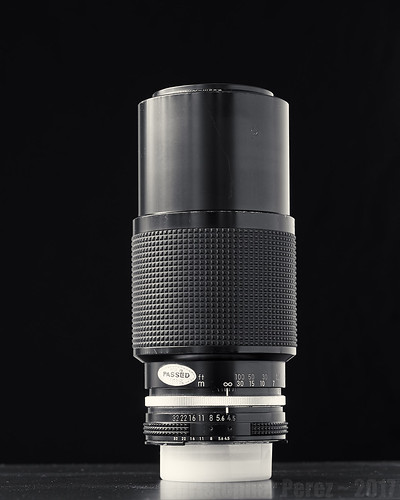
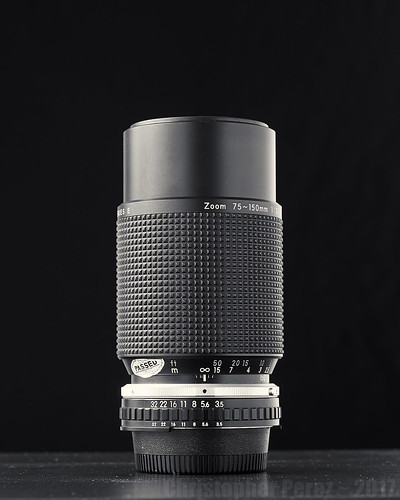
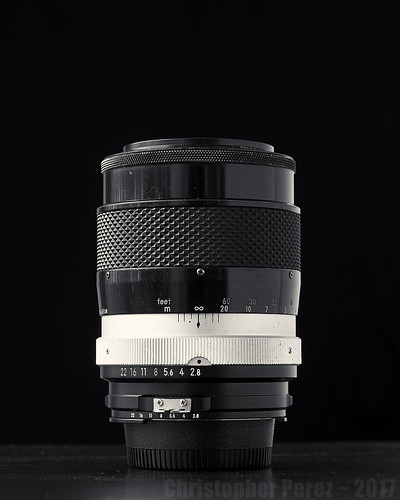
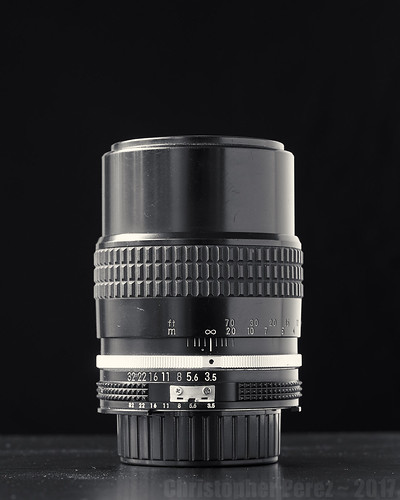
Nikon Nikkor + Lens TurboII + Sony A5000

Thursday, February 15, 2018

Comparison ~ 135mm lenses, Schneider, Nikon, Sony

... once more into the abyss, shall we?

Today I would like to take a look at several 135mm lenses that I happen to have on hand just now.  Two lenses are new to the Toy Box.  One arrived as part of a stack of things I purchased.  I'd inspected it in the field but failed to notice "cleaning marks" (scratches) on the front element.  The second lens arrived as part of the Super Deal that I scored off eBay point fr and it set me back all of 7 Euro.

Setup 
  • Sony A6000, 100ISO, AWR converted in Sony's software 
  •  Big Beefy Manfrotto tripod 
  • Lenses - 
    • Sony 55-210mm f/4.5-6.3 SEL OSS 
    • Nikon Nikkor 135mm f/2.8 Ai with mint condition glass
    • Nikon Nikkor 135mm f/2.8 non-Ai with scratched front element ("cleaning marks")
    • Nikon Nikkor 135mm f/3.5 Ai 4 element airspaced
    • Schneider-Kreuznach Tele-Xenar 135mm f/3.5 Exakta mount
The adapted lenses were shot using "straight through" adapters. None of them were mounted on a focal reducer. So what we will observe here is full frame lens performance on APS-C sized/cropped sensors. This means the very outer limits of the field of view will not be compared at all. If something already performs poorly at the outer edges of the APS-C frame, it will very likely be pretty horrible at the far edges of the full frame 35mm format.

Comparison

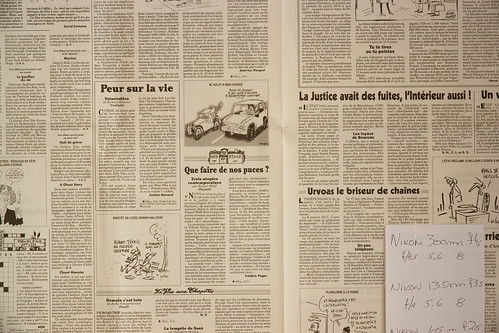
Here is the overall scene.

Scene Setup ~ 135mm lens comparison


Here are the results.

[If you click on the image it'll take you to the Flickr hosting site. Once there, look at the file at full resolution. In many cases the differences between lenses is small and likely can't be seen until you take a squint at the comparison at 100 percent.]

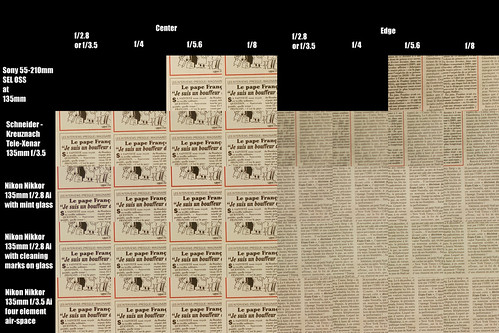
Schneider Nikkor Sony 135mm ~ Comparison


Comments 

Starting with the Sony 55-210mm f/4.5-6.3 SEL OSS, what I see is that it's sharp in the center at 135mm from wide open (which in this case is only f/5.6).  The edges of the scene are a little soft and distorted.  This may be due to field curvature, or it might be due to the inexpensive zoom design.  Photographing 2D subjects is always trying for non-flat field lenses (most optics are non-flat field).  For the price ($100 used) this is a usable lens.

Next up is the Schneider-Kreuznach Tele-Xenar 135mm f/3.5.  This is a lens I picked up for 7 Euros.  I needed to clean the front two lens groups.  One was fogged and the other looked like fungus was starting to grow around the edges.  Once cleaned up and after the Exakta adapter arrived I wanted to see how it behaved (hence this post).

In the center the Schneider is very sharp.  At the edges, it takes time for things to clean up (f/8).  Thinking back to the Sony comments, I wonder if field curvature might be coming into play.  What's surprising is how sharp it is in the center given the age of the optic (manufactured in the mid-1960's in this case).  I've always prefered Schneider to Zeiss lenses and this only confirms my already strong bias.

Another thing that I like about the Schneider 135mm is its size and weight.  This is what I like about the Nikon Nikkor 135mm f/3.5 Ai, too.  When compared side by side the f/2.8 Nikkors feel large, bloated, and heavy.  The difference is remarkable.   The depth of field effect moving from the f/3.5 to the f/2.8 optics (it's only half a stop, mind you) is indistinguishable.

The Nikon Nikkor 135mm f/2.8 Ai was given to me by a good friend.  The glass is in mint condition.  I thought it interesting to see how the scratched pre-Ai version I recently picked up performed by comparison.  Minimally, if scratches impact performance I would expect to see a drop in contrast and perhaps a drop in resolution as well.  Yet, what I see here is that both lenses are equally sharp and behave exactly the same way at all apertures.  Looking at the results I can not honestly tell which lens is scratched and which isn't.  Certainly the "cleaning marks" are light (they're not deep gouges), but to see absolutely no difference in performance?  This is a very interesting "learning" for me.

Lastly, I think the Nikon Nikkor 135mm f/3.5 Ai should become my 135mm "control" lens.  It is the standard by which I could measure all other 135mm lenses.  It is brilliant from wide open straight across the field and at all apertures.  All this "goodness" in a 45 Euro optic is impressive.  There is nothing finer.

Wednesday, February 14, 2018

Comparison ~ 50mm lens out of focus rendition

The Angry Photographer has a lot to say about out of focus rendition (aka: bokeh).  He has a bit to say about the Zeiss Jena DDR Tessar.  And he has a bit to say about the Meyer-Optik Gorlitz Domiplan.

As it turns out, I now have one each super cheap (weighing in at all of 7 Euro each) Tessar and Domiplan.  So... why not take a look at how these lenses compare against my much loved Nikon Nikkors?  Not from a resolution point of view.  I've done that already.  Rather, how about if I took my own look at out of focus rendition?

Setup
  • Shoot the same scene (through double pane glass, since it's so freak'n cold here)
  • Attempt to match the size of the out of focus rendition
  • Convert RAW to JPG using Sony's converter software
Comparison

If you click on the image below it will take you to Flickr where you can look at this in a larger size.  I included the entire scene and a section from that scene.

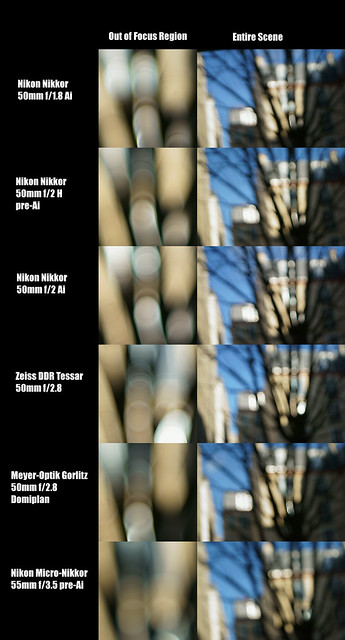
Out Of Focus Comparisons

Comments

What is surprising to me is how similar most of the lenses are to each other.  What differences there are tend to be rather subtle.

To begin with, I very rarely see a 35mm full frame 50mm lens with out of focus area rendition as smooth as longer focal lengths.  There seems to be a lot if "jittery-ness" or "harshness" in 50mm lenses.  Perhaps this is why some people have gone the opposite direction and are celebrating "bubble bokeh" where the out of focus areas are overcorrected.

Here is what I observe about the lenses I compared, starting from the smoothest, most "buttery" out of focus rendition to the harshest, most "bubble bokeh-y" (gawds! try saying that three times fast).
  • Nikon Micro-Nikkor 55mm f/3.5
  • Nikon Nikkor 50mm f/1.8
  • Nikon Nikkor 50mm f/2 Ai and H
  • Meyer-Optic Gorlitz 50mm f/2.8 Domiplan
  • Zeiss Jena DDR Tessar f/2.8
The Micro-Nikkor is really smooth in it's transition from sharp to out of focus.  The out of focus disks are flat and properly corrected.  It stands pretty much in a league of it's own in this regard.  It's the only 50mm (OK, this one is really 55mm) I've ever seen that can compete with longer focal length lenses in terms of out of focus rendition.  The lens is also sharp from wide open.  A drawback is that the maximum aperture is rather small (f/3.5), which means that the current rage razor thing depth of field is difficult to achieve.

Next comes the 50mm f/1.8 Ai "pancake" Nikkor.  With this lens a photographer can create the kind of razor thing depth of field images that are currently popular.  However, I see some "harshness" starting to creep into the out of focus areas.  I can clearly see a difference between this and the Micro-Nikkor, but I feel it still stands apart from the next two Nikkors, the f/2 Ai and H lenses. 

Beginning with the Nikkor f/2 lenses I feel we've fully entered into the zone of "bubble bokeh." This will make some photographers happy and will drive others nuts.  These two lenses come rather close to matching the Domiplan for their level of harsh "bubble bokeh" rendition.  Though I must say the f/2 Nikkors are ever so slightly less "harsh" than the old German lens.

Finally, the winner in the area of "bubble bokeh" generation is indeed the Zeiss Jena DDR Tessar 50mm f/2.8.  The Angry Photographer seems to have nailed the call on this one.  It gives the harshest and most "bubble-y" rendition of the small stack of lenses I considered here.  Too bad it's rather soft at the focus point.  But that's another matter for another time.

Sunday, February 11, 2018

50mm Lens Comparison ~ Sony, Nikon, Zeiss, Meyer-Optik Gorlitz

Occasionally I receive confirmation that I'm completely nuts.

Last year I decided to try and find the best lenses I could for less than 50 Euro.  I scored four or five lenses for that price or less.  Then one day things changed, again.  I won an auction for a mint Super-Takumar 200mm f/4 for 11 Euro and it felt like the bottom had fallen out of  my expectations for the old used lens market.

Confirmation of my lack of mental stability more recently arrived in the form of a box originating from Germany.  It held six lenses that I'd won in an auction off eBay point fr.  To be a bit more precise, it was a box filled with _cheap_ lenses.  The cost averaged across the entire purchase was 7 Euro per objectif.

Sorting through things I found four lenses of particular interest.  There was a Zeiss Jena DDR Tessar 50mm f/2.8, a Meyer-Optik Gorlitz 50mm f/2.8 Domiplan, a Schneider-Kruzenach 135mm f/3.5, and a Nikon Nikkor 50mm f/2 Ai. The other two lenses will be sold for cheap (the mounts are nothing I would ever use).

What encouraged me to bid on the auction were the two "bubble bokeh" lenses (not that I'm particularly "into" "bubble bokeh"), the Jena DDR Tessar and the Domiplan.  The Angry Photographer had good things to say about the lenses, so I decided to try my luck.

The Tessar lens design is well known and very well proven with well over a hundred years of implementation by a wide variety of manufacturers.  It consists of four lens elements in three groups.  The German made glass has the best reputation and prices are at times rather robust.

The Meyer-Optik Gorlitz Domiplan is a simple three element three group design.  It was made to be inexpensive and easily manufactured.  I see these at the photo swaps here in Europe.  Prices are variable and no one seems to buy them.  No one seems to like them.

Setup 
  • Sony A6000, 100ISO, AWR converted in Sony's software 
  • Big Beefy Manfrotto tripod
  • Lenses -
    • Sony 50mm f/1.8 SEL OSS (as the "control" lens)
    • Nikon Nikkor 50mm f/1.8 AiS
    • Nikon Nikkor 50mm f/2 H non-Ai
    • Nikon Nikkor 50mm f/2 Ai
    • Zeiss Jena DDR Tessar 50mm f/2.8 (M42 mount)
    • Meyer-Optik Gorlitz 50mm f/2.8 Domiplan (M42 mount)
The adapted lenses were shot using "straight through" adapters.  None of them were mounted on a focal reducer.  So what we will observe here is full frame lens performance on APS-C sized/cropped sensors.  This means the very outer limits of the field of view will not be compared at all.  If something already performs poorly at the outer edges of the APS-C frame, it will very likely be pretty horrible at the far edges of the full frame 35mm format.

Here is the scene -

Sony 50mm f/1.8 SEL OSS ~ Scene Setup

Comparison Results

[If you click on the image it'll take you to the Flickr hosting site. Once there, look at the file at full resolution. In many cases the differences between lenses is small and likely can't be seen until you take a squint at the comparison at 100 percent.]

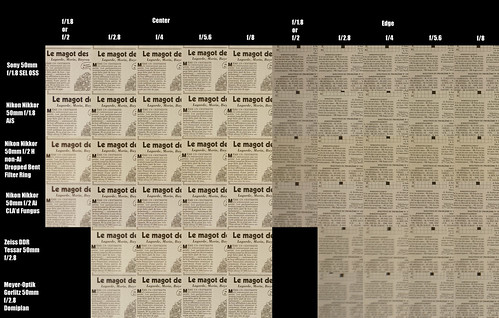
50mm lenses ~ Sony Nikkor Tessar Meyer Comparison

Observations

The Sony 50mm f/1.8 SEL OSS acted as the "control" lens.  It's performance is brilliant from wide open clear across the field.  This lens feels resolution limited by the sensor, it's that sharp.  It's light and easy to carry on Sony APS-C mirrorless cameras.  When I want AF, it's my "go to" lens in this focal length.

The Nikon Nikkor 50mm f/1.8 AiS continues to impress me.  While it's a little soft wide open due to spherical aberrations, starting one stop down it matches the Sony.  The lens is small and light.  Being a pancake lens it looks like the more common E-series Nikon of this focal length and aperture.  If I could carry just one lens, this might be it (but only when coupled with a Lens Turbo II focal reducer which gives a full frame 35mm field of view on the APS-C format).

Another lens that I already owned is the Nikon Nikkor 50mm f/2 H non-Ai.  In the Box of Toys, however, there was a Nikon Nikkor 50mm f/2 Ai.  The Angry Photographer on YouTube loves this lens.  So, I was interested to see how the two lenses of the same design but very different years of manufacturing might compare.  What I found is that the Ai version is slightly sharper (though one has to look very carefully) and the scene color matches other newer Ai and AiS Nikkors.  The old "H" version gives a warmer rendition (which is easily accounted for in processing).  For 7 Euros I think I'll be keeping the Ai (along with all the other lenses I can't seem to relieve myself of).

Next comes the Zeiss Jena DDR Tessar 50mm f/2.8.  For years I've heard about how wonderful Zeiss lenses are.  I've owned a number of these Tessar 50mm lenses of various vintages and, honestly, I've been underwhelmed.  This little pancake lens is no different.  It performs identically to every single 50mm Tessar I've ever looked at.  It's strange how consistent the lenses are between manufacturing sites and vintages.  That is to say, they are all soft wide open and never seem to "clean up" (sharpen up, if you like) as the lenses are stopped down.  I would've thought that by f/5.6 that lenses would match the Sonnar or Double Gauss design lenses, but they never ever do.  I'm not sure where the "magic" is supposed to be in these because I've never been able to find it.  I think the famous photographer David Duncan Douglas had this all sorted out over sixty years ago when he was in Japan and discovered Nikkor optics.

Lastly comes the very lowly three element airspace design Meyer-Optik Gorlitz 50mm f/2.8 Domiplan.  The lens is very light, very simple, and feels a little feeble.  Yet there's a little surprise.  Yes, it's well know for it's out of focus rendition.  It certainly has that to recommend itself.  In terms of resolution the edges of the APS-C format frame shows an incredible drop-off.  I can't imagine what the edges of full-frame 35mm look like.  It must be pure mush  However, the center of the field is sharp.  It's as sharp as anything of the era.  There's the surprise.  In fact, it's sharper than the Zeiss Jena DDR.  Because of this I find the Domiplan an amusing little curiosity.  It's like coming across a "cheeky little 2 Euro wine" from Bordeaux.

Wednesday, January 17, 2018

Lens Comparison ~ Nikon Nikkor 135mm, 300mm + Komura 2X against Tamron 150-600mm f/4.5-6.3

Something that I've wondered out for many years is just how good or bad 2x teleconverters can be from back in the day.

Recently I stumbled on a Komura Telemore 2x teleconverter.  It was relatively cheap and I was interested to see how it might perform.

Comparison Setup -
  • Sony NEX-5T, 100ISO, 2 second timer, "A" aperture preferred mode
  • Nikon Nikkor
    • 300mm f/4.5 pre-Ai - two passes, one with and another without Komura Telemore 2x converter
    • 135mm f/2.8 Ai + Komura Telemore 2x converter
  • Tamron 150-600mm f/4.5-6.3 version 1 on Sony AF adapter
  • Scene shot through double pane glass window (it was too damned cold to open the window for a clear shot)
Here is the scene at 300mm -

Nikkor 300mm f/4.5

Here is the scene at 600mm - 

Nikkor 300mm f8 Komura 2x

Comparison Results -

[If you click on the image it'll take you to the Flickr hosting site. Once there you and look at the file at full resolution. In many cases the differences between lenses is small and likely can't be seen until you take a squint at the image at 100 percent.]

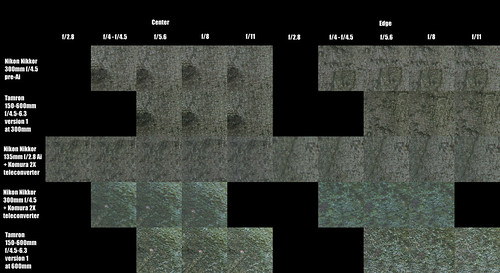
Nikkor 300mm 135mm Doubleur Tamron "Bigron" Comparisonb


Observations -

Looking at the Nikon Nikkor 300mm f/4.5 pre-Ai against the Tamron 150-600mm f/4.5-6.3 at 300mm shows not much difference between the two lenses in the center of the field.  As you can see, the single coated Nikkor is slightly less contrasty than the modern Tamron.  This can be easily corrected in processing by applying a gentle increase in contrast.  The edges of the frame show something interesting.  The Nikkor remains sharp where the Tamron gets slightly softer as the edge of the field is approached.

The Nikon Nikkor 135mm f/2.8 Ai mounted on the Komura Telemore 2x teleconverter shows that the Komura degrades performance rather rapidly.  At no aperture does the teleconverted Nikkor come close to wither the un-teleconverted 300mm Nikkor nor the Tamron.  Obvious decreases in contrast and resolution can be seen.

The same things can be said about the Nikkor 300mm, Komura Telemore combination.  Contrast is decreased and the resolution never really matches the modern Tamron "Bigron" zoom.  I can increase the contrast in processing, but there is no way to gain back resolution after the shutter has been tripped.

I was hoping to find a light(er) weight manual focus lens combination that I could use at the racetrack to photograph old cars and MotoGP motorcycles.  I won't be able to meet that goal with the Komura and Nikkor lenses.  For now I'll need to stay with the Tamron super zoom, which, it seems, performs admirably well.

Saturday, January 06, 2018

Is Photography Really Dead???

PetaPixel published an article that asks if photography is really dead.

I have to admit, the author makes more than a few decent points.

"...But what died, exactly? The techie crowd had become bored with these particular machines, moving on to newer, shinier gadgets, and young people, like most young people, just wanted to hook up. Nothing wrong with either, and certainly nothing new. The dedicated photographers who had been working quietly and being ignored likewise continued in this fashion, and will keep doing so even while everyone else is using brain implants to beam live VR experiences featuring their cats..."

It's the being ignored part that can be a little difficult.  Or more properly, it's the being unknown and unfindable part that working in isolation can bring.  Dedicated artists like to share their work and in the narcissistic world of social media self promotion it's very difficult to carry on any kind of conversation about the art and craft of imaging.

Here I sit in one of the most photographed cities in the world and yet I can count on fewer than two digits the number of dedicated photographers who live here as a friend or colleague.  All of my photographer friends live either in New York or out on the west coast of the USA.  Perhaps it's telling that many among these dedicated artists continue to pursue their vision using old tools, techniques, and processes.

I miss being able to sit around a table stacked with beers and "talking shop" and sharing the results of our latest efforts.  Doing so remotely, electronically, just doesn't carry the same impact as meeting someone face to face.  I learned so much from our casual conversations.

I learned about optics and the fact that lens coatings exist that make the glass disappear.  One of the gents I talked with worked in an optical company where the process and results were demonstrated.

I learned a lot about process.  Two other gents helped me understand the proper tools and techniques of hand-coating platinum-palladium solutions for making contact prints that can last unchanged for over 500 years.

I learned a lot about how to work with models.  Several gents continue to create gorgeous images of models.  They work both in the studio and in the open air.  Dealing with people takes time, intelligence, and the ability to convey emotions in sometimes subtle ways.

While there are so many aspects to photography that I will never fully grasp, simply talking with others helped to fill in the "blank spaces".

Many are the days when I consider "pulling the plug" on social media participation.  Though I know in doing so I could completely turn out the image sharing, conversation starter, art as a movement welcoming and participation light.


Nikon Nikkor + Lens TurboII + Sony A5000

Thursday, January 04, 2018

Comparison ~ Nikon Nikkor 300mm, 135mm, 105mm + Lens Turbo II

Continuing to troll the 'net for 50Euro or less highest quality lenses yielded up a Few More Fun Things.

Last year I sold a mint 300mm Nikon Nikkor f/4.5 pre-Ai lens.  Of course I started to regret the sale.  It was a really nice, sharp optic.  So when another came available at half the cost of the first 300mm, I jumped at it.

What I now have is an excellent condition 300mm lens that dates even earlier than my first example.  The focusing collar is smooth and accurate (nearly Super-Takumar-like in this respect, which is a surprise for such an old Nikkor).  The exterior condition is excellent.  But the front element has a few cleaning marks.  They are very light, very fine marks, but, neurotic as I am about such things, I know they are there.  I may learn to live with it.

The setup -
  • Sony A6000, 100ISO, AWR converted in Sony's software 
  • Big Beefy Manfrotto tripod 
  • Nikon Nikkor 
    • 300mm f/4.5 pre-Ai (c.1971)
    • 135mm f/3.5 Ai
    • 105mm f/2.5 Ai
    • all mounted on a Lens Turbo II focal length reducer
  • One pass where 300mm f/4.5 images were processed
    • Gimp -> FX Foundry Luminosity Sharpen
    • Gimp -> Curves (subtle adjustments to tonal range)
The results -

Here is the scene setup -

Scene Setup Nikkor 300mm, 135mm, 105mm comparison


Here are the results.

[If you click on the image it'll take you to the Flickr hosting site. Once there you and look at the file at full resolution. In many cases the differences between lenses is small and likely can't be seen until you take a squint at the image at 100 percent.]

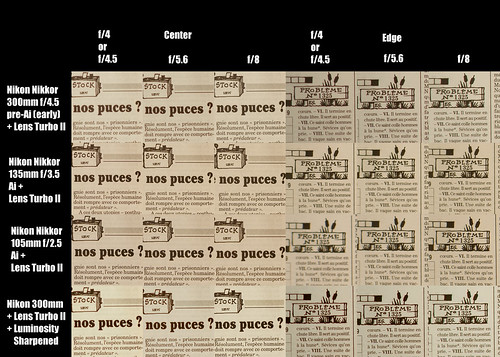
Nikon Nikkor 300mm, 135mm, 105mm Comparison


My observations -

The Nikon Nikkor 300mm f/4.5 pre-Ai stands up rather well against the wickedly sharp 135mm f/3.5 Ai.

Wide open the 300mm shows softness that typically comes from spherical aberrations.  You can see the effect around the large lettering.  One stop down and the 300mm seems to match the shorter focal length lenses across the field.

The 105mm f/2.5 Ai suffers at f/4 and a little at f/5.6 in the corners.  I think it is an effect of field curvature, particularly when the lens is used with the Lens Turbo II focal reducer.  I've seen similar things when making these kinds of 2D flat sheets of newsprint comparisons between various lenses.  I've specifically seen the effect with the 85mm "K" pre-Ai Nikkor, Lens Turbo II combination.

My comparisons are always made using un-altered, straight off the sensor images.  I convert AWR files using Sony's conversion software and I leave that software with it's default settings.  I never add nor subtract, for instance, "sharpness" nor contrast.

With this comparison I added a line where I took the 300mm Nikkor images and passed them through the Gimp and two functions.  Specifically, I passed the images through FX Foundry's Luminosity Sharpen and used "Curves" to try and match the tonal range of the 135mm f/3.5 images.

Luminosity Sharpen is a very subtle sharpener.  I think it's better than many "smart" sharpen algorithms in that Luminosity lightly touches the light/dark transitions and leaves the smooth areas alone.  Images don't typically look hard sharpened when I use this function.

What I find is that lightly processing the 300mm f/4.5 wide open image yields results that appear to match the wickedly sharp 135mm straight off the sensor results.  Carefully using "Curves" I was even able to reduce the effects of spherical aberration (look at the large lettering).  At f/5.6 and f/8 the 300mm lightly processed image results appear to as "sharp" as anything in this comparison.

The "sharpening" aspect of the processing is to carefully increase transitional zone contrast.  The human eye perceives this as "sharpness".   This means that just about any file made with a well designed and constructed optical system can be carefully "sharpened" to the point that the results appear sharper than the off the sensor originals.

While there is nothing new in recognizing the effects of "smart" sharpen functions, what I find interesting and promising is that in using these controls, I might be able to use this Nikon Nikkor 300mm f/4.5 pre-Ai for photographing motorsports and birds and exceed the results I used to obtain from my old Canon 7D, 100-400mm zoom kit.

Sunday, December 31, 2017

Tri-X black and white film "look" in digital...

I have to admit that I'm something of a fan of Mike Johnson's The Online Photographer.  He sometimes posts things that I find rather interesting.

Take this article on the great Formula One pilote, Francois Cevert as an example.  The chain of events that led to my exploration of Tri-X, it's grain in 35mm film, and trying to digitally emulate the effect was rather long and twisted.  Here's the story.

My uncle used to pass me his Road and Track magazines after he'd read them.  I, too, would read them thoroughly.  My favorite writer at the time was Henry Manney III.  The way he wrote about racing in Europe captivated my imagination and set the basis for my desire to one day visit that far-off continent.

If memory serves, Henry Manney III nearly single handedly introduced Formula One racing to American readers and followers of motorsport.  It was an exotic pastime and there seemed to be a big story to tell.  Even from so far away I had a sense that the Formula One Circus was a close knit community of owners, mechanics, and drivers who's one great passion was racing.

Being a dangerous sport drivers from time to time would die.  I remember when Jim Clark and later Mark Donahue were killed.  And I remember when Francois Cevert crashed heavily at Watkins Glen.  Even now these memories are charged with emotion.  There were so many skilled drivers and my best friend, Nelson, and I enjoyed watching some of them race at the Long Beach Grand Prix and out in the desert at the Riverside Motor Speedway in Southern California.

After reading The Online Photographer, I followed the link to Richard Kelly's wonderful work.  Looking at his images brought back a flood of memories.  My own photographs and negatives from those days are now either recycled or in a landfill somewhere.  Ugh.  If only I'd known how I might feel someday about my early, wobbly, adolescent imaging works.

I met an LA Times photographer many years ago to talk about the trade and how best to approach photography.  He showed me some of his work and showed me 16x20inch prints that were center mounted on 20x24inch ragboard.

I remember asking him about the grain.  The overarching esthetic at the time and de rigueur in the group of photographers I used to hang out with was to make prints as grain-free as possible.  This required large format cameras and slow film.  Yet the LA Times photographer's work was grainy and had a certain "grit" (for the lack of a better word).  They were fabulous.

What helped make them fabulous, in addition to the wonderful subject matter, was that they had all been made using a 35mm camera that was loaded with Tri-X and processed in D-76.  And very importantly the grain was absolutely sharp edge to edge on the print.

Lucky for me the photographer gave me an important hint to the secret for keeping negatives flat in the negative holder in an enlarger (without having to resort to Newton Ring inducing glass negative carriers).  Working out the rest of the secret in my own darkroom is what helped me land a job printing black and white photos for well-known photographers in Hollywood.  I worked at the Crossroads of the World print shop that Samy's Camera used to own and run.

All of this happened during the 1960's, 70's and early 1980's before I returned to the University of California, Irvine to pursue computer science, engineering, and a "real" job in aerospace.

Coming to the present and recalling the beauty of grainy small negative black and white images, I set about working out yet another secret in trying to match the effect in digital.  It turns out it's all pretty simple and straightforward.  Here is the process I use.
  • Desaturate a digital image
  • Using "Curves" and "Exposure" - set the shadow and highlights to taste (remembering to keep as much information in the highlights as possible - ie: don't clip the whites)
  • Using "Curves" - grab the mid-point of the curve and raise it a bit (to achieve a rather accurate film emulation "look")
  • Add "film" grain (Gimp, Capture One, etc all seem to have film grain functions)
Looking at the results feels to me as if the images without the emulation film grain were made with a very large format film camera.  The highlights and shadows are creamy and wonderful.  This holds true even in images originally made using a Canon A640 Point and Shoot that shot jpegs only.

The images with emulation film grain, on the other hand, have that small negative enlarged print "look" about them.  The effect is really quite striking.  I can see where the effect can be useful to underscore a certain photographic aesthetic.

[Large Format Film "look" on the left.  Small Format Film "look" on the right.  You'll need to click on each image to see the effect.]

Emulating Tri-X film "look" Emulating Tri-X film "look"

Emulating Tri-X film "look" Emulating Tri-X film "look"

Emulating Tri-X film "look" Emulating Tri-X film "look"

Saturday, December 23, 2017

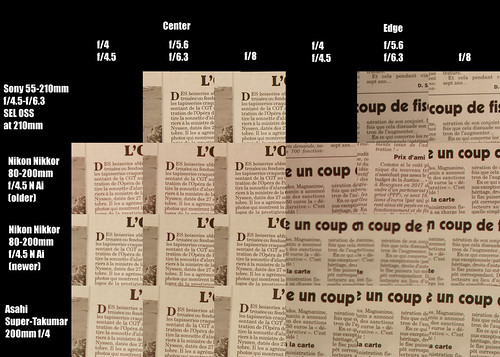
Comparison ~ Sony, Nikon, Asahi 200mm lenses

Trolling the 'net for lowest cost highest quality lenses has turned up a Few Fun Things.  With this in mind, a couple lenses arrived in the boite au lettre thanks to fleaBay and leboncoin and I wanted to see how they compared.

The setup -

  • Sony A6000, 100ISO, AWR converted in Sony's software 
  • Big Beefy Manfrotto tripod 
  • Sony 55-210mm f/4.5-6.3 SEL OSS 
  • two, count 'em, two! Nikon Nikkor 80-200mm f/4.5 Ai
  • Asahi (Pentax) 200mm f/4 Super-Takumar
To hold the Nikon zoom and Super-Takumar lenses I used a broad L-bracket I made as a cradle.  I was concerned that the tripod mount on the bottom of the A6000 might shear under the weight of the telephoto lenses.  It was hard to keep things aligned and focused, so I took several passes.  Even with this, I'm not convinced the results are fully representative of what the three lenses are capable of.  But perhaps its close enough for government work (as we say).

The results -

If you click on the image it'll take you to the Flickr hosting site. Once there you and look at the file at full resolution. In many cases the differences between lenses is small and likely can't be seen until you take a squint at the image at 100 percent.

Takumar Nikon Sony 200mm Comparison


My observations -

The Sony 55-210mm SEL OSS is really quite sharp in the center of the frame at 210mm.  The corners suffer a bit, though.  Still, if a subject is centered in the frame, it'll be wickedly sharp.  I think this is interesting given the rather modest price of these built-to cost lenses.  Though I think I also see the center performance very slightly degrade as the aperture is stopped down.

The Nikon Nikkor lenses are very slightly soft at 200mm compared to the other lenses here.  The corners are in keeping with what I've seen from zoom lenses, too.  That is, they too are soft compared to fixed focal length optics.  As is common with older lenses that I've looked at, contrast and resolution improve one or two stops down from wide open.

The Asahi 200mm f/4 Super-Takumar is a wonderful little lens.  It's nearly as long as the Nikkor zoom lenses, but given the Super-Tak's smaller diameter barrels it feels a lot smaller than the Nikons.  With fewer lens elements, the Asahi is lighter, too.  It feels good in the hand.

One of the things many people across the 'net note holds true with this lens, too.  This Super-Tak's focusing mechanism is incredibly smooth and is quite nearly perfect.  It's a real joy to use.  More importantly, the resolution and contrast are quite good out to the very edges of the frame.  All this and a price of 11Euros, to boot.

Friday, December 22, 2017

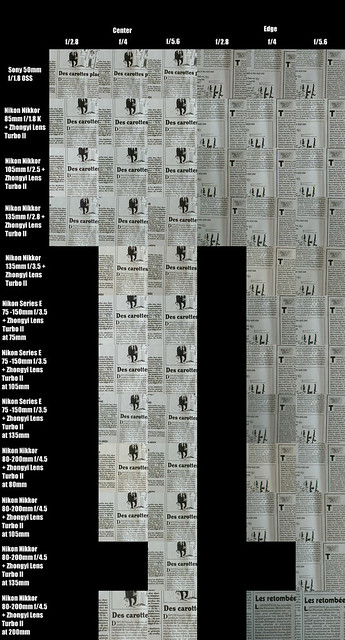
Big Comparison ~ 50mm to 210mm Sony, Nikon fixed and zoom lenses

Out of curiosity I went back and looked at the first year a friend and I copyrighted our look at the resolution of large format film lenses.  It turns out that it's been exactly 20 years.

I'm not sure this would qualify as a celebration or not, but here is my latest Fit of Curiosity and Insanity.  I wanted to see how several zoom lenses stacked up against fixed focal length optics from the same manufacturer.  Legend has it that zooms are less sharp than fixed focal length lenses.  This comparison would give me a chance to check reality against legend.


The setup -

  • Sony A6000, 100ISO, AWR converted in Sony's software 
  • Big Beefy Manfrotto tripod 
  • Sony 50mm f/1.8 SEL OSS as the control optic - this lens is amazing in every respect
  • Old Nikon manual focus lenses 
    • Nikkor 85mm f/1.8 K pre-Ai
    • Nikkor 105mm f/2.5 Ai
    • Nikkor 135mm f/2.8 Q Ai
    • Nikkor 135mm f/3.5 AiS
    • E-series 75-150mm f/3.5 at
      • 75mm
      • 105mm
      • 135mm
    • Nikkor 80-200mm f/4.5 N Ai at
      • 80mm
      • 105mm
      • 135mm
      • 200mm
    • Zhongyi Lens Turbo II focal reducer used on all Nikon lenses
The results -

If you click on the image it'll take you to the Flickr hosting site.  Once there you and look at the file at full resolution.  In many cases the differences between lenses is small and likely can't be seen until you take a squint at the image at 100 percent.

Nikom Tele Fixed and Zoom Comparison

My observations -

The Sony 50mm f/1.8 SEL OSS acted as my control lens for this comparison.  It's every bit as good as the Sigma 60mm f/2.8 Art DN I once owned, and perhaps a bit better.  In the area of out of focus rendition this Sony is brilliant where the Sigma was a bit harsh.  In terms of resolution I really can't tell any difference between the two lenses.

The fixed focal length Nikkors mated to the Lens Turbo II are all similarly sharp in the center of the frame from f/2.8 down thru the f-stop range.  In the cases where the extreme edges of the frame are just a tiny bit soft, they clean up nicely around f/4.

Looking at the zoom lenses and starting with the super cheap unloved E-series 75-150mm f/3.5 constant aperture, I came across something of a surprise.  Wide open at anything less than 135mm this lens is as sharp in the center as fixed focal length equivalents.  The edges, however, can be a bit soft.  However, even the edges clean up nicely by f/5.6 at the shorter focal lengths.  As a bonus, this lens came to me for around 40Euro.

Moving on to the Nikkor 80-200mm f/4.5 N Ai and again looking at the center resolution from wide open, this zoom appears to match the fixed focal length lenses between 80mm and 135mm.  At 200mm the lens is ever so slightly softer than the fixed length objectives.

Looking at the extreme edges of the frame, I should note that with this series zoom (I've owned two of them at the same time) shows a fairly big drop in resolution.  If you must have the edges perfectly sharp to the utter and very edge it's best to either slightly crop your zoom lens images or use a fixed focal length lens.  In general longer focal lengths are softer.

I would like to make a couple special notes.  The Sony 50mm f/1.8 is obviously brilliant and the prices on these are rather attractive.  If you shoot Sony APS-C mirrorless and like taking portraits or using a focal length slightly longer than "normal", I'd say this lens is a "must have."

The Nikkor 135mm f/2.8 is a beastly heavy optic for its focal length, but it's sharp from wide open.  I didn't expect the old design Q-series Ai to perform this well, but it does.  The out of focus rendition isn't half bad, either.  The prices on these are good if you shop carefully.  I've seen them trade hands for around 60Euro.

Lastly, I need to mention the Nikkor 135mm f/3.5 Ai.  The effect is subtle and you might not recognize it from the 2D newspaper shots I use when comparing various lenses, but the contrast and resolution of this lens is nothing short of phenomenal.  It "feels" very much like the brilliant Sigma 60mm Art DN and Sony 50mm f/1.8 SEL OSS.  If any lens has a dash of magic, this one definitely has it.  I find this little lens to be wickedly awesome.

Tuesday, December 19, 2017

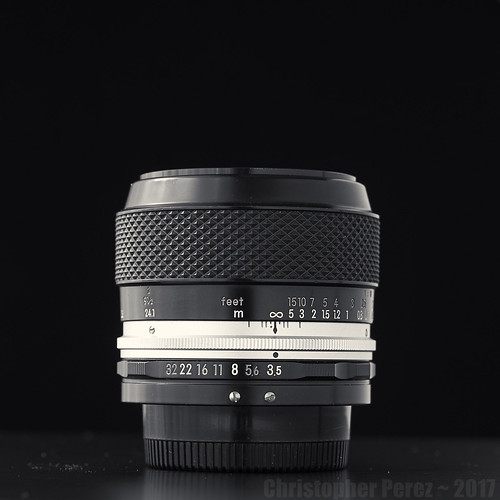
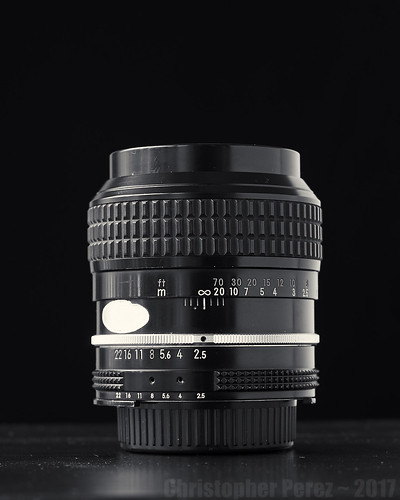
Lens Stories ~ Nikon Micro-Nikkor 55mm f/3.5 pre-Ai

Nikon Micro-Nikkor 55mm f/3.5

I've owned this lens for years, having picked it up well before we moved to Europe.  It's small and light so it was easy to pack and carry across the Vasty Waters.

If memory serves I paid 100USD for it.  But, as the Lens Gods would have it, it sat unused while I worked through the last years of my DSLR insanity.  After the Sony NEX/Alpha series found their place in the closet and after the Canon strong-AA filtered behemoths were sold I bought the appropriate adapter and re-tried the Nikon Micro-Nikkor 55mm f/3.5 pre-Ai.  I'm glad I did.

From a design perspective the 55mm f/3.5 macro is 5 element 4 group Double Gauss.  I call it a Double Gauss even though the rear cemented doublet in the traditional design is really just a single element in the Micro-Nikkor.  In any event, the lens design is rather simple and with few air to glass surfaces it feels like images really "pop."

Looking at it's performance I find that it's wickedly sharp from wide open.  Contrasty, too.  Just a marvel, actually.  Nikon designed and built a very beautiful lens when they made this one.  Rumor has it that the f/2.8 version is even better, but I can't see how.  There was a pleasant surprise lying beyond resolution and contrast.

When I was looking at my fast Nikkors and how they render the out of focus regions I uncovered a surprise.  Wide open the out of focus highlights from the Micro-Nikkor are flat, creamy, smooth, and utterly glorious.  Of all the 50-ish mm lenses I've owned this is one the best OOFR's of any of them, with only the 50mm f/1.8 AiS being able to complete with the 55mm f/3.5.

The Micro-Nikkor's aperture is "slow" compared to the 50mm f/1.8 AiS.  But the world does not revolve around razor thin depth of field, does it?  Yes.  Sure.  It's All The Rage these days.  Yet, if you're an artist who doesn't work quite that way this kind of old optic might be very usable for focusing on the eyes and keeping your subject's nose in focus too, all the while getting that OOFR yumminess, at the very same time.

Just the other day a fellow photographer friend contacted me.  It'd been a long time since we'd traded emails.  I went out to his website to get caught up on what he's been doing.  Lo and behold, what's this?   He bought a new Sony mirrorless camera and finds he enjoys using a Nikon Micro-Nikkor 55mm f/2.8.  I took a look at what he's done with the combo and... found... huh... not 1/2 bad, this.

I looked at Ken's gorgeous work and it was as if the Beautiful Muse whispered something in my direction, too.  Inspiration, in this case, came in the form of three pears.  She arrived on a day when we do our weekly house-cleaning.  After the floors were vacumned (quick and easy in 55 metres carres), the plumbing plunged (ah the glories of French egoutes), and while waiting for the sheets to dry (yea! we have our very own clothes dryer!!),  I gently carried the pears into the living room next to the big floor to ceiling windows, arranged them in various ways, and set to work.  Of course the lens I used had to be this sweet 55mm f/3.5 Nikon Micro-Nikkor.

Monday, December 18, 2017

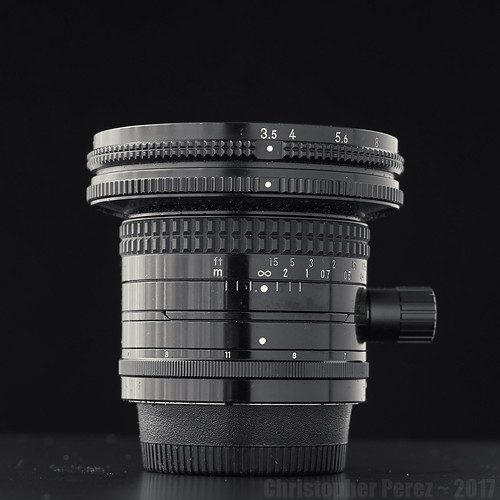
Lens Stories ~ Nikon Nikkor 28mm f/3.5 Perspective Control

Nikon Nikkor 28mm f/3.5 PC


Here's something of an albatross.  It's a Nikon Nikkor 28mm f/3.5 PC (perspective control) lens.  I bought it years ago for around 550USD back when I thought it would be just the ticket for taking photographs of buildings.  Yet over the now many years it's been shot in anger very few times.  It followed me to Europe and, even now, rests peacefully in the Toy Box as a rather expensive testament to my lack of impulse control.

What makes this lens "special" is it's vast field of view and unique barrel construction.  It covers a much broader area than is normally required by a 35mm full frame lens.  The lens barrel allows sliding movements of up to 11mm's.  This is a shift lens.

Shift lenses are great for situations where you want to avoid "keystone" optical effects when photographing subjects such as tall buildings.  If you level the camera where the plane of focus is parallel to the plane of the subject you can shift the lens to include more of a building (for example) and less of the foreground.  Looking at this image the vertical lines remain parallel and I was able to eliminate a lot of the uninteresting foreground but shifting the lens up.

This lens is not a tilt/shift.  In those kinds of lenses you can not only shift a lens (decenter it) you can also tilt the plane of focus.  Because of the more complex barrel mechanism these tend to be rather expensive (and well out of my price range, particularly these days).  Tilt/shift lenses provide imaging flexibilities similar to an old fashioned large format film camera.  Changing the alignment of the focus plane to the subject allows a user to manage what portions of the scene are in focus and which are not.

The reason my lens sits largely unused and unloved is that modern image processing software usually have "keystone" correction functions.  You can make vertical lines parallel very quickly and easily on a computer.  This, in turn, removes the "need" for a specialized lens and has put downward pressure on prices of these old shift optics.

Other than when deliberately used because I feel guilty, I don't really know what to do with it, so this pretty Nikon Nikkor 28mm f/3.5 PC Albatross sits in the Toy Box.  I wonder if someone would like to trade with me for another "interesting" lens?

Thursday, December 14, 2017

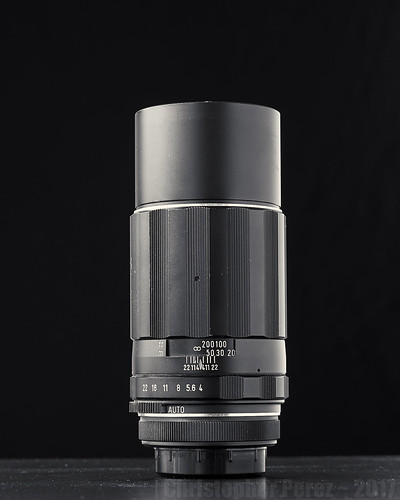
Lens Stories ~ Asahi (Pentax) Super-Takumar 200mm f/4

Lens Stories ~ Asahi Super-Takumar 200mm f/4


Just when I thought I'd seen the bottom of the old manual lens market prices I bid crazily low and rather late in an auction on a mint with sunshade, back bouchon, and original case 200mm lens.  I fully expected someone to snipe this out from under me.  Seriously.  My bid was that low.

Do I really need another 200mm lens?  No.  I have the pair of Nikon Nikkor 80-200mm f/4.5 N Ai lenses and they seem plenty sharp on the long end.  Do I need to add a different lens mount (m42 in this case) to my normal all Nikon F-mount line up?  No.  Not really.  Though adapters are cheap (4Euro thru Amazon plus shipping).  Do I really have room for another lens in the Toy Box?  Um.  Isn't there always room for something fun and interesting?

Well, as the Lens Gawds would have it, I now have another beautiful optic to add to the Toy Box.  Bid welcome to a very lovely Asahi (Pentax to many of us mortals living in the West) Super-Takumar 200mm f/4 lens.

After successfully rationalizing my insanity I compared it to the Nikkor zooms.  What I see is that the Super-Tak is narrower in diameter, of similar overall length, and lighter than the Nikons.  As it typical of nearly every Takumar I've ever handled the focus ring action is very smooth and silky where Nikon lenses sometimes feel "gummed up", sloppy (as on certain well used zoom lenses), and sometimes not quite as precise.

As for resolution, the Takumar and Nikkor lenses perform similarly in the center from wide open down through the f-stop range.  At the extreme edges where the Nikkor's fall off dramatically in terms of resolution the Super-Tak remains sharp.  Starting around f/8 I notice that chromatic aberrations tend to increase in the Asahi, however.  It's nothing that a little anti-CA fringing function in processing can't handle, but I was surprised to see it.  Perhaps there's a good reason manufacturers switched to ED glass once such things became available?  In any event, f/4 or f/5.6 and be there, says I.  It's a very sharp optic at those two apertures across the field.

OK.  So what the [blank] am I going to do with this lens?  I have no idea at this point.  Maybe I'll take to the track to photograph the MotoGP at le Mans in the spring.  Perhaps I'll take it back to le Mans to photograph the vintage races during la classique.  We shall see what we shall see.  I may need to secure a press pass so I can get closer to the track.

... and before I forget, I should tell you what this wee-beasty set me back.  How about 11Euro?  Might that do the trick?

Wednesday, December 13, 2017

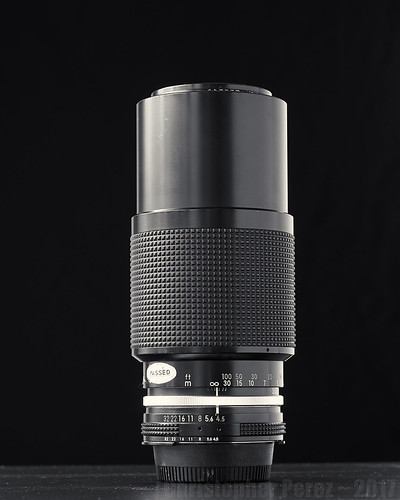
Lens Stories ~ Nikon Nikkor 80-200mm f/4.5 N Ai (in better condition)

Lens Stories ~ Nikon Nikkor 80-200mm f/4.5 N


As I've said before, I'm old, retired, and don't have too many safe things to do other than surf the 'net and find old unloved lenses and cameras.

There's not much to tell about this lens that I haven't already said about the other.  The Nikon Nikkor 80-200mm f/4.5 N Ai is sharper than it has any right to be.  It's large-ish and unwield-ish in that it can be a handful for this Old Man with shooting in fast changing situations.  It doesn't have a tripod mount so I've rigged up a way of resting in on a wood L-bracket I made.  In the hands of a younger person I can't imagine there being any problem using the optic and coming away with wonderful images.

What makes this lens different than my first copy is that I found this one after the prices on many old manual focus lenses had dropped through the floor.  Where something like this might've been tagged at 150Euro just a year or two ago, I picked this one up off eBay point fr for a whopping 40Euro.

The lens is in mint condition throughout.  It never seems to have bumped around someone's camera bag, nor does it look like it was much used.  Like my 75-150mm Nikon E-series zoom this lens looks like it was purchased and then ignored.  I couldn't believe it when I opened the box and found this 'beaut inside.

Thinking of the potential impact of owning two copies of the same lens, perhaps I need to start a new club or group of some kind?  Maybe I could call it the Unloved Secret Lens Society.  I'm not sure what we'd do, except sit around and talk about all the old great glass found for very few pieces of silver.  Oh, and to compare work we've made using these wonderful optics.  Over beer, of course.  Into the wee-hours of the afternoon, of course.  Before heading to home and hearth for a nice dinner, of course.

I have to admit I'm a True Sucker for pretty, old, cheap, sharp lenses.

Tuesday, December 12, 2017

Lens Stories ~ Nikon Nikkor 80-200mm f/4.5 N Ai

Lens Stories ~ Nikon Nikkor 80-200mm f/4.5 N


Being old, retired and having not much to do but surf the 'net and get into trouble, I stumbled across an article by Ken Rockwell.  His comments were about a Nikon Nikkor 80-200mm f/4.5 N Ai.  It got me to thinking back to the time I bought a then new pre-Ai version out of Japan and had to sell it immediately because, honestly, I couldn't afford it, even at the then cheap Japanese prices.  I never got to shoot it so have no idea how it performed.

Returning to near present time and flush with money from the sale of one thing or another I surfed leboncoin point fr and found the zoom version M. Rockwell described.  It wasn't in great condition, but the glass seemed clean and clear.  The exterior showed that the lens had beat around someone's camera bag unused for years.

Of course I didn't realize the bottom was about to fall out of the market on these.  Up to this point I saw them sell for around 100Euro in good condition.  A the Photo Foire down in Bievre I'd see these sitting on the table for as much as 150Euro.  I paid 80Euro for the lens and hoped it would perform well.

A quick comparison  between this and a couple other lenses shows that, yes, Nikon's reputation is justified and that Ken Rockwell is correct.  This Nikkor is sharp from wide open across the field to about 7/8th's of the way out (when used with a Lens Turbo II focal reducer).  In the extreme corners the lens obviously falls off rather badly.  If I remembered to account for this I could easily get around the problem with a slight crop of the image.  If I avoid using the Lens Turbo II the Nikkor is sharp to the very edges of the frame (because the scene is cropped on APS-C compared to Full Frame).

In practice the lens is bigger and heavier than the cheap kit-zoom Sony 55-210mm f/4.5-6.3 SEL OSS.  Used on my much liked Sony APS-C mirrorless cameras the Nikkor can be a little unwieldy, particularly as I age.  The older I get the shakier I'm becoming, so a fast shutter speed and sufficient time to focus are necessities.  Since the zoom has a combined focus/zoom ring, focusing and not changing the field of view (zoom) can be a little challenging.  The more I use the lens, the fewer problems I have operating it.  Old Dogs can still learn, or so it seems.

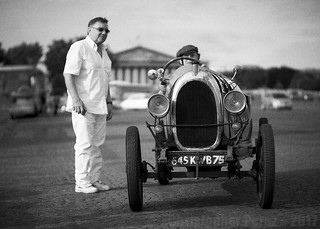
One of the first times I took it out I went to la traversee de Paris.  This is where 600+ vintage and classic vehicles drive around Paris, kick up a bit of dust, and make themselves seen.  For me it's always a complex environment.  People are coming and going.  Cars are driving around.  Using an old manual focus lens can be very challenging, indeed.  Seeing something interesting, framing, focusing, and tracking as something changes position isn't easy.  Yet I feel I was able to come away with a few good things.
[example1, example2, example3, example4]

Monday, December 11, 2017

Lens Stories ~ Nikon 75-150mm f/3.5 E-series AiS

Lens Stories ~ Nikon 75-150mm f/3.5 E


I read somewhere that the much unloved and often ignored Nikon 75-150mm f/3.5 E-series AiS was actually an underground unsung favorite amongst fashion photographers.  The article suggested that the lens was just "unsharp" enough to smooth models skin and yet sharp enough to capture important details.  It was supposed to be one of those Goldie Locks lenses; it was reputed to be just right.

There had been a couple of these at the Photo Foire in Bievre over the years.  Remembering what I read I'd pick one up, look at it, move the zoom ring around, think, ponder, cogitate, and then sit the lens back on the table.  Asking prices seemed to be around 50Euro regardless of condition.  Most seemed more worn from bumping around a shop or a photographer's closet than from actual use.  That seemed the true measure of being unloved.

Finding one on eBay is easy.  The auction site is lousy with 75-150mm manual focus lenses of varying manufacture, too.  Everyone seems to have made their version, including Canon, Nikon, Kiron, Vivitar, Tamron, Tokina, etc.  Prices are nearly always low and it's not uncommon that a lens goes un-bid and gets relisted.

Just how unloved are these old 2x zooms?  I just found a Solitel for 6Euro Buy It Now. Makinon, Osawa and Hanimex are all under 12Euro Buy It Now.  I won't suggest that the optical designs and manufacturing are up to Nikon standards.  They are not.  If you look at cross-sectional drawings of the various 75-150mm lenses you'll see differences in design that may be visible in the way each lens renders an image.  Unloved equals cheap, or so it seems.  Bottles of no-name wine cost more than these lenses.

The subject of this story showed up on eBay point fr with very few lowball bids.  It was listed as being in excellent condition.  So, as is my usual habit when I'm interested in something, I bid late and bid low, fully expecting that someone would come along and snipe the auction out from under me.

Surprise! yet another lens won for the Toy Box.  This one set me back 35Euro.

When the lens arrived it was indeed in mint like new condition.  What a happy surprise.  When I compared it against Nikon Nikkor lenses of similar focal length I was very happily surprised.  Here is what I found.

Wide open the 75-150mm Nikon is less sharp than the 135mm Nikkor f/3.5 Sharpness King and less sharp than the 85mm f/1.8 K.  From f/5.6 on down through f/11, though, this cheap 75-150mm matches anything in the Toy Box.
[example1, example2, example3, example4]

So what was the comment about fashion photographers preferring the cheap E-series 75-150mm Nikon?  Where did it's underground cult status come from?  Did they really shot the lens wide open all the time?   I think I've stumbled on something rather interesting.

If you look at the aperture shape you'll notice a rather angular, ugly set of aperture blades.  But, there's Magic in this thar lens!  From wide open the out of focus rendition matches the performance of the 105mm and 85mm Nikkors.  In some ways as you stop it down the zoom exceeds the performance of the two fixed focal length optics.

That aperture is an ugly nasty shaped hole.  How is it possible, then, that the out of focus rendition might be better stopped down than the fixed focal length Nikkors?  What did Nikon do?  Surely they didn't deliberately design it this way.  It _has_ to be a fluke.

But there it is.  The out of focus highlights are amazingly absolutely flat disks.  No Funky Bubble Bokeh here.  Nope.  Not one iota of that weird stuff.  Magic, I tell you.  Serious juju.  Very serious juju.  All this for a rather modest price.

Friday, December 08, 2017

Lens Stories ~ Nikon Nikkor 135mm f/2.8 Q Ai

Lens Stories ~ Nikon Nikkor 135mm f/2.8 Ai


This story begins almost three decades ago.  It involves moving to Oregon, it involves a large company that no longer exists, it involves lunchtime conversations with people who became friends, and it involves a certain Ducati 860GT that swallowed a valve, bent a rod, and ended up in my hands after many years sitting idle.  This tale involves a lens, too.

I was on my way to Seattle to, hopefully, work for Boeing in their passive sensor group.  But before I could get there Tektronix, a company that used to be the center of what was called the Silicon Forest, made me a job offer.  Newly married and looking for a nice place to raise my first wife's children we ended up buying a house in the Portland area.

While my first wife's health slowly failed my work life was challenging in its own way, but it kept food on the table and a roof over our heads.  The division of Tektronix I worked for was sold and I interviewed very poorly at the new company and didn't make the transition.  Instead, I stayed at Tek and finally found a slot in the mid-range logic analyzer division.  Over the course of the five years I worked out at Walker Road where I made many new friends.

One of the guys I had lunch with on a regular basis talked about owning a Ducati that broke a valve, swallowed it, and bent a rod.  I was intrigued by the story of a decent motorcycle that was sitting untended.  My colleague didn't have the time to repair it.  So I paid him a visit.  In fact, I paid him many visits over the years.  Each time I'd pay homage to the Badly Wounded Ducati.

It must've been the alignment of the stars and planets, but one day my friend offered to sell the Ducati.  I jumped at the chance to own something I'd wanted ever since the very first time I rode a 1978 900SuperSport at 130mph down the Ortega Highway in southern California.  That bike belonged to an editor of one of the motorcycle magazines that I sometimes took photographs for.  The handling and pace of the Italian bike really captured my attention.

Granted, the 860GT didn't have the desmo valvetrain of the 900SS, and it had a two step ignition timing advance (instead of a proper curve that advanced the timing as the revs increased).  Still, this 860GT retained it's original Conti pipes which guaranteed it would sound glorious in a Concrete Jungle as I blasted thru.

A little more time, a new piston sleeve, a real 900SS crank set and the bike roared to life.

The former colleague and I have remained friends over the years.  Much of what we talk about, when we aren't talking bikes, is about cameras and photography.  He remains an absolute Camera Freak, even to this day.  In fact, he recently picked up a new Nikon D850.  Just because.  Oh, and he picked up a really nice Zeiss 135mm f/2 lens to go with it.  Which brings us back to photography and this Lens Story.

I lamented to my friend that I very much regretted letting a mint condition 135mm f/2.8 Q Nikon Nikkor go for practically little money.  I'm still not sure what got into me the day I sold it so cheaply.  Mint optics of just about any vintage can be difficult to come by.  Some days I'm stupid.  Other days I'm less stupid.  On that day I was particularly stupid.

Next thing I know, a nice little 135mm f/2.8 replacement ended up in the boite au lettre.  My friend explained to me that since he'd acquired the Zeiss he had no need for the Nikkor and he sent me his old lens.  For free.

That was rather kind of him, but I need to find a way to repay his kindness one day soon.

Thursday, December 07, 2017

Lens Stories ~ Nikon Nikkor 135mm f/3.5 AiS

Lens Stories ~ Nikon Nikkor 135mm f/3.5 Ai


Scrolling through videos on YouTube can pose a danger to the wallet.  Though, in this case, it's only mildly dangerous.  It's more of a mosquito bite on the wallet, not a full-blown black-adder poisoned-fang lethal bite, if you know what I mean.

Here's the video I watched that caused the mosquito bitten wallet.

Scanning the eBay point fr uncovered quite a few of the f/2.8 Nikkor 135mm lenses.  Indeed, they cost about what the Angry Photographer said they do.  For an old retired living off a fixed income kind of guy such things are way too much money.

The Angry Photographer has a different video where he talks about the Asahi/Pentax Super-Takumar 135mm f/3.5.  Those remain cheap, but that's not what caught my attention.  The thing that I paid particular attention to was that the Super-Takumar 135mm f/3.5 are four element in four group lenses and they are very small and light.  The only problem for me is that I have a Lens Turbo II focal reducer in Nikon F mount, and not in Pentax m42.  So I couldn't use a Super-Tak as anything but a 200mm full frame equivalent lens on my Sony APS-C mirrorless cameras.

I've had very good experiences with four element four group lenses.  For years I used a couple Kodak 203mm Ektars on 4x5 inch film.  They were incredibly sharp and very very contrasty, even though they are simple single coated lenses.  I also had and enjoyed several early Red Dot Artar lenses.  Same optical configuration, very similar results, that is to say they were very sharp and very contrasty.

When I found out that the Ai and AiS versions of the Nikon Nikkor 135mm f/3.5 lens implemented a four element four group design, I felt I had to give it a try.  But only if I could find one in my price range.  So the hunt began.

These days I've set my ceiling for lenses at 50Euro.  I feel I can live with the mosquito bite sized prices.  Anything more expensive than that bites into the Beer Budget.

Continuing my scan of eBay point fr I found one f/3.5 AiS Nikkor that looked to be in pretty good shape.  People weren't bidding it up, either.  It had a small dent on the side of the retractable lens shade and I wondered if that was scaring people off.  Normally a thrashed/well-used early pre-Ai version can sell for as little as 75Euro.  This multi-coated lens wasn't any where near those kinds of prices, so I bid late and bid low.

Et voila!  Scored for around 40Euro and another lens was added to the Toy Box.

I compared it against some of my other lenses and found that from wide open on down through the f-stops that this little, somewhat light-weight, multi-coated AiS 135mm f/3.5 lens is really the Cat's Meow.  It is amongst the sharpest lenses I own.
[example1, example2, example3, example4]

A bonus is that the out of focus rendition is really quite satisfactory, too.  It gives me nice flat out of focus highlights with none of that ugly, busy, nasty "bubble bokeh" that lesser lenses are prone to. 

This is quite an amazing lens.

Wednesday, December 06, 2017

Lens Stories ~ Nikon Nikkor 105mm f/2.5 Ai

Lens Stories ~ Nikon Nikkor 105mm f/2.5 Ai


I mentioned that I once had too many 85mm Nikon Nikkor manual focus lenses.  To solve the problem I put two up for sale.  Instead of selling the 85mm f/1.8 H I traded it for a Nikon Nikkor 105mm f/2.5 AiS.

Over the years I've tended to prefer 85mm over 100mm lenses.  The 85mm focal length felt somehow "natural" to me, where the 100mm lenses I owned never did.  The 100mm lenses felt too "tight" on a subject and didn't feel like it had much "depth".

It's only 20mm longer than an 85mm, but that small difference in focal length made this a challenging lens for me to use.  I constantly needed to take a few steps more steps away from my subject and, of course, I found myself in spaces with little room to move.  In the cases where there was enough room to step away from the subject the perspective was slightly, but visibly flattened.

So why this 105mm Nikkor in my Box of Toys?  With too many 85mm lenses and after having already sunk the original investment costs I thought it could be interesting to add another focal length to the kit for no monetary outlay. It would give me the opportunity to see once and for all if there was any magic in this lens, to see if there was that special "something" that I'd missed over all the years of using lenses and cameras.

In the history of 35mm lenses the 105mm f/2.5 Nikkor is legendary.  Steve McCurry used this kind of lens to make his famous image of the Afghan Girl.  Some folks on the internet consider the 105mm to be one of the best portrait lens ever made.  There seems to be a lot to recommend it.

In practice the lens is slightly sharper wide open than any of the 85mm Nikkors I've owned.  Stopped down, of course, there is no difference in resolution between most lenses as the sensor is the limiting factor until you reach the limits of optical diffraction around f/11 or f/16 (depending on sensor site size).  The field is flat and unlike the 85mm K Nikkor there are no Petzval-inspired "swirls" in the out of focus regions.

The lens might have felt critically sharp, clinically modern except for one thing.  The no-Petzval-inspired out of focus regions are incredibly smooth and creamy.  It looks like something from another age by the way it balances nice resolution against the way the sharpness falls off.    Perhaps the effect is a result of the simple four element three group design?

Modern computer generated optical designs are commonly much more complex than the 105mm Nikkor.  For example, Sigma's new 85mm f/1.4 Art implements fourteen elements in twelve groups.  While the Sigma is no doubt outstanding in nearly every measurable way, I'm finding I prefer the "look" of old simple classic optics.

I used to think the best out of focus rendering lens in my current collection of optical tools was the 85mm f/1.8 K.  Reconsidered, I find I'm wrong.  Of all the lenses I currently have and all the 35mm lenses I have ever owned this 105mm Nikkor f/2.5 AiS has the best out of focus rendition.  It's simply marvelous.
[example1, example2]

Tuesday, December 05, 2017

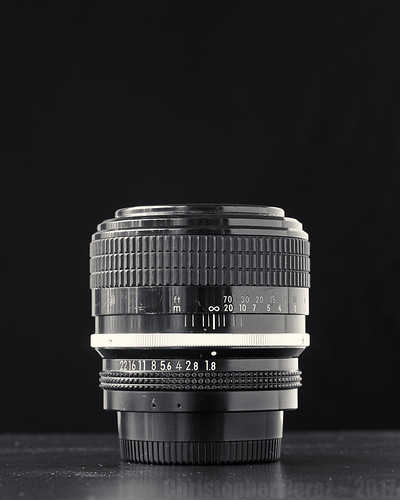
Lens Stories ~ Nikon Nikkor 85mm f/1.8 K pre-Ai

Lens Stories ~ Nikon Nikkor 85mm f/1.8 K


Lenses as tools of photography can gain status in various ways that enable or enhance the imaging process.  Some lenses are legendary for their resolution (Kodak Ektar, Schneider, Zeiss, Leica all come to mind).  Some lenses are prized for the way they "render" a scene.  Some people claim they can tell a lens "signature" which would be a give-away as to which lens was used in the making of an image (and on this point I've put a few of these people to the test and I think their claims are nothing more than bunk).  Other optical effects are more obvious.

A number of years ago a small part of the community of photographers re-awakened to the "swirling" out of focus area rendition given by old Petzval lenses.  In search of this effect eBay prices for the original 1800's lenses as well as lenses for much smaller formats like the Helios 40 and Contax Biotar lenses started climbing through the roof.  Even now when someone finds a lens that gives a Petzval-like effect eBay prices rapidly climb.  I'm thinking of old Russian slide projector lenses.

All this seeking for that "special" effect seems to me to be like looking for magic.  Maybe you can find it and buy it, but how does one use it?  In all my years of photography I have come across very few artists who create magical images using the magical effects of the Petzval.  One of these artists is named Alex Timmermans.  He uses the real thing and I find his images to be, well, magical.

Recently I looked in my Box of Goodies and found I had three 85mm Nikon Nikkor lenses.  One was a newer design f/2 Ai.  Another was an old pre-Ai single-coated f/1.8 H.  And the last is the subject of this article.  It's a Nikon Nikkor 85mm f/1.8 K (multi-coated) pre-Ai.  The first two lenses have found new homes, but the K is still with me.

This lens came by way of leboncoin here in France.  Someone offered it for what was at the time a rather fair price.  Normally I wouldn't see one for less than 250Euro, and at those prices the lenses were usually pretty beat up.  These lenses reputedly had that certain "magic" about them. They are legendary (or at least they were).  So I snapped this one up almost as soon as it had been posted.  And this is where I was reminded of carefully checking any piece of camera gear before hauling out my wallet.

The moment I returned home and had it mounted on a camera I realized that while the man who sold the lens might well have bought a f/1.4 Nikkor and had no need for the f/1.8, it one had sand in the focusing mechanism!  Ugh. The lens had spent too much time in the desert (though the glass is perfect - which reminds me of a story about a lens I bought years ago that had be sand blasted during a windstorm somewhere out in the desert southwest of the USA).  It meant I needed to disassemble the optic, clean it, and put it all back together.  I couldn't believe the amount of sand in the focusing mechanism.

Lesson learned; ALWAYS check ALL aspects of a lens before buying.

I went through all the effort required to get this lens in proper shape because this series of 85mm lenses is known for it's Petzval-like out of focus rendition.  It can give a "swirl" effect.  You see, I too had been infected by this weird photographic tool virus and the various claims to magic.

Using the old single coated H version of the lens showed that, indeed, the out of focus areas swirl on these Nikon Nikkor 85mm f/1.8 manual focus lenses.  But for learning how to use the effect, I have to work on it.  It seems that I have no talent for these kinds of special effects.
[example1, example2, example3, example4]

However, and this is indeed a very nice "however", when used on a Sony APS-C mirrorless and Lens Turbo II focal reducer, the Nikon Nikkor 85mm f/1.8 K gives almost the smoothest, creamiest out of focus rendition of any small format lens I've ever owned.  It's absolutely glorious.
[example1, example2, example3, example4]