Sally Mann has a beautiful show running at the Jeu de Paume in Paris just now.
My wife and I went last Sunday to see it just after the Bastille Day celebrations were finished (the museum didn't open until 13h30 that day).
The crowds were small-ish, though it was difficult to move freely through the first couple of rooms of the exhibit. But once well inside the show there were fewer people and we could enjoy taking our time to look at the photographs.
My gawd! those photos can be beautiful. It was a real joy to see deep, richly printed black and white images. We found Sally Mann's work to be very expressive and deeply moving.
In general, I think the French have a difficult time understanding and appreciating the large landscape works of someone like Ansel Adams. Those works tend to be remote and cold and people aren't real sure how these can be appreciated.
Certain West Coast photographers like Edward Weston are more approachable for the French. And if I understand correctly, it has to do with his bohemian lifestyle (he reportedly had many lovers), his images of people and more personal subjects and his political sensibilities (he spent time in Mexico around the edges of the Communist movement).
From the number of shows we see listed here in Paris, the French embrace American street photographers, mainly from New York. And they really appreciate good American photographers who make Paris their home, like Peter Turnley.
So it was interesting to us to see how the French reacted to Sally Mann. Her work is not as literal as some people might be used to. Listening to the French as they talked through the show was fascinating. Some marveled at the optical effects that create
smooth out of focus background renditions. Some people were taken by
the beauty of Sally's subjects (and my gawd! can her subjects be beautiful). And others were surprised by how
slavery in America continues to impact culture and society there and how this history could be so accurately portrayed in an artistic work.
For me the exhibit worked well on two levels. The first is that her work is inspirational. Sally Mann has found a way to use the tools of photography to express the various themes she explores in a way that transcends the tools in the creation of her works of art.
The second level is more profound. Much is made about race relations in America. After seeing the show I can't help but feel a deep sadness for terrible things in American history that continue to influence the present.
Tuesday, July 16, 2019

Sunday, June 16, 2019
Nikon Micro-Nikkor, Nikkor 105mm lenses ~ a closer look
Recently I picked up a Nikon Micro-Nikkor 105mm f/4 P Ai lens, thinking and hoping that it's out of focus rendition would be similar to the 55mm Micro-Nikkor lenses I have. Someone on the 'net suggested that the 105mm Micro-Nikkor f/4 is "wickedly" sharp from wide open. So this blog entry takes a look at this and compares its resolution with three other 105mm Nikkor lenses I have on hand.
Setup -
Setup -
- Sony A6000, 100ISO, 2 second delay timer, RawTherapee conversion software
- Big Beefy Manfrotto tripod
- Lenses compared
- Nikon Micro-Nikkor 105mm f/4 P Ai
- Nikon Nikkor 105mm f/2.5 P pre-Ai
- Nikon Nikkor 105mm f/2.5 Ai
- Nikon Nikkor 35mm to 105mm f/3.5 to f/4.5 AiS zoom at 105mm
- Lens Turbo II focal length reducer
It's become obvious to me over the years that nearly all lenses suffer from field curvature. Some lenses, as we might expect, have more pronounced curved fields than others. So to account for this, I have taken to shooting two images at each comparison aperture. The first image is focused in the center of the field, and the second image focuses at the very edge of the field of view. It is important to note that I'm not attempting to measure how much field curvature there is. All I'm looking at is, at the edge of the field, how sharp the optic is. If one photographs flat subject matter, nearly all lens will be more or less out of focus at the edge of the field.
Comparison Results -
[If you click on the image it'll take you to the Flickr hosting site. Once there, look at the file at full resolution. In many cases the differences between lenses is small and likely can't be seen until you take a squint at the comparison at 100 percent.]

Comments -
Comparing the Nikon Micro-Nikkor 105mm f/4 P Ai to the Nikon Nikkor 105mm f/2.5 and f/4.5 zoom, I see that wide open the f/4 Micro-Nikkor lens is indeed quite sharp, though I might not call it "wickedly" sharp. Focusing at the edges of the frame I see that the Micro-Nikkor is slightly less sharp wide open than the center, but that this cleans up very nicely as the aperture is stopped down. As for field curvature (which I am not in any measuring, but simply noting), the Micro-Nikkor suffers from a small amount where the 55mm Micro-Nikkors I looked at do not. I appears to me that to have a perfectly sharp image across a flat field that a user will need to stop down a click or two from wide open.
Looking at the 105mm f/2.5 P and Ai lenses I see that both are sharp in the center wide open. In the corners, too, the non-Ai P 105mm appears to match the 105mm f/2.5 Ai. Though it could be noted that field curvature of the early P non-Ai lens stronger than the updated design Ai. Compared with the Micro-Nikkor, it is difficult to tell a difference when curvature is accounted for in resolution between them across the field. The only note would be that field curvature is less with the Micro-Nikkor than it's f/2.5 brothers.
Comparison Results -
[If you click on the image it'll take you to the Flickr hosting site. Once there, look at the file at full resolution. In many cases the differences between lenses is small and likely can't be seen until you take a squint at the comparison at 100 percent.]
Comments -
Comparing the Nikon Micro-Nikkor 105mm f/4 P Ai to the Nikon Nikkor 105mm f/2.5 and f/4.5 zoom, I see that wide open the f/4 Micro-Nikkor lens is indeed quite sharp, though I might not call it "wickedly" sharp. Focusing at the edges of the frame I see that the Micro-Nikkor is slightly less sharp wide open than the center, but that this cleans up very nicely as the aperture is stopped down. As for field curvature (which I am not in any measuring, but simply noting), the Micro-Nikkor suffers from a small amount where the 55mm Micro-Nikkors I looked at do not. I appears to me that to have a perfectly sharp image across a flat field that a user will need to stop down a click or two from wide open.
Looking at the 105mm f/2.5 P and Ai lenses I see that both are sharp in the center wide open. In the corners, too, the non-Ai P 105mm appears to match the 105mm f/2.5 Ai. Though it could be noted that field curvature of the early P non-Ai lens stronger than the updated design Ai. Compared with the Micro-Nikkor, it is difficult to tell a difference when curvature is accounted for in resolution between them across the field. The only note would be that field curvature is less with the Micro-Nikkor than it's f/2.5 brothers.
Lastly, I took a look at a Nikon Nikkor 35mm-105mm f/3.5-f/4.5 AiS zoom at 105mm. Wide open resolution suffers across the field. Stopped down to f/5.6, however, the lens looks quite good in the center and matches the three fixed focal length 105mm lenses here. At the edges the zoom's resolution appears to clean up rather nicely at f/8. Regarding field curvature, of the four lenses looked at here this zoom shows the most curvature. The curvature is quite dramatic, actually.
Saturday, June 15, 2019
Nikon Nikkor 85mm f/1.8 and f/2 lenses ~ a closer look
It so happens that I picked up another Nikon Nikkor 85mm f/2 Ai lens. I owned one when I moved here, sold it, and got to wondering how it compared to my other, older 85mm f/1.8 K pre-Ai. So here is yet another look at how they compare from a resolution point of view.
Setup -
Setup -
- Sony A6000, 100ISO, 2 second delay timer, RawTherapee conversion software
- Big Beefy Manfrotto tripod
- Lenses compared
- Nikon Nikkor 85mm f/1.8 K pre-Ai
- Nikon Nikkor 85mm f/2 Ai
- Lens Turbo II focal length reducer
It's become obvious to me over the years that nearly all lenses suffer from field curvature. Some lenses, as we might expect, have more pronounced curved fields than others. So to account for this, I have taken to shooting two images at each comparison aperture. The first image is focused in the center of the field, and the second image focuses at the very edge of the field of view. It is important to note that I'm not attempting to measure how much field curvature there is. All I'm looking at is, at the edge of the field, how sharp the optic is. If one photographs flat subject matter, nearly all lens will be more or less out of focus at the edge of the field.
Comparison Results -
[If you click on the image it'll take you to the Flickr hosting site. Once there, look at the file at full resolution. In many cases the differences between lenses is small and likely can't be seen until you take a squint at the comparison at 100 percent.]

Comments -
Comparing the Nikon Nikkor 85mm f/1.8 K pre-Ai to the Nikon Nikkor 85mm f/2 Ai, I see that wide open the early f/1.8 lens is slightly less sharp than the newer design f/2 Ai. At the edges of the frame, the f/1.8 K pre-Ai lens clearly lags the f/2 Ai. Yet both lenses sharpen up very nice from f/4, and from f/4 on down the aperture range both lenses appear to be equal in the center and edges of the frame.
In terms of field curvature, I see that the f/1.8 K pre-Ai suffers from greater field curvature than the newer f/2 Ai optic (remember, I'm not trying to measure the field curvature, only noting the curvature in relative terms).
Since I don't sharpen the comparison images in any way, I thought it might be interesting to see what a rather aggressive unsharp mask might do to images from both lenses at wide open and f/2.8 in the center and at the edges. The USM was set to a 2 pixel radius and a 0.5 contrast step. This is pretty steep and I normally put the USM image in a separate layer and adjust its opacity over the original image to balance the harshness of the USM to make the final image more "film-like" (I feel some of the software tools can make an image appear "artificial" and cell-phone-like).
Comparison Results -
[If you click on the image it'll take you to the Flickr hosting site. Once there, look at the file at full resolution. In many cases the differences between lenses is small and likely can't be seen until you take a squint at the comparison at 100 percent.]
Comments -
Comparing the Nikon Nikkor 85mm f/1.8 K pre-Ai to the Nikon Nikkor 85mm f/2 Ai, I see that wide open the early f/1.8 lens is slightly less sharp than the newer design f/2 Ai. At the edges of the frame, the f/1.8 K pre-Ai lens clearly lags the f/2 Ai. Yet both lenses sharpen up very nice from f/4, and from f/4 on down the aperture range both lenses appear to be equal in the center and edges of the frame.
In terms of field curvature, I see that the f/1.8 K pre-Ai suffers from greater field curvature than the newer f/2 Ai optic (remember, I'm not trying to measure the field curvature, only noting the curvature in relative terms).
Since I don't sharpen the comparison images in any way, I thought it might be interesting to see what a rather aggressive unsharp mask might do to images from both lenses at wide open and f/2.8 in the center and at the edges. The USM was set to a 2 pixel radius and a 0.5 contrast step. This is pretty steep and I normally put the USM image in a separate layer and adjust its opacity over the original image to balance the harshness of the USM to make the final image more "film-like" (I feel some of the software tools can make an image appear "artificial" and cell-phone-like).
In both cases, the USM makes the wide open and f/2.8 images appear sharper than their f/4 to f/8 non-USM equivalents on the two lenses. The f/1.8 K pre-Ai lens still lags the f/2 Ai wide open. But, this shows what is possible if one wants to clean up an image that was shot at the widest aperture. The results can be pretty darned impressive.
Monday, June 03, 2019
Nikon Nikkor 85mm f/2 and f/1.8 ~ point light source comparison
For many years I looked at just one dimension of commercially available optics - resolution. With this blog entry I continue to look at other aspects of optical performance. For the series of postings I look at under, neutral, and over corrected spherical aberration in out of focus rendition on subject matter behind the point of focus.
Setup -
- Sony NEX5T, ISO 100, 2 second timer
- Big Beefy Manfrotto tripod
- Lenses using with a Lens Turbo II focal reducer -
- Nikon Nikkor 85mm f/2 Ai
- Nikon Nikkor 85mm f/1.8 K pre-Ai
- NOTE1: Lenses were shot at their widest apertures only
- NOTE2: Out of focus samples are from points _behind_ the point of focus to compare background out of focus rendition
- RawTherapee to convert RAW files into black and white and to set the black levels
If you click on the following image you can inspect it at 100 percent.
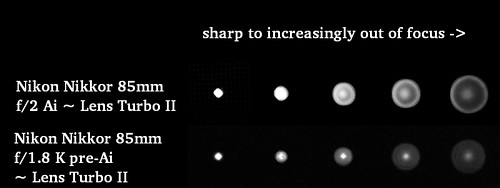
Comments -
NOTE: I feel the Lens Turbo II focal reducer adds a bit of under-corrected spherical aberration.
The Nikon Nikkor 85mm f/2 Ai lens shows under corrected spherical aberration as well as a bright edge ring that suggests over correction around the outside of the out of focus disk. In normal use, I expect the out of focus rendition to be "harsher" than, say, the next lens from Nikon.
The Nikon Nikkor 85mm f/1.8 K pre-Ai lens shows classic under corrected spherical aberration with a bright dot in the center of a smooth disk. In normal use, I expect the out of focus rendition to be "delicate" (using Nikon's own description of the effect) and smooth across the field.
Resources -
For further information on how the topic of out of focus rendition, optical properties, and Nikon lens design history, please refer to the following -
A PhD thesis on the impact of "soft focus" lenses on the history of photography - http://research-repository.st-andrews.ac.uk/handle/10023/505
An excellent starting point for understanding out of focus rendition (I might not completely agree with his interpretations/observations, but his foundation of understanding is quite good) - http://jtra.cz/stuff/essays/bokeh/
Nikon lens design histories - https://imaging.nikon.com/history/story/
Point light source discussions - https://www.dpreview.com/forums/thread/4031515
Zeiss comments on optical design - https://lenspire.zeiss.com/photo/en/article/how-does-zeiss-define-bokeh-an-interview-with-dr-stefan-ballmann
Metabones Focal Reducer whitepaper - https://www.metabones.com/assets/a/stories/Speed%20Booster%20White%20Paper.pdf
Monday, May 27, 2019
Nikon Micro-Nikkor, Nikkor 105mm ~ point light source comparison
For many years I looked at just one dimension of commercially available optics - resolution. Now I continue to look at other aspects of optical performance. For this series I look at under, neutral, and over corrected spherical aberration in out of focus rendition on subject matter behind the point of focus.
Setup -
- Sony NEX5T, ISO 100, 2 second timer, +1 EV
- Big Beefy Manfrotto tripod
- Lenses using with a Lens Turbo II focal reducer -
- Nikon Micro-Nikkor 105mm f/4 Ai
- Nikon Nikkor 105mm f/2.5 P pre-Ai (early Sonnar design)
- Nikon Nikkor 105mm f/2.5 Ai (later modified Sonnar, slightly more symmetrical design)
- NOTE1: Lenses were shot at their widest apertures only
- NOTE2: Out of focus samples are from points _behind_ the point of focus to compare background out of focus rendition
- RawTherapee to convert RAW files into black and white and to set the black levels
If you click on the following image you can inspect it at 100 percent.
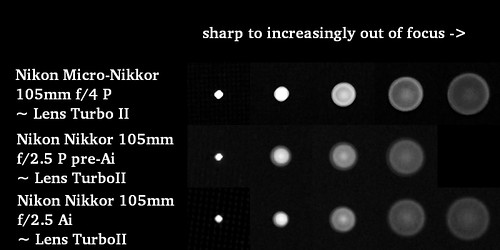
Comments -
NOTE: I feel the Lens Turbo II focal reducer adds a bit of under-corrected spherical aberration.
I had expected the Micro-Nikkor to show similar neutral very smooth out of focus rendition to the pair of 55mm Micro-Nikkors I looked at. Alas, this is not the case.
These three Nikon Nikkor, Micro-Nikkor 105mm f/4 and f/2.5 P pre-Ai and Ai lenses show under corrected spherical aberrations. At the point of focus, the Micro-Nikkor is one of the sharpest lenses I've looked at. But that's not what this comparison is about.
In normal photography I would expect, based on these comparisons, that there will be a very smooth and delicate (to use Nikon's own word on the topic) out of focus field rendition, with the f/4 Micro-Nikkor showing a stronger "condom ring" (which will contribute to a distracting out of focus rendition) than the two f/2.5 lenses (compare the smooth, rounded edges of the out of focus disks of the f/2.5 lenses against the sharp edged disks of the Micro-Nikkor).
Resources -
For further information on how the topic of out of focus rendition, optical properties, and Nikon lens design history, please refer to the following -
A PhD thesis on the impact of "soft focus" lenses on the history of photography - http://research-repository.st-andrews.ac.uk/handle/10023/505
An excellent starting point for understanding out of focus rendition (I might not completely agree with his interpretations/observations, but his foundation of understanding is quite good) - http://jtra.cz/stuff/essays/bokeh/
Nikon lens design histories - https://imaging.nikon.com/history/story/
Point light source discussions - https://www.dpreview.com/forums/thread/4031515
Zeiss comments on optical design - https://lenspire.zeiss.com/photo/en/article/how-does-zeiss-define-bokeh-an-interview-with-dr-stefan-ballmann
Metabones Focal Reducer whitepaper - https://www.metabones.com/assets/a/stories/Speed%20Booster%20White%20Paper.pdf
Sunday, May 26, 2019
Nikon Nikkor 28mm lenses ~ point light source comparison
Returning home after passing a winter in the south I am inspired to continue my look into point light source in-focus, out of focus comparisons.
Setup -
If you click on the following image you can inspect it at 100 percent.

Comments -
NOTE: I feel the Lens Turbo II focal reducer adds a bit of under-corrected spherical aberration.
The Nikon Nikkor 28mm f/2.8 Ai shows under-corrected spherical aberrations with just a moderately strong bright ring around the edge of the image circle. In normal photography I would expect, based on these comparisons, that there will be a hint of a "busy" rendition in a smooth, delicate out of focus field.
The Nikon Nikkor 28mm f/3.5 H shows stronger over-corrected spherical aberration with a fairly bright edge ring on out of focus disks. The center, as with it's brother lens the f/2.8, shows under-corrected spherical aberration. In normal photography I would expect, based on these comparisons, that there will be a somewhat confusing rendition of the out of focus field, mixing the two aberration types as this lens does.
The Nikon Nikkor 28mm f/3.5 PC (perspective control) lens shows moderate under-corrected spherical aberration with a hint of a bright ring around the edge of the out of focus disk. In normal photography I would expect the lens to be a hint of a "busy" field against a smooth, delicate out of focus rendition.
Resources -
For further information on how the topic of out of focus rendition, optical properties, and Nikon lens design history, please refer to the following -
A PhD thesis on the impact of "soft focus" lenses on the history of photography - http://research-repository.st-andrews.ac.uk/handle/10023/505
An excellent starting point for understanding out of focus rendition (I might not completely agree with his interpretations/observations, but his foundation of understanding is quite good) - http://jtra.cz/stuff/essays/bokeh/
Nikon lens design histories - https://imaging.nikon.com/history/story/
Point light source discussions - https://www.dpreview.com/forums/thread/4031515
Zeiss comments on optical design - https://lenspire.zeiss.com/photo/en/article/how-does-zeiss-define-bokeh-an-interview-with-dr-stefan-ballmann
Metabones Focal Reducer whitepaper - https://www.metabones.com/assets/a/stories/Speed%20Booster%20White%20Paper.pdf
Setup -
- Sony NEX5T, ISO 100, 2 second timer, +1 EV
- Big Beefy Manfrotto tripod
- Nikon lenses using with a Lens Turbo II focal reducer -
- Nikon Nikkor 28mm f/2.8 Ai
- Nikon Nikkor 28mm f/3.5 H pre-Ai
- Nikon Nikkor 28mm f/3.5 PC
- NOTE1: Lenses were shot at their widest apertures only
- NOTE2: Out of focus samples are from points _behind_ the point of focus to compare background out of focus rendition
- RawTherapee to convert RAW files into black and white and to set the black levels
If you click on the following image you can inspect it at 100 percent.
Comments -
NOTE: I feel the Lens Turbo II focal reducer adds a bit of under-corrected spherical aberration.
The Nikon Nikkor 28mm f/2.8 Ai shows under-corrected spherical aberrations with just a moderately strong bright ring around the edge of the image circle. In normal photography I would expect, based on these comparisons, that there will be a hint of a "busy" rendition in a smooth, delicate out of focus field.
The Nikon Nikkor 28mm f/3.5 H shows stronger over-corrected spherical aberration with a fairly bright edge ring on out of focus disks. The center, as with it's brother lens the f/2.8, shows under-corrected spherical aberration. In normal photography I would expect, based on these comparisons, that there will be a somewhat confusing rendition of the out of focus field, mixing the two aberration types as this lens does.
The Nikon Nikkor 28mm f/3.5 PC (perspective control) lens shows moderate under-corrected spherical aberration with a hint of a bright ring around the edge of the out of focus disk. In normal photography I would expect the lens to be a hint of a "busy" field against a smooth, delicate out of focus rendition.
Resources -
For further information on how the topic of out of focus rendition, optical properties, and Nikon lens design history, please refer to the following -
A PhD thesis on the impact of "soft focus" lenses on the history of photography - http://research-repository.st-andrews.ac.uk/handle/10023/505
An excellent starting point for understanding out of focus rendition (I might not completely agree with his interpretations/observations, but his foundation of understanding is quite good) - http://jtra.cz/stuff/essays/bokeh/
Nikon lens design histories - https://imaging.nikon.com/history/story/
Point light source discussions - https://www.dpreview.com/forums/thread/4031515
Zeiss comments on optical design - https://lenspire.zeiss.com/photo/en/article/how-does-zeiss-define-bokeh-an-interview-with-dr-stefan-ballmann
Metabones Focal Reducer whitepaper - https://www.metabones.com/assets/a/stories/Speed%20Booster%20White%20Paper.pdf
Saturday, May 25, 2019
Sigma 19mm, 30mm, Sony 50mm ~ point light source comparison
Having looked at the out of focus rendition of vintage Nikon lenses, I wanted to see what, if anything, had changed over the years of optical design and look at three current lenses.
Setup -
If you click on the following image you can inspect it at 100 percent.
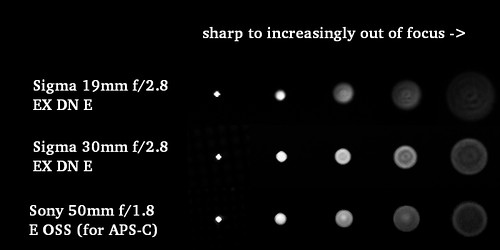
Comments -
The Sigma 19mm f/2.8 EX DN E out of focus rendition confuses me. There is a slight bright ring around the out of focus disk, along with a bright center with a dark whole in the middle. The further out of focus the point, the more "choppy" the disk becomes. Concentric circles form the farther out of focus the disk becomes.
The Sigma 30mm f/2.8 EX DN E out of focus rendition confuses me just like the 19mm Sigma does. There is a bright outter ring to the disk, followed by a brighter center with a dark hole in the middle. The "choppy" field effect across the disk is less than with the 19mm, but it's still clearly visible.
The Sony 50mm f/1.8 SEL OSS starts out having a nice smooth disk with a brighter center just like the lens is under-corrected. But the further out of focus the point is, the stronger the outter ring becomes. It's as if the Sony lens is both under and over-corrected.
Resources -
For further information on how the topic of out of focus rendition, optical properties, and Nikon lens design history, please refer to the following -
A PhD thesis on the impact of "soft focus" lenses on the history of photography - http://research-repository.st-andrews.ac.uk/handle/10023/505
An excellent starting point for understanding out of focus rendition (I might not completely agree with his interpretations/observations, but his foundation of understanding is quite good) - http://jtra.cz/stuff/essays/bokeh/
Nikon lens design histories - https://imaging.nikon.com/history/story/
Point light source discussions - https://www.dpreview.com/forums/thread/4031515
Zeiss comments on optical design - https://lenspire.zeiss.com/photo/en/article/how-does-zeiss-define-bokeh-an-interview-with-dr-stefan-ballmann
Metabones Focal Reducer whitepaper - https://www.metabones.com/assets/a/stories/Speed%20Booster%20White%20Paper.pdf
Setup -
- Sony NEX5T, ISO 100, 2 second timer, +1 EV
- Big Beefy Manfrotto tripod
- Lenses designed for Sony E-mount APS-C cameras -
- Sigma 19mm f/2.8 EX DN E
- Sigma 30mm f/2.8 EX DN E
- Sony 50mm f/1.8 SEL OSS
- NOTE1: Lenses were shot at their widest apertures only
- NOTE2: Out of focus samples are from points _behind_ the point of focus to compare background out of focus rendition
- RawTherapee to convert RAW files into black and white and to set the black levels
If you click on the following image you can inspect it at 100 percent.
Comments -
The Sigma 19mm f/2.8 EX DN E out of focus rendition confuses me. There is a slight bright ring around the out of focus disk, along with a bright center with a dark whole in the middle. The further out of focus the point, the more "choppy" the disk becomes. Concentric circles form the farther out of focus the disk becomes.
The Sigma 30mm f/2.8 EX DN E out of focus rendition confuses me just like the 19mm Sigma does. There is a bright outter ring to the disk, followed by a brighter center with a dark hole in the middle. The "choppy" field effect across the disk is less than with the 19mm, but it's still clearly visible.
The Sony 50mm f/1.8 SEL OSS starts out having a nice smooth disk with a brighter center just like the lens is under-corrected. But the further out of focus the point is, the stronger the outter ring becomes. It's as if the Sony lens is both under and over-corrected.
Resources -
For further information on how the topic of out of focus rendition, optical properties, and Nikon lens design history, please refer to the following -
A PhD thesis on the impact of "soft focus" lenses on the history of photography - http://research-repository.st-andrews.ac.uk/handle/10023/505
An excellent starting point for understanding out of focus rendition (I might not completely agree with his interpretations/observations, but his foundation of understanding is quite good) - http://jtra.cz/stuff/essays/bokeh/
Nikon lens design histories - https://imaging.nikon.com/history/story/
Point light source discussions - https://www.dpreview.com/forums/thread/4031515
Zeiss comments on optical design - https://lenspire.zeiss.com/photo/en/article/how-does-zeiss-define-bokeh-an-interview-with-dr-stefan-ballmann
Metabones Focal Reducer whitepaper - https://www.metabones.com/assets/a/stories/Speed%20Booster%20White%20Paper.pdf
Thursday, May 09, 2019
Nikon Nikkor 100mm to 300mm lenses ~ a closer look
It so happens that I picked up a rather inexpensive (supposedly in need of repair, but in reality didn't need any such thing) 100-300mm Nikon Nikkor f/5.6 AiS.
I've recently been impressed by the Nikon 75-150mm E-series (yes! it's true) and the Nikkor 80-200mm f/4.5 N Ai zoom lenses. None of the more modern Canon EOS zoom lenses were ever this close to being wonderfully razor sharp at the point of focus and creamy smooth in the out of focus regions. So when this 100-300mm AiS Nikkor came along for so little money, I had to have a look at it's performance.
Setup -
Comparison Results -
[If you click on the image it'll take you to the Flickr hosting site. Once there, look at the file at full resolution. In many cases the differences between lenses is small and likely can't be seen until you take a squint at the comparison at 100 percent.]
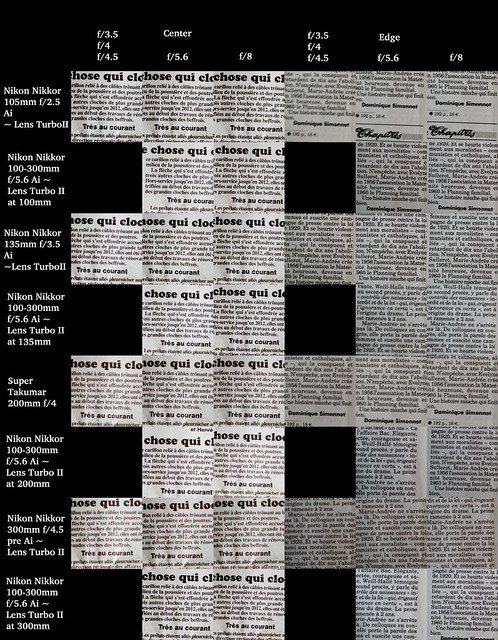
Comments -
Comparing the Nikon Nikkor 100-300mm f/5.6 AiS to a Nikon Nikkor 105mm f/2.5 Ai, I see that both the 105mm and 100-300mm lenses are both very sharp in the center of the frame. At the edges, the 100-300mm lens remains very sharp. It appears the 105mm f/2.5 Ai suffers from a bit of field curvature as the edges of the frame are clearly not as sharp as the zoom on this 2D subject.
Comparing the Nikon Nikkor 100-300mm f/5.6 AiS to a Nikon Nikkor 135mm f/3.5 Ai, I see that both the 135mm and 100-300mm lenses are very sharp in the center of the frame. At the edges, the 135mm lens remains very sharp, with the 100-300mm lens trailing ever so slightly in terms of absolute resolution.
Comparing the Nikon Nikkor 100-300mm f/5.6 AiS to a Super-Takumar 200mm f/4 M42 lens, I see that the 200mm is very slightly sharper than the 100-300mm lens in the center of the frame. At the edges, the 200mm lens is very slightly less sharp than the 100-300mm lens.
Comparing the Nikon Nikkor 100-300mm f/5.6 AiS to a Nikon Nikkor 300mm f/4.5 pre-Ai, I see that the 100-300mm lens is very sharp straight across the field. The fixed focal length 300mm f/4.5 lens is clearly behind the zoom in terms of resolution.
Overall, the Nikon Nikkor 100-300mm f/5.6 AiS lens is truly outstanding at f/5.6 (which is wide open with this optic) and f/8. In the center it can keep up with the fixed focal length lenses I compared this zoom to. The optic's field is surprisingly flat and exceeds three of the four fixed focal length lenses in terms of flat field resolution at the extreme edges of the frame.
So, how much did this super sharp wonder zoom set me back? 30Euros.
I've recently been impressed by the Nikon 75-150mm E-series (yes! it's true) and the Nikkor 80-200mm f/4.5 N Ai zoom lenses. None of the more modern Canon EOS zoom lenses were ever this close to being wonderfully razor sharp at the point of focus and creamy smooth in the out of focus regions. So when this 100-300mm AiS Nikkor came along for so little money, I had to have a look at it's performance.
Setup -
- Sony A6000, 100ISO, 2 second delay timer, RawTherapee conversion software
- Big Beefy Manfrotto tripod
- Lenses compared
- Nikon Nikkor 105mm f/2.5 Ai
- Nikon Nikkor 135mm f/3.5 Ai
- Super-Takumar 200mm f/4
- Nikon Nikkor 300mm f/4.5 pre-Ai
- Nikon Nikkor 100-300mm f/5.6 AiS
- compared at 100mm
- 135mm
- 200mm
- 300mm
- Lens Turbo II adapter with the Nikkors, but not the Takumar
Comparison Results -
[If you click on the image it'll take you to the Flickr hosting site. Once there, look at the file at full resolution. In many cases the differences between lenses is small and likely can't be seen until you take a squint at the comparison at 100 percent.]
Comments -
Comparing the Nikon Nikkor 100-300mm f/5.6 AiS to a Nikon Nikkor 105mm f/2.5 Ai, I see that both the 105mm and 100-300mm lenses are both very sharp in the center of the frame. At the edges, the 100-300mm lens remains very sharp. It appears the 105mm f/2.5 Ai suffers from a bit of field curvature as the edges of the frame are clearly not as sharp as the zoom on this 2D subject.
Comparing the Nikon Nikkor 100-300mm f/5.6 AiS to a Nikon Nikkor 135mm f/3.5 Ai, I see that both the 135mm and 100-300mm lenses are very sharp in the center of the frame. At the edges, the 135mm lens remains very sharp, with the 100-300mm lens trailing ever so slightly in terms of absolute resolution.
Comparing the Nikon Nikkor 100-300mm f/5.6 AiS to a Super-Takumar 200mm f/4 M42 lens, I see that the 200mm is very slightly sharper than the 100-300mm lens in the center of the frame. At the edges, the 200mm lens is very slightly less sharp than the 100-300mm lens.
Comparing the Nikon Nikkor 100-300mm f/5.6 AiS to a Nikon Nikkor 300mm f/4.5 pre-Ai, I see that the 100-300mm lens is very sharp straight across the field. The fixed focal length 300mm f/4.5 lens is clearly behind the zoom in terms of resolution.
Overall, the Nikon Nikkor 100-300mm f/5.6 AiS lens is truly outstanding at f/5.6 (which is wide open with this optic) and f/8. In the center it can keep up with the fixed focal length lenses I compared this zoom to. The optic's field is surprisingly flat and exceeds three of the four fixed focal length lenses in terms of flat field resolution at the extreme edges of the frame.
So, how much did this super sharp wonder zoom set me back? 30Euros.
Tuesday, May 07, 2019
Nikon Nikkor 100-300mm f/5.6 Ai ~ point light source comparison
For many years I looked at just one dimension of commercially available optics - resolution. Now I wanted to start looking at other aspects of optical performance. For this series I look at spherical aberration (looking for under, neutral, or over correction) in out of focus rendition on subject matter behind the point of focus.
Setup -
- Sony A6000, ISO 100, 2 second timer
- Big Beefy Manfrotto tripod
- Lens using with a Lens Turbo II focal reducer -
- Nikon Nikkor 100-300mm f/5.6 Ai zoom
- NOTE1: Lens was shot at the widest aperture only
- NOTE2: Out of focus samples are from points _behind_ the point of focus to compare background out of focus rendition
- RawTherapee to convert RAW files into black and white and to set the black levels
If you click on the following image you can inspect it at 100 percent.

Comments -
NOTE: I feel the Lens Turbo II focal reducer adds a bit of under-corrected spherical aberration.
The Nikon Nikkor 100-300mm f/5.6 Ai zoom at 100mm shows a flat out of focus disk. The further out of focus a dot becomes, the more a slight under-corrected spherical aberration in the out of focus regions is revealed. Based on this comparison, in normal photographic use this lens at this focal length should produce a smooth out of focus rendition.
At 200mm, this Ai zoom continues to show a flat neutral disk. The further out of focus a dot becomes, the more a slight under-corrected spherical aberration in the out of focus regions is revealed. Under normal photographic conditions I would expect that this lens at 200mm will continue to show a smooth out of focus rendition.
At 300mm, this Ai zoom shows very neutral out of focus rendition. Under normal photographic conditions I would expect this lens at this focal length to produce extremely smooth out of focus rendition.
Resources -
For further information on how the topic of out of focus rendition, optical properties, and Nikon lens design history, please refer to the following -
A PhD thesis on the impact of "soft focus" lenses on the history of photography - http://research-repository.st-andrews.ac.uk/handle/10023/505
An excellent starting point for understanding out of focus rendition (I might not completely agree with his interpretations/observations, but his foundation of understanding is quite good) - http://jtra.cz/stuff/essays/bokeh/
Nikon lens design histories - https://imaging.nikon.com/history/story/
Point light source discussions - https://www.dpreview.com/forums/thread/4031515
Zeiss comments on optical design - https://lenspire.zeiss.com/photo/en/article/how-does-zeiss-define-bokeh-an-interview-with-dr-stefan-ballmann
Metabones Focal Reducer whitepaper - https://www.metabones.com/assets/a/stories/Speed%20Booster%20White%20Paper.pdf
Monday, April 15, 2019
Nikkor Soft filters ~ another look
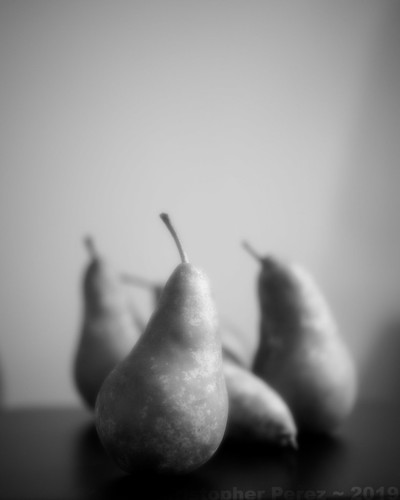
I quickly realized that using a point light source to explore how Nikkor Soft #1 and #2 filters might influence out of focus regions was insufficient. Since the camera was out and the pears were in season, I took a series of images to illustrate optical renditions a bit more clearly.
What I wanted to see was what effect, if any, a soft filter might have on out of focus rendition comparing a neutrally corrected for spherical aberration against an under-corrected lens.
Setup -
If you click on the following images you can inspect them at 100 percent.

Nikon Micro-Nikkor 55mm f/2.8 Ai - no filter

Nikon Micro-Nikkor 55mm f/2.8 Ai - #1 Soft filter
Nikon Micro-Nikkor 55mm f/2.8 Ai - #2 Soft filter

Nikon Nikkor 85mm f/1.8 K ~ no filter

Nikon Nikkor 85mm f/1.8 K ~ #1 Soft filter

Nikon Nikkor 85mm f/1.8 K ~ #2 Soft filter
Comments -
Differences between the neutrally and under-corrected spherical aberration out of focus renditions can be subtle. Look at the out of focus stems and the shadows on the left side of the pears. If you study the images carefully, you will begin to see the real world effects of out of focus rendition optical corrections.
When using Nikkor Soft filters, you can see how mid-tone contrast is lowered as well as reducing resolution. Looking carefully, again, you can begin to see how the light/dark transitions are different between the two lenses.
Here is one final example. It was made using a Nikon Nikkor 50mm f/1.8 AiS which is under-corrected for spherical aberration in the out of focus areas behind the point of focus. I added a Nikkor #1 Soft filter and shot the lens wide open to get the maximum out of focus rendition effect.

Resources -
For further information on how the topic of out of focus rendition, optical properties, and Nikon lens design history, please refer to the following -
A PhD thesis on the impact of "soft focus" lenses on the history of photography - http://research-repository.st-andrews.ac.uk/handle/10023/505
An excellent starting point for understanding out of focus rendition (I might not completely agree with his interpretations/observations, but his foundation of understanding is quite good) - http://jtra.cz/stuff/essays/bokeh/
Nikon lens design histories - https://imaging.nikon.com/history/story/
Point light source discussions - https://www.dpreview.com/forums/thread/4031515
Zeiss comments on optical design - https://lenspire.zeiss.com/photo/en/article/how-does-zeiss-define-bokeh-an-interview-with-dr-stefan-ballmann
Metabones Focal Reducer whitepaper - https://www.metabones.com/assets/a/stories/Speed%20Booster%20White%20Paper.pdf
What I wanted to see was what effect, if any, a soft filter might have on out of focus rendition comparing a neutrally corrected for spherical aberration against an under-corrected lens.
Setup -
- Sony NEX5T, ISO 100, 2 second timer, -1 EV
- Big Beefy Manfrotto tripod
- Lenses using with a Lens Turbo II focal reducer -
- Nikon Micro-Nikkor 55mm f/2.8 Ai (neutrally corrected spherical aberration)
- Nikon Nikkor 85 f/1.8 K pre-Ai (under-corrected spherical aberration)
- NOTE1: Lenses were shot at the widest aperture only
- RawTherapee to convert RAW files into black and white and to set the black levels
If you click on the following images you can inspect them at 100 percent.
Nikon Micro-Nikkor 55mm f/2.8 Ai - no filter
Nikon Micro-Nikkor 55mm f/2.8 Ai - #1 Soft filter
Nikon Micro-Nikkor 55mm f/2.8 Ai - #2 Soft filter
Nikon Nikkor 85mm f/1.8 K ~ no filter
Nikon Nikkor 85mm f/1.8 K ~ #1 Soft filter
Nikon Nikkor 85mm f/1.8 K ~ #2 Soft filter
Comments -
Differences between the neutrally and under-corrected spherical aberration out of focus renditions can be subtle. Look at the out of focus stems and the shadows on the left side of the pears. If you study the images carefully, you will begin to see the real world effects of out of focus rendition optical corrections.
When using Nikkor Soft filters, you can see how mid-tone contrast is lowered as well as reducing resolution. Looking carefully, again, you can begin to see how the light/dark transitions are different between the two lenses.
Here is one final example. It was made using a Nikon Nikkor 50mm f/1.8 AiS which is under-corrected for spherical aberration in the out of focus areas behind the point of focus. I added a Nikkor #1 Soft filter and shot the lens wide open to get the maximum out of focus rendition effect.
Resources -
For further information on how the topic of out of focus rendition, optical properties, and Nikon lens design history, please refer to the following -
A PhD thesis on the impact of "soft focus" lenses on the history of photography - http://research-repository.st-andrews.ac.uk/handle/10023/505
An excellent starting point for understanding out of focus rendition (I might not completely agree with his interpretations/observations, but his foundation of understanding is quite good) - http://jtra.cz/stuff/essays/bokeh/
Nikon lens design histories - https://imaging.nikon.com/history/story/
Point light source discussions - https://www.dpreview.com/forums/thread/4031515
Zeiss comments on optical design - https://lenspire.zeiss.com/photo/en/article/how-does-zeiss-define-bokeh-an-interview-with-dr-stefan-ballmann
Metabones Focal Reducer whitepaper - https://www.metabones.com/assets/a/stories/Speed%20Booster%20White%20Paper.pdf
Sunday, April 14, 2019
Nikkor Soft filters 1 and 2 ~ point light source comparison
Here's a question: What effect might a soft focus filter have on out of focus rendition? I decided to have a look.
For many years I looked at just one dimension of commercially available optics - resolution. Now I wanted to start looking at other aspects of optical performance. For this series I look at spherical aberration (looking for under, neutral, or over correction) in out of focus rendition on subject matter behind the point of focus.
More specifically, I wanted to see how Nikkor soft filters might influence the out of focus regions of under-corrected spherical aberration lenses.
Setup -
If you click on the following image you can inspect it at 100 percent.

Comments -
NOTE: I feel the Lens Turbo II focal reducer adds a bit of under-corrected spherical aberration.
The Nikon Nikkor soft filters appear to mute out of focus disk intensity. The stronger the number filter, the stronger the effect. In general, the basic underlying effect of spherical aberration appears to remain, such as the bright center spot that is common to under-corrected lenses.
So, what have I shown? Not much that is readily/easily visible from the point light source comparison. Based on experience, however, the effects of using a soft filter are more easily judged across a full image. Even though I doubt I will significantly deepen my understanding of soft filters, I will take a look at this effect in a future post.
Resources -
For further information on how the topic of out of focus rendition, optical properties, and Nikon lens design history, please refer to the following -
A PhD thesis on the impact of "soft focus" lenses on the history of photography - http://research-repository.st-andrews.ac.uk/handle/10023/505
An excellent starting point for understanding out of focus rendition (I might not completely agree with his interpretations/observations, but his foundation of understanding is quite good) - http://jtra.cz/stuff/essays/bokeh/
Nikon lens design histories - https://imaging.nikon.com/history/story/
Point light source discussions - https://www.dpreview.com/forums/thread/4031515
Zeiss comments on optical design - https://lenspire.zeiss.com/photo/en/article/how-does-zeiss-define-bokeh-an-interview-with-dr-stefan-ballmann
Metabones Focal Reducer whitepaper - https://www.metabones.com/assets/a/stories/Speed%20Booster%20White%20Paper.pdf
For many years I looked at just one dimension of commercially available optics - resolution. Now I wanted to start looking at other aspects of optical performance. For this series I look at spherical aberration (looking for under, neutral, or over correction) in out of focus rendition on subject matter behind the point of focus.
More specifically, I wanted to see how Nikkor soft filters might influence the out of focus regions of under-corrected spherical aberration lenses.
Setup -
- Sony NEX5T, ISO 100, 2 second timer, -1 EV
- Big Beefy Manfrotto tripod
- Lenses using with a Lens Turbo II focal reducer -
- Nikon Nikkor 50mm f/1.8 AiS
- Nikon Micro-Nikkor 55mm f/2.8 Ai
- Nikon Nikkor 85 f/1.8 K pre-Ai
- NOTE1: Lenses were shot at the widest aperture only
- NOTE2: Out of focus samples are from points _behind_ the point of focus to compare background out of focus rendition
- RawTherapee to convert RAW files into black and white and to set the black levels
If you click on the following image you can inspect it at 100 percent.
Comments -
NOTE: I feel the Lens Turbo II focal reducer adds a bit of under-corrected spherical aberration.
The Nikon Nikkor soft filters appear to mute out of focus disk intensity. The stronger the number filter, the stronger the effect. In general, the basic underlying effect of spherical aberration appears to remain, such as the bright center spot that is common to under-corrected lenses.
So, what have I shown? Not much that is readily/easily visible from the point light source comparison. Based on experience, however, the effects of using a soft filter are more easily judged across a full image. Even though I doubt I will significantly deepen my understanding of soft filters, I will take a look at this effect in a future post.
Resources -
For further information on how the topic of out of focus rendition, optical properties, and Nikon lens design history, please refer to the following -
A PhD thesis on the impact of "soft focus" lenses on the history of photography - http://research-repository.st-andrews.ac.uk/handle/10023/505
An excellent starting point for understanding out of focus rendition (I might not completely agree with his interpretations/observations, but his foundation of understanding is quite good) - http://jtra.cz/stuff/essays/bokeh/
Nikon lens design histories - https://imaging.nikon.com/history/story/
Point light source discussions - https://www.dpreview.com/forums/thread/4031515
Zeiss comments on optical design - https://lenspire.zeiss.com/photo/en/article/how-does-zeiss-define-bokeh-an-interview-with-dr-stefan-ballmann
Metabones Focal Reducer whitepaper - https://www.metabones.com/assets/a/stories/Speed%20Booster%20White%20Paper.pdf
Friday, April 12, 2019
Nikon Nikkor 80-200mm f/4.5 N Ai zoom ~ point light source comparison
I heard that spending time along the Cote d'Azur could be good for one's art. While I make no claims to be an artist, spending time in the sun along the Mediterranean Sea inspired me to more deeply consider optics as applied to the craft of photography.
For many years I looked at just one dimension of commercially available optics - resolution. Now I wanted to start looking at other aspects of optical performance. For this series I look at spherical aberration (looking for under, neutral, or over correction) in out of focus rendition on subject matter behind the point of focus.
Setup -
If you click on the following image you can inspect it at 100 percent.
Comments -
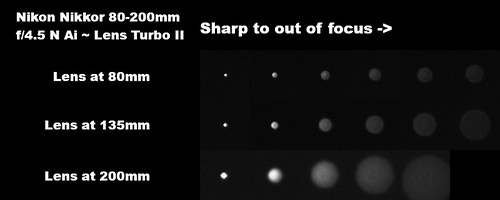
NOTE: I feel the Lens Turbo II focal reducer adds a bit of under-corrected spherical aberration.
The Nikon Nikkor 80mm - 200mm f/4.5 N Ai zoom at 80mm and 135mm shows slight under-corrected spherical aberration in the out of focus regions. Based on this comparison, in normal photographic use this lens at this focal length should produce a very smooth out of focus rendition.
At 200mm, this Ai zoom shows very very neutral out of focus rendition. Under normal photographic conditions I would expect this lens at this focal length to produce extremely smooth out of focus rendition.
Resources -
For further information on how the topic of out of focus rendition, optical properties, and Nikon lens design history, please refer to the following -
A PhD thesis on the impact of "soft focus" lenses on the history of photography - http://research-repository.st-andrews.ac.uk/handle/10023/505
An excellent starting point for understanding out of focus rendition (I might not completely agree with his interpretations/observations, but his foundation of understanding is quite good) - http://jtra.cz/stuff/essays/bokeh/
Nikon lens design histories - https://imaging.nikon.com/history/story/
Point light source discussions - https://www.dpreview.com/forums/thread/4031515
Zeiss comments on optical design - https://lenspire.zeiss.com/photo/en/article/how-does-zeiss-define-bokeh-an-interview-with-dr-stefan-ballmann
Metabones Focal Reducer whitepaper - https://www.metabones.com/assets/a/stories/Speed%20Booster%20White%20Paper.pdf
For many years I looked at just one dimension of commercially available optics - resolution. Now I wanted to start looking at other aspects of optical performance. For this series I look at spherical aberration (looking for under, neutral, or over correction) in out of focus rendition on subject matter behind the point of focus.
Setup -
- Sony NEX5T, ISO 100, 2 second timer, -1 EV
- Big Beefy Manfrotto tripod
- Lens using with a Lens Turbo II focal reducer -
- Nikon Nikkor 80mm - 200mm f/4.5 N Ai zoom
- NOTE1: Lens was shot at the widest aperture only
- NOTE2: Out of focus samples are from points _behind_ the point of focus to compare background out of focus rendition
- RawTherapee to convert RAW files into black and white and to set the black levels
If you click on the following image you can inspect it at 100 percent.
Comments -
NOTE: I feel the Lens Turbo II focal reducer adds a bit of under-corrected spherical aberration.
The Nikon Nikkor 80mm - 200mm f/4.5 N Ai zoom at 80mm and 135mm shows slight under-corrected spherical aberration in the out of focus regions. Based on this comparison, in normal photographic use this lens at this focal length should produce a very smooth out of focus rendition.
At 200mm, this Ai zoom shows very very neutral out of focus rendition. Under normal photographic conditions I would expect this lens at this focal length to produce extremely smooth out of focus rendition.
Resources -
For further information on how the topic of out of focus rendition, optical properties, and Nikon lens design history, please refer to the following -
A PhD thesis on the impact of "soft focus" lenses on the history of photography - http://research-repository.st-andrews.ac.uk/handle/10023/505
An excellent starting point for understanding out of focus rendition (I might not completely agree with his interpretations/observations, but his foundation of understanding is quite good) - http://jtra.cz/stuff/essays/bokeh/
Nikon lens design histories - https://imaging.nikon.com/history/story/
Point light source discussions - https://www.dpreview.com/forums/thread/4031515
Zeiss comments on optical design - https://lenspire.zeiss.com/photo/en/article/how-does-zeiss-define-bokeh-an-interview-with-dr-stefan-ballmann
Metabones Focal Reducer whitepaper - https://www.metabones.com/assets/a/stories/Speed%20Booster%20White%20Paper.pdf
Thursday, April 11, 2019
Nikon 75-150mm f/3.5 E-series zoom ~ point light source comparision
I heard that spending time along the Cote d'Azur could be good for one's art. While I make no claims to be an artist, spending time in the sun along the Mediterranean Sea inspired me to more deeply consider optics as applied to the craft of photography.
For many years I looked at just one dimension of commercially available optics - resolution. Now I wanted to start looking at other aspects of optical performance. For this series I look at spherical aberration (looking for under, neutral, or over correction) in out of focus rendition on subject matter behind the point of focus.
Setup -
If you click on the following image you can inspect it at 100 percent.

Comments -
NOTE: I feel the Lens Turbo II focal reducer adds a bit of under-corrected spherical aberration.
The Nikon 75mm to 150mm f/3.5 AiS zoom at 75mm shows under-corrected spherical aberration in the out of focus regions. Based on this comparison, in normal photographic use this lens at this focal length should produce a very smooth out of focus rendition.
At 100mm, this AiS zoom continues to show under-corrected spherical aberration. Under normal photographic conditions I would expect that this lens at 100mm will continue to show a very smooth out of focus rendition.
At 150mm, this AiS zoom shows very very neutral out of focus rendition. Under normal photographic conditions I would expect this lens at this focal length to produce extremely smooth out of focus rendition.
Resources -
For further information on how the topic of out of focus rendition, optical properties, and Nikon lens design history, please refer to the following -
A PhD thesis on the impact of "soft focus" lenses on the history of photography - http://research-repository.st-andrews.ac.uk/handle/10023/505
An excellent starting point for understanding out of focus rendition (I might not completely agree with his interpretations/observations, but his foundation of understanding is quite good) - http://jtra.cz/stuff/essays/bokeh/
Nikon lens design histories - https://imaging.nikon.com/history/story/
Point light source discussions - https://www.dpreview.com/forums/thread/4031515
Zeiss comments on optical design - https://lenspire.zeiss.com/photo/en/article/how-does-zeiss-define-bokeh-an-interview-with-dr-stefan-ballmann
Metabones Focal Reducer whitepaper - https://www.metabones.com/assets/a/stories/Speed%20Booster%20White%20Paper.pdf
For many years I looked at just one dimension of commercially available optics - resolution. Now I wanted to start looking at other aspects of optical performance. For this series I look at spherical aberration (looking for under, neutral, or over correction) in out of focus rendition on subject matter behind the point of focus.
Setup -
- Sony NEX5T, ISO 100, 2 second timer, -1 EV
- Big Beefy Manfrotto tripod
- Lens using with a Lens Turbo II focal reducer -
- Nikon E-series 75mm - 150mm f/3.5 AiS zoom
- NOTE1: Lens was shot at the widest aperture only
- NOTE2: Out of focus samples are from points _behind_ the point of focus to compare background out of focus rendition
- RawTherapee to convert RAW files into black and white and to set the black levels
If you click on the following image you can inspect it at 100 percent.
Comments -
NOTE: I feel the Lens Turbo II focal reducer adds a bit of under-corrected spherical aberration.
The Nikon 75mm to 150mm f/3.5 AiS zoom at 75mm shows under-corrected spherical aberration in the out of focus regions. Based on this comparison, in normal photographic use this lens at this focal length should produce a very smooth out of focus rendition.
At 100mm, this AiS zoom continues to show under-corrected spherical aberration. Under normal photographic conditions I would expect that this lens at 100mm will continue to show a very smooth out of focus rendition.
At 150mm, this AiS zoom shows very very neutral out of focus rendition. Under normal photographic conditions I would expect this lens at this focal length to produce extremely smooth out of focus rendition.
Resources -
For further information on how the topic of out of focus rendition, optical properties, and Nikon lens design history, please refer to the following -
A PhD thesis on the impact of "soft focus" lenses on the history of photography - http://research-repository.st-andrews.ac.uk/handle/10023/505
An excellent starting point for understanding out of focus rendition (I might not completely agree with his interpretations/observations, but his foundation of understanding is quite good) - http://jtra.cz/stuff/essays/bokeh/
Nikon lens design histories - https://imaging.nikon.com/history/story/
Point light source discussions - https://www.dpreview.com/forums/thread/4031515
Zeiss comments on optical design - https://lenspire.zeiss.com/photo/en/article/how-does-zeiss-define-bokeh-an-interview-with-dr-stefan-ballmann
Metabones Focal Reducer whitepaper - https://www.metabones.com/assets/a/stories/Speed%20Booster%20White%20Paper.pdf
Wednesday, April 10, 2019
Nikon Nikkor 35mm f/3.5 - 105mm f/4.5 zoom ~ point light source comparison
I heard that spending time along the Cote d'Azur could be good for one's art. While I make no claims to be an artist, spending time in the sun along the Mediterranean Sea inspired me to more deeply consider optics as applied to the craft of photography.
For many years I looked at just one dimension of commercially available optics - resolution. Now I wanted to start looking at other aspects of optical performance. For this series I look at spherical aberration (looking for under, neutral, or over correction) in out of focus rendition on subject matter behind the point of focus.
Setup -
If you click on the following image you can inspect it at 100 percent.

Comments -
NOTE: I feel the Lens Turbo II focal reducer adds a bit of under-corrected spherical aberration.
The Nikon Nikkor 35mm f/3.5 to 105mm f/4.5 Ai zoom at 35mm shows under-corrected spherical aberration in the out of focus regions. Based on this comparison, in normal photographic use this lens at this focal length should produce a fairly smooth out of focus rendition.
At 50mm, this Ai zoom shows under-corrected spherical aberration with a somewhat bright over-corrected spherical aberration out of focus disk edge. Under normal photographic conditions I would expect that this lens at 50mm might product a "busy" and slightly confusing out of focus rendition.
At 105mm, this Ai zoom shows very neutral out of focus rendition. Under normal photographic conditions I would expect this lens at this focal length to produce very smooth out of focus rendition.
Resources -
For further information on how the topic of out of focus rendition, optical properties, and Nikon lens design history, please refer to the following -
A PhD thesis on the impact of "soft focus" lenses on the history of photography - http://research-repository.st-andrews.ac.uk/handle/10023/505
An excellent starting point for understanding out of focus rendition (I might not completely agree with his interpretations/observations, but his foundation of understanding is quite good) - http://jtra.cz/stuff/essays/bokeh/
Nikon lens design histories - https://imaging.nikon.com/history/story/
Point light source discussions - https://www.dpreview.com/forums/thread/4031515
Zeiss comments on optical design - https://lenspire.zeiss.com/photo/en/article/how-does-zeiss-define-bokeh-an-interview-with-dr-stefan-ballmann
Metabones Focal Reducer whitepaper - https://www.metabones.com/assets/a/stories/Speed%20Booster%20White%20Paper.pdf
For many years I looked at just one dimension of commercially available optics - resolution. Now I wanted to start looking at other aspects of optical performance. For this series I look at spherical aberration (looking for under, neutral, or over correction) in out of focus rendition on subject matter behind the point of focus.
Setup -
- Sony NEX5T, ISO 100, 2 second timer, -1 EV
- Big Beefy Manfrotto tripod
- Lenses using with a Lens Turbo II focal reducer -
- Nikon Nikkor 35mm f/3.5 - 105mm f/4.5 Ai zoom
- NOTE1: Lens was shot at the widest aperture only
- NOTE2: Out of focus samples are from points _behind_ the point of focus to compare background out of focus rendition
- RawTherapee to convert RAW files into black and white and to set the black levels
If you click on the following image you can inspect it at 100 percent.
Comments -
NOTE: I feel the Lens Turbo II focal reducer adds a bit of under-corrected spherical aberration.
The Nikon Nikkor 35mm f/3.5 to 105mm f/4.5 Ai zoom at 35mm shows under-corrected spherical aberration in the out of focus regions. Based on this comparison, in normal photographic use this lens at this focal length should produce a fairly smooth out of focus rendition.
At 50mm, this Ai zoom shows under-corrected spherical aberration with a somewhat bright over-corrected spherical aberration out of focus disk edge. Under normal photographic conditions I would expect that this lens at 50mm might product a "busy" and slightly confusing out of focus rendition.
At 105mm, this Ai zoom shows very neutral out of focus rendition. Under normal photographic conditions I would expect this lens at this focal length to produce very smooth out of focus rendition.
Resources -
For further information on how the topic of out of focus rendition, optical properties, and Nikon lens design history, please refer to the following -
A PhD thesis on the impact of "soft focus" lenses on the history of photography - http://research-repository.st-andrews.ac.uk/handle/10023/505
An excellent starting point for understanding out of focus rendition (I might not completely agree with his interpretations/observations, but his foundation of understanding is quite good) - http://jtra.cz/stuff/essays/bokeh/
Nikon lens design histories - https://imaging.nikon.com/history/story/
Point light source discussions - https://www.dpreview.com/forums/thread/4031515
Zeiss comments on optical design - https://lenspire.zeiss.com/photo/en/article/how-does-zeiss-define-bokeh-an-interview-with-dr-stefan-ballmann
Metabones Focal Reducer whitepaper - https://www.metabones.com/assets/a/stories/Speed%20Booster%20White%20Paper.pdf
Tuesday, April 09, 2019
Nikon and Schneider 135mm lenses ~ point light source comparison
I heard that spending time along the Cote d'Azur could be good for one's art. While I make no claims to be an artist, spending time in the sun along the Mediterranean Sea inspired me to more deeply consider optics as applied to the craft of photography.
For many years I looked at just one dimension of commercially available optics - resolution. Now I wanted to start looking at other aspects of optical performance. For this series I look at spherical aberration (looking for under, neutral, or over corrections) in out of focus rendition on subject matter behind the point of focus.
Setup -
If you click on the following image you can inspect it at 100 percent.
Comments -
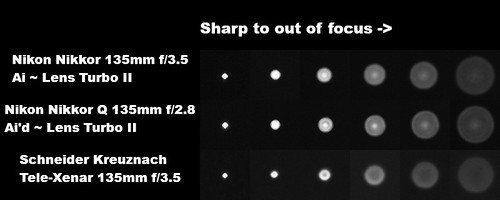
NOTE: I feel the Lens Turbo II focal reducer adds a bit of under-corrected spherical aberration.
The Nikon Nikkor 135mm f/3.5 Ai lens shows under corrected spherical aberrations. In normal photography I would expect, based on these comparisons, that there will be a very smooth and delicate (to use Nikon's own word on the topic) out of focus field rendition.
The Nikon Nikkor 135mm f/2.8 Q Ai'd lens shows under corrected spherical aberrations. The out of focus disk shows variable luminosity and is not as smooth as the f/3.5 Ai. In normal photography I would expect, based on these, that there will be a smooth and delicate (to use Nikon's own word on the topic) out of focus field rendition.
The Schneider Kreuznach Tele-Xenar 135mm f/3.5 lens shows over corrected spherical aberrations. In normal photography I would expect, based on these comparisons, that there will be the tendency to hollow out highlights and brighter areas of the out of focus field rendition. Some would call this a tendency toward a "harsh" out of focus rendition.
Resources -
For further information on how the topic of out of focus rendition, optical properties, and Nikon lens design history, please refer to the following -
A PhD thesis on the impact of "soft focus" lenses on the history of photography - http://research-repository.st-andrews.ac.uk/handle/10023/505
An excellent starting point for understanding out of focus rendition (I might not completely agree with his interpretations/observations, but his foundation of understanding is quite good) - http://jtra.cz/stuff/essays/bokeh/
Nikon lens design histories - https://imaging.nikon.com/history/story/
Point light source discussions - https://www.dpreview.com/forums/thread/4031515
Zeiss comments on optical design - https://lenspire.zeiss.com/photo/en/article/how-does-zeiss-define-bokeh-an-interview-with-dr-stefan-ballmann
Metabones Focal Reducer whitepaper - https://www.metabones.com/assets/a/stories/Speed%20Booster%20White%20Paper.pdf
For many years I looked at just one dimension of commercially available optics - resolution. Now I wanted to start looking at other aspects of optical performance. For this series I look at spherical aberration (looking for under, neutral, or over corrections) in out of focus rendition on subject matter behind the point of focus.
Setup -
- Sony NEX5T, ISO 100, 2 second timer, -1 EV
- Big Beefy Manfrotto tripod
- Lenses using with a Lens Turbo II focal reducer -
- Nikon Nikkor 135mm f/3.5 Ai
- Nikon Nikkor 135mm f/2.8 Q Ai'd
- Lens using a straight through adapter (ie: no focal length reduction to APS-C sensor) -
- Schneider Keuznach Tele-Xenar 135mm f/3.5 (late 1950's to early 1960's)
- NOTE1: Lenses were shot at their widest apertures only
- NOTE2: Out of focus samples are from points _behind_ the point of focus to compare background out of focus rendition
- RawTherapee to convert RAW files into black and white and to set the black levels
If you click on the following image you can inspect it at 100 percent.
Comments -
NOTE: I feel the Lens Turbo II focal reducer adds a bit of under-corrected spherical aberration.
The Nikon Nikkor 135mm f/3.5 Ai lens shows under corrected spherical aberrations. In normal photography I would expect, based on these comparisons, that there will be a very smooth and delicate (to use Nikon's own word on the topic) out of focus field rendition.
The Nikon Nikkor 135mm f/2.8 Q Ai'd lens shows under corrected spherical aberrations. The out of focus disk shows variable luminosity and is not as smooth as the f/3.5 Ai. In normal photography I would expect, based on these, that there will be a smooth and delicate (to use Nikon's own word on the topic) out of focus field rendition.
The Schneider Kreuznach Tele-Xenar 135mm f/3.5 lens shows over corrected spherical aberrations. In normal photography I would expect, based on these comparisons, that there will be the tendency to hollow out highlights and brighter areas of the out of focus field rendition. Some would call this a tendency toward a "harsh" out of focus rendition.
Resources -
For further information on how the topic of out of focus rendition, optical properties, and Nikon lens design history, please refer to the following -
A PhD thesis on the impact of "soft focus" lenses on the history of photography - http://research-repository.st-andrews.ac.uk/handle/10023/505
An excellent starting point for understanding out of focus rendition (I might not completely agree with his interpretations/observations, but his foundation of understanding is quite good) - http://jtra.cz/stuff/essays/bokeh/
Nikon lens design histories - https://imaging.nikon.com/history/story/
Point light source discussions - https://www.dpreview.com/forums/thread/4031515
Zeiss comments on optical design - https://lenspire.zeiss.com/photo/en/article/how-does-zeiss-define-bokeh-an-interview-with-dr-stefan-ballmann
Metabones Focal Reducer whitepaper - https://www.metabones.com/assets/a/stories/Speed%20Booster%20White%20Paper.pdf
Monday, April 08, 2019
Nikon Nikkor 105mm f/2.5 P and Ai ~ point light source comparison
I heard that spending time along the Cote d'Azur could be good for one's art. While I make no claims to be an artist, spending time in the sun along the Mediterranean Sea inspired me to more deeply consider optics as applied to the craft of photography.
For many years I looked at just one dimension of commercially available optics - resolution. Now I wanted to start looking at other aspects of optical performance. For this series I look at under, neutral, and over corrected spherical aberration in out of focus rendition on subject matter behind the point of focus.
Setup -
If you click on the following image you can inspect it at 100 percent.
Comments -
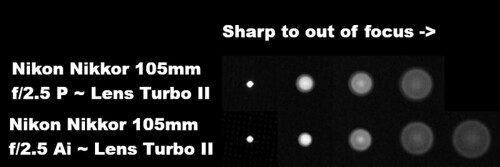
NOTE: I feel the Lens Turbo II focal reducer adds a bit of under-corrected spherical aberration.
Both Nikon Nikkor 105mm f/2.5 P pre-Ai and Ai lenses show under corrected spherical aberrations. In normal photography I would expect, based on these comparisons, that there will be a very smooth and delicate (to use Nikon's own word on the topic) out of focus field rendition.
Resources -
For further information on how the topic of out of focus rendition, optical properties, and Nikon lens design history, please refer to the following -
A PhD thesis on the impact of "soft focus" lenses on the history of photography - http://research-repository.st-andrews.ac.uk/handle/10023/505
An excellent starting point for understanding out of focus rendition (I might not completely agree with his interpretations/observations, but his foundation of understanding is quite good) - http://jtra.cz/stuff/essays/bokeh/
Nikon lens design histories - https://imaging.nikon.com/history/story/
Point light source discussions - https://www.dpreview.com/forums/thread/4031515
Zeiss comments on optical design - https://lenspire.zeiss.com/photo/en/article/how-does-zeiss-define-bokeh-an-interview-with-dr-stefan-ballmann
Metabones Focal Reducer whitepaper - https://www.metabones.com/assets/a/stories/Speed%20Booster%20White%20Paper.pdf
For many years I looked at just one dimension of commercially available optics - resolution. Now I wanted to start looking at other aspects of optical performance. For this series I look at under, neutral, and over corrected spherical aberration in out of focus rendition on subject matter behind the point of focus.
Setup -
- Sony NEX5T, ISO 100, 2 second timer, -1 EV
- Big Beefy Manfrotto tripod
- Lenses using with a Lens Turbo II focal reducer -
- Nikon Nikkor 105mm f/2.5 P pre-Ai (early Sonnar design)
- Nikon Nikkor 105mm f/2.5 Ai (later modified Sonnar, slightly more symmetrical design)
- NOTE1: Lenses were shot at their widest apertures only
- NOTE2: Out of focus samples are from points _behind_ the point of focus to compare background out of focus rendition
- RawTherapee to convert RAW files into black and white and to set the black levels
If you click on the following image you can inspect it at 100 percent.
Comments -
NOTE: I feel the Lens Turbo II focal reducer adds a bit of under-corrected spherical aberration.
Both Nikon Nikkor 105mm f/2.5 P pre-Ai and Ai lenses show under corrected spherical aberrations. In normal photography I would expect, based on these comparisons, that there will be a very smooth and delicate (to use Nikon's own word on the topic) out of focus field rendition.
Resources -
For further information on how the topic of out of focus rendition, optical properties, and Nikon lens design history, please refer to the following -
A PhD thesis on the impact of "soft focus" lenses on the history of photography - http://research-repository.st-andrews.ac.uk/handle/10023/505
An excellent starting point for understanding out of focus rendition (I might not completely agree with his interpretations/observations, but his foundation of understanding is quite good) - http://jtra.cz/stuff/essays/bokeh/
Nikon lens design histories - https://imaging.nikon.com/history/story/
Point light source discussions - https://www.dpreview.com/forums/thread/4031515
Zeiss comments on optical design - https://lenspire.zeiss.com/photo/en/article/how-does-zeiss-define-bokeh-an-interview-with-dr-stefan-ballmann
Metabones Focal Reducer whitepaper - https://www.metabones.com/assets/a/stories/Speed%20Booster%20White%20Paper.pdf
Sunday, April 07, 2019
Nikon Nikkor 85mm, Pentax 85mm Soft ~ point light source comparison
I heard that spending time along the Cote d'Azur could be good for one's art. While I make no claims to be an artist, spending time in the sun along the Mediterranean Sea inspired me to more deeply consider optics as applied to the craft of photography.
For many years I looked at just one dimension of commercially available optics - resolution. Now I wanted to start looking at other aspects of optical performance. For this series I look at under, neutral, and over corrected spherical aberration in out of focus rendition on subject matter behind the point of focus.
Setup -
If you click on the following image you can inspect it at 100 percent.
Comments -
NOTE: I feel the Lens Turbo II focal reducer adds a bit of under-corrected spherical aberration.
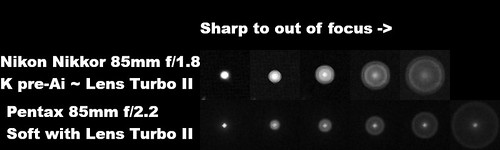
The Nikon Nikkor 85mm f/1.8 pre-Ai shows under corrected spherical aberrations. In normal photography I would expect, based on these comparisons, that there will be a smooth out of focus field rendition.
The Pentax 85mm f/2.2 Soft shows very strongly under spherical aberration corrections. In normal photography I would expect, based on these comparisons, that there will be an extremely smooth and very soft rendition across the field.
There is something interesting about the Pentax soft that should be carefully noted. The point light source remains strongly represented in the center of the out of focus disk well beyond what might be considered the normal point of focus. This is physical evidence for how a severely under-corrected spherical aberration optic can exhibit extreme depths of field, even when the lens is shot wide open.
Resources -
For further information on how the topic of out of focus rendition, optical properties, and Nikon lens design history, please refer to the following -
A PhD thesis on the impact of "soft focus" lenses on the history of photography - http://research-repository.st-andrews.ac.uk/handle/10023/505
An excellent starting point for understanding out of focus rendition (I might not completely agree with his interpretations/observations, but his foundation of understanding is quite good) - http://jtra.cz/stuff/essays/bokeh/
Nikon lens design histories - https://imaging.nikon.com/history/story/
Point light source discussions - https://www.dpreview.com/forums/thread/4031515
Zeiss comments on optical design - https://lenspire.zeiss.com/photo/en/article/how-does-zeiss-define-bokeh-an-interview-with-dr-stefan-ballmann
Metabones Focal Reducer whitepaper - https://www.metabones.com/assets/a/stories/Speed%20Booster%20White%20Paper.pdf
For many years I looked at just one dimension of commercially available optics - resolution. Now I wanted to start looking at other aspects of optical performance. For this series I look at under, neutral, and over corrected spherical aberration in out of focus rendition on subject matter behind the point of focus.
Setup -
- Sony NEX5T, ISO 100, 2 second timer, -1 EV
- Big Beefy Manfrotto tripod
- Lenses using with a Lens Turbo II focal reducer -
- NikonNikkor 85mm f/1.8 K pre-Ai
- Pentax 85mm f/2.2 Soft in Nikon F mount (rare? I've never seen this lens in a Nikon mount before)
- NOTE1: Lenses were shot at their widest apertures only
- NOTE2: Out of focus samples are from points _behind_ the point of focus to compare background out of focus rendition
- RawTherapee to convert RAW files into black and white and to set the black levels
If you click on the following image you can inspect it at 100 percent.
Comments -
NOTE: I feel the Lens Turbo II focal reducer adds a bit of under-corrected spherical aberration.
The Nikon Nikkor 85mm f/1.8 pre-Ai shows under corrected spherical aberrations. In normal photography I would expect, based on these comparisons, that there will be a smooth out of focus field rendition.
The Pentax 85mm f/2.2 Soft shows very strongly under spherical aberration corrections. In normal photography I would expect, based on these comparisons, that there will be an extremely smooth and very soft rendition across the field.
There is something interesting about the Pentax soft that should be carefully noted. The point light source remains strongly represented in the center of the out of focus disk well beyond what might be considered the normal point of focus. This is physical evidence for how a severely under-corrected spherical aberration optic can exhibit extreme depths of field, even when the lens is shot wide open.
Resources -
For further information on how the topic of out of focus rendition, optical properties, and Nikon lens design history, please refer to the following -
A PhD thesis on the impact of "soft focus" lenses on the history of photography - http://research-repository.st-andrews.ac.uk/handle/10023/505
An excellent starting point for understanding out of focus rendition (I might not completely agree with his interpretations/observations, but his foundation of understanding is quite good) - http://jtra.cz/stuff/essays/bokeh/
Nikon lens design histories - https://imaging.nikon.com/history/story/
Point light source discussions - https://www.dpreview.com/forums/thread/4031515
Zeiss comments on optical design - https://lenspire.zeiss.com/photo/en/article/how-does-zeiss-define-bokeh-an-interview-with-dr-stefan-ballmann
Metabones Focal Reducer whitepaper - https://www.metabones.com/assets/a/stories/Speed%20Booster%20White%20Paper.pdf
Saturday, April 06, 2019
Nikon Micro-Nikkor 55mm lenses ~ point light source comparison
I heard that spending time along the Cote d'Azur can be good for one's art. While I make no claims to be an artist, spending time in the sun along the Mediterranean Sea inspired me to more deeply consider optics as applied to photography. For many years I have looked at one dimension of commercially available optics. Now I wanted to start looking at other aspects of optical performance. For this series I look at under, neutral, and over corrected spherical aberration in out of focus rendition on subject matter behind the point of focus.
Setup -
If you click on the following image you can inspect it at 100 percent.
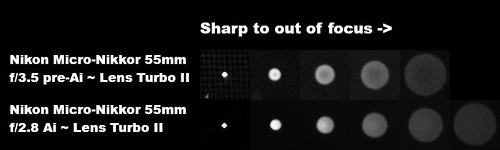
Comments -
NOTE: I feel the Lens Turbo II focal reducer adds a bit of under-corrected spherical aberration.
The Nikon Nikkor 55mm f/3.5 pre-Ai shows very very slight over corrected spherical aberrations. In normal photography I would expect, based on these comparisons, that there will be a smooth out of focus field rendition.
The Nikon Nikkor 55mm f/2.8 Ai shows quite neutral spherical aberration corrections with just a hint of under-corrected behavior in the center of the out of focus disk. In normal photography I would expect, based on these comparisons, that there will be an extremely smooth out of focus field rendition.
There is something interesting about the Micro-Nikkor 55mm macro lenses. They are pretty neutral in their renderings. These are the first (though not the only) lenses I encountered that exhibit this kind of behavior. In practical use I loved the f/3.5 version in this regard for many of the images I made along the Cote d'Azur this winter. Now, after these comparisons, I have mounted the f/2.8 version on a camera and have already found it's out of focus rendering to be as beautiful as I expected/hoped it would be.
Resources -
For further information on how the topic of out of focus rendition, optical properties, and Nikon lens design history, please refer to the following -
A PhD thesis on the impact of "soft focus" lenses on the history of photography - http://research-repository.st-andrews.ac.uk/handle/10023/505
An excellent starting point for understanding out of focus rendition (I might not completely agree with his interpretations/observations, but his foundation of understanding is quite good) - http://jtra.cz/stuff/essays/bokeh/
Nikon lens design histories - https://imaging.nikon.com/history/story/
Point light source discussions - https://www.dpreview.com/forums/thread/4031515
Zeiss comments on optical design - https://lenspire.zeiss.com/photo/en/article/how-does-zeiss-define-bokeh-an-interview-with-dr-stefan-ballmann
Metabones Focal Reducer whitepaper - https://www.metabones.com/assets/a/stories/Speed%20Booster%20White%20Paper.pdf
Setup -
- Sony NEX5T, ISO 100, 2 second timer, -1 EV
- Big Beefy Manfrotto tripod
- Nikon lenses using with a Lens Turbo II focal reducer -
- Nikon Micro-Nikkor 55mm f/2.8 Ai
- Nikon Micro-Nikkor 55mm f/3.5 pre-Ai
- NOTE1: Lenses were shot at their widest apertures only
- NOTE2: Out of focus samples are from points _behind_ the point of focus to compare background out of focus rendition
- RawTherapee to convert RAW files into black and white and to set the black levels
If you click on the following image you can inspect it at 100 percent.
Comments -
NOTE: I feel the Lens Turbo II focal reducer adds a bit of under-corrected spherical aberration.
The Nikon Nikkor 55mm f/3.5 pre-Ai shows very very slight over corrected spherical aberrations. In normal photography I would expect, based on these comparisons, that there will be a smooth out of focus field rendition.
The Nikon Nikkor 55mm f/2.8 Ai shows quite neutral spherical aberration corrections with just a hint of under-corrected behavior in the center of the out of focus disk. In normal photography I would expect, based on these comparisons, that there will be an extremely smooth out of focus field rendition.
There is something interesting about the Micro-Nikkor 55mm macro lenses. They are pretty neutral in their renderings. These are the first (though not the only) lenses I encountered that exhibit this kind of behavior. In practical use I loved the f/3.5 version in this regard for many of the images I made along the Cote d'Azur this winter. Now, after these comparisons, I have mounted the f/2.8 version on a camera and have already found it's out of focus rendering to be as beautiful as I expected/hoped it would be.
Resources -
For further information on how the topic of out of focus rendition, optical properties, and Nikon lens design history, please refer to the following -
A PhD thesis on the impact of "soft focus" lenses on the history of photography - http://research-repository.st-andrews.ac.uk/handle/10023/505
An excellent starting point for understanding out of focus rendition (I might not completely agree with his interpretations/observations, but his foundation of understanding is quite good) - http://jtra.cz/stuff/essays/bokeh/
Nikon lens design histories - https://imaging.nikon.com/history/story/
Point light source discussions - https://www.dpreview.com/forums/thread/4031515
Zeiss comments on optical design - https://lenspire.zeiss.com/photo/en/article/how-does-zeiss-define-bokeh-an-interview-with-dr-stefan-ballmann
Metabones Focal Reducer whitepaper - https://www.metabones.com/assets/a/stories/Speed%20Booster%20White%20Paper.pdf
Friday, April 05, 2019
Nikon Nikkor 24mm, (2)28mm, 35mmPC ~ point light source comparison
Returning home after passing a winter in the south I am inspired to continue my look into point light source in-focus, out of focus comparisons.
Setup -
If you click on the following image you can inspect it at 100 percent.
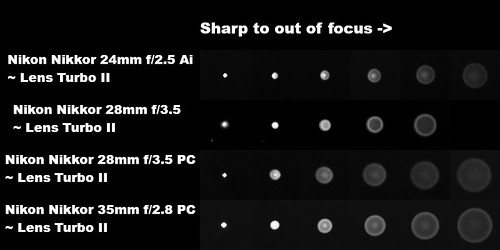
Comments -
NOTE: I feel the Lens Turbo II focal reducer adds a bit of under-corrected spherical aberration.
The Nikon Nikkor 24mm f/2.8 Ai shows under-corrected spherical aberrations with just a hint of a bright ring around the edge of the image circle. In normal photography I would expect, based on these comparisons, that there will be an ever so slightly "busy" rendition in a smooth, delicate out of focus field.
The Nikon Nikkor 28mm f/3.5 H shows strong over-corrected spherical aberration. I find this interesting as this was designed by the man who developed the 105mm f/2.5 P and 50mm f/1.4 S Nikkors. He clearly understood the effects of under-corrected spherical aberration on out of focus rendering. In normal photography I would expect, based on these comparisons, that there will be a strong "soap bubble bokeh" rendition of the out of focus field.
The Nikon Nikkor 28mm f/3.5 PC (perspective control) lens shows moderate under-corrected spherical aberration with a hint of a bright ring around the edge of the out of focus disk. In normal photography I would expect the lens to be slightly "busy" against a smooth out of focus field rendition.
The Nikon Nikkor 35mm f/2.8 PC (perspective control) lens shows moderate under-corrected spherical aberration with a somewhat strong bright ring around the edge of the out of focus disk. In normal photography I would expect the lens to be "busy" against a somewhat smooth out of focus field rendition.
Resources -
For further information on how the topic of out of focus rendition, optical properties, and Nikon lens design history, please refer to the following -
A PhD thesis on the impact of "soft focus" lenses on the history of photography - http://research-repository.st-andrews.ac.uk/handle/10023/505
An excellent starting point for understanding out of focus rendition (I might not completely agree with his interpretations/observations, but his foundation of understanding is quite good) - http://jtra.cz/stuff/essays/bokeh/
Nikon lens design histories - https://imaging.nikon.com/history/story/
Point light source discussions - https://www.dpreview.com/forums/thread/4031515
Zeiss comments on optical design - https://lenspire.zeiss.com/photo/en/article/how-does-zeiss-define-bokeh-an-interview-with-dr-stefan-ballmann
Metabones Focal Reducer whitepaper - https://www.metabones.com/assets/a/stories/Speed%20Booster%20White%20Paper.pdf
Setup -
- Sony NEX5T, ISO 100, 2 second timer, -1 EV
- Big Beefy Manfrotto tripod
- Nikon lenses using with a Lens Turbo II focal reducer -
- Nikon Nikkor 24mm f/2.8 Ai
- Nikon Nikkor 28mm f/3.5 pre-Ai
- Nikon Nikkor 28mm f/3.5 PC
- Nikon Nikkor 35mm f/2.8 PC
- NOTE1: Lenses were shot at their widest apertures only
- NOTE2: Out of focus samples are from points _behind_ the point of focus to compare background out of focus rendition
- RawTherapee to convert RAW files into black and white and to set the black levels
If you click on the following image you can inspect it at 100 percent.
Comments -
NOTE: I feel the Lens Turbo II focal reducer adds a bit of under-corrected spherical aberration.
The Nikon Nikkor 24mm f/2.8 Ai shows under-corrected spherical aberrations with just a hint of a bright ring around the edge of the image circle. In normal photography I would expect, based on these comparisons, that there will be an ever so slightly "busy" rendition in a smooth, delicate out of focus field.
The Nikon Nikkor 28mm f/3.5 H shows strong over-corrected spherical aberration. I find this interesting as this was designed by the man who developed the 105mm f/2.5 P and 50mm f/1.4 S Nikkors. He clearly understood the effects of under-corrected spherical aberration on out of focus rendering. In normal photography I would expect, based on these comparisons, that there will be a strong "soap bubble bokeh" rendition of the out of focus field.
The Nikon Nikkor 28mm f/3.5 PC (perspective control) lens shows moderate under-corrected spherical aberration with a hint of a bright ring around the edge of the out of focus disk. In normal photography I would expect the lens to be slightly "busy" against a smooth out of focus field rendition.
The Nikon Nikkor 35mm f/2.8 PC (perspective control) lens shows moderate under-corrected spherical aberration with a somewhat strong bright ring around the edge of the out of focus disk. In normal photography I would expect the lens to be "busy" against a somewhat smooth out of focus field rendition.
Resources -
For further information on how the topic of out of focus rendition, optical properties, and Nikon lens design history, please refer to the following -
A PhD thesis on the impact of "soft focus" lenses on the history of photography - http://research-repository.st-andrews.ac.uk/handle/10023/505
An excellent starting point for understanding out of focus rendition (I might not completely agree with his interpretations/observations, but his foundation of understanding is quite good) - http://jtra.cz/stuff/essays/bokeh/
Nikon lens design histories - https://imaging.nikon.com/history/story/
Point light source discussions - https://www.dpreview.com/forums/thread/4031515
Zeiss comments on optical design - https://lenspire.zeiss.com/photo/en/article/how-does-zeiss-define-bokeh-an-interview-with-dr-stefan-ballmann
Metabones Focal Reducer whitepaper - https://www.metabones.com/assets/a/stories/Speed%20Booster%20White%20Paper.pdf
Wednesday, April 03, 2019
Nikon Nikkor 50mm and Micro-Nikkor 55mm ~ point light source comparison
Returning home after passing a winter in the south I am inspired to continue my look into point light source in-focus, out of focus comparisons.
Setup -
If you click on the following image you can inspect it at 100 percent.
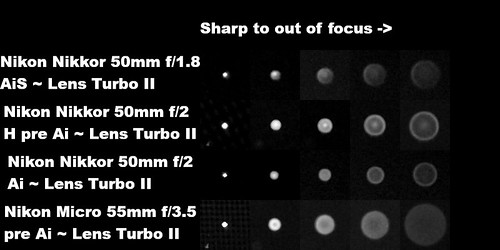
Comments -
NOTE: I feel the Lens Turbo II focal reducer adds a bit of under-corrected spherical aberration.
The Nikon Nikkor 50mm f/1.8 AiS "pancake" lens shows under-corrected spherical aberration from the moment the point light source goes out of focus. The brighter ring around the outside of the image circle seems to indicate a bit of over-corrected spherical aberration as well. In normal photography I would expect, based on these comparisons, that there will be an ever so slightly "busy" rendition in a smooth, delicate out of focus field.
The Nikon Nikkor 50mm f/2 H pre-Ai single coated lens shows rather strong under-corrected and over-corrected spherical aberration. In normal photography I would expect, based on these comparisons, that there will be a somewhat strong "busy" rendition set against a smooth, nuanced out of focus field.
The Nikon Nikkor 50mm f/2 H Ai multi-coated lens shows rather strong over-corrected spherical aberration. In normal photography I would expect, based on these comparisons, that there will be a strong "busy" rendition of an out of focus field. It would expect strong "soap bubble bokeh" rendition.
The Nikon Micro-Nikkor 55mm f/3.5 pre-Ai single coated lens shows neutrally corrected spherical aberration. In normal photography I would expect, based on these comparisons, that there will be a smooth out of focus field.
Resources -
For further information on how the topic of out of focus rendition, optical properties, and Nikon lens design history, please refer to the following -
A PhD thesis on the impact of "soft focus" lenses on the history of photography - http://research-repository.st-andrews.ac.uk/handle/10023/505
An excellent starting point for understanding out of focus rendition (I might not completely agree with his interpretations/observations, but his foundation of understanding is quite good) - http://jtra.cz/stuff/essays/bokeh/
Nikon lens design histories - https://imaging.nikon.com/history/story/
Point light source discussions - https://www.dpreview.com/forums/thread/4031515
Zeiss comments on optical design - https://lenspire.zeiss.com/photo/en/article/how-does-zeiss-define-bokeh-an-interview-with-dr-stefan-ballmann
Metabones Focal Reducer whitepaper - https://www.metabones.com/assets/a/stories/Speed%20Booster%20White%20Paper.pdf
Setup -
- Sony NEX5T, ISO 100, 2 second timer, -1 EV
- Big Beefy Manfrotto tripod
- Nikon lenses using with a Lens Turbo II focal reducer -
- Nikon Nikkor 50mm f/1.8 AiS "pancake"
- Nikon Nikkor 50mm f/2 H pre-Ai single coated
- Nikon Nikkor 50mm f/2 Ai multi-coated
- Nikon Micro-Nikkor 55mm f/3.5 pre-Ai
- NOTE1: Lenses were shot at their widest apertures only
- NOTE2: Out of focus samples are from points _behind_ the point of focus to compare background out of focus rendition
- RawTherapee to convert RAW files into black and white and to set the black levels
If you click on the following image you can inspect it at 100 percent.
Comments -
NOTE: I feel the Lens Turbo II focal reducer adds a bit of under-corrected spherical aberration.
The Nikon Nikkor 50mm f/1.8 AiS "pancake" lens shows under-corrected spherical aberration from the moment the point light source goes out of focus. The brighter ring around the outside of the image circle seems to indicate a bit of over-corrected spherical aberration as well. In normal photography I would expect, based on these comparisons, that there will be an ever so slightly "busy" rendition in a smooth, delicate out of focus field.
The Nikon Nikkor 50mm f/2 H pre-Ai single coated lens shows rather strong under-corrected and over-corrected spherical aberration. In normal photography I would expect, based on these comparisons, that there will be a somewhat strong "busy" rendition set against a smooth, nuanced out of focus field.
The Nikon Nikkor 50mm f/2 H Ai multi-coated lens shows rather strong over-corrected spherical aberration. In normal photography I would expect, based on these comparisons, that there will be a strong "busy" rendition of an out of focus field. It would expect strong "soap bubble bokeh" rendition.
The Nikon Micro-Nikkor 55mm f/3.5 pre-Ai single coated lens shows neutrally corrected spherical aberration. In normal photography I would expect, based on these comparisons, that there will be a smooth out of focus field.
Resources -
For further information on how the topic of out of focus rendition, optical properties, and Nikon lens design history, please refer to the following -
A PhD thesis on the impact of "soft focus" lenses on the history of photography - http://research-repository.st-andrews.ac.uk/handle/10023/505
An excellent starting point for understanding out of focus rendition (I might not completely agree with his interpretations/observations, but his foundation of understanding is quite good) - http://jtra.cz/stuff/essays/bokeh/
Nikon lens design histories - https://imaging.nikon.com/history/story/
Point light source discussions - https://www.dpreview.com/forums/thread/4031515
Zeiss comments on optical design - https://lenspire.zeiss.com/photo/en/article/how-does-zeiss-define-bokeh-an-interview-with-dr-stefan-ballmann
Metabones Focal Reducer whitepaper - https://www.metabones.com/assets/a/stories/Speed%20Booster%20White%20Paper.pdf
Subscribe to:
Comments (Atom)