It seems he has a YouTube channel as well.
I'll never ever get anything close to what that guy has.

It seems he has a YouTube channel as well.
I'll never ever get anything close to what that guy has.
Shared with little comment...
Aero Ektar lenses on old cameras (yes, I used to own an Aero Ektar and used it on a Speed Graphic, too, but what a BEAST that setup was)
David Burnett photographing the 2nd impeachment hearings
Eric Lindbloom "Angels at the Arno" is a book that was shot using 120 film in a cheap meniscus lens Diana
David Hamilton's "Venezia"/"Venice" is a book that was shot in a very soft style
A friend sent links and hints to these and other stuff just yesterday. After wandering around that side of the photo-universe I felt I had to share them in case you're not already aware (I certainly wasn't - not that I know everything - very far from it, in fact).
The passion for photography is clearly evident to me. Makes me wish Paris hadn't just re-confined for the third time in a year. I feel stuck along the cote d'Azur and I don't have access to my "things." I feel I'd like to continue to explore the use of a lens that I modified. And I'd like to order a few books, too.
I realize this is a First World Problem and that we're all in the midst of something deadly serious (Covid-19). Hopefully my wife and I will both have our vaccinations soon.
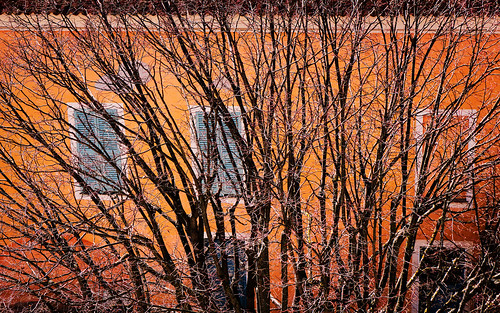
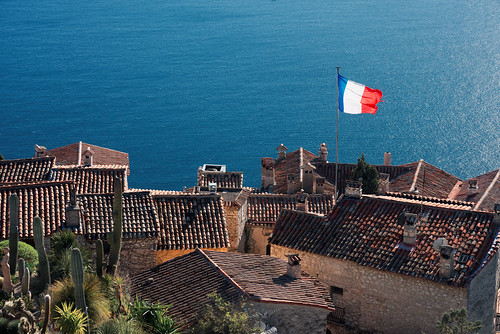
Peille ~ Village Perche'
in the Alps above Menton and Monaco
The prior two winters we in Nice I feel I learned quite a bit about out of focus rendition (aka: "bokeh"). I had a small stack of Nikkor and Takumar manual focus lenses that I'd brought with me. The project was sparked by my wondering how on planet earth the 85mm f/2.2 SF Pentax had apparently such extreme depth of field, even wide open at f/2.2. My questions were eventually answered and I felt I'd spent my time well during winter "down time" when there wasn't much to do along the cote d'Azur.
This year I changed things up quite a bit. I left all my manual focus lenses at home and abstained from dragging the gorgeous low-milage A7 full frame with me. This year I'm going all AF after having learned that manual glass can be quite heavy and the weight limit on baggage can be breeched if one isn't careful when making an emergency return to Paris via aircraft.
I brought with me two EVF Sony APS-C mirrorless cameras. One is a NEX7 that a friend sent me and the other is my old A6000. The A6000 has a 70-350mm f/4.5-6.3 G-Master OSS mounted on it and the NEX7 has mounted on it what turns out to be a very lovely 16-70mm Zeiss ZA f/4 OSS. The out of focus rendition of the Zeiss lens is to my eyes nothing short of wonderful. I may have to write something about these two lenses someday, but we'll see.
This has left me with no photography blog project to work on. The weather is different this year than the last two (colder and wetter). The pandemic has kept folks locked down (even as they fail to wear masks - is it any wonder that this part of France has blown up "red" on the Covid charts?). And even though we bought a used car (our first in our nine years of living in Europe), we head out about once a week. This still leaves a ton of "down time."
My mind ricochets off this and that idea. Daydreaming, thinking about this and that, and considering my recent realization that Sony has correctly implemented the human perception model for converting color to black and white, something tickled the 'ol brain cells and I got to wondering how "sharp" in-camera jpgs might be compared with AWR (raw) format images processed with "Capture Sharpen" in RawTherapee.
This was my first pass.

Click on the image and inspect it at 100 resolution
It is pretty easy to see that the AWR image processed using "Capture Sharpen" is "sharper" than the out of the camera jpg with "Sharpness" set to 0.
This led naturally to the question of what might things look like if I took the in-camera jpg processing "Sharpness" up to +1? Here's what I found.

Here is the full scene
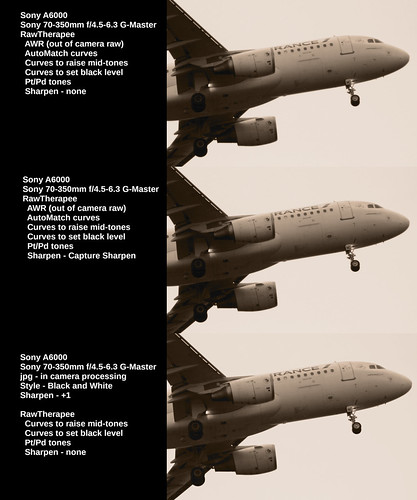
Click on the image and inspect it at 100 resolution
Comparing AWR/"Capture Sharpen" image with the out of the camera jpg with sharpness set to +1 suddenly became much more difficult. At first I didn't notice any difference. It turns out, differences are rather subtle.
My eyes feel strained. On very close 100 percent full resolution inspection (ie: staring at the screen for minutes on end) AWR/"Capture Sharpen" _feels_ to me "digital" with hard edges and steep light/dark transitions. The in-camera jpg processing _feels_ much more like film to me. There is a nice "roundness" to the sharpened image.
I will continue to shoot AWR because I like the flexibility in image processing. If I really want a film like "roundness" to my AWR, I can apply a light unsharp mask or turn down the sharpening parameters of "Capture Sharpen".
There may be times when in-camera jpg processed images are more than adequate. If I set the imaging storage to AWR + jpg I would have the best of both worlds, right?
Which might lead to an interesting new project. What? I have no idea. I seem to have plenty of time on my hands to think about it, though.
A friend sent me a Sony HX90V 30x point and shoot camera to play around with. He said there's nothing wrong with carrying a 30x zoom "toy camera" since it fits nicely in a pocket.
The HX90V small sensor has a narrow dynamic range and tends to be rather "noisy", even at low ISO. These things, compared with the APS-C Sony mirrorless cameras.
Just for grins, I decided to see what would happen if I reduced the file sizes and to see if or where image quality might come close to the APS-C performance.
Here is what I found.
[As always, click on the following image and enlarge it to 100 percent to observe any differences]

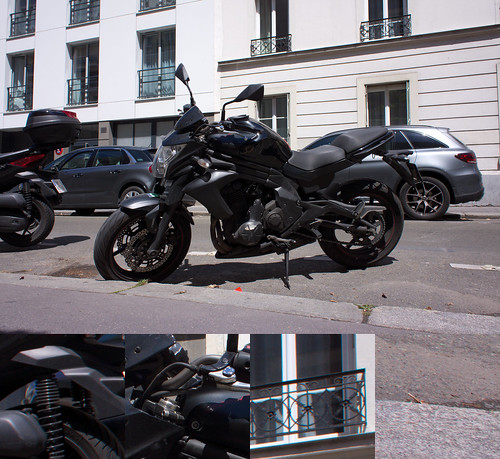
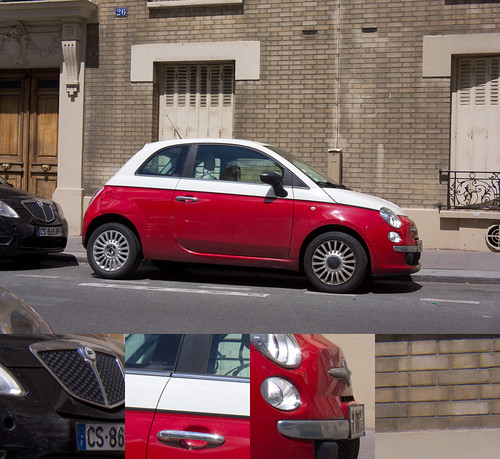
The images down the center of the panel are 100 percent full resolution crops of their respective base images. The superiority of the APS-C system in terms of pure image quality is evident.
Looking at the downsized images at 100 percent (the images down the right side of the panel) show things have pretty much "evened out." The HX90V photos look pretty good. The only somewhat minor differences being in color rendition.
Which goes to show that a little 30x zoom point and shoot camera is just fine for sharing images across the internet.
And if you don't live or die by side by side comparisons with other systems, with proper care and handling the little HX90V Sony can turn out rather acceptable images, even for up to A3 size prints.
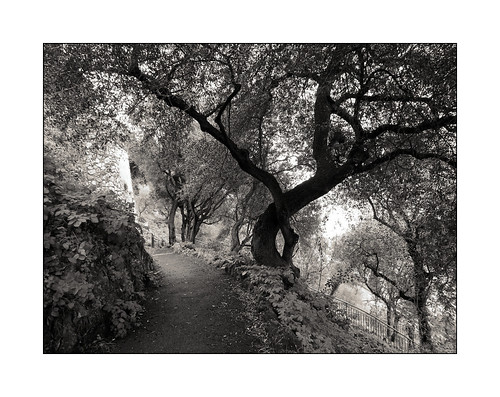
Sony HX90V image from
a walk around Mont Boron, Nice, France
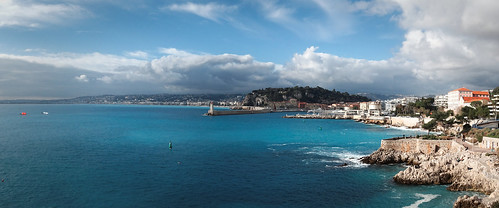
Yesterday was a glorious day here in Nice.
My wife and I went for a nice walk along the sea. I had the Sony HX90V with me and shot a few images.
This week we tried out a new vehicle we purchased while spending the winter in Nice.
There's not much photographic to say about the pretty little Prius except she drives like nothing I've ever driven before, and we've already had a Prius when we lived in Portland. The new version is a Dream Ship. Nothing I've ever driven is as smooth, quiet, nor as well integrated as this. She's a "keeper." It's how we will get around Europe and into the hard to find places.
We have friends who were here in Nice at the same time we were and we'd promised to drive them to Eze to see the jardin exotique that sits at the very top of a huge granite spike.
The only problem was that I'd only driving the Prius once or twice and it'd been at least 9 years since I'd driven on a regular basis. This would be our first trip out and about, or "off leash", as it were. We decided a reconnaissance trip was in order to get the nerves settled and to check out the "lay of the land." We did this the day before we were to meet our friends.
Just before reaching the village of Eze from Nice there is a nice scenic turnout. Turnout we did and I picked up the Sony NEX-7/16-70mm f/4 ZA OSS and made a few images.
When I got home I realized that some of them were slightly soft. What had I done? Was the lens OK? Was something out of alignment? What photographic madness had befallen me?
After thinking for a few moments and slapping my forehead a couple times to get the neurons firing again I realized that I'd done myself in.

This otherwise wonderful image is slightly out of focus. Ugh.
The old fortress at the top of the hill is the high
point of the jardin exotique.
After two years of photographing "stuff" using manual focus lenses, I decided I liked choosing my focus point and then to re-frame a scene to take a photo. In the case of the Zeiss 16-70mm I would set the autofocus in a certain way.
Early Sony NEX cameras have the nasty habit of focusing on a background, particularly if it is contrastier than a subject/object that is closer to the camera. It took me a long time to realize what was going on and even longer to find an adequate autofocus "work around."
My Sony NEX-7 is set up to use the smallest focus point and to activate the back button to perform the autofocus at a very specific point. I know where I want the point of focus and the camera had to learn to trust me, event if I had to beat it into submission.
What I'd done at the turnout was set the focus the first time, and then forgot to focus just before making other images. Silly me, I'd gotten out of the "manual focus" back button autofocus habit. Of course I meant to refocus each time, but I'd simply forgotten to hit the back button focus before hitting the shutter release.
The next day was clear and even more glorious. Our drive to Eze with our friends was quick and easy. We visited the jardin and walked around the medieval village. As I made photographs I forced myself to remember to hit the back button focus before each and every image.
This time when I got home all of my images were properly focused. Not lens problems. No pilot errors. Just plain "goodness."
I really hate making mistakes, particularly after I'd deliberately set the camera up to behave in a specific way. It's a good thing I don't do this for a living.
It's fun remembering the Old Days.
I used Ilford film and paper for a very long time. So I find this video rather interesting.
My father sent yet another video. This time it is on Ansel Adams and the Zone System of exposure.
Of course, with digital equipment most of these considerations have been effectively automated. We seldom consider these kinds of details and certainly not in this specific way.
Watching the video reminded me of two things surrounding the development (LOL!) and use of the Zone System.
First, Phil Davis wrote "Beyond the Zone System" where he helped us understand that film/developer combinations subtly moved the color spectrum up and down the tonal curve. While not as flexible as performing human perception conversions of digital color to monochrome, I think that anything that leads to a better understanding and control of one's tool set very helpful.
Second is something I find incredibly ironic about Ansel Adam's Zone System. It involves the history of the development (2x LOL!!) of this system of exposure control.
One of the photography professors that he taught with at the California School of Fine Arts had suggested this method to Mr. Adams. This professor apparently picked up on the idea from William Mortensen. Reviewing the early Camera Craft books that William wrote where he talks about a very specific series of exposure placement and development perhaps you can see what I'm getting at.
If you know the history of Saint Ansel, the Group 64, and their collective hate for William Mortensen, perhaps you will have already guessed at the irony of the Zone System. I use the word hate because Mr. Adams wrote in a letter that (that was curiously published in his autobiography) he wouldn't be sad if Mr. Mortensen were dead.
I have no idea what would provoke such a strong response from certain West Coast Photographers, but there you have it. A little photo-history drama.
Not to make too much out of the whole episode, here's a video on the works of one of Ansel Adams sudents, John Sexton.
Viewers seldom care about process. Good photography should speak for itself, right?
My father sent me another video -
I didn't realize there had been a movie camera there to record the event. It's pretty interesting to see how they did the climb and to catch a glimpse the stills camera being set up.
Of course this day led to the making of one of the most iconic images Saint Ansel ever made.
By contrast (pun intended?), our current imaging equipment automates nearly everything to perfection. Who remembers how to balance shutter speed and aperture against the sensitivity of the light gather materials? Who cares about film/developer combinations and their effects on local contrast? No, we have it rather easy these days, don't we?
Then, just the other day, I stumbled on an interview with a photographer I've known nothing about. I thought she has some rather interesting things to say about technologies and their relation to image creation.
How we "see" appears to be linked to the tools we use.
NOTE: if you haven't already seen this, it, too, is quite good, but from a different perspective.
Readers may already be aware of something key to understanding Black and White photography and human vision. For myself, it has taken a very long time to sort any of this out. Alas, here I am. Finally.
It is already well understood that taking a color digital image and de-saturating it creates an all too often uninteresting mess. What occurred to me is that Black and White film, too, could be a complete and utter mess. It was always a struggle to get something we called "tonal separation" between the grays.
Back in the day I understood
how a panchromatic emulsion was different from orthochromatic. And I
thought I understood how filters could be useful when shooting
panchromatic film. But, still, film took years of working with to try and get something "interesting" out of. As I say this, I'm thinking of all the "special" developer setups (Rodinol at 200:1 dilution instead of 25:1) and process methods ("semi-standing" for 30 to 45 minutes so as to "bring up" shadow details). What alchemical insanity it all was just to try and get some "tonal separation."
What took me forever to understand is that human perception has something very important to say about how we see color tones in Black and White. Tim Soret clearly illustrates the importance of understanding and using the principals of human perception in imaging. With this in mind, what I have come to learn and appreciate is that digital Black and White image quality can _exceed_ that of Black and White film.
Such a shocking realization, this.
On the other hand, I naively thought that digital in-camera Black and White image conversions were simply de-saturated color images. So I learned how to apply human perception corrections on the computer.
Recently, a friend sent me his wee-Point and Shoot Sony HX90V 30x small sensor plinkey-plinkey camera. It's kind of a fun camera, what with the long zoom range and all that. The poor dear delivers only jpgs and I quickly searched for ways to get the best out of the small setup.
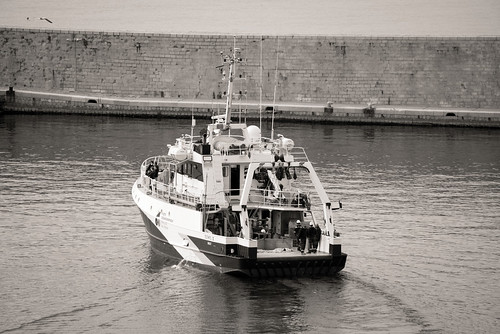
Wandering the Paris streets during our second Covid-19 confinement I made an image my friend and I thought was actually pretty nice. Fortunately, I took two shots. One in color and the second using Sony's in-camera "Black and White Style" (_not_ the High Contrast nor the Rich Tone conversions).
Straight out of the camera the Black and White "Style" image looks really nice (see the following image).
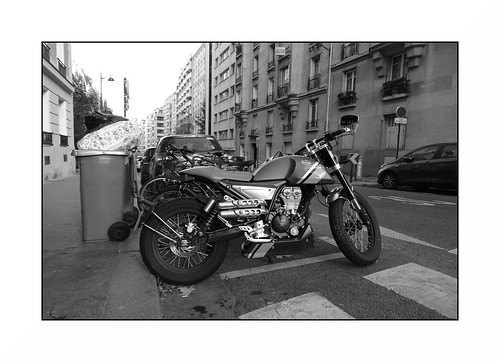
To consider what was going on I took the color version of the image and did a human perception conversion on it to compare against the out of the camera version. Guess what? They matched. Perfectly.
Confirming that Sony is, indeed, using the human perception model for their in-camera Black and White "Style" conversions, I took an A7, stacked three different colors with a bit of yellow and re-ran the comparison.
Note: The human perception model is implemented in the Open Source Software the Gimp as "Lch Color" channel and in RawTherapee as "Luminance."

How do Nikon, Canon, Fuji, Olympus, Panasonic, or perhaps rather interestingly Leica with their Black and White only bling-bling in-camera conversions work? Interested parties should have a look.
For myself I've confirmed that Sony has "hit this one out of the park!"
Here are a few more images nearly straight out of the HX90V plinkey-plinkey - One Two Three Four
My father sent me another video of Ansel Adams.
As I watched it I realized that Europeans don't hold the West Coast photographers in very high regard. The possible exception being Edward Weston, but even he is not as celebrated as, say, New York street photographers nor Weston's lover, Tina Modatti.
I grew up knowing about and following the life and works of Ansel Adams. I went to every show I could, including a fabulous exhibition in LA when I worked in a black and white print lab on Sunset blvd (it was the lab for Samy's Cameras, also on Sunset). He was a central figure in my photographic awareness.
With time I "moved on" to learning about and appreciating other photographer's works. People who know me know that I have a great appreciation for what William Mortensen did for photography. If you don't already understand what I'm saying, check out Mortensen's "Camera Craft" series of guides on model posing, negative and print processes and camera technique.
Coming back to Ansel Adams for a moment, I had an opportunity to buy one of his "Moonrise" prints from his gallery in Yosemite Valley. I had the $800 in my pocket. Stupid me, I went and bought a used Leica M3 with a 50mm f/1.5 Summarit lens, instead. I rue the day I made that decision the way I did.
It is fascinating to watch the following video and to see a young Mr. Sexton working as Ansel's assistant. Sexton was in Portland once on a lecture and book tour and I got to meet him and learn a bit about his approach to seeing things.
Anyway. Enough of that. Here is the video.
My father sent me the following video.
I find it interesting as it illustrates, for me, the deep understanding a person needed of their tools and techniques to make a decent image.
Of course, there is an easy comparison to today's cell phones. I can imagine current image makers wondering what all the fuss was about.
As a person who made the transition from alchemy, through controlling the materials as carefully as I could, to simply pressing a button, I could ramble on for many beer or wine soaked hours. But, in truth, it all is of little import.
All that matters is the image.
I really like what this guy says and did here. It is making me stop and think a bit more deeply about out of focus rendition and its importance (or lack there-of) in photography.
I recently snarked and whinged over obvious changes taking place in the community of image makers. Not knowing what else to do, bored I guess, I decided to see what was on the market. Which led to an upheaval of equipment chez moi.
The shift started with the Elinchrom flash kit. Then, like magic, half of my collection of Nikon Nikkor glass was on offer. Only to be replaced by a couple things.
Lots going out. Just a bit coming in. Better balance of tools and materials? Maybe.

From a photoshoot I had
shortly after moving to Paris
lit using Elinchrom Bx500Ri
The Elinchrom flash system was used perhaps a dozen times. I'd purchased the materials new in anticipation of working with models in Paris of the kind I enjoyed working with back in Portland, Oregon. Alas, things are quite different here, I had a big lesson to learn, and I was never able to get anything serious off the ground.
After nearly three years of sitting idle, I sold nearly everything from the studio kit. I've kept the backdrop system of poles and stands "just in case" something comes up. I will use available light should any future opportunities to work with creative people arise.

A small sample of the collection of
Nikkor lenses that used to take up
space in the closet
With the Nikkors I rationalized the sales by admitting I had way too much glass in the closet. I had duplicates and sometimes quadruplicates of nearly every focal length from 20mm up through 300mm. So a bunch of stuff had to go.
Knowing now what I know about out of focus rendition and how nearly all lenses out resolve film and sensors, I decided to keep a few that I've found have unique properties. The Micro-Nikkors and an interesting 50mm a/1.8 AiS remain in the closet. So do the incredible 85mm f/1.8 K and early 105mm f/2.5 P. I'm weighing keeping the surprisingly good 75-150mm Series-E f/3.5 and an old 35mm f/2 pre-Ai as well.
After a few sales the envelope of resources had grown somewhat large and, lo and behold, I can across an inexpensive nearly mint Zeiss 16-70mm ZA OSS f/4 for the Sony APS-C mirrorless cameras.

Sony NEX-7 with Zeiss 16-70mm f/4 ZA OSS
What a find this has been! The 18-55mm Sony kit lens only "comes good" around f/8. Looking at the resolution of the 16-70mm Zeiss from wide open proves to me the value of spending a bit of money for something "decent."
Then I looked at the out of focus rendition and I find I am very pleasantly surprised. I contrast the Zeiss experience against my long time use of a Canon 24-105mm L f/4. The Canon lens was hugely expensive and had more than a few short-comings that became obvious with use. However, the Zeiss optic is so good that it doesn't seem to have any weaknesses. I might have to spend a year or two using it as my daily "beater" lens.
Thumbing a bit deeper into the envelope revealed even more resources. So, what to do next? Well, it turns out I want to solve a specific problem that I was having photographing automobiles at the Montlhery Autodrome. It is a high banked track that dates from the early 20th century and motor-events are held nearly every weekend there.

Nikon Nikkor 100-300mm f/5.6 AiS ~
a real beast to manually focus, but when
I nail the focus - woohoo!!!
Previously I used a Nikon Nikkor 100-300mm f/5.6 AiS to reach out and show the steepness of the racetrack's incline. This lens isn't often talked about, but it is one of the finest optics, fixed focal length or zoom, that I've ever encountered in this range. The out of focus rendition is "to die for" gorgeous. The resolution is incredible from wide open. It really is that good. But, manually focusing that thing at 300mm is a real bear, even when perched on a monopod.
I'm not sure how it happened, but I rediscovered that Sony recently released a 70-350mm G-Master optic for their APS-C system. A friend has been sharing some images from airshows in England, where he uses a Canon 100-400mm L.
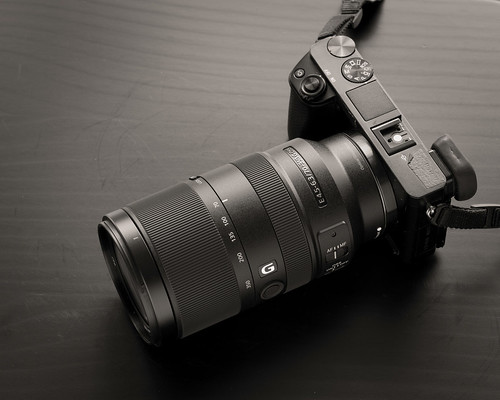
Sony A6000 with Sony 70-350mm f/4.5-6.3 G-Master
At 350mm's on the long end the Sony isn't quite as long a lens as the 100-400mm Canon, but it might be close enough (what's 50mm's, really now). It has better reviews than the more expensive full frame Sony 70-300mm G-Master. The out of focus rendition looks nearly the equal of the 100-300mm Nikkor. For this old man who is getting a little shaky the very best part is that the Sony 70-350mm comes with auto-focus and optical image stabilization.
I'm looking forward to Montlhery re-opening events to the public (we're in the midst of a pandemic just now). This coming spring at the Vintage Revival I hear that the Beast of Turin will thunder its way around the circuit. What a sight that will be! Maybe my wife and I will be able to go across la manche to see our English friends, too, as soon as things open up again. There are a few of our friend's airshows that I'd like to see what this lens can do.
All this leads me to the current state. I really should stop buying and selling things, but it's what I do when I'm bored and photo opportunities are few.
When the situation changes and I can get out more I know I will be able to concentrate on making images and this Madness will pass.
Oh. Have I mentioned I've taken up drawing? Hah. I must really be bored.

Beast of Turin Fiat S76 at Retromobile 2016
[A couple days after I posted the following comments, The Online Photographer had this to say.]
Kirk Tuck says it well.
"...blogging sure has changed over the last eleven years. We used to talk as much about gear back then as we do now but it seemed more important at the beginning. People were still transitioning to digital from their filmic pasts. Gear was improving by leaps and bounds. Mirrorless cameras were in their infancy and it seemed that DSLRs would rule forever. LED lighting was on very few peoples' radars. Portable flashes were the hot photo topic - that, and full frame cameras..."
This is my experience, too.
I look at the three flash monobloc system I paid 1900Euro (TVA included) just eight years ago when my wife and I first moved to Europe and, well, it's worth, if I'm lucky, perhaps 200Euro for the entire thing at this point. And, truth be told, there are less expensive and more feature laden solutions for lighting.
Lenses are things I've looked at as part of photographic systems since the 1980s. Much as changed here, as well. Even the cheap glass is capable of outperforming (in certain meaningful ways) earlier, more expensive items. The higher end optics are so outstanding that they are now controlling 11th order effects in optical design, where just a few years ago a lens designer told me it was crazy to think there was much to be gained by trying to control 7th order effects.
Advancements in image processing software have largely nullified the limitations of ultra-small sensors. Current mobile phones are clear examples of what I mean by this. Image stacking for noise reduction, as well as increases in resolution are now done in-device and on the fly.
Many of the things that made photography a craft, such as lens selection, focusing, aperture, shutter speed, and ISO (ASA, back in the day) have, again, been nullified by advancements in technology integration.
I'm left with knowing and understanding things that are no longer be necessary to making a decent image. Wet plate collodion alchemists may have felt something similar when dry plate, and soon thereafter, dry roll film became widely and cheaply available.
As always, the magic ultimately lay not in the alchemy, the chemistry, the lenses, the cameras, nor the techniques, but in the application of these in making a good photograph. That was always the goal, regardless of how one got there.
Yet, here too, current practitioners are shutting down their blogs. I'm thinking of Ming Thein as I type this. While the world is in constant flux, but Ming's and Kirk's recent decisions to shutter their blogs seem somehow related.
Making a good photograph no longer is the goal. See the billions of images posted to Instagram, Facebook, and Pinterest as examples of what I mean.
In my own case, after many years of engaging social media platforms and discussion forums and photography websites, I have closed nearly all of my accounts. Some of this was by my choice (I don't like Facebook nor Instagram nor DPReview, and Pinterest seems oddly organized). Others made choices for me (Tumblr with policy changes, Google shutting down Google+, MySpace users going elsewhere, etc.).
Only my Flickr account and this blog remain active. These are my outward facing portals in the on-line world. As what I know increasingly lacks relevancy, as I run out of things to share and things to say, maybe this, too, will change?