Wednesday, November 27, 2019

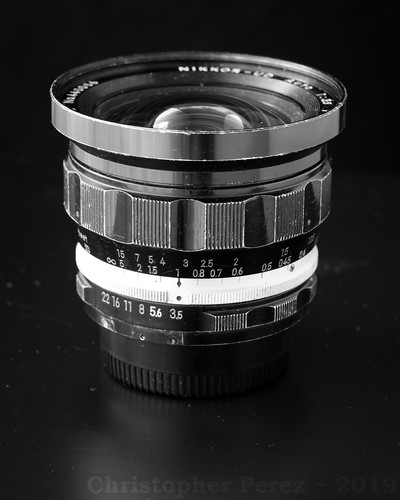
Lens Stories ~ Nikon Nikkor 20mm f/3.5 UD pre-Ai

The gifts keep coming.

Lens Stories ~ Nikon Nikkor 20mm f/3.5 UD pre-Ai

In the box along with the Sony NEX-7 my friend sent a Nikon Nikkor 20mm f/3.5 UD.  I was surprised, pleased, and, of course, very interested to see how it performed.

Historically, Nikon had earlier designs for a 2,1cm lens.  Those were symmetrical and the rear element set recessed deeply into, first, Nikon rangefinder camera bodies and later the Nikon F SLR.  In the case of the SLR the mirror had to be mounted up and out of the way so the rear element set could be properly positioned, thus nullifying the benefits of being able to look through the lens.

Thinking about it for a moment, the 20mm f/3.5 UD I was now holding represents Nikon's first strongly asymmetrical ultra-wide angle lens designed specifically for the Nikon F SLR.  For its time the lens would've been rather unique.

Lens Stories ~ Nikon Nikkor 20mm f/3.5 UD pre-Ai

Off to beers with a friend one day I took one of my trusty Sony NEX-5T cameras (I have far too many of these because, well, they're cheap now) with a Lens Turbo II focal reducer and mounted the old Nikkor.  The first thing I noticed was just how large the 20mm Nikkor is when used on a very slim, very small APS-C Sony mirrorless camera.  The next interesting thing I would notice had to wait until I returned from the pub.

One of the images that I'd taken had deliberately included sections of strong daylight highlights and deep pub-interior shadows.  The (now) small 16mpixel sensor is well known for it's long 13EV dynamic range.  The newer 24mpixel APS-C Sony sensors only slightly extend the range to 13.4EV (NEX-7).  So this, to me, means the old sensor will continue to perform very nicely for much of the kinds of photography I tend to do.

Liking fields of subtle grays I am pleasantly surprised by the detail and "creaminess" of the image I took of my friend.  As you can see, there is detail deep into the shadows and the highlights roll off nicely, just like when using old silver halide film.

The lens appears to produce little to no flare, which is quite remarkable considering the age of the optic and the fact it is only single coated.  It is sharp from wide open. 

I think this lens is a "keeper."

Lens Stories ~ Nikon Nikkor 20mm f/3.5 UD first light

Thursday, November 21, 2019

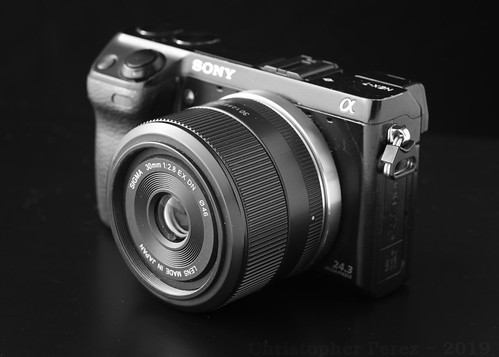
Camera Story ~ Sony NEX-7

A friend sent me his "old" Sony NEX-7.  Such a gift this is.  Such a gift.

Lens Stories ~ Sony NEX-7

My friend's first NEX-7 had died a mysterious and sudden death.  So he went down to the local camera store and picked up a nice used example as a replacement.  This second NEX-7 is the one he sent me.

I really like how Sony implemented the "rangefinder" EVF in the upper left-hand corner of these cameras.  In bright sunlight I can see what I'm focusing on and my "hit rate" is much better than with the non-EVF NEX-5T or A5000 camera bodies that I also use.

The first thing I did after receiving the camera was to check that the sensor was clean, and it was.  Then I took some photos and then applied black tape to "blacked out" the make and model information.  I like my cameras appearance better when I do this.  Lastly, I opened an instruction manual and read through how to set the functions and dials and wheels.

It is easy to see how similar it is to the more recent Sony A6000.  The controls layout, the overall size and weight of the cameras are nearly the same.  There is a strong family resemblance between these two. There are a couple minor differences (such as an AF mode control switch) between the NEX-7 and A6000.

Another difference is the Sony NEX-7 dual wheel control.  I think they called this "tri-navi", or something like that.  This is different from any Sony camera I've used.  There are two programmable wheels along the top back edge.  The default setting has the right wheel modifying the exposure value for setting under/over-exposure.  The left wheel is dedicated to aperture, shutter speed controls.  Then there is the role of the (unmarked) "function" key and how it is programmed.

Lens Stories ~ Sony NEX-7

After fiddling around with this for awhile it all seems rather complicated to me.  I can barely keep straight the menuing systems change that took place between the NEX-series cameras and the newer A-series.  When in a photo-shoot I find myself checking the setting, concentrating on not bumping something, rechecking and so-forth.

I seldom encounter a need to change a camera's setting once I enter a photo-shoot.  Sometimes I will change the over/under exposure settings, but that's easily done on the wheel control on the back of the camera.

In any event, I try to anticipate the conditions I will find myself in, set a camera's controls and functions, and then try to avoid, as I said, bumping any of the dials and controls during a shoot.

Reading the manual I came across the method Sony provides for disabling the dual wheel system.  It involves holding down the (unmarked) "function" key that sits just next to the shutter release button.  Now that this has been sorted I feel the camera won't "fight" me when I accidentally bump something or other.

According to DxOMark the Sony NEX-7 has 13.4EVs of dynamic range.  Which is to say, it has over 13 "f-stops" of dynamic range.  By comparison, the Sony A6000 I have is reported to have 13.7EVs of dynamic range.  The difference between these two cameras would be, I imagine, rather difficult to see in practice.

In summary, think the camera will be every bit as good an image making machine as the A6000 which I will continue to very much enjoy using.

Camera Story ~ Sony NEX-7

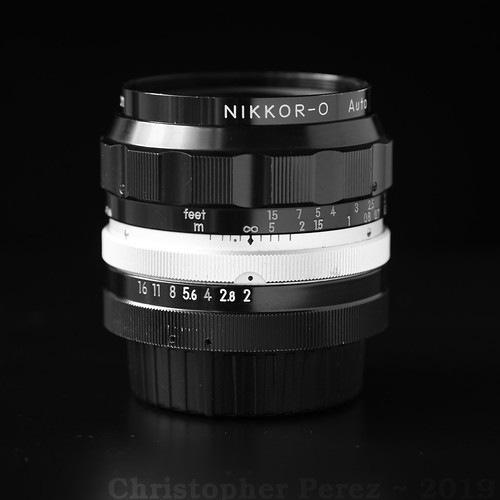
For the illustration images seen here I mounted-up a nice, light, sharp little Sigma 30mm f/2.8 EX DN.  Shortly after taking the images I blacked out the bright spots and replaced the Sigma lens with a Lens Turbo II, Nikon Nikkor-O 35mm f/2 pre-Ai setup.  It's in this configuration that I will see how things work out for me and my friend's "old" camera.

Sunday, November 17, 2019

Nikon Nikkor 50mm f/2 H pre-Ai, Micro-Nikkor 55mm f/3.5 pre-Ai ~ Macro Comparison

Something in an article on Nikon's Thousand and One Nights site caught my attention.  They said, referring to the Nikon Nikkor 50mm f/2 H -

"...We should also mention that the drop in performance for close-up work is small, and not only is the high quality maintained at the closest focusing distance of 0.45m (1.5ft.), but the lens also produces high quality when used on a bellows or extension rings for macrophotography..."

I happen to have a copy of the pre-Ai 50mm f/2 as well as a Micro-Nikkor 55mm f/3.5 which is also pre-Ai.  So I thought it might be interesting to see how the two lenses compared.

Setup ~
  • Sony A6000, 2 second delay, 100ISO
  • Big Beefy Manfrotto tripod
  • Straight-through Nikon to Sony E adapter
  • Lenses -
    • Nikon Nikkor-H 50mm f/2 pre-Ai
    • Nikon Micro-Nikkor 55mm f/3.5 pre-Ai
  • Two tourist "0 Euro" as flat subject-matter
  • Rawtherapee (no sharpening) to convert from AWR to jpg

Comparison ~

Here is the scene setup.

Scene Setup ~ Macro Study


Here is the comparison.

[If you click on the image it'll take you to the Flickr hosting site. Once there, look at the file at full resolution. In many cases the differences between lenses is small and likely can't be seen until you take a squint at the comparison at 100 percent.]

Macro Comparison ~ Nikon 50mm f/2, 55mm f/3.5


Comments ~

Note: Keep in mind that when dealing with macro subjects that the slightest field curvature in a lens will cause the edges of the frame to not be in focus.  However, if you either focus at the edges (which isn't exactly useful for keeping the center of the frame sharp) or stop the lens down to (as in this case, f/8) you will often see that the edges are, in fact, quite sharp.

Wide open the 50mm Nikkor-H f/2 pre-Ai is slightly soft in the center of the frame and very soft at the extreme edges.  Starting at f/2.8 the center is actually acceptably sharp.  This continues all the way through f/8 (and likely beyond, but I didn't test for the smallest apertures).  The edges of the frame become progressively sharp as the lens is stopped down.  Around f/8 the resolution begins to approach that of the Micro-Nikkor.

The Micro-Nikkor 55mm f/3.5 pre-Ai, by comparison, is very sharp from wide open across the entire field.  To me this remains an absolutely brilliant general purpose optic.

What I take from this comparison is that, yes, the Nikkor-H 50mm f/2 is mostly stable when focused at macro distances.  Like most non-macro lenses, it suffers from field curvature.  This makes the lens an interesting challenge when working with flat documents.  Yet when dealing with bugs, morning dew-drops and other potentially interesting subjects in a non-flat real world the lens is, as advertised, quite good for macro work.

Note 2: I have enjoyed reading Nikon's Thousand and One Nights series.  Their comments on early lens design, the trade-offs they made, and results they were seeking are, for me, very informative.  Their writings have helped me consider lenses more deeply than just the shallow one-dimensional considerations of "sharpness" and "resolution" that I've been overly prone to for the past 20 years.

Monday, November 11, 2019

Lens Stories ~ Nikon Nikkor-O f/2 pre-Ai

In a fit of downsizing the Lens Closet I sold a very good condition Nikon Nikkor 35mm f/2 Ai. 

There was just "something" on the edge of perception that made images special when I used this lens.  As always, for me regret is a powerful motivator.  Even though I am rich in 28mm and 50mm lenses, I just had to have another copy of the 35mm f/2.


Nikon Nikkor-O 35mm f/2 ~ Lens Stories

I've been thinking about this for over two years.  I've been trolling "that auction site" to see what might turn up.  I've been hoping that I could mend the errors of my ways.

Then, one day not too long ago, I came across a beautiful-looking early single-coated pre-Ai Nikkor-O version of the lens.  It had a case and, well, it looked rather un-used.

With patience that comes with age I bid late in the auction and, surprise!, won.

The package the lens arrived in had been sliced by a sharp blade along one seam.  While unopened, I wondered who did that and why?  The story I got from the point relais where I picked the lens up from was completely bogus.  Something was up.  So I opened the package right there in front of the man, just to make sure everything was OK.  It was, so I took my new acquisition and left.

From my first example of the lens I knew that Nikkor-O would be sharp.  There is a bit of field curvature, but along that line of that curvature images are sharp all the way to the edge of the frame.

Once back to home and hearth I took a quick look at the lens' out of focus rendition.  It looks and "feels" similarly to the Nikon Nikkor 50mm f/1.8 AiS and the 24mm f/2.8 Ai.  Which is to say, behind the point of focus the Nikkor-O is gently under-corrected for spherical aberration.

The all up cost, including delivery?  It came in under my self-imposed limit of 50Euro with more than a few Euro left over. 

When will I ever learn my lesson about selling lenses that I like?  For the moment balance in life has been re-achieved. 


Nikon Nikkor-O 35mm f/2 ~ Lens Stories

[NOTE: The photos in this album and this album, too, were shot using the Nikon Nikkor-O 35mm f/2 pre-Ai]

Saturday, November 09, 2019

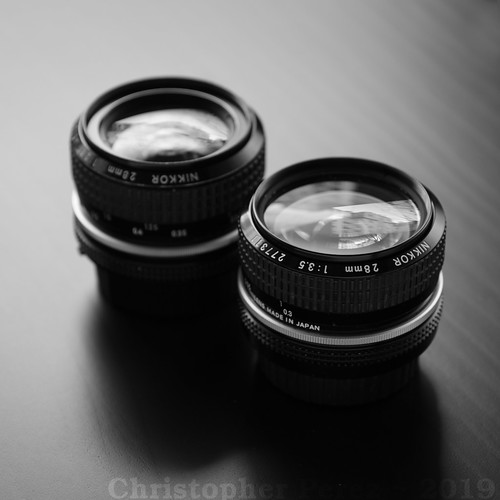
Lens Stories ~ Nikon Nikkor 28mm f/3.5 pre-Ai, f/2.8 Ai

Returning to my usual and customary target of spending less than 50Euro a lens we come to a pair of 28mm Nikon Nikkors.  One is pre-Ai and f/3.5.  The other is Ai and f/2.8.


Nikon Nikkor 28mm f/2.8 and f/3.5 ~ Lens Stories

The Nikon Nikkor 28mm f/3.5 pre-Ai was, in fact, the lens that taught me the virtue of patience and keeping a sharp eye out for more fun toys.  Er.  I mean photographic tools.

Searching "that auction site" one day, I stumbled across an early design 28mm.  The bids were low and so I decided to watch it.  Then, at the last moment I bid low and still won.  The lens was scored for significantly less than 50Euro.

What I'd read was this was the first wide angle lens Nikon designed for the F mount SLR cameras.  Historically the first lenses hit the market in 1959.

Being an early design, "conventional wisdom" suggests this lens isn't as sharp as a more modern optic.  Maybe I have a "good" lens, but I don't see the f/3.5 lens' performance as being any less than outstanding from wide open.  Well, in the center, at least.  The edges aren't at all bad wide open when you take into account field curvature.  In general it takes stopping down to f/5.6 for things to clean up pin sharp across a flat field.

The Nikon Nikkor 28mm f/2.8 is a favorite of some people on the 'net.  It has a reputation for being sharp, light, and "handy".  This version of the optic was first introduced in 1974.  Looking at a cross-section of the lens it's easy to see where the f/2.8 design differs from the earlier f/3.5.

Taking into account for mild field curvature, indeed, my copy of the f/2.8 is sharp from wide open in the center all the way to the edges of the field.  And looking at the out of focus rendition, the more modern lens is ever so slightly under corrected for spherical aberration behind the point of focus.

While I think the f/2.8 gives a softer, more "delicate" out of focus rendition than the f/3.5, there are times when I feel the older design lens is just plain perfect as is.  Check out this example and perhaps you will see what I mean.

As for what I paid for the Nikon Nikkor 28mm f/2.8 Ai, there's a bit of a story.  It begins with a box of lenses that I bought of "that auction site."  A good 70 percent of the lenses were easily fixed up and one was, in fact, mint.  So I put it on a local to France sales site and suggested I'd be open to trades for something interesting.  One morning in my inbox was an email suggesting the 28mm.  The gent was happy for the trade and I'm sure the lens he now has is keeping him plenty happy.

In the end, the 28mm f/2.8 set me back all of 7Euro.

What I have here are two wonderful lenses.  They are simply Nikon pin sharp and both give a creamy out of focus rendition.  I can't tell the difference between them.

Do I honestly "need" two 28mm lenses, or three, really, if you count the pretty 28mm f/3.5 PC that I also own?  I suddenly find myself rather rich in this focal length.


Nikon Nikkor 28mm f/2.8 and f/3.5 ~ Lens Stories

[NOTE: The wide angle photos in this album were all shot using the Nikon Nikkor 28mm f/3.5 pre-Ai]

Thursday, November 07, 2019

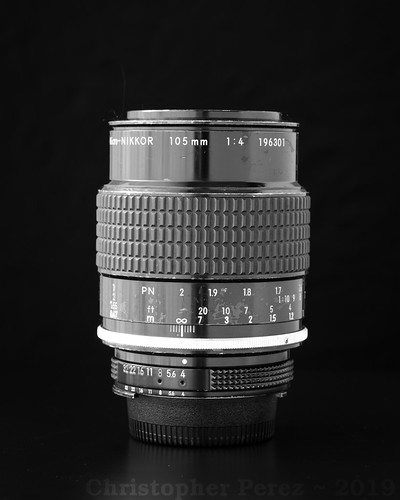
Lens Stories ~ Nikon Micro-Nikkor 105mm f/4 Ai

Lens Stories ~ Nikon Micro-Nikkor 105mm f/4

On the same day, at the same time, and with the same seller that I broke my self-imposed Lens Budget Cap of 50Euros when I purchased the Nikon Nikkor 85mm f/2 Ai, I purchased a second lens.

The other lens was the worst condition lens that I think I've bought in nearly 30 years.  The first bad condition optic purchased lo those many years ago was a Zeiss Tessar 15cm that had come with a 4x5 view camera and who's front element was severely scratched.  The lens was so badly damaged there was no contrast in an image.  To help myself "feel" better about that transaction I rationalized by saying I received a pretty nice camera for little money and a junk lens for free.

In the case of the Micro-Nikkor 105mm f/4 Ai my rationalization for the purchase was a bit different.  Indeed, the exterior of the lens looks terrible.  Even that old 15cm Tessar looked better on the outside than this thing does.  There is so much "brassing" ("aluminuming"?) on the Micro-Nikkor that I might be able to use it as a reflector to bounce light into shadows.  I exaggerate, but not by much.

What separated my money from the wallet was something that I'd considered when looking at the out of focus rendition of the Micro-Nikkor 55mm f/3.5 pre-Ai and f/2.8 Ai lenses.  These lenses were my first encounter with nearly neutral spherical aberration control behind (and, of course in this case, in front) of the point of focus.  Hoping that Nikon had designed all it's Micro-Nikkor lenses this way led me to think the 105mm f/4 could be a natural compliment to the shorter focal length macro lenses.

I should stop here for a moment and explain why neutrally controlled spherical aberration in the out of focus areas is important to me.  CarsMotorcycles.

While for some subject matter I absolutely love the under-corrected spherical aberration out of focus rendition of both the 105mm f/2.5 and 85mm f/1.8 K, when photographing machinery I feel distracted by the "softness" and highlight "pop" I many times get when using those lenses.  They "feel" like outstanding portrait lenses more than they feel like the best tools to document machines.

After getting the Bruised Beast home I took a look at its "resolution" and its out of focus rendition.  Yes, the Micro- Nikkor is as sharp as I expected it to be.  Yes, the Micro-Nikkor has a flatter field from wide open than my other 105mm lenses.  But...  Surprise!  Surprise!!  The out of focus rendition is closer to the performance of the 105mm f/2.5 P and updated design Ai lenses than to the neutral spherical aberration corrections of the Micro-Nikkor 55mm lenses.

So... now what to do...?


Lens Stories ~ Nikon Micro-Nikkor 105mm f/4

Tuesday, November 05, 2019

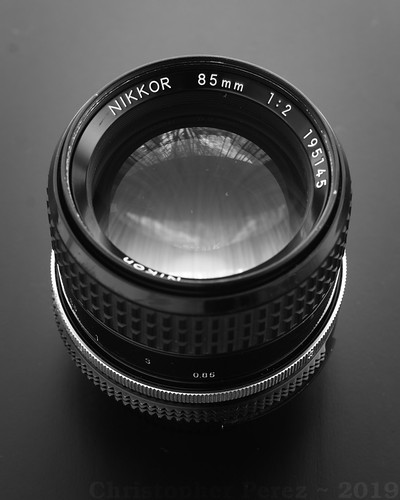
Lens Stories ~ Nikon Nikkor 85mm f/2 Ai

OK.  So I broke my own self imposed budget limit.  I couldn't help myself.  I'm sure I could justify the purchase based on non-budgetary criteria.  My fuzzy little mind remembers wondering how Nikon's successor to the 85mm f/1.8 H, HC, K lens performed behind the point of focus.

I'd read that the 85mm Nikkor f/2 was a "boring" lens.  Sharp(ish) wide open and nothing special by way of its out of focus rendering.

I owned a pretty Nikon Nikkor 85mm f/2 Ai when I first moved to Europe.  But it was sold in a fit of "downsizing" the photographic tools cabinet.  Slowly, over the years, I came to regret the decision.  So when this lens came up at a somewhat reasonable price, my 50Euro per-lens budget cap went out the window.

Nikon Nikkor 85mm f/2 ~ Lens Stories

Being one to not trust what's posted on the 'net, I decided to have yet another look at this lens.  Here is what I found (confirmed, yet some more?, oh gawds, the Insanity continues).

The Nikon Nikkor 85mm f/2 Ai is very slightly sharper wide open than any of the Nikon Nikkor 85mm f/1.8 H, HC, or K lenses that I've owned.  By f/2.8 my eyes can't see any difference in "resolution" between the two lenses.

Looking at behind the point of focus rendition I see that the f/2 lens is much more neutral in it's correction of spherical aberration than the f/1.8 lens is.  Perhaps it is this characteristic that some people find "boring?"  I wonder.

In any event, the f/2 lens has shallower depth of field wide open than it's f/1.8 sibling.  This has a lot to do with how the out of focus region spherical aberration is treated.

Nikon Nikkor 85mm f/2 ~ Lens Stories

Standing back a bit and looking at the two lens designs, I can hazard a guess or two about their performance trade-offs and design details.  Perhaps the most obvious is this.  The f/1.8 H, HC, K lens is a wonderful portrait lens in the old style.  The lens designer gave that lens a subtle, beautiful behind the point of focus rendition.  Highlights positively "glow" and it reminds me in some ways of a lovely Wollensak Verito large format optic.  The complement to the older 85mm lens, in my mind, is the lovely 50mm f/1.8 Ai/AiS.

The Nikon Nikkor f/2 Ai lens, on the other hand, feels well corrected.  It could be a good companion to the Micro-Nikkor 55mm f/3.5 pre-Ai and f/2.8 Ai and Nikkor-O 35mm f/2 lenses that I tend to shoot with.

Sunday, November 03, 2019

Lens Stories ~ 3 Nikon telephoto zooms

I'm at a loss to explain why the prices have seemingly dropped out of the old manual focus lens market.  Sure, there are likely more than a few good reasons for this, but nothing stands out in my mind as the _most_ likely explanation.

No matter.  I find I'm enjoying finding brilliant optics for not much money.  It's too much fun, in fact, and I've made something of a game of it all, searching for the cheapest and best optics I can find.

I set an arbitrary upper limit on what I will spend on an old piece of glass at 50Euro.  Perhaps surprisingly I'm able to many times pick up a lens for less than that, delivered.  Here are three examples.

3 Nikon zooms ~ Lens Stories

Some time back I picked up a Nikon Nikkor 80-200mm f/4.5 N for what I felt at the time was a shockingly low price (much less than the one seen in the previous link).  The lens is in very good condition and the optics are mint.

Not long after I found a mint condition Nikon 75-150mm f/3.5 AiS for half what I paid for the 80-200mm.  These days no one seems to like the short 2x zoom, but go back to when the lens first came to market and you'd see fashion photographers use practically nothing else (yes, I exaggerate, but not by much).  This lens, while costing so little, delivers much more than you might believe possible.

After spending the winter in Nice I came home and causally scanned the latest lens offerings on the 'net and came across the mighty Nikon Nikkor 100-300mm f/5.6 AiS for what I'd paid for the 80-200mm.  This model zoom is long but makes not accommodation for a tripod foot to help balance the rig while on a tripod or monopod.  But, it's a lot lighter than other lenses in this class, so I thought I'd give it a try.

The 100-300mm was being sold "as is."  This is usually an indication that something is wrong.  In this case the focusing sleeve was reportedly "loose."  This happens frequently with these old zoom lenses.  Nikon used a felt ring to keep the push-pull focusing sleeve snug against the inner barrels.  When the lens arrived it turned out to be much much better than expected.  It's perfectly usable "as is."

Normally I prefer fixed focal length lenses.  Traditionally they tend to be sharper across the field and are better able to manage spherical aberrations in the out of focus areas.  So I put these three zooms to "the test" to see what Nikon did with their early versions.

In all three cases, resolution in the center of the field of these zooms are at least the equal to their fixed focal length counterparts.  The edges of the 75-150mm and 80-200mm were testing slightly soft.  The 100-300mm, however, is brilliant straight across the frame.
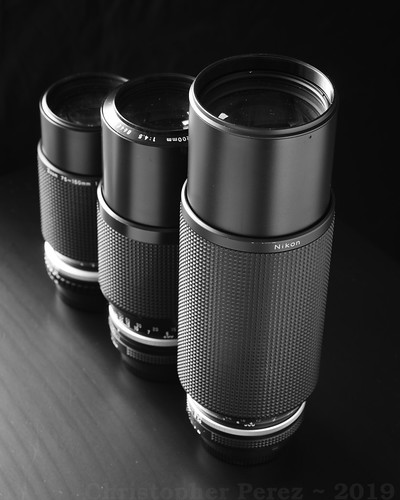
3 Nikon zooms ~ Lens Stories


Then I reminded myself (by conducting yet more comparisons) that many of my fixed focal length lenses suffered from field curvature.  When I accounted for this be refocusing at the edge of the frame when I conducted my "resolution" comparisons I found that in nearly every single case that the "resolution" at the edge matched the "resolution" at the center _from wide open_.  So I took another look at the two shorter zooms and, yes, found they too can suffer from field curvature and produce sharp images at the edge of a frame when the curvature is accounted for.

Next, I took a look at the  out of focus rendition behind the point of focus of these zooms.  True to what Nikon says about nearly all their lens designs, the 75-150mm and 80-200mm lenses at the shorter focal lengths have been under-corrected for spherical aberration behind the point of focus.

One more thing of interest, however, came quickly apparent.  In the case of these two zooms, there was something happily surprising that happens at the longest focal lengths, and in the case of the 100-300mm, the same thing holds true at all focal lengths. The out of focus rendition is dreamy creamy smooth neutral.  The rendition is so good that they are every bit as good as any of the current new all the rage "smooth trans focus" apodization filter lenses from Sony (formerly Minolta), Fuji, and Canon.  Yes.  It's true.

3 Nikon zooms ~ Lens Stories


So what do I have here?  In total, here are three wonderful Nikon zoom lenses. The zooms are sharp sharp sharp in a fixed focal length sense of "sharp".  Yes, they gently suffer from varying degrees of field curvature, though none are worse in this regard than the fixed lenses I have looked at.  Best of all, they all have beautifully controlled out of focus rendition.  The only difference from their fixed focal length siblings, really, other than the obvious ability to change focal lengths, is the maximum aperture.

If I had to choose just one lens (and thankfully I don't, certainly not at these kinds of prices) the 100-300mm f/5.6 AiS stands out as something truly special.

Tuesday, October 01, 2019

Spherical Aberration and Depth of Field ~ a comparison

Looking at the effects of spherical aberration on out of focus rendition has led me to better understand depth of field and why calculating it is not as straightforward as one might believe.

A neutrally corrected lens (such as a Nikon Micro-Nikkor 55mm f/3.5 or f/2.8, or a Nikon Nikkor 85mm f/2) will show a balanced out of focus transition.  That is, the rate of change from sharp to out of focus will be similar both in front of and behind the point of focus.

A lens (such as a Nikon Nikkor 85mm f/1.8 K or 105mm f/2.5 P) that is under-corrected for spherical aberration behind the point of focus will show greater depth of field behind the point of focus than in front of that point.

Conversely, a lens (such as a Nikon Nikkor 50mm f/2 H) that is over-corrected behind the point of focus will show a shallower depth of field behind the point of focus than in front of that point.

Studying the links found under Resources (below) helped me understand how this is possible and how optical physics and photographic imaging work in real life.

I happen to have three lenses that span the range of neutral correction to severely under-corrected spherical aberration.  I didn't feel any need to compare an over-corrected lens as the effect should be obvious from looking at the Comparison image below.


Setup -
  • Sony A6000 handheld
  • Lenses using with a Lens Turbo II focal reducer -
    • Nikon Nikkor 85mm f/2 Ai 
    • Nikon Nikkor-K 85mm f/1.8 K pre-Ai
    • Pentax 85mm f/2.2 Soft (in Nikon F mount - the only one I've ever seen)
  • NOTE1: Lenses were shot at their widest apertures only
  • RawTherapee to convert RAW files into jpg using "Film low ISO" profiles

 Comparison -

The image on the left shows the effect of spherical aberration on depth of field.  The image on the right is simply the scene as it came out of the camera for each lens compared.

If you click on the following image you can inspect it at 100 percent.

Out of Focus Comparison ~ 85mm lenses


Comments -

NOTE: I feel the Lens Turbo II focal reducer adds a bit of under-corrected spherical aberration.

NOTE 2: Recall that if a lens is under-corrected behind the point of focus that the very same lens will be over-corrected in front of that focus point.

The neutrally corrected Nikon Nikkor 85mm f/2 Ai lens was focused on the red 80cm indication on the tape.  The 79cm (behind the point of focus) and the 81cm (in front of the point of focus) are to my eyes at the limit of what I would call "in focus" - 1cm in front and 1cm behind the point of focus means that in this situation there is a total 2cm of "depth of field".

The under-corrected Nikon Nikkor 85mm f/1.8 K pre-Ai lens was focused on the 79.5cm mark (I missed the 80cm mark).  Using the f/2 lens as a reference I would say that the 80cm mark in front of the point of focus and the 77.5cm mark behind the point of focus are at the limits of what I would call "in focus." 

This is approximately 0.5cm in front and 2cm behind the point of focus - with a total "depth of field" of 2.5cm.  Clearly, "depth of field" has contracted in front of the point of focus and expanded behind the point of focus.  This, directly, is the effect of behind the point of focus under-corrected spherical aberration on "depth of field".

The severely under-corrected Pentax 85mm f/2.2 Soft lens is an interesting study in "depth of field."  It is so severely under-corrected and so filled with spherical aberration that I missed the intended 80cm focus point.  Everything from 84cm through to 75cm appears to my eyes to be well defined sharp to be called "sharp."  In this setup the Pentax Soft is giving 9cm of "depth of field."


Resources -

For further information on how the topic of out of focus rendition, optical properties, and Nikon lens design history, please refer to the following -

A PhD thesis on the impact of "soft focus" lenses on the history of photography - http://research-repository.st-andrews.ac.uk/handle/10023/505

An excellent starting point for understanding out of focus rendition (I might not completely agree with his interpretations/observations, but his foundation of understanding is quite good) - http://jtra.cz/stuff/essays/bokeh/

Nikon lens design histories - https://imaging.nikon.com/history/story/

Point light source discussions - https://www.dpreview.com/forums/thread/4031515

Zeiss comments on optical design -  https://lenspire.zeiss.com/photo/en/article/how-does-zeiss-define-bokeh-an-interview-with-dr-stefan-ballmann

Metabones Focal Reducer whitepaper - https://www.metabones.com/assets/a/stories/Speed%20Booster%20White%20Paper.pdf

Wednesday, September 25, 2019

Out of Focus Rendition ~ Yet More Comparisons


Looking at a WiFi bridge we have in the apartment I could see the potential for looking at bit more at out of focus rendition in old Nikon Nikkor lenses.  I could get out of focus dots and lines with no more effort than clicking the shutter.

Setup -
  • Sony A6000 handheld
  • Lenses using with a Lens Turbo II focal reducer -
    • Nikon Nikkor-H 28mm f/3.5 pre-Ai
    • Nikon Nikkor 28mm f/2.8 Ai
    • Nikon Nikkor-O 35mm f/2  pre-Ai
    • Nikon Nikkor 50mm f/1.8 AiS
    • Nikon Nikkor-H 50mm f/2 pre-Ai 
    • Nikon Micro-Nikkor 55mm f/3.5 pre-Ai
    • Nikon Nikkor-K 85mm f/1.8 K pre-Ai
    • Nikon Nikkor 85mm f/2 Ai
    • Nikon Nikkor-P 105mm f/2.5 pre-Ai 
    • Nikon Micro-Nikkor 105mm f/4 Ai
  • NOTE1: Lenses were shot at their widest apertures only
  • NOTE2: Out of focus samples are from points _behind_ the point of focus to compare background out of focus rendition
  • RawTherapee to convert RAW files into black and white and to set the black levels
  Comparison -

Here is the comparison setup.  Pretty WiFi bridge, don't you think?  More seriously, the top leading edge of the bridge is where I focused.  As you can see, the body of the bridge goes out of focus.

Out of Focus Rendition Comparison


If you click on the following image you can inspect it at 100 percent.

Out of Focus Rendition Comparison


Comments -

NOTE: I feel the Lens Turbo II focal reducer adds a bit of under-corrected spherical aberration.

If there is a doughnut highlight outline around the edge of an out of focus dot or a stronger line along the edges of an out of focus line, the lens likely has over-corrected spherical aberrations behind the point of focus.  Some people call this "soap bubble bokeh."

In this comparison I feel the following lenses exhibit noticeable over-corrected spherical aberrations behind the point of focus.
  • Nikon Nikkor-H 28mm f/3.5 pre-Ai
  • Nikon Nikkor-H 50mm f/2 pre-Ai

If a dot or line is smooth across the out of focus area, then the lens exhibits neutral spherical aberration correction.  

In this comparison I feel the following lenses exhibit neutrally controlled spherical aberrations behind (and, of course, in front of) the point of focus.
  • Nikon Micro-Nikkor-P 55mm f/3.5 pre-Ai
  • Nikon Nikkor 85mm f/2 Ai

If a dot or line is brighter in the center of the out of focus area, then the lens exhibits under-corrected spherical aberrations.  Nikon in their Thousand and One Nights series describes this as leading to a "delicate" out of focus rendition.

In this comparison I feel the following lenses exhibit noticeable under-corrected spherical aberrations behind the point of focus.
  • Nikon Nikkor-H 28mm f/2.8 Ai
  • Nikon Nikkor-O 35mm f/2 pre-Ai
  • Nikon Nikkor 50mm f/1.8 AiS
  • Nikon Nikkor-K 85mm f/1.8 pre-Ai 
  • Nikon Nikkor-P 105mm f/2.5 pre-Ai
  • Nikon Micro-Nikkor 105mm f/4 Ai

Using this knowledge I can now match the "look" of images that I make.  That is, if I want the Nikon described "delicate" out of focus rendition, I know which lenses to choose from.  Similarly, since I don't like the "harshness" of over-corrected out of focus rendition, I know which lenses to avoid.


One last thing.  I feel I should comment on the use of black and white for these comparisons.

Many of the lenses I looked at were designed during the era of black and white film.  When looking at the color rendition, some of the lenses showed a bit of what I must interpret to be chromatic aberration.  That is to say, the edge of out of focus areas are tinted/tinged with magenta on one side and green on the other.  When shooting black and white film, this wasn't easily observable.  But with the advent of color film, lens designers now had the opportunity to correct more lens faults in response to user demand for "better" lenses.

Here is an example of what I mean (with increased saturation and contrast to more strongly illustrate the effect).


Out of Focus Rendition Comparison


Resources -

For further information on how the topic of out of focus rendition, optical properties, and Nikon lens design history, please refer to the following -

A PhD thesis on the impact of "soft focus" lenses on the history of photography - http://research-repository.st-andrews.ac.uk/handle/10023/505

An excellent starting point for understanding out of focus rendition (I might not completely agree with his interpretations/observations, but his foundation of understanding is quite good) - http://jtra.cz/stuff/essays/bokeh/

Nikon lens design histories - https://imaging.nikon.com/history/story/

Point light source discussions - https://www.dpreview.com/forums/thread/4031515

Zeiss comments on optical design -  https://lenspire.zeiss.com/photo/en/article/how-does-zeiss-define-bokeh-an-interview-with-dr-stefan-ballmann

Metabones Focal Reducer whitepaper - https://www.metabones.com/assets/a/stories/Speed%20Booster%20White%20Paper.pdf

Tuesday, August 27, 2019

Pictorial Photography ~ three yearbooks

Back in the day, a certain Clarence H. White was a leading light in the area of photography as art.  His influence can't be understated.

Yet within the photographic culture we remember little to nothing about him.  Stieglitz?  Yes.  Weston?  Yes.  Other practioners?  Not so much.

I have the strange sensation that since "pictorial" photography was practically outlawed by Edward Steichen after seeing the light (pun intended), many photographers and their work have been largely forgotten.

So it was something of a surprise to see on the Gutenberg Press that they have three year books edited by White that are available for free download.

If you are interested in pictorialism in photography, or soft focus lenses, or late-19c tools, materials, and techniques, or photographic history these might be worth a look.

Paris Doux

Tuesday, July 16, 2019

Paris Exhibition ~ Sally Mann until 22 September 2019

Sally Mann has a beautiful show running at the Jeu de Paume in Paris just now.

My wife and I went last Sunday to see it just after the Bastille Day celebrations were finished (the museum didn't open until 13h30 that day).

The crowds were small-ish, though it was difficult to move freely through the first couple of rooms of the exhibit.  But once well inside the show there were fewer people and we could enjoy taking our time to look at the photographs.

My gawd! those photos can be beautiful.  It was a real joy to see deep, richly printed black and white images.  We found Sally Mann's work to be very expressive and deeply moving.

In general, I think the French have a difficult time understanding and appreciating the large landscape works of someone like Ansel Adams.  Those works tend to be remote and cold and people aren't real sure how these can be appreciated.

Certain West Coast photographers like Edward Weston are more approachable for the French.  And if I understand correctly, it has to do with his bohemian lifestyle (he reportedly had many lovers), his images of people and more personal subjects and his political sensibilities (he spent time in Mexico around the edges of the Communist movement).

From the number of shows we see listed here in Paris, the French embrace American street photographers, mainly from New York.  And they really appreciate good American photographers who make Paris their home, like Peter Turnley.

So it was interesting to us to see how the French reacted to Sally Mann.  Her work is not as literal as some people might be used to.  Listening to the French as they talked through the show was fascinating.  Some marveled at the optical effects that create smooth out of focus background renditions.  Some people were taken by the beauty of Sally's subjects (and my gawd! can her subjects be beautiful).  And others were surprised by how slavery in America continues to impact culture and society there and how this history could be so accurately portrayed in an artistic work.

For me the exhibit worked well on two levels.  The first is that her work is inspirational.  Sally Mann has found a way to use the tools of photography to express the various themes she explores in a way that transcends the tools in the creation of her works of art.

The second level is more profound.  Much is made about race relations in America.  After seeing the show I can't help but feel a deep sadness for terrible things in American history that continue to influence the present.

Sunday, June 16, 2019

Nikon Micro-Nikkor, Nikkor 105mm lenses ~ a closer look

Recently I picked up a Nikon Micro-Nikkor 105mm f/4 P Ai lens, thinking and hoping that it's out of focus rendition would be similar to the 55mm Micro-Nikkor lenses I have.  Someone on the 'net suggested that the 105mm Micro-Nikkor f/4 is "wickedly" sharp from wide open.  So this blog entry takes a look at this and compares its resolution with three other 105mm Nikkor lenses I have on hand.

Setup -
  • Sony A6000, 100ISO, 2 second delay timer, RawTherapee conversion software 
  • Big Beefy Manfrotto tripod 
  • Lenses compared
    • Nikon Micro-Nikkor 105mm f/4 P Ai
    • Nikon Nikkor 105mm f/2.5 P pre-Ai
    • Nikon Nikkor 105mm f/2.5 Ai
    • Nikon Nikkor 35mm to 105mm f/3.5 to f/4.5 AiS zoom at 105mm
  • Lens Turbo II focal length reducer
Note:
It's become obvious to me over the years that nearly all lenses suffer from field curvature.  Some lenses, as we might expect, have more pronounced curved fields than others.  So to account for this, I have taken to shooting two images at each comparison aperture.  The first image is focused in the center of the field, and the second image focuses at the very edge of the field of view.  It is important to note that I'm not attempting to measure how much field curvature there is.  All I'm looking at is, at the edge of the field, how sharp the optic is.  If one photographs flat subject matter, nearly all lens will be more or less out of focus at the edge of the field.

Comparison Results -
[If you click on the image it'll take you to the Flickr hosting site. Once there, look at the file at full resolution. In many cases the differences between lenses is small and likely can't be seen until you take a squint at the comparison at 100 percent.]

Nikon Nikkor 105mm Comparison


Comments -

Comparing the Nikon Micro-Nikkor 105mm f/4 P Ai to the Nikon Nikkor 105mm f/2.5 and f/4.5 zoom, I see that wide open the f/4 Micro-Nikkor lens is indeed quite sharp, though I might not call it "wickedly" sharp.  Focusing at the edges of the frame I see that the Micro-Nikkor is slightly less sharp wide open than the center, but that this cleans up very nicely as the aperture is stopped down.  As for field curvature (which I am not in any measuring, but simply noting), the Micro-Nikkor suffers from a small amount where the 55mm Micro-Nikkors I looked at do not.  I appears to me that to have a perfectly sharp image across a flat field that a user will need to stop down a click or two from wide open.

Looking at the 105mm f/2.5 P and Ai lenses I see that both are sharp in the center wide open.  In the corners, too, the non-Ai P 105mm appears to match the 105mm f/2.5 Ai.  Though it could be noted that field curvature of the early P non-Ai lens stronger than the updated design Ai.  Compared with the Micro-Nikkor, it is difficult to tell a difference when curvature is accounted for in resolution between them across the field.  The only note would be that field curvature is less with the Micro-Nikkor than it's f/2.5 brothers.

Lastly, I took a look at a Nikon Nikkor 35mm-105mm f/3.5-f/4.5 AiS zoom at 105mm.  Wide open resolution suffers across the field.  Stopped down to f/5.6, however, the lens looks quite good in the center and matches the three fixed focal length 105mm lenses here.  At the edges the zoom's resolution appears to clean up rather nicely at f/8.  Regarding field curvature, of the four lenses looked at here this zoom shows the most curvature.  The curvature is quite dramatic, actually.

Saturday, June 15, 2019

Nikon Nikkor 85mm f/1.8 and f/2 lenses ~ a closer look

It so happens that I picked up another Nikon Nikkor 85mm f/2 Ai lens.  I owned one when I moved here, sold it, and got to wondering how it compared to my other, older 85mm f/1.8 K pre-Ai.  So here is yet another look at how they compare from a resolution point of view.

Setup -
  • Sony A6000, 100ISO, 2 second delay timer, RawTherapee conversion software 
  • Big Beefy Manfrotto tripod 
  • Lenses compared
    • Nikon Nikkor 85mm f/1.8 K pre-Ai
    • Nikon Nikkor 85mm f/2 Ai
  • Lens Turbo II focal length reducer
Note:
It's become obvious to me over the years that nearly all lenses suffer from field curvature.  Some lenses, as we might expect, have more pronounced curved fields than others.  So to account for this, I have taken to shooting two images at each comparison aperture.  The first image is focused in the center of the field, and the second image focuses at the very edge of the field of view.  It is important to note that I'm not attempting to measure how much field curvature there is.  All I'm looking at is, at the edge of the field, how sharp the optic is.  If one photographs flat subject matter, nearly all lens will be more or less out of focus at the edge of the field.

Comparison Results -
[If you click on the image it'll take you to the Flickr hosting site. Once there, look at the file at full resolution. In many cases the differences between lenses is small and likely can't be seen until you take a squint at the comparison at 100 percent.]

Nikon Nikkor 85mm Comparison


Comments -

Comparing the Nikon Nikkor 85mm f/1.8 K pre-Ai to the Nikon Nikkor 85mm f/2 Ai, I see that wide open the early f/1.8 lens is slightly less sharp than the newer design f/2 Ai.  At the edges of the frame, the f/1.8 K pre-Ai lens clearly lags the f/2 Ai.  Yet both lenses sharpen up very nice from f/4, and from f/4 on down the aperture range both lenses appear to be equal in the center and edges of the frame.

In terms of field curvature, I see that the f/1.8 K pre-Ai suffers from greater field curvature than the newer f/2 Ai optic (remember, I'm not trying to measure the field curvature, only noting the curvature in relative terms).

Since I don't sharpen the comparison images in any way, I thought it might be interesting to see what a rather aggressive unsharp mask might do to images from both lenses at wide open and f/2.8 in the center and at the edges.  The USM was set to a 2 pixel radius and a 0.5 contrast step.  This is pretty steep and I normally put the USM image in a separate layer and adjust its opacity over the original image to balance the harshness of the USM to make the final image more "film-like" (I feel some of the software tools can make an image appear "artificial" and cell-phone-like).

In both cases, the USM makes the wide open and f/2.8 images appear sharper than their f/4 to f/8 non-USM equivalents on the two lenses.  The f/1.8 K pre-Ai lens still lags the f/2 Ai wide open.  But, this shows what is possible if one wants to clean up an image that was shot at the widest aperture.  The results can be pretty darned impressive.

Monday, June 03, 2019

Nikon Nikkor 85mm f/2 and f/1.8 ~ point light source comparison


For many years I looked at just one dimension of commercially available optics - resolution.  With this blog entry I continue to look at other aspects of optical performance.  For the series of postings I look at under, neutral, and over corrected spherical aberration in out of focus rendition on subject matter behind the point of focus.

Setup -
  • Sony NEX5T, ISO 100, 2 second timer
  • Big Beefy Manfrotto tripod
  • Lenses using with a Lens Turbo II focal reducer -
    • Nikon Nikkor 85mm f/2 Ai
    • Nikon Nikkor 85mm f/1.8 K pre-Ai
  • NOTE1: Lenses were shot at their widest apertures only
  • NOTE2: Out of focus samples are from points _behind_ the point of focus to compare background out of focus rendition
  • RawTherapee to convert RAW files into black and white and to set the black levels
  Comparison -

If you click on the following image you can inspect it at 100 percent.

Nikon Nikkor 85mm lenses ~ Point Light Source Comparison


Comments -

NOTE: I feel the Lens Turbo II focal reducer adds a bit of under-corrected spherical aberration.

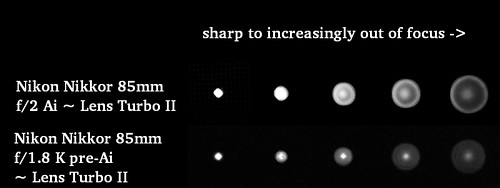
The Nikon Nikkor 85mm f/2 Ai lens shows under corrected spherical aberration as well as a bright edge ring that suggests over correction around the outside of the out of focus disk.  In normal use, I expect the out of focus rendition to be "harsher" than, say, the next lens from Nikon.
The Nikon Nikkor 85mm f/1.8 K pre-Ai lens shows classic under corrected spherical aberration with a bright dot in the center of a smooth disk.  In normal use, I expect the out of focus rendition to be "delicate" (using Nikon's own description of the effect) and smooth across the field.


Resources -

For further information on how the topic of out of focus rendition, optical properties, and Nikon lens design history, please refer to the following -

A PhD thesis on the impact of "soft focus" lenses on the history of photography - http://research-repository.st-andrews.ac.uk/handle/10023/505

An excellent starting point for understanding out of focus rendition (I might not completely agree with his interpretations/observations, but his foundation of understanding is quite good) - http://jtra.cz/stuff/essays/bokeh/

Nikon lens design histories - https://imaging.nikon.com/history/story/

Point light source discussions - https://www.dpreview.com/forums/thread/4031515

Zeiss comments on optical design -  https://lenspire.zeiss.com/photo/en/article/how-does-zeiss-define-bokeh-an-interview-with-dr-stefan-ballmann

Metabones Focal Reducer whitepaper - https://www.metabones.com/assets/a/stories/Speed%20Booster%20White%20Paper.pdf

Monday, May 27, 2019

Nikon Micro-Nikkor, Nikkor 105mm ~ point light source comparison


For many years I looked at just one dimension of commercially available optics - resolution.  Now I continue to look at other aspects of optical performance.  For this series I look at under, neutral, and over corrected spherical aberration in out of focus rendition on subject matter behind the point of focus.

Setup -
  • Sony NEX5T, ISO 100, 2 second timer, +1 EV
  • Big Beefy Manfrotto tripod
  • Lenses using with a Lens Turbo II focal reducer -
    • Nikon Micro-Nikkor 105mm f/4 Ai
    • Nikon Nikkor 105mm f/2.5 P pre-Ai (early Sonnar design)
    • Nikon Nikkor 105mm f/2.5 Ai (later modified Sonnar, slightly more symmetrical design)
  • NOTE1: Lenses were shot at their widest apertures only
  • NOTE2: Out of focus samples are from points _behind_ the point of focus to compare background out of focus rendition
  • RawTherapee to convert RAW files into black and white and to set the black levels
  Comparison -

If you click on the following image you can inspect it at 100 percent.

Nikon Nikkor 105mm Point Lightsource Comparison


Comments -

NOTE: I feel the Lens Turbo II focal reducer adds a bit of under-corrected spherical aberration.

 I had expected the Micro-Nikkor to show similar neutral very smooth out of focus rendition to the pair of 55mm Micro-Nikkors I looked at.  Alas, this is not the case.

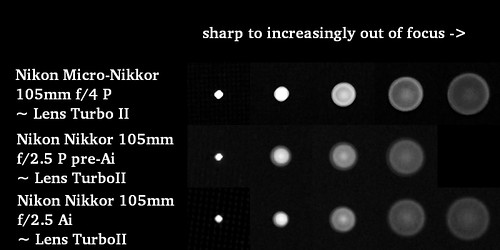
These three Nikon Nikkor, Micro-Nikkor 105mm f/4 and f/2.5 P pre-Ai and Ai lenses show under corrected spherical aberrations.  At the point of focus, the Micro-Nikkor is one of the sharpest lenses I've looked at.  But that's not what this comparison is about.

In normal photography I would expect, based on these comparisons, that there will be a very smooth and delicate (to use Nikon's own word on the topic) out of focus field rendition, with the f/4 Micro-Nikkor showing a stronger "condom ring" (which will contribute to a distracting out of focus rendition) than the two f/2.5 lenses (compare the smooth, rounded edges of the out of focus disks of the f/2.5 lenses against the sharp edged disks of the Micro-Nikkor).


Resources -

For further information on how the topic of out of focus rendition, optical properties, and Nikon lens design history, please refer to the following -

A PhD thesis on the impact of "soft focus" lenses on the history of photography - http://research-repository.st-andrews.ac.uk/handle/10023/505

An excellent starting point for understanding out of focus rendition (I might not completely agree with his interpretations/observations, but his foundation of understanding is quite good) - http://jtra.cz/stuff/essays/bokeh/

Nikon lens design histories - https://imaging.nikon.com/history/story/

Point light source discussions - https://www.dpreview.com/forums/thread/4031515

Zeiss comments on optical design -  https://lenspire.zeiss.com/photo/en/article/how-does-zeiss-define-bokeh-an-interview-with-dr-stefan-ballmann

Metabones Focal Reducer whitepaper - https://www.metabones.com/assets/a/stories/Speed%20Booster%20White%20Paper.pdf

Sunday, May 26, 2019

Nikon Nikkor 28mm lenses ~ point light source comparison

Returning home after passing a winter in the south I am inspired to continue my look into point light source in-focus, out of focus comparisons.

Setup -
  • Sony NEX5T, ISO 100, 2 second timer, +1 EV
  • Big Beefy Manfrotto tripod
  • Nikon lenses using with a Lens Turbo II focal reducer -
    • Nikon Nikkor 28mm f/2.8 Ai
    • Nikon Nikkor 28mm f/3.5 H pre-Ai
    • Nikon Nikkor 28mm f/3.5 PC
  • NOTE1: Lenses were shot at their widest apertures only
  • NOTE2: Out of focus samples are from points _behind_ the point of focus to compare background out of focus rendition
  • RawTherapee to convert RAW files into black and white and to set the black levels
  Comparison -

If you click on the following image you can inspect it at 100 percent.

Nikon Nikkor 28mm Point Lightsource Comparison


Comments -

NOTE: I feel the Lens Turbo II focal reducer adds a bit of under-corrected spherical aberration.

The Nikon Nikkor 28mm f/2.8 Ai shows under-corrected spherical aberrations with just a moderately strong bright ring around the edge of the image circle.  In normal photography I would expect, based on these comparisons, that there will be a hint of a "busy" rendition in a smooth, delicate out of focus field.

The Nikon Nikkor 28mm f/3.5 H shows stronger over-corrected spherical aberration with a fairly bright edge ring on out of focus disks.  The center, as with it's brother lens the f/2.8, shows under-corrected spherical aberration.  In normal photography I would expect, based on these comparisons, that there will be a somewhat confusing rendition of the out of focus field, mixing the two aberration types as this lens does.

The Nikon Nikkor 28mm f/3.5 PC (perspective control) lens shows moderate under-corrected spherical aberration with a hint of a bright ring around the edge of the out of focus disk.  In normal photography I would expect the lens to be a hint of a "busy" field against a smooth, delicate out of focus rendition.


Resources -

For further information on how the topic of out of focus rendition, optical properties, and Nikon lens design history, please refer to the following -

A PhD thesis on the impact of "soft focus" lenses on the history of photography - http://research-repository.st-andrews.ac.uk/handle/10023/505

An excellent starting point for understanding out of focus rendition (I might not completely agree with his interpretations/observations, but his foundation of understanding is quite good) - http://jtra.cz/stuff/essays/bokeh/

Nikon lens design histories - https://imaging.nikon.com/history/story/

Point light source discussions - https://www.dpreview.com/forums/thread/4031515

Zeiss comments on optical design -  https://lenspire.zeiss.com/photo/en/article/how-does-zeiss-define-bokeh-an-interview-with-dr-stefan-ballmann

Metabones Focal Reducer whitepaper - https://www.metabones.com/assets/a/stories/Speed%20Booster%20White%20Paper.pdf

Saturday, May 25, 2019

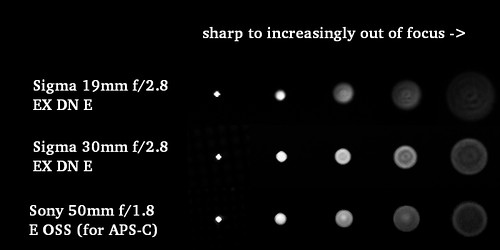
Sigma 19mm, 30mm, Sony 50mm ~ point light source comparison

Having looked at the out of focus rendition of vintage Nikon lenses, I wanted to see what, if anything, had changed over the years of optical design and look at three current lenses.

Setup -
  • Sony NEX5T, ISO 100, 2 second timer, +1 EV
  • Big Beefy Manfrotto tripod
  • Lenses designed for Sony E-mount APS-C cameras -
    • Sigma 19mm f/2.8 EX DN E
    • Sigma 30mm f/2.8 EX DN E
    • Sony 50mm f/1.8 SEL OSS
  • NOTE1: Lenses were shot at their widest apertures only
  • NOTE2: Out of focus samples are from points _behind_ the point of focus to compare background out of focus rendition
  • RawTherapee to convert RAW files into black and white and to set the black levels
  Comparison -

If you click on the following image you can inspect it at 100 percent.

Sigma, Sony APS-C Point Lightsource Comparison


Comments -

The Sigma 19mm f/2.8 EX DN E out of focus rendition confuses me.  There is a slight bright ring around the out of focus disk, along with a bright center with a dark whole in the middle.  The further out of focus the point, the more "choppy" the disk becomes.  Concentric circles form the farther out of focus the disk becomes.

The Sigma 30mm f/2.8 EX DN E out of focus rendition confuses me just like the 19mm Sigma does.  There is a bright outter ring to the disk, followed by a brighter center with a dark hole in the middle.  The "choppy" field effect across the disk is less than with the 19mm, but it's still clearly visible.

The Sony 50mm f/1.8 SEL OSS starts out having a nice smooth disk with a brighter center just like the lens is under-corrected.  But the further out of focus the point is, the stronger the outter ring becomes.  It's as if the Sony lens is both under and over-corrected.


Resources -

For further information on how the topic of out of focus rendition, optical properties, and Nikon lens design history, please refer to the following -

A PhD thesis on the impact of "soft focus" lenses on the history of photography - http://research-repository.st-andrews.ac.uk/handle/10023/505

An excellent starting point for understanding out of focus rendition (I might not completely agree with his interpretations/observations, but his foundation of understanding is quite good) - http://jtra.cz/stuff/essays/bokeh/

Nikon lens design histories - https://imaging.nikon.com/history/story/

Point light source discussions - https://www.dpreview.com/forums/thread/4031515

Zeiss comments on optical design -  https://lenspire.zeiss.com/photo/en/article/how-does-zeiss-define-bokeh-an-interview-with-dr-stefan-ballmann

Metabones Focal Reducer whitepaper - https://www.metabones.com/assets/a/stories/Speed%20Booster%20White%20Paper.pdf

Thursday, May 09, 2019

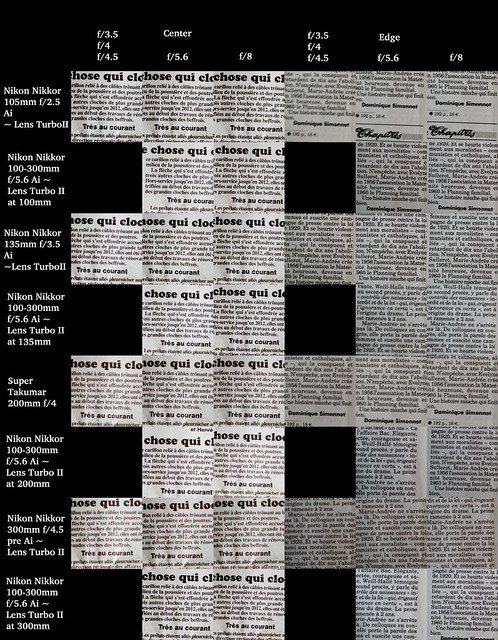
Nikon Nikkor 100mm to 300mm lenses ~ a closer look

It so happens that I picked up a rather inexpensive (supposedly in need of repair, but in reality didn't need any such thing) 100-300mm Nikon Nikkor f/5.6 AiS.

I've recently been impressed by the Nikon 75-150mm E-series (yes! it's true) and the Nikkor 80-200mm f/4.5 N Ai zoom lenses.  None of the more modern Canon EOS zoom lenses were ever this close to being wonderfully razor sharp at the point of focus and creamy smooth in the out of focus regions.  So when this 100-300mm AiS Nikkor came along for so little money, I had to have a look at it's performance.

Setup -
  • Sony A6000, 100ISO, 2 second delay timer, RawTherapee conversion software 
  • Big Beefy Manfrotto tripod 
  • Lenses compared
    • Nikon Nikkor 105mm f/2.5 Ai
    • Nikon Nikkor 135mm f/3.5 Ai
    • Super-Takumar 200mm f/4
    • Nikon Nikkor 300mm f/4.5 pre-Ai 
    • Nikon Nikkor 100-300mm f/5.6 AiS 
      • compared at 100mm
      • 135mm
      • 200mm
      • 300mm
  • Lens Turbo II adapter with the Nikkors, but not the Takumar

Comparison Results -
[If you click on the image it'll take you to the Flickr hosting site. Once there, look at the file at full resolution. In many cases the differences between lenses is small and likely can't be seen until you take a squint at the comparison at 100 percent.]

Nikon Nikkor 100mm to 300mm ~ Comparison


Comments -

Comparing the Nikon Nikkor 100-300mm f/5.6 AiS to a Nikon Nikkor 105mm f/2.5 Ai, I see that both the 105mm and 100-300mm lenses are both very sharp in the center of the frame.  At the edges, the 100-300mm lens remains very sharp.  It appears the 105mm f/2.5 Ai suffers from a bit of field curvature as the edges of the frame are clearly not as sharp as the zoom on this 2D subject.

Comparing the Nikon Nikkor 100-300mm f/5.6 AiS to a Nikon Nikkor 135mm f/3.5 Ai, I see that both the 135mm and 100-300mm lenses are very sharp in the center of the frame.  At the edges, the 135mm lens remains very sharp, with the 100-300mm lens trailing ever so slightly in terms of absolute resolution.

Comparing the Nikon Nikkor 100-300mm f/5.6 AiS to a Super-Takumar 200mm f/4 M42 lens, I see that the 200mm is very slightly sharper than the 100-300mm lens in the center of the frame.  At the edges, the 200mm lens is very slightly less sharp than the 100-300mm lens.

Comparing the Nikon Nikkor 100-300mm f/5.6 AiS to a Nikon Nikkor 300mm f/4.5 pre-Ai, I see that the 100-300mm lens is very sharp straight across the field.  The fixed focal length 300mm f/4.5 lens is clearly behind the zoom in terms of resolution.

Overall, the Nikon Nikkor 100-300mm f/5.6 AiS lens is truly outstanding at f/5.6 (which is wide open with this optic) and f/8.  In the center it can keep up with the fixed focal length lenses I compared this zoom to.  The optic's field is surprisingly flat and exceeds three of the four fixed focal length lenses in terms of flat field resolution at the extreme edges of the frame.

So, how much did this super sharp wonder zoom set me back?   30Euros.

Tuesday, May 07, 2019

Nikon Nikkor 100-300mm f/5.6 Ai ~ point light source comparison


For many years I looked at just one dimension of commercially available optics - resolution.  Now I wanted to start looking at other aspects of optical performance.  For this series I look at spherical aberration (looking for under, neutral, or over correction) in out of focus rendition on subject matter behind the point of focus.

Setup -
  • Sony A6000, ISO 100, 2 second timer
  • Big Beefy Manfrotto tripod
  • Lens using with a Lens Turbo II focal reducer -
    • Nikon Nikkor 100-300mm f/5.6 Ai zoom
  • NOTE1: Lens was shot at the widest aperture only
  • NOTE2: Out of focus samples are from points _behind_ the point of focus to compare background out of focus rendition
  • RawTherapee to convert RAW files into black and white and to set the black levels
 Comparison -

If you click on the following image you can inspect it at 100 percent.

Nikon Nikkor 100mm to 300mm f/5.6 Ai ~ point light source comparison


Comments -

NOTE: I feel the Lens Turbo II focal reducer adds a bit of under-corrected spherical aberration.

The Nikon Nikkor 100-300mm f/5.6 Ai zoom at 100mm shows a flat out of focus disk.  The further out of focus a dot becomes, the more a slight under-corrected spherical aberration in the out of focus regions is revealed.  Based on this comparison, in normal photographic use this lens at this focal length should produce a smooth out of focus rendition.

At 200mm, this Ai zoom continues to show a flat neutral disk.  The further out of focus a dot becomes, the more a slight under-corrected spherical aberration in the out of focus regions is revealed.  Under normal photographic conditions I would expect that this lens at 200mm will continue to show a smooth out of focus rendition.

At 300mm, this Ai zoom shows very neutral out of focus rendition.  Under normal photographic conditions I would expect this lens at this focal length to produce extremely smooth out of focus rendition.


Resources -

For further information on how the topic of out of focus rendition, optical properties, and Nikon lens design history, please refer to the following -

A PhD thesis on the impact of "soft focus" lenses on the history of photography - http://research-repository.st-andrews.ac.uk/handle/10023/505

An excellent starting point for understanding out of focus rendition (I might not completely agree with his interpretations/observations, but his foundation of understanding is quite good) - http://jtra.cz/stuff/essays/bokeh/

Nikon lens design histories - https://imaging.nikon.com/history/story/

Point light source discussions - https://www.dpreview.com/forums/thread/4031515

Zeiss comments on optical design -  https://lenspire.zeiss.com/photo/en/article/how-does-zeiss-define-bokeh-an-interview-with-dr-stefan-ballmann

Metabones Focal Reducer whitepaper - https://www.metabones.com/assets/a/stories/Speed%20Booster%20White%20Paper.pdf