Wednesday, August 17, 2022

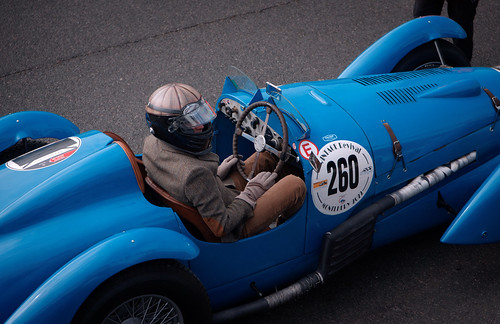
Into the Daylight ~ Flash Photography and Old Cars

With a big car event coming up, I was excited to try my hand at lighting up one of my favorite subjects.  Nothing serious, of course.  I'm retired and don't need nor want to impress anyone.  No, this is just for the pleasure of pursuing a topic, understanding as much as I can, and to make an image or two that please me and only me.

I've been reading too many articles by David Hobby and Joe McNally.  I seem to have caught the bug to shoot small flash.  Here was yet Another Itch that needed to be Scratched.  Photographically speaking.

To add another Itchy Spot to the Whole Plot, just the other day I read a very short article on how to photograph HotRods.  The difference between what this article talked about (shooting in open shade) and what I would be doing is that I'd be working under partly cloudy to full sun conditions

I have three Cheap Chinese Flash units that I've picked up over the years.  My calculations indicated I might _just_ be able to augment the power of the sun and make my subjects standout a bit from a slightly under-exposed background.  That would be the goal.

My camera setups would be as follows -

  • Sony A7 - set to full manual mode (stored settings as M1)
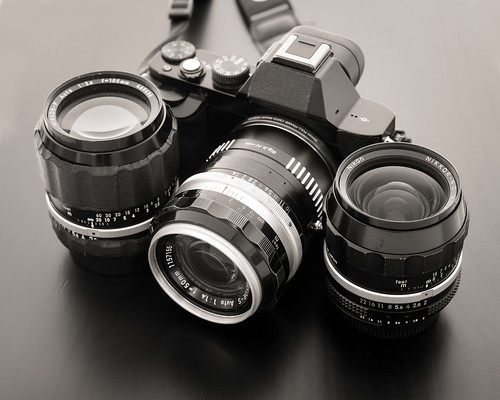
  • Nikon Nikkor 24mm f/2.8 Ai
  • Polarizing filter

My second camera would be -

  • Sony A6000 - also set to full manual mode (again stored settings as M1)
  • Nikon Micro-Nikkor 55mm f/3.5
  • Lens Turbo II focal reducer
  • Polarizing filter

It all seems a silly thing to in this Day and Age use manual focus Nikkors.  Working with AF lenses and meter-coupled apertures would certainly be a faster, more accurate way to proceed, right?  Well...

There were several competing ideas that swirled around my (sometimes empty) brain.  One, as I've already said, was to use flash to brighten the subject relative to the background.  Another idea was to see how wide I could get the aperture so as to blur the background.  And the third swirling idea was to use a Polarizing filter to try and control reflections off shiny, painted, waxed surfaces.

In short, I would be trying to manage complexities in a discrete, one thing at a time, manner.  It's sometimes important to keep an Aging Mind well exercised.  Or so I'm told, but I can't remember who said it.  I made a joke there.  Did you get it?

I love the "idea" of my Nikkor lenses.  Manual focus.  Beautiful out of focus rendition when shot wide open.  Manual aperture settings so I know exactly where I'm at.  Of course, shooting in broad daylight would mean stopping lenses down and potentially sharpening up the entire scene with good depth of field.

Fortunately the (old hand calculated designs based on history and practical knowledge) Nikkors are by current standards (of computer ray traced designs solving for 11th order effects) brilliantly sharp stopped down.  

I have modern AF Top Drawer lenses as well as many old Nikkors, and, frankly, from one click down on the aperture it's awfully difficult to tell any difference between them.  So, with a few mental gymnastics I was able to convince myself to use the old Nikkors.

For the Cheap Chinese Flash setup, here's what would be used - 

  • Three Yongnuo YN560 flash units
  • A cheap three flash mount bracket
  • A cheap flash stand
  • A RF/FM remote trigger system consisting of
    • On-camera trigger
    • Two remote flash hot-shoe'd receivers

All I needed to do when switching cameras from 24mm to 55mm and back again would be to slip the on-camera RF/FM trigger from one body to the other.

To make a complex situation more complex, I packed a 2-stop ND filter.  This would allow me to open up the aperture, well, by 2 stops.  If I did this right, I would be able to explore what happens to a scene when both sun-enhancing flash and narrower depth of fields are used in tandem.  The effect might be interesting.

So how did my little experiment of shooting the all manual, maybe needlessly complex setup end up?  Not 1/2 bad, actually.  Let's have a look, shall we?

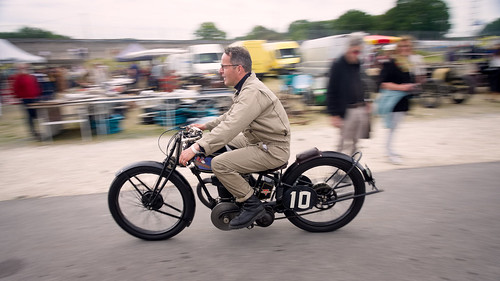
This was done under full sun (to my right).  I put the flash units to the right as well, set their power to 1/4 and under-exposed the overall scene by 1/2 a stop.  The depth of field is a little too good and the background is a bit distracting to my eyes.  Though, the scene is well placed with the view of the large buildings in the background.  I like the way the flashes did their jobs to bring the bike out of the mess.  Even if it's just a little.

le traversee de Paris estivale ~ 2022


Shooting against the sun, setting the flash to my left, and putting the power at 1/4 or 1/2 on all three units I was able to blast the Holy Heck out of the Buick.  The overall scene was under-exposed by, again, 1/2 stop.  I like the effect.  The people and the trees in the background at back-lit.  So would the car be if I hadn't painted the car in light the way I did.

la traversee de Paris ~ 2022


Three young ladies were being photographed by a local photographer.  They were using the cars as backdrops.  All three were "Miss" somethingorother.  This lady was Miss Montmartre. 

Had I not used fill-flash the scene would've been a lighting mess.  The sun was throwing very strong shadows off everything and the Jaguar XK-SS would've disappeared into an inky black hole where no light could escape.  I needed to flatten the contrast a little and to "open up" the Miss' far-side face if I could.

If you know me, you know I've owned several Jags in my life.  They were my childhood pinnacle of automobilisme.  They all had sexy lines and could push a gentleman smartly down the motorway at impressive speeds.

I'd read where the D-type race car had been lightly re-designed to take normal road-gear (bumpers, passenger seat, that kind of thing).  Very few were made, though, before that portion of the Jaguars factory burnt.  So it came as a huge surprise to see this car.  Sure, the young lady is pretty.  There's no doubt about that.  But that Jag?  Oh All Things That Are Holy this was glorious!!

I'm not sure if it's an original or a "continuation" version.  Somehow I just can't see someone driving a many-millions of Euros car around Paris just for the hell of it.  The insurance alone would cost a fortune.  So I'm thinking this must be a very accurate reproduction (perhaps even done up by the factory?).

la traversee de Paris ~ 2022


Early on in my little photo-session I balanced the overall scene exposure with the flash and let the flash simply fill the shadows.  Looking at the cameras LCD convinced me I liked the gentle effect that simple flash-fill might bring.

For this Renault Alpine the sun was was over to my left (almost, but not quite shooting against it) and it cast a strong shadow to the right.  So I placed the three flash setup to my right, set the power to 1/16 or 1/8 (rather low, whichever it was) and this is the image I came away with.

It's almost as if you can't see the effect of the flash.  If I wasn't talking about it, would a viewer even notice?  It's kind of interesting to think about in this way.

One more thing, look at the quality of the light.  Having worked with flash for decades I might've guessed that a large light modifier had been used to "soften" up the light.  But that's not the case at all.  The three flash units were all bare and no light modifiers were used at all.  This is just straight flash fill.
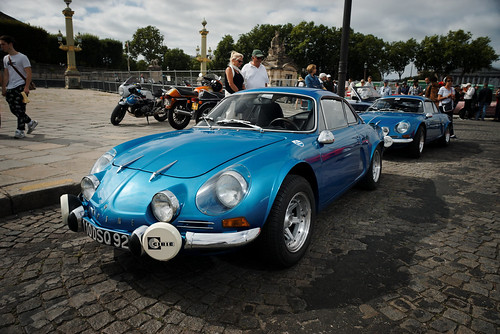
Renault Alpine ~ la traversee de Paris estivale ~ 2022


Lastly, we come to Coluche.  How the great French humorist comes to be associated with this Ford Fairlane is beyond me.  But there you have it.  Coluche's name is attached to this car.

Ford made this line of Fairlanes back in the 1950's.  By the late '50's Ford sold the factory, designs, tools, and everything to Simca. Simca continued to produce these cars for several years after.  I have to look at the badges to know which side of the Ford Sale any particular car comes from.

For this image the full sun was over left shoulder.  You can see the flash-filled shadow from the sun on the ground to the right of the car.  The overall exposure was set to -1/2EV to knock down the sky a bit and to make the people darker.  

I set the three flashes power to full *pop* and set the stand to my right.  If you look at the cars fin in the center of the frame, you can just make out the shadow that the flash threw off the fin and onto the rear trunk.

To me this image really "pops."  It's filled with colors and shapes.  It "feels" interesting.  It fully expresses what I wanted to capture about these old cars that participate in le traversee de Paris.  All it took was three RF/FM controlled flash mounted on a cheap flash stand.

la traversee de Paris ~ 2022

Thursday, August 11, 2022

Another Up-Sizing look ~ automobiles in the wild and out on the streets of Paris

Years ago (as in 14 at this point) The Online Photographer had an article about how a photographer took a 4 megapixel sensor'd image and made glorious 13x19 inch prints.

 Here's what was said about the image - "This rider was going about 75 mph when the photo was taken, and you can see every stitch, vent perforation, and the pebble texture of the leather with excellent detail and clarity."

This has stuck with me over the years.  I've written several times about trying to simulate a similar up-sizing process using the Gimp.  My first attempt involved UnSharp Mask sharpening the basic file, up-sizing using the Cubic operation, and then USM sharpening again.  It was an interesting process, but there was always something slightly soft about my final results.

Two years ago I saw that RawTherapee came out with a "Capture Sharpen" function.  I didn't think about it too much at first about how it might related to up-sizing an image.  All I knew was that my images took on a sudden and happy increase in "sharpness" in their native sizes.

I guess I could step back and say that my early Canon DSLR images, at the time, felt "sharp" enough to me.  Then I experienced Sony's APS-C sensors and realized I my Canon gear was lacking.  More recently I've added a couple Sony full frame sensor'd A7 cameras to the Box of Toys.  These take to "Capture Sharpen" like ducks to water and are far sharper than any of my old Canon files that are also "Capture Sharpened".  If there is anything sharper, please, please show it to me.  I'd like to see it.

In 10 years I've moved from Canon "acceptable", "ya, that's pretty OK" sharpness to Sony "oh my ever loving gawd!" levels of sharpness.

When is "enough" enough?  I've been wrangling over the added cost of moving up the Food Chain a bit to acquire a 42mpixel Sony A7R2.  The additional pixels could make life better, right?  More, better, happiness.  Stay with the "in crowd" to maximize flexibility and overall image quality.  Perhaps rather shallow justifications for buying more camera equipment.

In similar time, or should I say "just in time", I stumbled across an interesting video where a guy makes rather large pleasing prints from an old 10mpixel Leica M8.  It immediately reminded me that perhaps I hadn't fully explored careful up-sizing processes.  

Between Stephen Sharf's process notes and seeing this video I then felt I might even save a few Louis d'Or or Pistoles by staying with a lower cost but still (hopefully) viable 24mpixel sensor'd solution.  For the price of one used Sony A7R2 (around 1100USD) I could have three used Sony A7 (around 400USD each).

Borrowing from 14 years ago to consider the idea of making 42mpixel sized prints by careful up-sizing 24mpixel image might prove "interesting."  Stephen Sharf  started with a 4mpixel (2464 x 1648 pixels) Canon 1D image and ended up with a 6840pixel x 4680pixel print file that looked, by all accounts, to be wonderful at 13x19 inches.

"...

1. Each image is sharpened upon import into Photoshop using the Photokit Sharpener "Capture Sharpen" macro to recover detail lost by the sensor (effectively infinite number of photons, finite number of pixels).

2. Each image is then upressed using Bicubic Smoother in PS to give the pixel dimensions at 360 ppi.

3. The image is then sharpened for printing using Photokit Sharpener using the Inkjet, 360 dpi, Glossy sharpening macro.

4. The image is then exported to ImagePrint, a RIP, and printed on Stephen's old warhorse Epson 2400 using the appropriate color profile and ImagePrint to drive the printer.

5. The photo is then printed on InkJet Art Microceramic Lustre..."

Looking at my up-sizing process I thought about improvements I might make.  For the first sharpening step I could use RawTherapee's "Capture Sharpen" in place of the Gimp's various "smart sharpen" operators.

Second, I could use the Gimp's "NoHalo" up-sizing operator.  This would replace the "Cubic" operator that I had been using, and recently found to be soft compared with "NoHalo".  

Third, I could try various Gimp G'Mic sharpening operators to see if there was something demonstrably better than "UnSharp Mask."  To this end I find I like the G'Mic "Inverse Diffusion" sharpening operator.  I think it's really nice, particularly if I put a sharpened copy of the image in a layer and lower the opacity while observing the effect at 100 to 200 percent viewing sizes.

To test all this I took an image from a recent la traversee de Paris that I'd made using flash fill (three flash units, in fact, to try and keep up with the sun), a Sony A7, and a pretty little Nikon Nikkor 24mm f/2.8 Ai lens.


Renault Alpine ~ la traversee de Paris estivale ~ 2022


Here is what I found.

Rawtherapee Capture Sharen Comparison


Keep in mind, I'm well aware of the fact I'm not adding ANY information to an up-sized file.  All I'm doing is smoothing ("spackeling", if you prefer) the transitions between expanded pixels.  This is, afterall, what Stephen did all those years ago, and he came away with good looking prints.

The comparison begins with the base 6000x4000pixel image unsharpened, followed by "Capture Sharpen" version.  I see a useful improvement in "sharpness."  The effect is rather dramatic, actually.  

The out of focus rendition wasn't much effected, though I did note higher contrast when using "Capture Sharpen" and perhaps a "grainier" feel to the out of focus region when pixel peeping. This would hold true for subsequent process variations, too.

Using the Gimp's "NoHalo" 9000x6000pixel up-sizing operation on an un-"Capture Sharpen"ed image I see overall smoothness in the image.  There is little to no objectionable noise and pixelation seems to be well under control.

Applying G'Mic "sharp" function called "Inverse Diffusion" to the base un-sharpened, up-sized image I see that things still look pretty nice.  Though I don't show it here, this result is "sharper" than using the Gimp's "Cubic" up-sizing operator and the Gimp's USM sharpener that I used in my earlier studies.

Considering the "NoHalo" up-sized "Capture Sharpen"ed image, I do have to say, that looks eminently printable straight away.  Artifacts introduced by up-sizing a "Capture Sharpen"ed image seem fairly well controlled, even though they are more evident than in the un-Capture Sharpened images.  We can see these artifact when "pixel-peeping", but they will be slightly masked in a final print.

The "Inverse Diffusion" sharpen operation applied to a "Capture Sharpen"ed image is simply too much.  Well, to my eyes, at least.  So to tame the overall effect down a bit, I put the "Inverse Diffusion" sharpened image in a layer and set the opacity to 40 percent.  This seemed to be a pretty good balance between too much noise with too many artifacts, and further increases in "sharpness."  Balanced in this way the image really "pops."

To this point in my investigations I feel the un-sharpened/NoHalo up-sized/Inverse Diffusion sharpened image is very nice and is probably quite printable as is.  

However, for the ultimate "pop" without the feeling of being "oversharpened", the Capture Sharpen/NoHalo up-size/Inverse Diffusion at 40percent opacity really rocks my boat.

I didn't stop there.

How it occurred to me I will never know, but I thought about having RawTherapee add just a hint of noise reduction early in the process to see if it had any effect on the intensity of the artifacts introduced by "Capture Sharpen" in an up-sized image.  

I'd recently come to understand the RawTherapee "Noise Reduction" operation can be very subtle when I want it to be.  It can also act like a heavy hammer when the ISO's are through the roof and the noise is so great I can't sleep at night.  No, I'd try to take a very soft hand to the low-ISO image noise to see if I could "knock off the edges" just a tiny, nearly un-noticable bit. 

I implemented the following process -

  • Import image to RawTherapee
  • "Capture Sharpen" image
  • "Noise Reduction" applied with minimal action on the sliders
  • Pass the "tif" image into the Gimp
  • Up-Size using "NoHalo"
  • G'Mic "Inverse Diffusion" sharpen image in a layer
  • Set sharpened image layer to 40percent opacity

Take a close look at the last two image sets and compare them with images further up the chart.  What do you see?  Not half bad, eh?

To encapsulate my current feelings of which would be "best" -

  • Quite "adequate" - RawTherapee un-sharpen base image/Gimp NoHalo upsize/G'Mic Inverse Diffusion sharpen

  • Amazing "pop" - Rawtherapee Capture Sharpen base image/Gimp NoHalo upsize/G'Mic Inverse Diffusion sharpen layer with opacity set to 40 percent

  • Pleasingly "luscious" - Rawtherapee Capture Sharpen + very subtle Noise Reduction of a base image/Gimp NoHalo up-sizing/G'Mic Inverse Diffusion sharpen layer with opacity set to 40 percent

After all is said and done... should I be able to take a 6000x4000 Sony sensor'd image, apply any of these three process versions, and come away with a beautifully printable image that is 48 inches long? ... maybe ... maybe yes...  quite possibly ...

Friday, August 05, 2022

Into the Daylight ~ a Cheap Chinese Flash Adventure

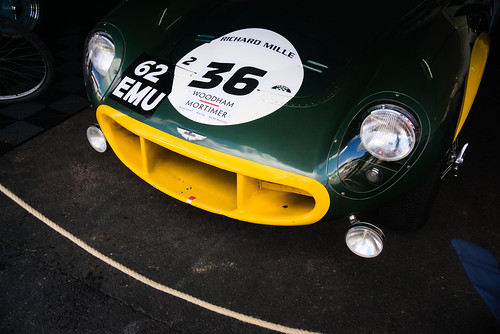
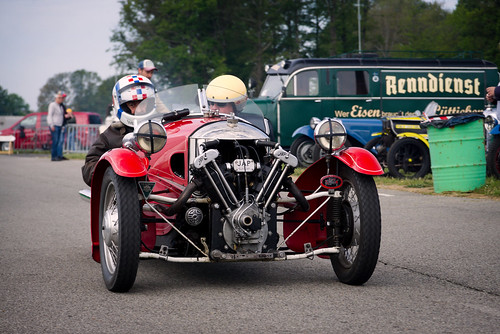
This is the ninth year I've shown up to photograph la traversee de Paris.  The event is run twice a year, once in early January and once in late July/early August.  Each time I go I try to find a different way to photograph the event, and each year I've tried to improve my "seeing" of the very common subject that is the automobile.

la traversee de Paris estivale ~ 2022


For this years summer event (the "estivale") I decided to try to separate automobiles from a darker background by using flash fill.  You've probably rightly guessed that I've read a bit too much Joe McNally and David Hobby.

Flash setup -

  • Three Yongnuo YN560 flash units
  • Mounted on a cold shoe bracket that takes the three flashes
  • Triggered by a cheap wireless FM RC setup -
    • Trigger on camera
    • Two receivers mounted to two of the three remote units
      • These two flash units to "M" - manual 
    • One of the flash units to "S1" - slave1

This allows all three flashes to trigger simultaneously.  

The whole plot was put on top of a cheap flash stand.  The off-camera stand allowed me good flexibility on where to place the lighting rig.  It can be far from the camera.  It can be lowered and put close to the subject.  I can move the lighting rig to the shadow side of the scene.  Or I could place the rig right up over the camera. In other words, in running cable-free RF triggered flash units I can arrange the rig as I feel the scene demands.

la traversee de Paris estivale ~ 2022

My biggest concern about this setup centered around Real World flash output.  I'd measured the output of these cheap Chinese flashes and the Guide Number is truly 22.  The published GN of 58 is wrong under the conditions I find myself in.  I feared that it would be a real challenge to get three flashes to balance and ultimately overpower the sun.

Camera setup

  • Sony A7 with stored setup in mode "M1" 
  • ISO100
  • 1/200th sec shutter speed (which I'd tested before leaving home to confirm the shutter wouldn't cut the upper portion of the frame)
  • White Balance set to "Daylight" (which in Sony World is 5025Kelvin - about 500Kelvin lower than I like as the flash is too blue, so I had to adjust in processing, and will need to set the WB manually to 5500 in the future and save it as part of my "M1" selection)
  • Nikon Nikkor 24mm f/2.8 Ai manual focus lens adapted to the A7
  • Find the desired aperture setting by watching the exposure needles while turning the aperture ring

My original goal was to lightly over-drive the flash output to the background exposure.   I had intended to drop the metered exposure -1EV to -2EV.  

Yet once I was on scene and working I realized I kind of preferred setting the overall exposure as the multi-zone exposure system reported it at 0EV adjustment.  In the end this was a lucky choice.  It kept the sky from blowing out.  The non-sky portion of the scene was between -0.5EV, or perhaps -1.5EV, depending on where the sun was relative to the subject and the direction I pointed the lens in.  For the most part this was what I was looking for.

la traversee de Paris estivale ~ 2022


The day started out cloudy.  With overcast skies I could set the flash power on all three units between 1/8 and 1/4 power.  I breathed a sigh of relief.  The flash units could recycle quickly and I wasn't burning the batteries to the ground by having to use 1/2 or 1 Power all the time.

This would become my process.  Meter the scene by watching the needles move with respect to the aperture.  Take a shot.  Look at the result.  Adjust the flash  power output up or down depending on what I saw.

After the sun came out, I found I could put the three flash units between 1/2 to 1 (Full Pop) Power.  This rig could augment the sun and I could actually under-expose the overall scene by 1EV.  Since the flashes were doing their "thing" by blasting as much light as they could give, the subject was brought back into proper exposure.

la traversee de Paris estivale ~ 2022

The overall experience made me wish for a couple of things.  First, I wished for accurate GN's.  While GN22 got the job done, to not make the flashes work so hard I think I'll need to add one or two more units to the rig.

Certainly Sony, Nikon, and Canon all make accurate Guide Number claims.  To have three SB800, for instance, would add overall flexibility to my setup, but those are expensive.  Just one SB800 used on the open market would be more than I paid for the three Yongnuo's new.  Obviously you _do_ sometimes get what you pay for.

On the other hand, with a little DIY I should be able to add two more cold shoes if/when the time comes and I feel the need for more Cheap Chinese Light. 

la traversee de Paris estivale ~ 2022

 Image "Explore"'d on Flickr
7 August, 2022

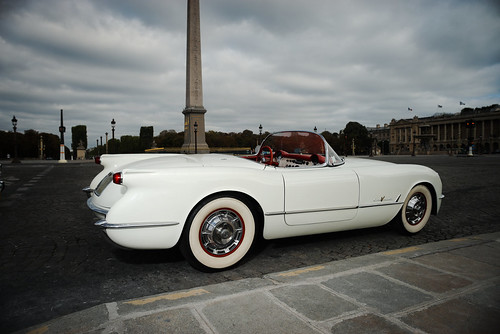
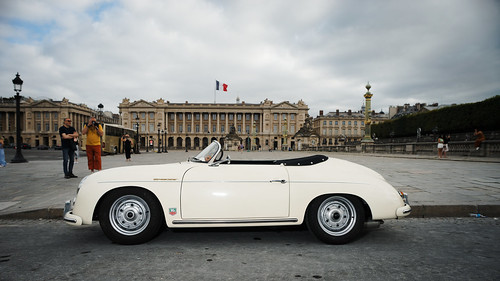
The second thing I wished for is really a minor thing in the overall scheme of things.  For 30 percent of the photos I wish I'd dropped the metered exposure 1/2 stop further.  Some of my images, while looking pretty decent, could've benefited from a slightly darker background as a way to help make the primary subject "pop" a bit more.  The white Porsche 356 is a good example of that.  Compare this image to the Corvette above it and you'll perhaps understand my wish.

Thursday, July 28, 2022

Cheap Chinese Flash Units ~ Marketing vs Reality

In the process of preparing for a project I discovered something about the three Yongnuo YN560 flash units I own.  

The published Guide Number (GN58 at 105mm) does not match my experience.  This makes it difficult to accurately expose a scene using the manufacturer supplied information.

As you already know, this model of flash is completely manual.  There is no TTL capability, nor is there any built-in RF triggering (at least in the series one and two versions I own).

Someone measured the output of a more recent model Yongnuo flash and shared their results.  They concluded that their measurements proved the factory Guide Numbers were accurate.  

Who am I to doubt? So I followed carefully what was measured, set the camera and flash to the appropriate settings, and the image was... *sad clown sounds*...  two stops under-exposed.  

Huh.  What had I done wrong?

If you've followed me over the years, you already know the importance I place on sorting things out "in the real world."  Forget the marketing lies.  Forget what someone claims to have measured, particularly if things aren't adding up correctly.  Somethings they can be wrong.  Or I should say, in the earlier days of Chinese manufacturing and sales, mostly wrong.  And sometimes there are significant differences in systems of measurement and/or understanding.

So what would the real Guide Number of my flash units be?

To sort it all out I took a Sony A7 and A6000, mounted up a couple old manual focus Nikkor lenses, grabbed a tape measure and set out to find the answer.

Here is the simple formula for determining Guide Numbers -

    Guide Number = Distance (meters or feet) X Aperture

Test Setup -

  •  Sony A7 (following values set to M1 on the mode dial for future use in the field)
    • ISO 100
    • 1/125th sec shutter speed
    • Daylight white balance
  • Nikon Nikkor 24mm f/2.8
  • Nikon Micro-Nikkor 55mm f/3.5
  • Subject exactly 1 meter from the sensor plane

As you will see I made things as easy as possible to calculate GN's at various flash power settings by setting the distance to 1 meter. 1 times anything is still just anything. In this case the Guide Number is simply the Aperture (anything).

    Guide Number = 1 meter Distance X Aperture

At each aperture setting (f/2 through f/22) I carefully noted the flash power output that gave the best range of tones from highlight down through and into deep shadows by looking at the image histogram.

Using 1/125th of a second and 100ISO, mapping flash power (FP) settings to Guide Number to distance, here is the matrix I came up with.  As you can see, at 1 meter, the Guide Number in my case is the same as the aperture.

In my system of Sony cameras, camera settings, Nikon manual focus lenses, and Yongnuo flash I found that the Full Power Guide Number is 22 at all flash zoom settings except 100mm where the Guide Number is a whopping 24.  I found these  GN's are valid for all three of my Yongnuo YN560 units.  There is no variation between them.

  • Distance = 1 meter
    • GN2, f/2, FP 1/128
    • GN3, f/2.8, FP 1/64
    • GN4, f/4, FP 1/32
    • GN6, f/5.6, FP 1/16
    • GN8, f/8, FP 1/8
    • GN11, f/11, FP 1/4
    • GN16, f/16, FP 1/2
    • GN22, f22, FP 1 (full pop)
  • Distance = 2 meters
    • GN4, f/2, FP 1/32
    • GN6, f/2.8, FP 1/16
    • GN8, f/4, FP 1/8
    • GN11, f/5.6, FP 1/4
    • GN16, f/8, FP 1/2
    • GN22, f/11, FP 1 (full pop)
  • Distance = 3 meters 
    • GN6, f/2, FP 1/16
    • GN8, f/2.8, FP 1/8
    • GN11, f/4, FP 1/4
    • GN16, f/5.6, FP 1/2
    • GN22, f/8, FP 1 (full pop)

To see how this works, let's say I have a subject 3 meters away and I would like to hit it with the correct amount of flash power with a lens aperture of f/4.  Looking at the matrix I see I need to set the flash (FP) to 1/4.  This is exactly how it reads on the back of the flash, so I don't have to think any further about it.  Hit the shutter release et voila, a perfect exposure.

Now let's say I have a subject that is 2 meters away and I am using a polarizing filter (to knock reflections off certain subject surfaces).  Let's say I would like to use an aperture of f/2.  Looking at the table I see the flash power setting would be 1/32.  Then taking into consideration that polarizing filters grab approximately two stops of light I see that I need to go from the GN of 4 to a GN of 8, where the flash is now set to 1/8 power.  Hit the shutter release et voila, a perfect exposure.

Let's do one more calculation, shall we.  Let's say we have a subject three meters away, want to use f/5.6 _and_ we have a polarizing filter.  We start with a GN of 16.  Then we need to account for the polarizing filter which is another two stops.  A GN of 22 won't cut it as it's only good for one more stop.  So, we need two flash units at 3 meters set to a GN of 22 (full pop) to give the subject enough light.  Hit the shutter release et voila, a perfect exposure.

You might question why go through all the trouble?  After-all, for a mere 500Euro/USD you can get a camera manufacturers own fully integrated flash system.  Valid question, right? 

A valid response is I'm a Cheap Old Slob.  Being retired and living on a fixed income can do that to a guy.  Further, I come from a time where these kinds of mental gymnastics were required and not optional.  Balancing ISO (ASA back in the day) against shutter speed, flash output, and lens aperture was simply part of the act of making a photograph.

Here's what I paid (approximately) -

  • 50Euro each for two new Yongnuo YN560II flash units 
  • 40Euro used for a third series 1 flash
  • 30Euro on a pair of cheap flash stands
  • 15Euro for a pair of shoot-thru umbrellas
  • 8Euro for a silver bounce umbrella
  • 15Euro for a three flash cold bracket
  • 20Euro for an RF (FM band) trigger with two remote receivers.

For less than 230Euro/USD I now have a fairly flexible fully GN verified three light system.  This, where just one Sony/Nikon/Canon flash would cost over twice that much.

I hope to be able to share results from an upcoming project.  It would be fun show what's possible while on a fixed Cheap Old Slob income.

Saturday, July 23, 2022

Photo Ops ~ July 2022

2022 isle de France Photo-opportunities - So, this is it for the updates on the Paris region photo-ops for awhile.  I have a lot to do over the summer and we'll be very busy through the Fall and Winter.  Bretagne and Italy will be in the cards.  These two places are always outstanding photo-ops.

[I've redone this sequence and put the completed events in reverse order putting the most recently finished events at the top.]


le Mans Classic - 30 June - 3 July DONE Photos Here


Aston Martin DB3S - 1955 ~ le Mans Classic 2022


Cafe Racer Montlhery - 18-19 June *NOPE* We were in the midst of a heatwave

Paris - Rambouillet avec les Teuf-Teuf - 28 rassemblement a Paris 7eme, 29 May a Rambouillet *NOPE* I went to the WRONG location!!!  Oh, man.  This isn't good.  I feel like such an idiot.

Rallye des Princesses - 14-19 May *DONE* Photos Here!

Rallye des Princesses ~ Paris 2022 

Vintage Revival Montlhery - 7-8 May - the Beast will be there (the only surviving Fiat S76) *DONE* Photos Here!


Vintage Revival Montlhery ~ 2022


Tour Auto - 25-30 April *Did not attend*

la traversee de Paris - 27 March *CANCELLED at the last moment! Argghhhh*  but it was rescheduled - yea!!! la traversee de Paris - 17 April *DONE* Photos Here!

la traversee de Paris ~ 2022


Foire Photo - Chelles - 20 March *Did not attend* 


Retromobile - 16-20 March *DONE*  Photos here!


Retromobile, Paris ~ 2022


Salon International de l'Agriculture *DONE*  Photos here!

Salon International de l'Agriculture, Paris ~ 2022


That's all for now.


Bugatti Brescia Type 13 1923 ~ Vintage Revival Montlhery ~ 2022


Sunday, June 12, 2022

Specialty Lenses ~ a more personal history

Specialty "soft focus" lenses can be a real kick in the pants, but most of the time they are difficult to control.

I've owned many "soft focus" lenses.

It all started with a 12inch Portland lens that I dearly wish I'd kept.  I didn't use it much and I now very much regret selling that lens.  I paid next to nothing for it and got next to nothing selling it on.

I also owned a Wollensak Verito, but it never was mounted nor used.  Stupid, stupid, silly me.  What I'd give to have that lens back.  Like the Portland soft focus lens, I paid next to nothing for the Verito and got very little when I sold it.

There were three other large format soft focus lenses that passed through my toy box.  Two came from Fuji and were the 180mm and 250mm SF lenses.  Like the Verito and Portland optics I never came to grip with the Fujinon SF, even though I tried them many times.  Something simply did not "click" (ahem) for me.  Same for a gorgeous Rodenstock 300mm Imagon lens that came with a complete set of sieves.

The "soft focus" lens I had the most luck with was a Mamiya 150mm SF for RB67 that came with the sieve set.  I picked it up for cheap from KEH and used it on a workman-like Mamiya RZ.  I photographed some of my wife's roses and peonies with it.  I still have several palladium contact prints that I made from digital inter-negatives that I scanned from the original 120 6x7cm.  The prints "sing" to me.  The flowers "glow" so magnificently.   These prints remain something quite special.

I have a Pentax 85mm f/2.2 Soft that was originally in Pentax K mount, but came to me in Nikon F mount.  Talk about under-corrected spherical aberration behind the point of focus!  Eowza!! that thing is over the top.  

Even stopping the Pentax down it fails to sharpen up in any meaningful way.  It's simply too much for me and I'd prefer a bit more softness control.  It's probably too much for other people, too.  I've had this lens forsale on a local website for months and no one appears the least bit interested.  Can't say I blame them.

After trading emails with a scientist photographer who received his PhD in the topic of "pictorialist" lenses I learned something interesting.  Of course, now I'd like to find the lens he says modern day "pictorialists" swear by.  It's the Minolta Varisoft 85mm lens and hey cost the moon.  I doubt I'll ever find one for a reasonable living on a fixed income price.  Though I do keep my eyes open.

A couple years ago I picked up a box of lenses for 7Euro each.  One of them was a Nikon Nikkor 50mm f/2 Ai.  It was disassembled, cleaned up, and as it was being put back together, a thought occurred to me that maybe using the rear element set all by itself could be "interesting."  I found I needed to put a couple extension tubes in line to get the setup to focus from infinity down to something pretty close.  It did the trick.  Some of the photos I made with it weren't half bad.

Paris ~ Fall 2020

Paris ~ Fall 2020

Since hunting and gathering is a full time obsession for me, the 50mm f/2 Nikkor was sold.  In the process of moving to Nikkor 50mm f/1.4 manual focus lenses, I stumbled across a 20Euro beater Nikkor-S.C.  I got the parts off it I needed for another Nikkor-S.C. project and quickly realized I had a similar setup to my old Soft Focus Special.

Using an 11mm extension tube I found the Nikkor-S.C. 50mm f/1.4 rear element set Soft Focus Special could focus from infinity to about a foot.  This was a much shorter lens adaptation than the f/2 was.


Nikon Nikkor-S.C. 50mm f/1.4 without front element set

Nikon Nikkor-S.C. 50mm f/1.4 without front element set


Looking at how it renders I feel that it behaves rather similarly to the old Wollensak Varito.  There's swirl around the edges of the frame.  There's loads of barrel distortion (which I didn't find in this quantity in the converated 50mm H f2).  The under-corrected spherical aberration is controllable using the aperture.  To help protect the lens internals I mounted up an old UV filter.  In short, not a bad "find" out of a cheap ready for the recycler lens.


Nikon Nikkor-S.C. 50mm f1.4 without front element set

Nikon Nikkor-S.C. 50mm f1.4 without front element set

Nikon Nikkor-S.C. 50mm f1.4 without front element set

Nikon Nikkor-S.C. 50mm f1.4 without front element set


Nikon Nikkor-S.C. 50mm f/1.4 without front element set

Nikon Nikkor-S.C. 50mm f/1.4 without front element set


How does the rear element set of a classic old manual focus double Gauss design give a soft focus rendition?  Nikon's "Thousand and One Nights" history series may have the answer.  When designing wide aperture SLR lenses they would "fight fire with fire" by letting under-corrected spherical aberration dominate both element sets of deeply ground element curves.  The trick appears to be to balance that under-correction.  The first element set gives under-correction and the second element set inverts the effect and re-corrects it back out.

With this in mind, you can use either the front or aft element set from a double Gauss lens to achieve a similar effect.  In the case of my thrashed 50mm S.C. the fore element group has deep scratchs and boatloads of fungus, but the rear element set remains clear.  This, it turns out, matches the configuration of the old Portland soft focus lens that I dearly miss.  The aperture is in from the element(s) and controls the level of softness.

One thing I notice is the out of focus transition behind the point of focus is very very smooth from the "get-go."  Where most old under-corrected 50mm lenses transition through the out of focus disk having a bright center _and_ a somewhat bright outter ring, this Nikkor SF Special transitions straight to beautiful under-corrected spherical aberration behind the point of focus.  No outter ring around the out of focus disk.  It's glorious.

I don't like this kind of rendering for automobiles (though things look slightly better in Black and White than they do in color) or many of the man-made subjects around town. The effect, however, looks pretty good on vegetation and in portraiture.  It's a matter of finding a subject that, to one's eyes, is enhanced by the softness.

Friday, June 10, 2022

Lens Out of Focus Rendition ~ a more personal history

Out of focus rendition behind the point of focus is where the "character" of a lens is.

For years I thought optical resolution was where "magic" could be found in a lens.  It took me a couple decades to learn otherwise.  Sharp lenses aren't hard to make.  Everyone is capable of manufacturing lenses that are "sharp."

I've learned that, for me, it's other optical properties that make a lens interesting and adds "character" to an image.  This is what I'm talking about when I write about the out of focus rendition behind the point of focus.  There are three kinds of out of focus rendition and they are as follows.

  • Under-Corrected Spherical Aberration - the out of focus disk of highlights are lighter (show more energy) in the center of the disk than at the edge
  • Neutrally-Corrected Spherical Aberration - the out of focus disk of highlights are smooth and evenly illuminated across the disk
  • Over-Corrected Spherical Aberration - the out of focus disk of highlights show bright edges and are "hollow" in the center of the disk

NOTE: These effects are most often and most easily seen when a lens is shot wide open.

Nikon knows that under-corrected spherical aberration behind the point of focus can produce a "subtle", "delicate", and "beautiful" effect.  From what I see they've been designing lenses to build this into their lenses since at least the end of WWII. For their old manual focus lenses Nikon has a clear understanding of the effect.

Zeiss lenses tend to be designed for neutral spherical aberration corrections.  I have a gorgeous Sony Zeiss 16-70mm f/4 ZA OSS that appears to be been designed this way.  And I have a couple Nikon zoom lenses that behave this way, too.  One is the cheap and under-appreciated E-series 75-150mm f/3.5.  The other is the 100-300mm f/5.6 AiS which is also cheap and under-appreciated.  I find out of focus rendering to be wonderfully smooth.

Old manual focus over-corrected lenses tend to appear "sharper" at the point of focus than under-corrected lenses (where spherical aberration tends to veil an image).  I'm convinced this is why certain manufacturers chose this approach.  I'm thinking of the Zeiss 50mm f/3.5 and f/2.8 Tessar lenses and many of the Canon FL, FD, and FDn designs.  This effect is what people tend to call "soap bubble bokeh."  I don't like it, but I know of photographers who do.

Back when I shot large format film (4x5inch up through 12x20inches) I felt with no real evidence other than "Tribal Widsom" that German made lenses were the "best."  I owned a nice collection of Schneider, Voightlander, and Zeiss lenses.

It was only recently that I read about Nikon's lens design philosophy and how they applied their under-corrected spherical aberration approach to their medium and large format lenses, as well.

I saw "something" in the way a pretty little Nikkor-M 200m f/8 performed, but at the time I couldn't "put my finger" on what it was.  Well, looking at a few of my old negatives I now see it was this out of focus rendition that makes Nikkor optics so special.  It was a real missed opportunity for me to explore what the Nikkor-W series of lenses were capable of. 

How to know how a lens was designed for behind the point of focus rendition?

This is easy.  Very easy, in fact.  Using a digital camera with focus magnification -

  1) Mount a lens on a camera

  2) Find and focus on bright highlights

  3) Magnify a highlight to 15x

  4) Start to slowly turn the focus ring from farther away to closer

  5) Watch the highlights as they go out of focus, note the highlights in one of three following ways:

        a) Bright point in the center of the expanding luminous out of focus disk - this indicates under-corrected spherical aberration behind the point of focus.  Often with old lenses you will see what appears to be a brighter ring around the edges of the out of focus disks.  This is normal.  What's important is to see is that the center is brighter than the surrounding disk area (with the possible exception of the very edges of the disk).

        b) Luminous out of focus disk remains smooth across the field - this indicates a neutrally corrected optic (these tended, until recently, to be rather rare in my experience)

        c) Bright disk edges with hollow center - the out of focus disk looks like a doughnut - this indicates an over-correction leading to "soap bubble bokeh"

I do this when considering a lens I'm not already familiar with and this simple technique works a charm.

Modern mirrorless AF lenses from Sony, Nikon, and Olympus are designed to eliminate as many optical defects as possible.  With the aid of computer ray tracing software and improved manufacturing techniques many new lenses are darned near "perfect."  You can use the technique of verifying the out of focus rendition on current optics, too.

Wednesday, June 08, 2022

Lens "Sharpness" ~ a more personal history

In looking at lenses and cameras, in doing these tests and comparisons I've always taken the simplest, most direct approach possible.  No fancy, often very expensive, test and measurement gear.  Just a standard USAF military test chart, newspaper, or "interesting" subject, cameras, lenses, film, and, more recently, digital sensors, a lot of research, more than a few conversations with scientists, and a bit of experience.  

Anyone can duplicate what I've done.  Which is partly the point.  If there are any questions about what I've written, people can have a look for themselves to see what's true, correct, or not.

I thought perhaps was now the time to share and sum up a few things that I've learned over the past quarter century of poking and prodding.

Lenses, unless otherwise designed and with very few exceptions, are sharp. Period.

Fixed focal length lenses are sharp, at least.  Zoom lenses?  It's a bit more complicated.

I've been fortunate enough to have been able to enjoy a vast variety of lenses over the years.  How many hundreds and hundreds of lenses have I owned, tried, tested, compared, considered, shot with, and written about?  Everything from very large format film down through APS-C digital have spent time in my Closet of Goodies. 

In my youth I shot primarily 35mm.  A Pentax H1A was my very first "serious" camera.  Then came a Canon FTb QL, Pentax MX and MV, a Nikon FM, a Canon F1 (first of the series),  several Canon AE-1/AV-1/AE-1 Program, and two Leica M3.

I had access to a Mamiya C220 for some years as well.  It was a wonderful camera.

One year I had a tax rebate large enough to allow me to buy a new Sinar F with extension rail, and what turned out to be a very nice, borderline fabulous 210mm f/5.6 Schneider Symmar-S MC.  I owned that setup for many many years and have more than a few wonderful negatives from that setup.

In my early 35mm and 120 format days I didn't have many thoughts about optics.  I didn't know enough then to form an opinion and I wasn't curious enough to have a look.  All I wanted to do was "find some magic", shoot a few good photos, become famous, and lead the Life of Riley.  

After realizing the world wasn't exactly coming to my doorstep and that I needed to put my head down, apply some effort, and simply get to work, I became curious all kinds of thing, including looking at what was really going on with cameras and lenses and such.   The Sinar F 4x5, Schneider Symmar-S MC 210mm kit was the first to fed that curiosity.

It started with the aid of a USAF Resolution Test Chart back in 1998.  I shared some of my first test results with folks on-line in the then still the academic implementation of what would soon become the "internet".  Those were the days of UUnet, modems, newsgroups, and the East/West communications link that stretched between MIT and Tektronix.

Kerry Thalmann (an engineer from Intel) contacted me (I was working at Tektronix at the time) and suggested we look at a bunch of his lenses too.  The mossy rock was soon scooting unflappably down the hill.  Here I am 24 years later, still looking at photography things, asking questions, and generally poking around to see whatever there is to see.  

I quickly learned that old lenses could be as good as new while looking at a pair of turn of the century Protar lenses and compared them against something quite modern.  Yes, the modern lens looked very so slightly "sharper", but there was certainly nothing wrong with the Protar images.  It took extreme magnification to see any difference between lenses from the early and late 20th century.  This was an important learning for me because this was the first time I experienced something that would frequently ran counter to whatever marketing literature came my way.

Of course I found I preferred some lenses more than others.  Often it more than anything else came down to whichever lenses had the most reliable shutters.  Here is a list of Large Format Favorites.

  • Schneider Super Symmar XL 110mm f/5.6 on 4x5inch
  • Schneider Symmar-S MC 210mm f/5.6 on 4x5inch and 5x7inch
  • Kodak Commercial Ektar 300mm f/6.3 on 8x10inch
  • Kodak Wide Field Ektar 250mm f/6.7 on 7x17inch
  • Fuji Fujinon C 450mm f/12.5 on 12x20inch
     

I also found joy in shooting Schneider's "Angulon" series of optics, too.  They are small, light, and covered large pieces of film quite well.  Other small, light optics that were wonderful to use were the rare and difficult to find Zeiss Jena Germinar lenses.

My favorite medium format lenses were Schneider Xenotar on Rolleiflex TLRs.  They were slightly less sharp than the glorious Mamiya 7 optics, but they had contrast, those Schneiders did.  Why on Gawds Green Earth I ever sold those Rollei's?  Well, I couldn't bring them with me when we moved to Europe.  It was a simple as that.  So I sold them.

For a short time I owned a cosmetically pristine Hasselblad 500CM.  It was one of those classic "dream cameras" that seemed too often just out of reach financially.  I had a couple film backs, a 45 degree finder, 50mm, 80mm, 120mm, and 150mm Zeiss lenses.  I wanted to love the setup.  I really did.  But it spent as much time in the shop getting repaired as it did on a tripod getting used.

It was always the little niggling things.  In-body light-trap barn door springs were prone to bending.  The light-trap materials used on film backs were prone to leaking light after just a couple months of use.  The whole plot felt weak and under-engineered.  I'd learned how to replace the film-back light trap materials.  But after the camera body went to the shop for it's third light-trap spring replacement I was done.  No more.  It was more of a pain in the arse than it was worth.

Looking for a replacement to the recalcitrant Hasselblad led me to discover a wonderful Mamiya 7.  The 50mm, 80mm, and 150mm lenses were all demonstrably sharper than anything I'd ever "tested" at 120 line-pair per mm, baby! (which, BTW, was the absolute resolution limit of TMax 100 in D76).  The camera was light, handy, and gave a nice, large, useable 6x7cm negative.  Along with the Rolleis, I think that if I ever get back into film (which I never will) I'd sure like to have another Mamiya 7.

My arrival to the New Age of digital photography was at first a horror show.  

Canon EOS APS-C format lenses and 40D and 50D in-camera jpg processing were absolute cr*p.  Images are visibly soft.  Even now I can't believe just how bad some of that work was. I had to keep the final image sizes small to give the illusion of them being acceptable.  This is why at first I still hung on to my medium format cameras.

Convinced "better" lenses would do the trick, I sold the first couple of Canon optics and went with hugely expensive L-glass.

After seeing that even the L-glass looked "soft" under a wide variety of circumstances on a brand new Canon 5D MkII, I dug around the 'net and found an answer.  The in-camera jpg processor was junk.  Hence the switch to RAW, which helped, but wasn't the complete answer.

I learned that Canon sensors are "soft" due to the heavy AA filter they use over the sensor.  I could lean heavily on USM to get something semi-decent out of the 7D and 5D MkII RAW images.  I didn't know just how strong that AA filter is until, one day, I shot a 100-400mm f/4.5-5.6 Canon L adapted to Sony APS-C A6000.  It was like the clouds had parted and everything was now clear.  The difference was dramatic.

In the end, my Canon Drama of visibly soft image came down to three things.  Lenses were, in fact, just barely "good enough", but they weren't the primary source of my problems.  The in-camera jpg processor cranked out soft images... and... Canon's use of heavy AA filtering softened all output, RAW and JPG.

Recently I read Thom Hogan's comments on early zoom lenses being designed for adequacy, not optical perfection.  Here's what he said.

"...As film SLRs developed and gained in popularity, a number of things started to happen with optics. In particular, autofocus and zoom focal ranges added convenience that drove much of the designs in the 70's, 80's, and 90's. The original Tamron 28-200mm lens in the early 90's also started a trend that was much imitated: "good enough" across a wide range of things..."

Looking at this with nearly perfect 20/20 hindsight I have the strongest impression that Canon was doing everything just "good enough" but no better.  While I have no direct knowledge of this, M.Hogan indicates Canon's old design approach may still be in play here in the Mirrorless Age.

"...  It took Sony awhile to get on board, but Olympus and Nikon have done this from the beginning of their mirrorless endeavors: simply design better lenses. Far better lenses. Lenses with a near complete lack of negative attributes. Canon, unfortunately, seems to be going to take a while to get fully up to speed with this..." [the bold is my emphasis]

It bears repeating that Canon lenses for me looked substantially better when used on Sony cameras.  The jpg-processor and the strong AA filters of Canon cameras often masked optical performance.

Having moved on from Canon is probably the best thing I've done since switching to digital.  Really good Canon EOS to Sony E AF adapter performance was not at first to be found.  In frustration I sold all my L-glass.
As a consequence, I'm most familiar with Sigma and Sony lenses on crisp, clean, clear Sony sensor'd bodies.  In general I love them.  They are spectacular.  And, yes, I'm still very much in love with my old "filled with character when shot wide open" manual focus Nikon Nikkors.  There is lots for me to appreciate and enjoy on both old and new optics.

Lenses are seldom the determining factor in whether an image is "sharp" or not.   It turns out, film and sensors limit resolution.  Lenses most of the time just come along for the ride.

Monday, June 06, 2022

Current lens design technolgies paying off...

Thom Hogan has been around the block more than a few times and _really_ knows what he's talking about.

So when he writes about the current state of lens design technologies, it can pay to listen to him.

While I may in the end choose to stay with my old "charactered" SLR lenses on Full Frame Sony A7, I can fully appreciated what Thom writes about how good new lenses can be.  And for this I'm sorely tempted to sell off all the old stuff and go with the new.


Vintage Revival Montlhery ~ 2022

Tuesday, May 24, 2022

Alternative Legacy 3 Lens Kit ~ "extended" version

A couple of days ago I wrote about the "Ultimate 3 Lens Kit."  It was based on some old thinking and the examples of certain famous photographers who started the Magnum news imaging service.  That lens kit consisted of a 35mm, 50mm, and 85mm lens.

Some might wonder why I don't just use, oh, let's say, a Sony 16-70mm ZA f/4 OSS on one of the beautifully small and very capable APS-C EVF mirrorless bodies?  Why not, indeed.  In fact, when traveling and attempting to keep the overall weight of my camera gear to an absolute minimum and to maintain domestic harmony I'll take this lens and put it on a Sony A6000 or NEX7 EVF APS-C and call it "done."
If there ever was one zoom lens to rule them all, it would be this Sony Zeiss.  The out of focus rendition is very similar to Nikkor lenses (ie: gloriously smooth behind the point of focus).  The Sony Zeiss is very sharp.  And there is nearly nothing of that common zoom lens design field curvature that makes the edges go soft when shooting flat 2D subjects.  The rendition of this 16-70mm ZA zoom is something to proclaim far and wide.  Except...
I love the way fixed focal length lenses render.  It's subtle.  It's not obvious (I know, I repeat myself, repeatedly).  Perhaps it's only me who can claim to pixel-peep "see" any differences, but in general, I love Nikkor optics for the way they capture a scene.  They "feel" to me to be a little step above even the Sony Zeiss.

In current times and with the advent of cellphone cameras people have migrated toward using wider angle lenses.  I see this even in photographers who shoot their more "serious" works using larger sensored cameras.  Wider seems to be "better."

So, in the spirit of keeping up with the times, here is a proposal for a slightly different 3 lens kit.  This answers a question of what would happen if we extended the "ends" of the kit just a little bit. What might that look like, while remaining very usable for a wide range(r) of subjects?

On the long end, I propose a slightly longer than 85mm Nikon Nikkor-P 105mm (Xenotar-type) f/2.5 pre-Ai lens.  The wide open "character" of the 105mm f/2.5 Nikkors is nothing short of sublime. I'm sure everyone remembers Steve McCurry's famous images made using this focal length lens from Nikon.  It seems to have cemented not just his celebrity but the celebrity of the optic, too.  Not a bad place to start building this extended range 3 lens kit, then.

In the middle, I put an early Nikon Nikkor-S Auto 50mm f/1.4 lens.  This is filled with "character" when shot wide open.  Stopped down a stop or two and lens performance looks remarkably similar to current optics.  From this standpoint the 50mm Auto might be seen as an interesting "all around" selection.  You can have your "character" and modern rendition out of the same focal length lens.

Moving to the wide end of things, 28mm lenses fall nicely between all too often distorting 24mm optics (similar focal length to cellphone "selfie" lenses) and the "Ultimate 3 Lens Kit" 35mm selection.  On one hand, 28mm's is definitely wider than 35mm.  On the other, 28mm's take a bit more work than 24mm's to make it distort a scene.  As a bonus, the 28mm lens I chose has a bit of the wide open aperture "character" that I've come to appreciate from early Nikkor manual focus lenses.

Here it is, a proposal.  This lens selection is wider on one end and longer on the other than the "Ultimate 3 Lens Kit" and contains three lenses that I find are filled with "character."

  • Nikon Nikkor-N 28mm f/2 pre-Ai (updated with factory Ai aperture ring)
  • Nikon Nikkor-S 50mm f/1.4 pre-Ai
  • Nikon Nikkor-P 105mm f/2.5 pre-Ai


 Three Lens Kit ~ 28mm, 50mm, 105mm


Sunday, May 22, 2022

Legacy 3 Lens Kit ~ "classic" version

When I was young and dinosaurs still roamed the earth my photographer friends and I would talk a lot about the "Ultimate Camera/Lens Kit."

Following closely from well known practitioners, comme Henri Cartier Bresson, we settled on 35mm, 50mm , 85mm as the perfect kit to carry wherever we went and to any photoshoot we made.  We used 50mm most of the time and reached for the 35mm or 85mm lenses when a situation warranted it.

It was simple.

For many years I carried either a Canon F1, a Pentax MX, a Nikon FM, or a Leica M3 with a 50mm in the appropriate lens mount.

The Canon F1 was the original first model series version.  It was built like a tank.  The camera survived a drop at one of the first Long Beach Grand Prix, it was that strong.  Additional lenses for it were a 35mm f/3.5 FD, a 50mm f/1.8 FDn, a 135mm f/2.5 FL, and a 200mm f/3.5 FL.  Yet, the vast majority of the photographs I made with it were using the 50mm lens.

The Pentax MX was a beautifully small camera and the 50mm f/1.7 lens I used was perfectly balanced for the way the camera handled.  I had a couple other lenses for it, but the 50mm was my "go to" optic.  I made some nice images with that camera.  That was one of the more "perfect" kits I owned.

The Nikon FM was slightly larger than the Pentax.  I had a 50mm f/1.4 Auto Ai that I used.  The camera body had a winder, too.  It was a fun kit, but I was too young and inexperienced to realize what I had.  The Nikkor lenses were considered the class of the world for very good reason and I was completely clueless.

The Leica with an interesting 50mm f/1.5 Leitz came to me after a Samy's Print Lab big "important client" print session that netted enough money to get to decide between the German camera, a Swedish Hasselblad 500C/M, and an Ansel Adams 16x20inch "Moonrise" print.  Yes.  I'm stupid.  I should've purchased the Adams.  In fact, I can still see that gorgeous print in my mind's eye hanging in the Best Gallery in Yosemite Valley.  Ugh.  Oh well.  Missed opportunities, and all that.

Fast forward from the Dinosaur Era to the present and I find myself with a nice collection of Nikon Nikkor glass and a Sony A7 full frame mirrorless camera.  The Sony camera is actually smaller and lighter than a Canon AE-1 film body.  Though, it must be noted that with age the Sony, Nikkor kit is beginning to feel a little heavy.

Anyway, here is what my friends and I used to call the "Ultimate Kit."  It's been repurposed for use in the Digital Age and consists of a Nikon Nikkor-O 35mm f/2, a Nikkor 50mm f/1.4 AiS, and a Nikkor 85mm f/1.8 K.


Three Lens Kit ~ 35mm, 50mm, 85mm

Saturday, May 21, 2022

On converting digital Color into Black and White ~ One Last Time

Before I pause this blog, I thought I'd reiterate something that I learned about converting digital color to black and white.  

When I used to make prints for other photographers for a living, I always strove to tone richness, creamy whites, and deep/beautiful blacks.  If you look at so much of the modern digital black and white work it can be a muddy mess of yuck.  Sure, current practitioners might not see things that way.  They likely believe their B&W work is just wonderful.    Yet to me I have to ask why is so much work missing that tonal richness we used to have back in the day?

It turns out there's a very simple way of getting back to that classic old print richness and I wanted to write about it again, but Mike Johnson beat me to it.  And he says what needs to be said more clearly and succinctly that I ever could.

Here is a link to his Online Photographer blog article.


Musee des Arts et Metier ~ Paris 2021


I now know that processing digital files can be more flexible and more accurate in black and white imaging than film ever was.  And, with a bit of knowledge, we can achieve that old silver print "richness" that so much of the current digital B&W is lacking.  

It comes down to this two things.  First, humans see color tones in black and white in a specific way and, second, the material properties of silver halide papers and their effects on printed from negative images are rather different than people might think.

First, the way humans see color converted to black and white is very interesting.  Tim Soret does an excellent job of explaining what we "see." What human perception modeling allows is tonal separation.  Let me say this again, with emphasis: What human perception modeling allows is tonal separation.

This used to be the Holy Grail of black and white film photography.  In digital work to touch that Holy Grail of tonal separation is as simple as understanding which tool to use and why.


Musee des Arts et Metier ~ Paris 2021


As a side note, I was happy to see that Sony's in-camera black and white conversion fits M.Soret's description of human perception.  When I set a Sony mirrorless camera up for black and white, I can see the effect in the EVF and on the LCD.  Sony has done an outstanding job of eliminating much of the guesswork.  A photographer can really "see" in black and white.  It's so easy it sometimes feels like cheating.

My second learning about converting digital color to black and white is related to what I used to experience when I was a black and white print technician working on Sunset Blvd in Hollyweird, CA back when dinosaurs roamed the earth.  Exhibition quality prints we used to make for at the time famous photographers were nearly always creamy smooth/rounded in the high-tones and raised elevated in the mid-tones of a negative.

It's most definitely not sufficient to take a black and white negative, scan it and invert it to generate a positive image and call it done.  

The negative was always only part of the process, the starting point.  Further, if we stop at the black and white film negative, we're once again stuck in a sea of muddled yucky grays.  It's no better than performing a simple de-saturation of a digital file.  So how do we get around this and come closer to creating the tonal richness of old film-era prints? 


Musee des Arts et Metier ~ Paris 2021


Following Mike Johnson's guide, open the "curves" function in your photo editor, grab the middle of the curve, and lift/raise it.  Watch what happens to your image and stop lifting/raising the curve when the effect is correct.  Here is what M.Johnson says about using this approach.

"...[It]increases shadow contrast, raises the often radically lowered middle values, and softens the contrast of highlights, all at once. This is just B&W Tonality 101..."

To cement this learning we can look at old prints and study their tonal ranges.  We can "calibrate" our eye to the "richness" of tones and expressions that can be achieved.  M.Johnson suggests browsing a site called "Shorpy."  Indeed, studying photos there can be educational and inspirational.

Once you "see" the difference between a muddle mess of grays image and beautiful tonal expressions you'll know what to do.  Just follow these two steps: 

1) Use luminance/human perception modeling to perform the initial conversion from color into black and white

2) Raise the mid-tones using the "curves" tool


Musee des Arts et Metier ~ Paris 2021

Thursday, May 19, 2022

Roasted, Toasted, Gunky, Gummy Hell ~ Nikon Nikkor 50mm f/1.4 AiS cleanup

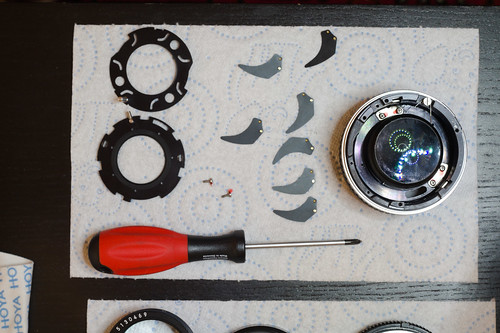
The Nikon Nikkor 50mm f/1.4 AiS I recently picked up quickly developed a problem.  I suddenly had a set of oily aperture blades.

Quick as a bunny I went over to Richard Haw's website to read-up on how to disassemble the oil-stricken lens.  The process didn't look too bad, but decided to take it a step at a time.  I didn't want to make a mess of it by stripping screw-heads like I accidentally had on an otherwise nice Auto S.C.

By the way the rear mount came off the AiS I knew someone had been into this lens before.  The screws weren't as tight as they are coming from the factory.

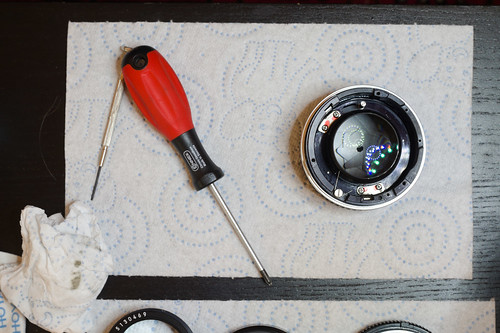
Step one, remove the rear mount and assess the situation to see if something had caught in the spring mechanism.  After looking around I reassembled it and realized I hadn't solved the problem.

Step two, re-remove the rear mount and drop the element carrier out the front barrel to get at the aperture mechanism.  As M.Haw suggests, the 50mm AiS aperture mechanism is just like the Nikon Nikkor 85mm f/2 Ai/AiS.  Easy peasy, right?

Looking into the lens from the front I realized there was a larger problem.  The person who'd gotten into the lens had used WAY too much grease.  Perhaps the focusing mechanism had been stiff?  Who knows?  All I knew is there was grease in places there it had no business being.  It was everywhere!

I had an oil spill to clean up.  Call in the Hazmat Crew!! and gallons of ETOH, denatured, of course.  The natured stuff is best left for the photographer (me). Yes.  I'm being somewhat dramatic.  LOL!

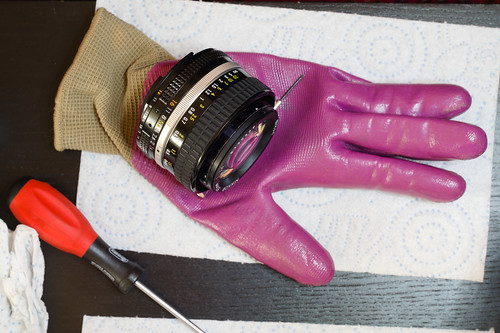
After reassembly and working with the lens for awhile it appears I may have solved the problem.  Keeping fingers crossed on that, but if I didn't get it all, I know I can easily get back into the optic.

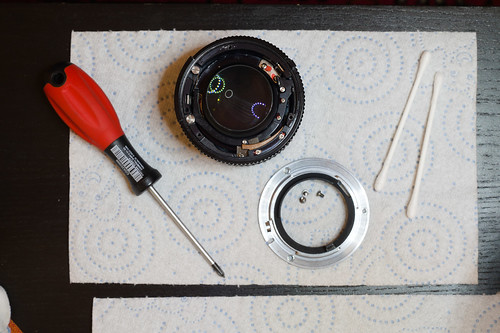
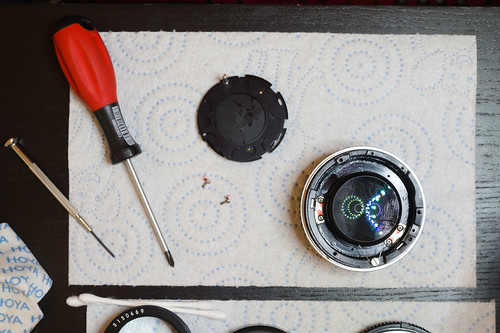
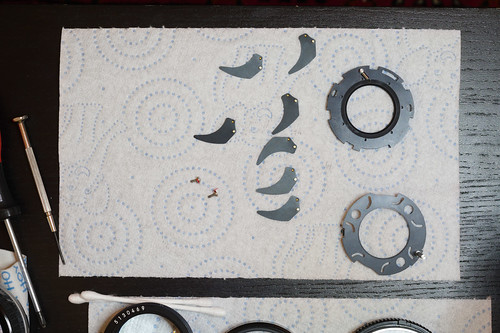
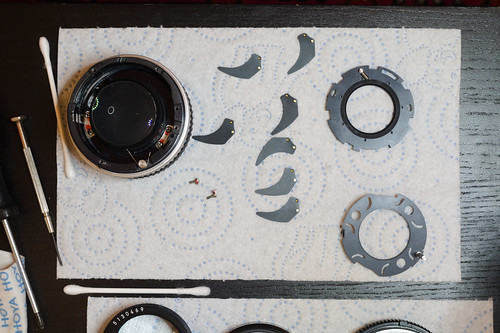
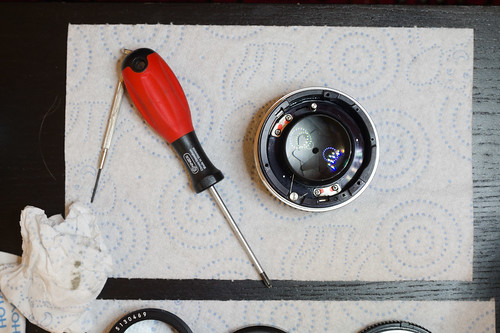
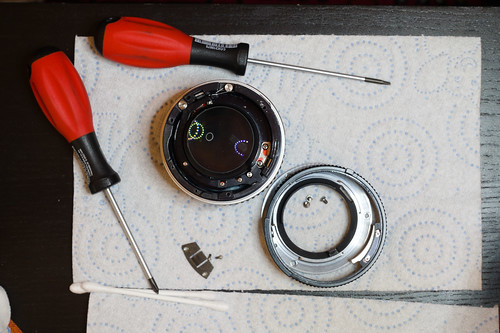
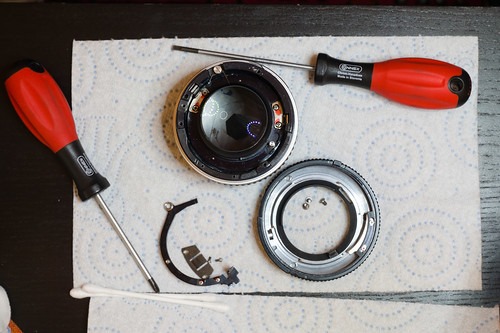
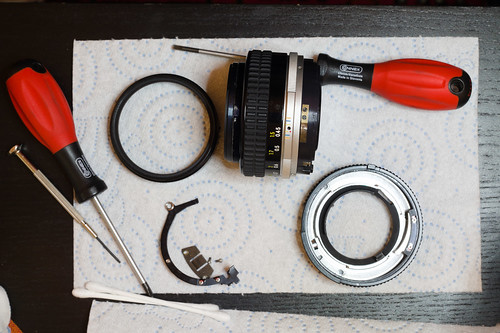
Here's the tale of the oil cleanup and aperture blade de-greasing in photos.


Nikon Nikkor 50mm f/1.4 AiS ~ partial teardown

Nikon Nikkor 50mm f/1.4 AiS ~ partial teardown

Nikon Nikkor 50mm f/1.4 AiS ~ partial teardown

Nikon Nikkor 50mm f/1.4 AiS ~ partial teardown

Nikon Nikkor 50mm f/1.4 AiS ~ partial teardown

Nikon Nikkor 50mm f/1.4 AiS ~ partial teardown

Nikon Nikkor 50mm f/1.4 AiS ~ partial teardown

Nikon Nikkor 50mm f/1.4 AiS ~ partial teardown

Nikon Nikkor 50mm f/1.4 AiS ~ partial teardown

Nikon Nikkor 50mm f/1.4 AiS ~ partial teardown

Nikon Nikkor 50mm f/1.4 AiS ~ partial teardown

Nikon Nikkor 50mm f/1.4 AiS ~ partial teardown

Nikon Nikkor 50mm f/1.4 AiS ~ partial teardown

Nikon Nikkor 50mm f/1.4 AiS ~ partial teardown

Nikon Nikkor 50mm f/1.4 AiS ~ partial teardown

Nikon Nikkor 50mm f/1.4 AiS ~ partial teardown

Nikon Nikkor 50mm f/1.4 AiS ~ partial teardown

Nikon Nikkor 50mm f/1.4 AiS ~ partial teardown

Nikon Nikkor 50mm f/1.4 AiS ~ partial teardown

Nikon Nikkor 50mm f/1.4 AiS ~ partial teardown

Nikon Nikkor 50mm f/1.4 AiS ~ partial teardown

Nikon Nikkor 50mm f/1.4 AiS ~ partial teardown


The End