Saturday, January 28, 2023

Sony 55mm f/1.8 ZA compared to Nikon Nikkor-P 105mm f/2.5 non-Ai

I find I don't normally need much focal length.  On those occasions when I do, there is the 70-350 G Sony that is actually quite brilliant on the APS-C bodies.  When coupled to the A6000, there's nothing to stop me making a decent image from far away.  Cars and motorcycles at the autodrome.

This leaves me wondering how I've accumulated this many manual focus telephoto lenses.  I still have four of them.

Question: Why have so many long-ish lenses have passed through my hands?  Why I buy them and then after several years sell them on? 

Answer: Manual focus telephoto lenses are a PIA, but... but... but... I get caught up in "this is a great lens that nobody knows about."  

I need to get with the program and remember why I don't like using manual focus telephoto lenses and nip future manual focus telephoto lens purchases in the bud.

Sure, there is focus peaking, but it's really only successful if I'm careful and paying attention.  I've found that my eyes aren't what they used to be.  Either that or I've grown impatient.  AF is Dialing for Dollars at the home of this Grumpy Old Fart.  Am I smart enough to pick up the phone?

Yet... I just can't seem to part with a Nikon Nikkor-P (Xenotar-type) 105mm f/2.5 pre-Ai.  I'm not sure why, but I just can't let this one go.  Before deciding once and for all if it stays or goes, I thought I'd better put the 105mm up against the much more modern 55mm f/1.8 Sony ZA.  If the 105mm came out poorly, then I'd know which way to proceed.

While I'm at it, why not compare these against an old Nikon Micro-Nikkor 105mm f/4 Ai?  It's reportedly the "Cat's Meow" when it comes to resolution.  I've never really taken to the Micro-Nikkor 105mm.  An old 55mm f/3.5 Micro-Nikkor?  Yes.  That's a brilliant lens from wide open.  This 105mm f/4?  Eh, not so much.  I'll be happy to sell it when a buyer comes along, like in 20 minutes.

This would leave me with two manual focus zooms that pass through 105mm, this Nikkor-P, and a beautiful 16-70mm Zeiss on APS-C that ends at, well, 105mm FF equivalent.  That still makes four 105mm lenses.  Gads, I'm rich in focal lengths I seldom use.


Nikon Nikkor 105mm f/2.5 (Xenotar version) ~ Lens Stories


Setup ~ 

  • Camera - 
    • Sony A7, 100ISO, 2sec timer, "A" mode
  • Lenses - 
    • Sony 55mm f/1.8 ZA
    • Nikon Nikkor-P 105mm f/2.5 pre-Ai
    • Nikon Micro-Nikkor f/4 Ai
  • Bogen tripod
  • RawTherapee -
    • Snug up the curves
    • With and without "Capture Sharpen" 
    • _No_ chromatic aberration correction on any of these lenses


Comparison ~

As always, click on the image and enlarge to 100percent to see whatever there is to be seen.


Sony 55mm f/1.8 ZA, Nikon Nikkor-P 105mm f/2.5 pre-Ai comparison


Comments ~

My new (to me) Sony 55mm f/1.8 ZA is brilliant from wide open and straight across the field.

The Nikon Nikkor-P 105mm f/2.5 pre-Ai is a Cats Thin Whisker behind the Sony from wide open and straight across the field.

Wide open the Nikon Micro-Nikkor 105mm f/4 Ai is visibly softer than the previous two lenses, but cleans up nicely at f/5.6

Add a bit of Rawtherapee Capture Sharpen and things appear quite equal between the three lenses.

It wouldn't cost me a dime to keep the 105mm Nikkor-P and I really should keep it as a "just in case" optic.  The only time I question the move is when I think about picking up an AF Sony 85mm f/1.8 or Sigma 90mm f/2.8 DG DN.  
 
What stops me?  The Sony is large-ish with a 67mm filter diameter and the Sigma suffers from pincushion distortion. The Nikkor-P is pretty much perfectly sized and suffers no distortion.
 
So to me there is no easy, clear answer just now.  If Sigma or Tamron were to make at the "right price" an AF lens as perfect as the Sigma 60mm Art and Sony 50mm SEL OSS are for APS-C, I'd probably reconsider my Nikkor-P.  Until then, I've pretty much decided this old Nikkor-P with current day levels of performance will stay in the kit.  Manual focus will remain an annoyance.

The Micro-Nikkor 105mm f/4 Ai was, in fact, sold 20 minutes after I wrote that earlier sentence about wishing it to be gone.

Tuesday, January 24, 2023

Sigma 24mm f/3.5 DG DN, Nikon Nikkor 24mm f/2.8 Ai comparison

Well, I did it.  I purchased an AF 24mm lens.  It's a Sigma 24mm f/3.5 DG DN for Sony E.  It's a pretty little thing.

There are plenty of comprehensive reviews that look at the Sigma, so I will limit myself to comparing French political newspaper photos between the new lens and  my old Nikon Nikkor 24mm f/2.8 Ai.  

I'm getting old.  Redundancy tends to confuse me.  For example, at one point I had 5 different 105mm Nikkors.  Which to use?  It was seldom an easy answer.  Perhaps the best answer for me is to simplify.  That leaves the current question - do I sell the Nikon now that I have the Sigma? 


Sigma 24mm f/3.5 DG DN on Sony A7


Setup ~ 

  • Camera - 
    • Sony A7, 100ISO, 2sec timer, "A" mode
  • Lenses - 
    • Sigma 24mm f/3.5 DG DN
    • Nikon Nikkor 24mm f/2.8 Ai
  • Bogen tripod
  • RawTherapee -
    • Snug up the curves
    • With and without "Capture Sharpen" 
    • Automated chromatic aberration correction on the Nikkor


Comparison ~

As always, click on the image and enlarge to 100percent to see whatever there is to be seen.


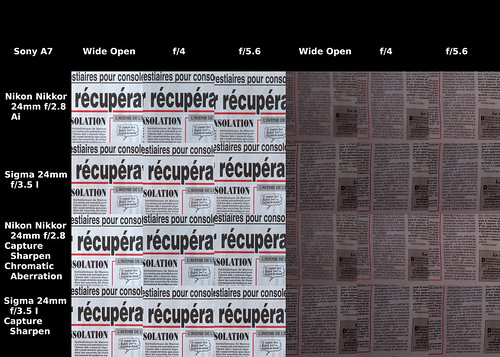
Sigma 24mm f/3.5 I, Nikon Nikkor 24mm f/2.8 Ai comparison


Comments ~

Previously I realized that the corners of the Nikon Nikkor 24mm f/2.8 Ai could clean up rather nicely by using a little Rawtherapee Chromatic Aberration correction.  I originally found a manual way of doing this and had set the sliders to +0.004 to get a good clean image all the way into the corners.  
 
While preparing this comparison I'd forgotten where the manual sliders were and stumbled across an automated function.  So I tried that this time around and, well, the results are about the same as what I'd performed manually.  Maybe my eyes aren't as bad as I think they are?

Looking at the center of the field, there's not much difference between the Sigma and the 40 year old Nikkor.  If I stare intently enough, I can see that the Sigma appears to be slightly sharper.
 
On the other hand the Nikkor gives a nice "meaty" sense of resolution.  I'll say more about this in another post, but this kind of "sharpness" is what I see in my new Sony ZA 35mm and 55mm lenses, as well as nearly every single Nikon Nikkor I've ever looked at.  There's something in common going on, here.  I suspect is has to do with optical design philosophies.

Considering the edges, there are three things that I see.  First, the Sigma is behaving like a very nice Flat Field lens.  It's sharp clear across the field into the corners.  As with before, the Nikkor corners clean up well by f/5.6 where it begins to look very "current" in it's rendition.
 
The second thing I see is that the Rawtherapee Chromatic Aberration correction works nicely on the Nikkor.  It's nice to note that this correction is not at all needed/useful with the Sigma.  The Sigma is beautiful in this regard where the Nikon benefits from a little (not much, really) help.

The third thing I see in the corners is that there is a bit more distortion in the Sigma than there is in the Nikkor.  The Nikkor looks quite "neutral" where the Sigma "pulls" a bit.  If I didn't have these side by side I'm not sure I'd notice much of anything.  But since we're here, I thought I'd better say something about it.
 
So where does this leave me?  We'll see, but I'm leaning toward selling the Nikon lens so someone else can benefit from its beautiful performance.


Sunday, January 22, 2023

Sony 35mm f/2.8 ZA compared to Nikon Nikkor 24mm f/2.8 Ai ~ part Two

Still thinking about edge softness in old lens designs and the article Thom posted that asks the question of "Do lenses have character?" I thought I'd better have another look at my Nikon Nikkor 24mm f/2.8 Ai. For completeness, as it were.  Just to verify I'd looked at as much I could before I let the pretty little lens find a new home.

In a prior post I looked at chromatic aberration software corrections and their limited effect on a Nikon Nikkor-O 35mm f/2 pre-Ai.  Since there wasn't much change after applying chromatic aberration corrections with the Nikkor-O I thought maybe the 24mm lens wouldn't clean up well either.


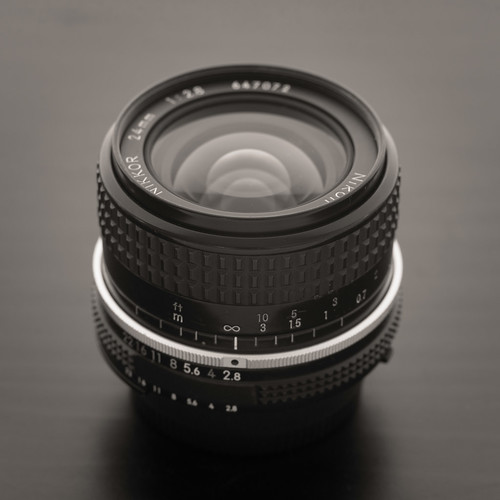
Nikon Nikkor 24mm f/2.8 Ai


The Toy Drawer is getting ever lighter as lenses are being sold on.  What I've found for myself is that having too many lens options causes me to get wrapped around the axle a little more often than I'd like.  It's not very conducive to being productive at image creation.  I'm now wondering if I should keep any manual focus lenses "just in case."  These comparisons are helping me sort my feelings.


Setup ~ 

  • Camera - 
    • Sony A7 - ISO100, 2sec timer, +1EV, AWB, etc...
  • Lenses - 
    • Sony 35mm f/2.8 ZA
    • Nikon Nikkor 24mm f/2.8 Ai
  • Bogen tripod
  • RawTherapee -
    • Snug up the curves
    • With and without Capture Sharpen
    • With and without chromatic aberration corrections (set to +0.004)

Comparison ~

As always, click on the image and enlarge to 100percent to see whatever there is to be seen.

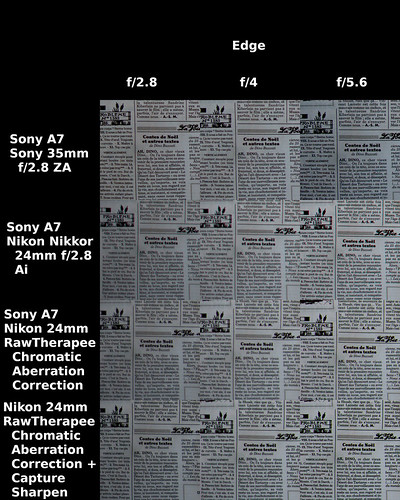
Sony 35mm f/2.8 ZA, Nikon Nikkor 24mm f/2.8 Ai comparison


Comments ~

With and without Capture Sharpening at anything wider than f/5.6 shows the 24mm's edges fail to clean up.  At f/5.6 on down, however, I can see that edge performance is looking nice and good, though it's still not up the Sony ZA 35mm's consistant across the field rendition.

Using RawTherapee's "Chromatic Aberrations" sliders, I moved them until the image at the edges looked "good" to my eyes.  It didn't take much, +0.004.  On close inspection the edges do, in fact, "look" better than the un-corrected versions.  It's subtle, but to me visible.

Adding "Capture Sharpen" to the chromatic aberration corrected images really makes the edges "pop".  These are quite usable, now.  What a contrast to my experience with the 35mm Nikkor-O!

Of course, wouldn't you know it?  After the previous comparison out of frustration I ordered a Sigma 24mm f/3.5 I.  The lens choice was made based on reviews seen across the "internets" for 24mm lenses with AF for the FE mount.  

NOTE on "internets": Thank ewe George B. Jr. for coining the word.  I'll never forget/forgive you for this.  

With this comparison I now wonder if I did the right thing?  OK.  OK.  Yes.  The whole Roto-Till Effort is to go all AF from now on.  Failing eyes and increased shaking hands.  Still, this Nikkor is pretty special for any lens of any age.  

The Sigma should be here shortly.  As soon as it arrives I'll put this Nikkor 24mm up against the Sigma.

Thursday, January 19, 2023

Sony 35mm f/2.8 ZA compared to Nikon Nikkor 24mm f/2.8 Ai ~ part One

I must enjoy the pain, the strain, the bloodshot eyes.

Not leaving well enough alone, I wanted to see if it's worth keeping a pretty little Nikon Nikkor 24mm f/2.8 Ai that I have.  I wanted to see how it compared to the Sony 35mm f/2.8 ZA and see if I need to try, say, something else, something modern, something AF.


Nikon Nikkor 24mm f/2.8 Ai


Setup ~ 

  • Camera - 
    • Sony A7, 100ISO, 2sec timer, "A" mode
  • Lenses - 
    • Sony 35mm f/2.8 ZA
    • Nikon Nikkor 24mm f/2.8 Ai
  • Bogen tripod
  • RawTherapee to snug up the curves, with and without "Capture Sharpen"

Comparison ~

As always, click on the image and enlarge to 100percent to see whatever there is to be seen.


Sony 35mm f/2.8 ZA, Nikon Nikkor 24mm f/2.8 Ai comparison


Comments ~

Looking at the center crops from f/2.8 on down there's not much difference between the new and old lenses.  Incredibly (to me, at least), both look nice and sharp.  This continues to hold true after Capture Sharpening.  
 
Wide open at f/2.8 the Nikkor does not show the common under-corrected spherical aberration that Nikon seems to have deliberately designed into their old SLR lenses.  Wide open is where the original Nikon "magic pixies" live.  But in the center this c.1980 24mm "feels" very modern.  It clearly keeps up with a lens 40 years newer.

The corners OTOH show clear differences between the newer Sony and the older Nikkor.  The Nikkor's edges never really clean up, though I can see that stopping down does help edge performance in the old lens.  I didn't even try to Capture Sharpen the edges for this comparison.

The f/5.6 Nikkor corners don't look exactly bad.  It's mainly in comparison to the Sony 35mm that I get the "feeling" that the Nikkor isn't quite as "modern" as I first hoped.

At this point in my Massive All Consuming Roto-Till of old Nikon manual focus glass into New Modern Wowy Zowy AF Must Have To Be In With The In Crowd, it looked like maybe the Nikon 24mm Ai is a candidate to be tilled into something else.

Wednesday, January 18, 2023

Sony 35mm f/2.8 ZA compared to Nikon Nikkor-O 35mm f/2 ~ part Two

I'm still pixel-peeping until the eyes go bloodshot.  I can't help myself.  I'm addicted to trying to understand differences between different optical designs and implementations and I'm between photo-opportunities with way too much time on my hands.

I noticed something just as my eyes were going bloodshot.  It concerns the edges of the field of the Nikon Nikkor-O 35mm f/2 pre-Ai that I have.  Yes, they are soft.  

Shortly after I noted the edge softness Thom posted an article that asks the question of "Do lenses have character?"  I found it a rather interesting history of lens design and its evolution.  

Something that caught my eye was his comment that "...a common thing I observe in lens characteristics, and one of the things that forms my use of the "old school" shorthand: the older the lens design, the less likely it performs well as you move closer to the corners..."

Indeed, one of the things I see at the edges is that the softness includes chromatic aberrations.  Unlike in 1971 when this lens was manufactured we now have software that can "correct" for this kind of aberration.  Might cleaning up the chromatic faults help make the corners appear sharper on this "old school" lens?  Here's my look at it.


Sony A7 ~ Sony 35mm f/2.8 ZA vs Nikon Nikkor-O 35mm f/2


As background, I'm still trying to figure out with of the last Nikon Nikkors I'll keep as my "just in case" lenses.  Not yet sure if I'll keep the Nikkor-O, but it does have some things I like about its rendition, so for now it'll stay in the Toy Drawer.

Setup ~ 

  • Camera - 
    • Sony A7
  • Lenses - 
    • Sony 35mm f/2.8 ZA
    • Nikon Nikkor-O 35mm f/2
  • Bogen tripod
  • RawTherapee to snug up the curves, with and without chromatic aberration corrections and Capture Sharpen

Comparison ~

As always, click on the image and enlarge to 100percent to see whatever there is to be seen.

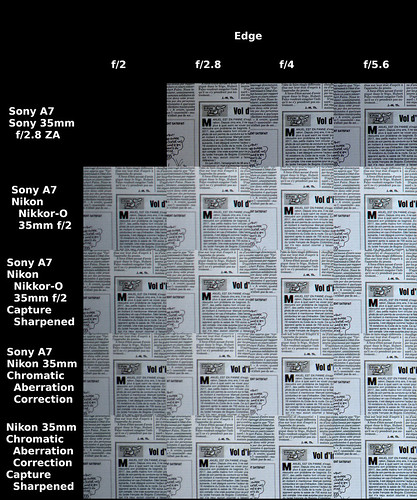
Nikon Nikkor-O 35mm f/2 vs Sony 35mm f/2.8 ZA ~ with aberration correction


Comments ~

As I previously said, without Capture Sharpening the Nikkor's edges never really clean up, though I can see that stopping down does help edge performance in the old lens.  Capture Sharpening the Nikkor-O at the edges begins to look decent starting at f/4 and looks pretty good at f/5.6, but it never ever comes close to that more current Sony 35mm f/2.8 ZA.

Using RawTherapee's "Chromatic Aberrations" sliders, I moved them until the image looked "good" to my eyes.  It didn't take much, +0.003 or +0.004 depending on the aperture.

At f/2 and f/2.8 the chromatic aberration corrected images don't look all that much better than before.  The differences are subtle and take a bit of study to see.  At f/4 and f/5.6 things are coming a little closer to the Sony 35mm, but are still a bit away from the ZA's sense of perfection.

In the case of this Nikkor-O I really haven't added much to Thom's conversation other than to confirm this lens' edge is soft at wider apertures.  Maybe the lesson is in situations that demand it to stop down to f/4 to get it to behave more fully up modern lens standards.

Saturday, January 14, 2023

Sony 35mm f/2.8 ZA compared to Nikon Nikkor-O 35mm f/2 ~ part one

After pixel-peeping lens comparisons until the eyes go bloodshot, one obvious question is how much change has been made since the 1960's in optical design and manufacturing?  Now that I have a couple lenses that were designed 50 years apart, perhaps I can have a look?


Sony A7 ~ Sony 35mm f/2.8 ZA vs Nikon Nikkor-O 35mm f/2


As background, I'm trying to figure out with of the last Nikon Nikkors I'll keep as my "just in case" lenses.  I still have a very pretty Nikon Nikkor-O 35mm f/2 pre-Ai.  How does it compare with a more recent Sony 35mm f/2.8 ZA?

Setup ~ 

  • Camera - 
    • Sony A7
  • Lenses - 
    • Sony 35mm f/2.8 ZA
    • Nikon Nikkor-O 35mm f/2
  • Bogen tripod
  • RawTherapee to snug up the curves, with and without "Capture Sharpen"

Comparison ~

As always, click on the image and enlarge to 100percent to see whatever there is to be seen.

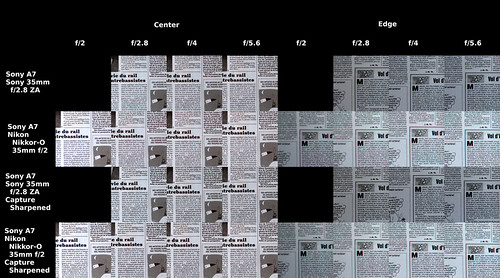
Nikon Nikkor-O 35mm f/2 vs Sony 35mm f/2.8 ZA


Comments ~

In the center from f/2.8 on down there's not much difference between the new and old lenses.  Both look nice and sharp.  This continues to hold true after Capture Sharpening.  Wide open at f/2, the Nikkor-O shows the common under-corrected spherical aberration that Nikon seems to have deliberately designed into their old SLR lenses.  Wide open is where the original Nikon "magic pixies" live.

The corners show clear differences between the newer Sony and the older Nikkor-O.  Without Capture Sharpening the Nikkor's edges never really clean up, though I can see that stopping down does help edge performance in the old lens.  With, however, Capture Sharpening the Nikkor-O is beginning to look decent starting at f/4 and looks pretty good at f/5.6.

The performance of a c.1970's lens matching modern optics?  OK, so the old Nikkor could use a bit of software support to clean up the corners.  Still. I'd say Nikon did a pretty good job designing and manufacturing the fast f/2 35mm optic 50 years ago.

Thursday, January 05, 2023

Roto Till Time ~ mid-Till ~ part Five

The Sony 35mm f/2.8 FE ZA is a very fine optic. So I naturally thought about it as a replacement for the Sigma 30mm f/2.8 EX DN I have for the APS-C cameras that live here.

Except, it might not be as easy as I first hoped.  Comparing the Sony ZA to the Sigma was pretty easy.  But...

The Sony 35mm ZA failed repeatedly to focus accurately on this day and under these circumstances on an A6000.  It focused and still focuses correctly on an A7, a NEX-7, and a NEX-5T.  

To arrive at some meaningful understanding of what's going on, I manually focused the Sony to see if I could isolate the problem.


Sony A7 ~ Sony 35mm f/2.8 ZA vs Nikon Nikkor-O 35mm f/2


I like using le Canard as my comparison subject.  The typeset print gives a nice crisp transition from light to dark.

Setup ~ 

  • Cameras - 
    • Sony A7
    • Sony A6000
  • Lenses - 
    • Sony 35mm f/2.8 ZA
    • Sigma 30mm f/2.8 EX DN 
    • Sigma 19mm f/2.8 EX DN
  • Bogen tripod
  • RawTherapee to snug up the curves, without "Capture Sharpen"

Comparison ~

As always, click on the image and enlarge to 100percent to see whatever there is to be seen.

35mm19mmSensorResolutionCheckComparison


Comments ~

Straight away it's clear that the Sony and Sigma lenses, with one camera/lens combination exception, do what they're supposed to.  That is, they are sharp from wide open across the field.
 
I also confirmed that my ability to manually focus these lenses in general is not as good as cameras AF systems.  Here is the reason I've decided to unload my beautiful manually focused old Nikon Nikkor lenses.  I feel the need for automated support for these old eyes.

Looking at the case of the Sony A6000 and 35mm ZA, the "missed focus" is evident wide open and at f/4.  By f/5.6 things clean up pretty well.  Looking closely at the AF series from this combination it "feels" to me like the actual focus point isn't all that far off the intended point.  
 
Am I making too much of this?  Maybe.  Maybe not.  
 
I've since gone back and tried this camera/lens combination on other subjects and it seems to focus correctly.  What happened during the comparison shown here?  I have no idea.  All I can say is that I turned the camera on and off several times and the contact points for the communications between the lens and camera looked to be OK.

I guess I'll have to file this under the heading of "Bizarre Unknowns."
 
Paris ~ 2022 
Sony NEX-5T with good for nothing 16mpixel sensor,
Sigma 30mm f/2.8 EX DN at f/4
Handheld.
Not half bad for a lens and camera that
are no longer made...


As for the comparison of the Sony 35mm ZA and Sigma 30mm on APS-C, the original reason for doing this comparison, can you see any difference between them?  I can't.

If for only the reason of uncertainty of focusing the ZA on the A6000, perhaps I'd do best to hold onto the old jewel Sigma 30mm.  The old Sigma is a great little optic.  
 
Why did Sigma stop making them?  Maybe there's no market for small/light/inexpensive/sharp lenses?  No.  I don't believe that.  Not for a moment do I believe that.
 

Saturday, December 31, 2022

Roto Till Time ~ mid-Till ~ part Four

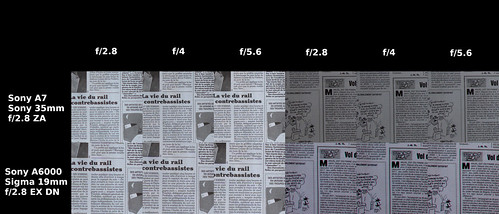
After finding the Sony 35mm f/2.8 FE ZA to be a very fine optic, I wondered how a little software function called "Capture Sharpen" might look with the 35mm Sony on an A7 full frame body and a Sigma 19mm f/2.8 EX DN on an APS-C A6000.

Short refresher course: 
"Capture Sharpen" is a software function that was seen some years back in Adobe's Photoshop application, Capture One, and somewhat more recently introduced in the Open Source Software RAW image processor called RawTherapee.

What "Capture Sharpen" does is offset the effects of Anti-Aliasing filters that some cameras have over the sensor.  AA filters combat moire color aberrations.  The filter softens images and the software tries to reverse the AA filter softening effect.

Sony A7 and A6000 have AA filters.  So I felt it would be interesting to see how the software changed a basic image.


Sony A7 ~ Sony 35mm f/2.8 ZA vs Nikon Nikkor-O 35mm f/2


I like using le Canard as my comparison subject.  The typeset print gives a nice crisp transition from light to dark.

Setup ~ 

  • Setup one - 
    • Sony A7, ISO100, 2second delay, AWB
    • Lens - Sony 35mm f/2.8 FE ZA
  • Setup two - 
    • Sony A6000, ISO100, 2second delay, AWB
    • Lens - Sigma 19mm f/2.8 EX DN
  • Bogen tripod
  • RawTherapee to snug up the curves, without and _with_ "Capture Sharpen"

Comparison ~

I compare the 35mm Sony on 24 mpixel Full Frame against a 19mm Sigma f/2.8 EX DN on 24 mpixel APS-C.  There are two sets of images from the lenses, the first set are without "Capture Sharpen" and the second pair of lines are with the software function applied.

As always, click on the image and enlarge to 100percent to see whatever there is to be seen.

Sony 35mm f/2.8 ZA vs Sigma 19mm f/2.8 EX DN with RawTherapee Capture Sharpen


Comments ~

The software does, indeed, work some serious magic.  Comparing the before and after "Capture Sharpen" images shows what this function is supposed to do.

Looking more critically, the Sigma 19mm f/2.8 EX DN corner images clean up nicely, but they don't quite match the Sony 35mm f/2.8 ZA until f/5.6.  I've used this particular 19mm lens for years and have always been satisfied with the image quality.

With this in mind, it'll be interesting to see if I can tell any "improvement" in image quality as I start using the 35mm ZA.  I suspect I won't be able to tell much, if anything, but I'll keep an open mind.  
 
The new (to me) Sony looks absolutely brilliant.
 

Novembre 2018 Rassemblement ~ Association Vincennes en Anciennes

Sony A5000 with Sigma 19mm f/2.8 EX DN
Can't imagine getting anything
sharper than this.

Tuesday, December 27, 2022

Roto Till Time ~ mid-Till ~ part Three

Roto-Tilling my old Nikon Nikkor lenses into new and shiny AF optics for the Full Frame Sony A7 cameras I own is fun.  There it is.  I have to admit it.  A friend rightly pointed out that it's in my nature to buy and sell.  The latest justification is that my eyes are getting flaky with age and that I can benefit from the automation.

One of the things that I feel when using Sony A7 Full Frame mirrorless cameras is that the image quality "feels" a whole lot like the image qualities of 4x5 and 8x10inch film cameras.  There is a lot of wonderful detail and subtle renditions possible with these A7 cameras.  I've thought a lot about how I used to shoot and to see if I could apply those approaches and lens selections to current digital imaging.

As with my experience of years ago working with a 210mm lens in 4x5 inch film, I remember the second most used focal length was 135mm/150mm.  Using a DOF calculator I found the equivalent Full Frame digital focal length is 35mm/40mm.

Since 40mm (150mm 4x5 film equivalent) lenses are a little steeply priced for this retired Way Way Behind the Curve kind of Cheapskate, I opted to look for as good a 35mm (135mm 4x5 film equivalent) as I could afford.

One of the Wild Out of Reach things I considered was finding a 482gram Sony RX1R to fill the 35mm focal length "need."  After reading a few reviews I learned the AF performance in low light might be a little dodgy and that the overall size/weight wasn't as small/low as perhaps I would've hoped.

On the other hand, a little 122gram 35mm f/2.8 FE ZA is as good as the camera body's AF can drive it at all light levels. Coupled to a 474gram Sony A7, the all up weight comes in at 596grams, or 110grams over the fixed mount lens with no dedicated EVF Sony RX1R.  And the 35mm lens would be a 1/4 the cheapest used price of an RX1R I could find.

So... I Hunted and Gathered a sweet little 35mm f/2.8 FE ZA Sony, brought it home, and took a look at how it compared with a known stellar optic.


Sony A7 ~ Sony 35mm f/2.8 ZA vs Nikon Nikkor-O 35mm f/2


Again, using le Canard as my subject, I took my by now mundane standard approach to comparing various lenses.

Setup ~ 

  • Setup one - 
    • Sony A7, ISO100, 2second delay, AWB
    • Lens - Sony 35mm f/2.8 FE ZA
  • Setup two - 
    • Sony A6000, ISO100, 2second delay, AWB
    • Lens - Sigma 19mm f/2.8 EX DN
  • Bogen tripod
  • RawTherapee to snug up the curves, with _no_ Capture Sharpen, just the lens and the sensor
     

Comparison ~

I compare the 35mm Sony on 24 mpixel Full Frame against a 19mm Sigma f/2.8 EX DN on 24 mpixel APS-C.  The reason is that I've seen that this Sigma is one of the sharpest/crispest/cleanest rendering lenses in the Closet of Goodies.

As always, click on the image and enlarge to 100percent to see whatever there is to be seen.

Sony 35mm f/2.8 ZA vs Sigma 19mm f/2.8 EX DN


Comments ~

The Sony 35mm f/2.8 FE ZA looks great across the field straight from wide open.  Of course people wrote about this 10 years ago when this model first hit the market.  Yes.  I'm 10 years Out of Date with the State of Things.

By comparison, the stellar little Sigma 19mm f/2.8 EX DN is just ever so slightly soft wide open in the center of the frame.  The edges never seem to catch up with the Sony, either.

As with all the new toys, er, sorry, new tools, I will need to give the Sony time to "settle in" and to become part of my workflow.  The resolution sure looks promising.  The size and weight make it a "no brainer" for carrying around.  This could be a lot of fun.

Monday, December 26, 2022

Roto Till Time ~ mid-Till ~ part Two

After successfully hunting and gathering, that is to say, after lassoing and dragging home a pretty little Sony 55mm f/1.8 FE ZA, it was time to compare it to two lenses it is intended to replace.  These being a beautiful Nikon Nikkor 50mm f/1.4 AiS and a good condition Nikon Nikkor-S Auto 50mm f/1.4 pre-Ai.

Sony A7 55mm 1.8 ZA vs Nikon Nikkor-S 50mm f/1.4 with adapter


Using le Canard as my subject, I took my by now mundane standard approach to comparing various lenses.

Setup ~ 

  • Sony A7, ISO100, 2second delay, AWB
  • Bogen tripod
  • Lenses -
    • Sony 55mm f/1.8 FE ZA
    • Nikon Nikkor 50mm f/1.4 AiS
    • Nikon Nikkor-S Auto f/1.4 pre-Ai
  • RawTherapee to snug up the curves, with _no_ Capture Sharpen, just the lens and the sensor
     

Comparison ~

To confirm the AF system of the Sony A7 was doing it's "thing" properly, I included a manually focused pass with the 55mm lens.

As always, click on the image and enlarge to 100percent to see whatever there is to be seen.

Sony 55mm f/1.8 vs Nikon Auto-S and AiS 50mm f/1.4 lenses


Comments ~

It appears the A7 AF system is indeed doing it's "thing" properly.  I really can't do any better by manually focusing.  

This is a Good Thing(tm) as the whole reason for Roto Tilling my lens collection is to gain automation as a way to help my aging eyes and to speed up the process of image taking.  It was getting to be a PIA having to slow way down to manually focus the Nikkors.  Increasingly I am not able to "nail" the focus, even with me taking my time.

Looking at the center of the field we can see where the Sony 55mm f/1.8 is sharp from wide open.  The Nikkor lenses show under-corrected spherical aberration at wide open.  This, I'm thoroughly convinced, is a deliberate design choice.  I think the Japanese appreciate the subtle "sfumato"-like rendition under-corrected spherical aberration can give. I'm keeping the Nikkor-S Auto just in case I can figure out how to use the shumato effect in Europe.

Stopping down, by f/2.8, the Nikkors and Sony lenses all look the same in the center of the frame.  The Nikkor Pixie Magic at f/1.4 and f/2 is now gone.  Said conversly, if I didn't want the focus automation, there is absolutely nothing wrong in terms of resolution with the old Nikkors.

At edges there are more obvious differences between the three optics.  The surprise is the Nikkor-S Auto at f/4 and f/5.6 which is clearly quite sharp at the edge.  

Perhaps unsurprisingly, the Sony is very sharp at the edges across the field.  I have say that current lens design appears to have meaningfully improved the species at the edges at wide apertures.

One of the reasons for selecting 55mm on Full Frame Sony A7 mirrorless is that it is the equivalent to my old and much loved 210mm Schneider Symmar-S MC f/5.6 that I used when I shot 4x5 film.  I shot the 210mm for decades and it served me well.  I think it will take a year of use to see if that's how it turns out in practice with the Sony 55mm.


Saturday, December 24, 2022

Roto Till Time ~ mid-Till ~ Part One

It was so frustrating trying to manually focus my Nikkor lenses under some conditions that I decided I was beating my head against an intellectual and historical wall.  

Sony A7 55mm 1.8 ZA vs Nikon Nikkor-S 50mm f/1.4 with adapter

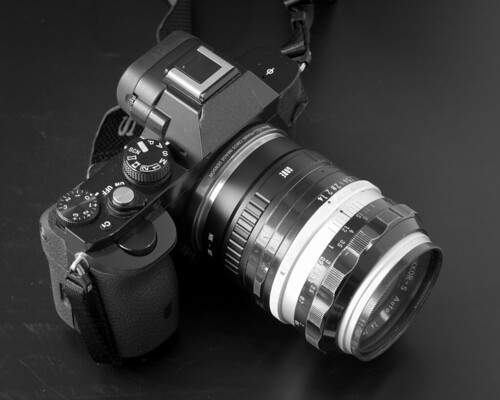
Sony A7 + adapter + Nikon Nikkor-S Auto 50mm f/1.4

The source of the frustration was I was missing the focus, even focus magnification in the EVF.  I'm getting old and my eyes aren't what they used to be.  After 50 years better/improved technologies exist.  Perhaps I should free my frustrated self and learn to trust the automation?

I know where the Magic Pixies are in old Nikkors, but they don't seem to enhance my photography, nor do they thrill me in the way I thought intellectually they should.  Historically, I wanted to own these lenses simply because they were the "thing to own" when I was young and I couldn't afford them then.  It'd come down to a "been there done that" situation.

Sony A7 55mm 1.8 ZA vs Nikon Nikkor-S 50mm f/1.4 with adapter

 Length comparison
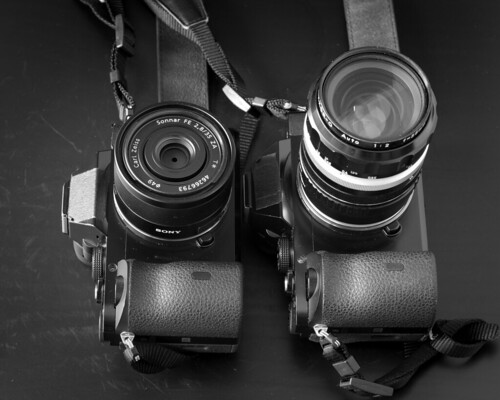
Sony A7 + adapter + Nikkor-S Auto 50mm f/1.4
Sony A7 + Sony 55mm f/1.8 ZA "Zeiss"

Six out of twelve Nikon Nikkor manual focus lenses were very quickly sold and have found new and hopefully better homes.

In counting the proceeds of early sales it was easy to see there were sufficient funds to pick up two AF FE for Sony lenses. I would, of course, have to shop very carefully. Zeiss labeled Sony manufactured lenses are not cheap.

Crazily enough, I didn't have to search very hard.  I educated myself to learn what "good" prices are these days.  Wouldn't you know it, but several lenses showed up for the "right" prices from several sellers straight away.  

Sony A7 55mm 1.8 ZA vs Nikon Nikkor-S 50mm f/1.4 with adapter

 Sony A7 + adapter + Nikkor-S Auto 50mm f/1.4
Sony A7 + Sony 55mm f/1.8 ZA "Zeiss"

Perhaps it was the winter holiday season and folks were looking for a little extra change?  After making contact I selected the most responsive sellers and picked both up two lenses on the same day. Color me impatient.

The first lens is a Sony 35mm f/2.8 ZA FE.  It had been purchased new and then seldom used.  The previous owner is a fashion videographer/photographer.  He found he preferred other lenses.  Checking the lens over I found the AF to be lightening quick.  I'd have to check the resolution later after I got home.

The second lens is a Sony 55mm f/1.8 ZA FE.  It too had been purchased new.  This one was bought about two years ago.  It was now being replaced by a Sony 50mm f/1.2 FE.  The lucky b*sard!  Like the 35mm f/2.8 the 55mm's AF is lightening quick, so I this one followed me home, too, where I could more fully explore its optical performance.

Sony A7 ~ Sony 35mm f/2.8 ZA vs Nikon Nikkor-O 35mm f/2

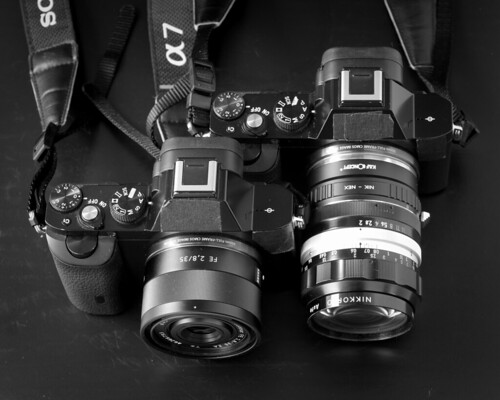
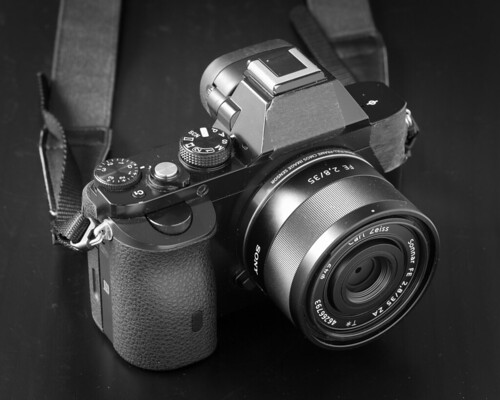
Sony A7 + Sony 35mm f/2.8 ZA "Zeiss"
Sony A7 + adapter + Nikkor-0 35mm f/2

The reason I started with 55mm and 35mm lenses on Full Frame Sony mirrorless is that when I shot 4x5 film, my favorite focal lengths were 210mm and 135/150mm.  The new Zeiss labeled Sony's are the large format equivalent focal lengths in the smaller format.

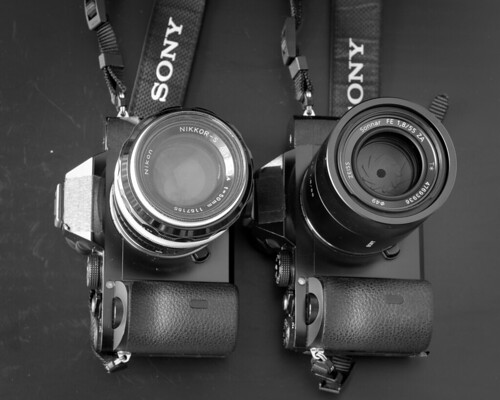
Comparing the overall sizes of these to my old Nikkors with adapters is an interesting exercise.

The 55mm f/1.8 isn't that much shorter than an adapted Nikkor-S Auto 50mm f/1.4.  The AF of the 55mm being the first obvious advantage over the Nikkor-S Auto.

The adapted 35mm Nikkor-O f/2 pre-Ai, however, looks like a telephoto compared with the Sony 35mm f/2.8 ZA.  In fact, the little Sony is so small that it is approximately the same size and weight as the lovely (and very unfortunately discontinued) Sigma 30mm f/2.8 EX DN.  Obviously the Sony covers Full Frame, where the Sigma only covers APS-C.

After I got home I compared the optical performance of the new tools against a couple old Nikkors that I still have and a pair of the Sigma EX DN that sit on my little APS-C cameras.  This will be the subject of Parts Two and Three of "mid-Till".


Sony A7 ~ Sony 35mm f/2.8 ZA vs Nikon Nikkor-O 35mm f/2

Sony A7 + Sony 35mm f/2.8 ZA "Zeiss"
Sony A7 + adapter + Nikkor-0 35mm f/2


Tuesday, December 13, 2022

... a funny thing happened on the way to the Coloseum...

Decision made and things suddenly move quite quickly.

After realizing the pixie-level magic that's hidden in old manual focus Nikkors did not suit my photographic style, and after deciding which of my vast hord of Nikon lenses are less loved than they should be, I started posting items for sale.

In similar time I've been wrangling over which AF lenses to purchase.  I'm thinking of three lenses at most.  One each super-wide, wide, and normal lenses.  Out go 12 Nikkors (I'll be keeping 4 "just in case this doesn't work out the way I think it will" kind of lenses) and in come three new tools.

Old Work ~ Hillsboro, Oregon

Sinar F, 90mm Schneider Super-Angulon f/5.6
My garage with a dismantled Jaguar XK150FHC.
Check out that old Mobile florescent light on the wall.
Now that I live in an apartment in France I find
I miss having a workspace like a garage.  Just
to do things in, you know what I mean?

Sony A7 images "feel" a lot like 4x5 view film camera work to me.  The image quality of the digital cameras have a clarity to them that I couldn't get with any film format smaller than 4x5 inches.

If my A7's are modern large format film camera equivalents, then perhaps I could think of which lenses I used most when I shot film? Back in the day I used various 90mm super wide angle, 135mm wide angle, and one 210mm slightly longer than "normal" lenses.

On a giggle and a lark, well, no, more seriously than that basic research, I went to a site where one can compare depth of field between lenses and formats.  When I typed in 90mm and 4x5 inch format I saw that the full frame digital equivalent is 24mm.  Huh.  Isn't that interesting.  I _love_ that focal length in FF digital, just as I did 90mm in LF work.

When I typed in 135mm when selecting 4x5inch film format the FF digital equivalent is 35mm.  Well.  Well.  Well.  That too is very useful.

"Sophia" ~ 1981 Ducati 500SL Pantah

Sinar F, 135mm Tessar formula f/5.6
I loved this bike.  It was only 500cc, but
oh how she was a sweet ride.  I got her
from David Dicks who was in the mid-west
at the time.  I had her several years before
passing her on to a friend, who then, in turn
passed her along to another/mutual friend.

Then I typed in 65mm and selected 1x full frame digital.  Why this switch in using the tool?  Well, I'd found a sweet looking little (or perhaps not so little) Sigma 65mm f/2 I lens for Sony and I hoped that it would turn out to be 210mm equivalent large format film.  I wanted to justify buying the Sigma. Except, it wasn't the equivalent focal length I thought it was.

65mm FF digital works out to be 240mm on 4x5.  Nope.  That's a deal breaker for me.  I never ever was in all my years of shooting film able to warm up to 30mm's difference on 4x5.  OK, sure, 240mm was wonderful on 5x7, but the reason should be obvious as to why that would be.

Old Work ~ Hillsboro, Oregon

Speed Graphic, 210mm Schneider Symmar-S/MC f/5.6
Hillsboro airshow and SU27 aircraft.  It was the
first time Russian material was allowed/escorted
into US airspace.  I can't believe I still have
the negatives from this event.  Gads! that was
a long time ago...

So which FF digital focal length matched my much loved 210mm Schneider Symmar S/MC f/5.6 that I used for nearly three decades?  Tappity tap tap tap... and the answer is - 55mm.

Well, would you look at that, will you?  Doesn't Sony make a 55mm f/1.8 FE that comes with a cute little Zeiss badge on it?

Wheels are turning.  I tell you.  Wheels are turning.

Sunday, December 11, 2022

Roto Till Time...

It has been a very tumultuous Fall.

Florence, Italy - 2022

We've been on the road traveling for three months.  We've seen sights.  We've been places.  Apartment door locks broke.  Washing machines self-destructed. Attempted picks were thwarted mid-pick... but.. Passports were later successfully picked.  Passports were miraculously returned through the US Embassy.  Covid was caught.  Covid was survived.  Yes, we were vaxx'd and boosted, so the effects were likely less than if we were stoopid enough to try and do it all on our own.

This is just the half of it.

Florence, Italy - 2022

Photographically it has been a tumultuous time as well.

To keep my travel kit as light as possible I carried a Sony A6000 with a Sony Zeiss ZA 16-70mm f/4 SEL OSS.  It did the trick.  Three months of photography.  Thousands of images to paw through.

During the quiet moments (yes, there were a few of those, too) I looked closely at Pictorialist images from the Sessionist Movement and for myself discovered something interesting.  "Soft Focus" lenses appear to work best on subjects in or about nature.  City and village images from the time tend to be sharp.  I've been interested in "soft focus" lenses to try and understand and then apply that understanding to make images that could be uniquely mine.

Rome - 2022

This kind of photography has been long contentious.  It is easy to remember that Group 64 hated William Mortensen, in part, because of his use of "soft focus" lenses.  This ignores the fact that after M.Mortensen left Hollywood I'm not aware of a single "soft focus" image that he ever made.  Maybe I'm wrong, but I can't find any.  He even talks a length about the importance of working with a clear, clean, sharp image.  

Makes me wonder what the Group 64 was going on about.  Pictorialism could be just as sharp as any other photographic style of the time.  So what was the difference between Group 64's approach and the Sessionists?  Maybe it had to do with the spirit with which photographers approached their craft?

It seems like Sessionists were experimenting with all manner of processing.  Clarence White, Karl Struss, Leonard Missone all worked on various techniques.  Later William Mortensen continued that tradition after the Sessionist movement had died.  Group 64 seemed to use whatever materials manufacturers sold them.

Rome - 2022

Some of the Pictorialist experimenting was indeed around optics.  Karl Struss tried different things and even had someone manufacture and sell lenses to his specification.

Yet, if I look at the vast majority of images from many different Pictorlist practitioners, they tend to be sharp and try to take advantage of various processes.  Platinum/palladium, gum bi-chromate, paper negative retouching and much more.  They also used special papers to try and add to the overall effect they were working toward.

In this light when I look closely at my preferred subjects they tend to be urban and not nature.  Process beyond posting to the internet and personal works tend to not rely on anything more than a camera and lens with a little software thrown in.

Rome - 2022

For the past four years I've tried to understand soft focus optics.  I've been considering Nikon Nikkor manual focus lenses.  There is pixie level magic in them and I think I finally understand why Nikon designed lenses the way they did.  They often give a subtle rendering when shot wide open.  Read through Nikon's Thousand and One Nights and perhaps you'll see what I mean.

Now that my curiosity has been satisfied and armed with the additional understanding that my preferred subjects do not respond well to "soft focus" rendering, I think it's time to let my old Nikkors go. 

Rome - 2022

Monday, November 28, 2022

Black and White using Snapseed...

[adapted from the description section of my Flickr images from Rome]

We were recently away in Brittany for a week and Italy for five weeks.  I didn't take the laptop and so I was rather constrained in image processing options.  But I thought a 10inch Android Tablet with Snapseed should be just fine.  Well, it should have been.

I shoot RAW and my images from this trip look "meh" after WiFi'ing them from the camera to the tablet and working them in Snapsee..  After 4 weeks it finally occurred to me to look at the file size.  Lo and behold, thumbnail jpgs were what were being transferred.  Ugh.  I felt stoopid.

Rome - 2022

Explored on Flickr
29 November, 2022

This easily explained why my cellphone images looked sharp on Flickr and the A6000 images do not.

Thinking about it a bit I tested shooting RAW + JPG.  Good, full Rez JPG were suddenly transfering.  Lesson learned, but only as we were reaching the end of or Roman Covid Holiday.  Have I mentioned how giving Romans are?  They were so kind they shared some damnable version of the Dreaded Lurgy with us.  I know, this has nothing to do with JPGs, except is does.  I lost 10 days of good full rez images due to the require downtime to recover.

Rome - 2022


While we were trying to recover, an interesting image processing approach came back to me.

I read about how Norman Seeff used to print high contrast images with a twist.  He used a black stocking between the enlarger lens and paper to give a interesting softness to some of his images.  He wasn't by any means the only one to do this.

When I worked at Samy Cameras photo lab on Sunset Blvd in Hollyweird we used to do this at client request.  It was really no big deal, but the effect was good for some subjects.

Rome - 2022


What was a bigger deal was our use of Agfa Portriga Rapid 111 Glossy paper.  It gave a gorgeous deep walnut brown tone.  We used this for may of the gallery shows we printed for various then famous photographers.

Taking the black stocking idea and borrowing tones from Portriga Rapid, it turns out, expresses pretty well how I feel about Rome.  So I created a series of images done in this old, outdated, likely not very hip manner.

Rome - 2022

The Snapseed process was straightforward.  

  • Import an image
  • Convert to monochrome using the Black and White "high contrast" option
  • Adjust the contrast as needed
  • Add a border
  • Dive into "Glamour Glow" and set "Glow" to around 35 or 40
  • Slide the color to +50 to add warm tones
  • Export the image

If I set the in-camera "Style" to Black and White with appropriate constrast, I can side-step the monochrome conversion in Snapseed.

Rome - 2022

The "Glamour Glow" color slider seems to be tied to the "Glow" setting.  The higher the "Glow" the more warm tone color is added.  Not sure why this is, but I think that's what I'm seeing.

Now that I'm home and using RawTherapee, I see just how smooth I can get my Black and White images.  Snapseed feels "gritty" in how it outputs images.  This isn't a bad thing, mind you.  It's just different.

Rome - 2022

Friday, September 09, 2022

Four Nikon Nikkor wide angle lenses...

Recently I was having a bit of a think.

The think I thought was about ditching old manual focus wide angle lenses and replacing them with auto-focus optics.  It wouldn't be for "improving" image quality.  I know there is nothing to be gained in terms of "sharpness" by going with modern lenses.

No.  My think I thought had to do with ease of use.  Hit a button and the lens focuses itself.  Just like with my APS-C Sony mirrorless cameras and lenses.  Only this time it would be for my Full Frame Sony mirrorless bodies.

That's where I stopped.

Why duplicate what I already have in the smaller, equally capable format?

So, instead of selling my old Nikkors to make way for new Sony/Tamron/Sigma, I brought out the lenses I was thinking of kicking to the curb and took their picture.  Silly, I know.


Nikon Nikkor wide angle collection

From left to right -
Nikon Nikkor UD 20mm f/3.5
Nikon Nikkor 24mm f/2.8 Ai
Nikon Nikkor-N 28mm f/2 (Ai adapted)
Nikon Nikkor-O 35mm f/2


One of the Games I've played over the past four or five years is to find the best lenses I can for less then 50Euro/50USD.  I've hit upon some wonderful "finds" in playing this game.

The single coated Nikon Nikkor 20mm f/3.5 UD came to me by way of a friend.  He gifted it to me and I don't count this toward my Game Play.  It's a wonderfully sharp lens, but it's also a little heavy.  There's loads of glass and metal in it.  This has stalled me from reaching for it when heading out.  Though I've promised myself that I _will_ use it for the next automobile event I attend.  I really shouldn't leave it at home as much as I do.

On the other hand, the lens I've used quite often is the Nikon Nikkor 24mm f/2.8 Ai.  It's small, light, and supremely sharp from wide open with gentle out of focus rendering in the rare cases where the depth of field narrows.  I picked this up for more than my Game Limit.  To my credit, however, this was purchased well before I started playing this silly Game.

Coming to the Nikon Nikkor-N 28mm f/2, this lens busted my Game Limit quite handily.  For some reason I just had to have it.  I couldn't get the thought of owning a 28mm f/2 out of my head.  As all too often happens when I start thinking this way, a nice little example showed up on my favorite auction site. The price I paid was ultimately less than what they typically go for.  So there is that.

The last lens in the lineup is a pretty little Nikon Nikkor-O 35mm f/2.  I'd foolishly sold a mint Ai version some years back.  I can't remember why it left the Toy Box, but it did and the sale was quickly regretted.  There were a few images I'd made with it where I felt the rendering was second to none.  So when I scored this early single-coated pre-AI version coming in well below my Game Limit there was nothing but joy Throughout the Land, or something similar.

Which leaves me with this - the tools I use must make me happy or out the door they go.  For some reason old Nikon manual focus lenses still, after all these years, make me happy to own, to think about, and, best of all, use.

Wednesday, August 17, 2022

Into the Daylight ~ Flash Photography and Old Cars

With a big car event coming up, I was excited to try my hand at lighting up one of my favorite subjects.  Nothing serious, of course.  I'm retired and don't need nor want to impress anyone.  No, this is just for the pleasure of pursuing a topic, understanding as much as I can, and to make an image or two that please me and only me.

I've been reading too many articles by David Hobby and Joe McNally.  I seem to have caught the bug to shoot small flash.  Here was yet Another Itch that needed to be Scratched.  Photographically speaking.

To add another Itchy Spot to the Whole Plot, just the other day I read a very short article on how to photograph HotRods.  The difference between what this article talked about (shooting in open shade) and what I would be doing is that I'd be working under partly cloudy to full sun conditions

I have three Cheap Chinese Flash units that I've picked up over the years.  My calculations indicated I might _just_ be able to augment the power of the sun and make my subjects standout a bit from a slightly under-exposed background.  That would be the goal.

My camera setups would be as follows -

  • Sony A7 - set to full manual mode (stored settings as M1)
  • Nikon Nikkor 24mm f/2.8 Ai
  • Polarizing filter

My second camera would be -

  • Sony A6000 - also set to full manual mode (again stored settings as M1)
  • Nikon Micro-Nikkor 55mm f/3.5
  • Lens Turbo II focal reducer
  • Polarizing filter

It all seems a silly thing to in this Day and Age use manual focus Nikkors.  Working with AF lenses and meter-coupled apertures would certainly be a faster, more accurate way to proceed, right?  Well...

There were several competing ideas that swirled around my (sometimes empty) brain.  One, as I've already said, was to use flash to brighten the subject relative to the background.  Another idea was to see how wide I could get the aperture so as to blur the background.  And the third swirling idea was to use a Polarizing filter to try and control reflections off shiny, painted, waxed surfaces.

In short, I would be trying to manage complexities in a discrete, one thing at a time, manner.  It's sometimes important to keep an Aging Mind well exercised.  Or so I'm told, but I can't remember who said it.  I made a joke there.  Did you get it?

I love the "idea" of my Nikkor lenses.  Manual focus.  Beautiful out of focus rendition when shot wide open.  Manual aperture settings so I know exactly where I'm at.  Of course, shooting in broad daylight would mean stopping lenses down and potentially sharpening up the entire scene with good depth of field.

Fortunately the (old hand calculated designs based on history and practical knowledge) Nikkors are by current standards (of computer ray traced designs solving for 11th order effects) brilliantly sharp stopped down.  

I have modern AF Top Drawer lenses as well as many old Nikkors, and, frankly, from one click down on the aperture it's awfully difficult to tell any difference between them.  So, with a few mental gymnastics I was able to convince myself to use the old Nikkors.

For the Cheap Chinese Flash setup, here's what would be used - 

  • Three Yongnuo YN560 flash units
  • A cheap three flash mount bracket
  • A cheap flash stand
  • A RF/FM remote trigger system consisting of
    • On-camera trigger
    • Two remote flash hot-shoe'd receivers

All I needed to do when switching cameras from 24mm to 55mm and back again would be to slip the on-camera RF/FM trigger from one body to the other.

To make a complex situation more complex, I packed a 2-stop ND filter.  This would allow me to open up the aperture, well, by 2 stops.  If I did this right, I would be able to explore what happens to a scene when both sun-enhancing flash and narrower depth of fields are used in tandem.  The effect might be interesting.

So how did my little experiment of shooting the all manual, maybe needlessly complex setup end up?  Not 1/2 bad, actually.  Let's have a look, shall we?

This was done under full sun (to my right).  I put the flash units to the right as well, set their power to 1/4 and under-exposed the overall scene by 1/2 a stop.  The depth of field is a little too good and the background is a bit distracting to my eyes.  Though, the scene is well placed with the view of the large buildings in the background.  I like the way the flashes did their jobs to bring the bike out of the mess.  Even if it's just a little.

le traversee de Paris estivale ~ 2022


Shooting against the sun, setting the flash to my left, and putting the power at 1/4 or 1/2 on all three units I was able to blast the Holy Heck out of the Buick.  The overall scene was under-exposed by, again, 1/2 stop.  I like the effect.  The people and the trees in the background at back-lit.  So would the car be if I hadn't painted the car in light the way I did.

la traversee de Paris ~ 2022


Three young ladies were being photographed by a local photographer.  They were using the cars as backdrops.  All three were "Miss" somethingorother.  This lady was Miss Montmartre. 

Had I not used fill-flash the scene would've been a lighting mess.  The sun was throwing very strong shadows off everything and the Jaguar XK-SS would've disappeared into an inky black hole where no light could escape.  I needed to flatten the contrast a little and to "open up" the Miss' far-side face if I could.

If you know me, you know I've owned several Jags in my life.  They were my childhood pinnacle of automobilisme.  They all had sexy lines and could push a gentleman smartly down the motorway at impressive speeds.

I'd read where the D-type race car had been lightly re-designed to take normal road-gear (bumpers, passenger seat, that kind of thing).  Very few were made, though, before that portion of the Jaguars factory burnt.  So it came as a huge surprise to see this car.  Sure, the young lady is pretty.  There's no doubt about that.  But that Jag?  Oh All Things That Are Holy this was glorious!!

I'm not sure if it's an original or a "continuation" version.  Somehow I just can't see someone driving a many-millions of Euros car around Paris just for the hell of it.  The insurance alone would cost a fortune.  So I'm thinking this must be a very accurate reproduction (perhaps even done up by the factory?).

la traversee de Paris ~ 2022


Early on in my little photo-session I balanced the overall scene exposure with the flash and let the flash simply fill the shadows.  Looking at the cameras LCD convinced me I liked the gentle effect that simple flash-fill might bring.

For this Renault Alpine the sun was was over to my left (almost, but not quite shooting against it) and it cast a strong shadow to the right.  So I placed the three flash setup to my right, set the power to 1/16 or 1/8 (rather low, whichever it was) and this is the image I came away with.

It's almost as if you can't see the effect of the flash.  If I wasn't talking about it, would a viewer even notice?  It's kind of interesting to think about in this way.

One more thing, look at the quality of the light.  Having worked with flash for decades I might've guessed that a large light modifier had been used to "soften" up the light.  But that's not the case at all.  The three flash units were all bare and no light modifiers were used at all.  This is just straight flash fill.
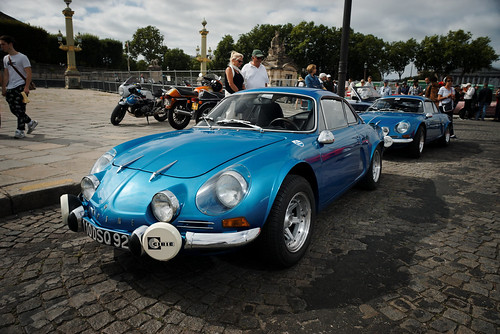
Renault Alpine ~ la traversee de Paris estivale ~ 2022


Lastly, we come to Coluche.  How the great French humorist comes to be associated with this Ford Fairlane is beyond me.  But there you have it.  Coluche's name is attached to this car.

Ford made this line of Fairlanes back in the 1950's.  By the late '50's Ford sold the factory, designs, tools, and everything to Simca. Simca continued to produce these cars for several years after.  I have to look at the badges to know which side of the Ford Sale any particular car comes from.

For this image the full sun was over left shoulder.  You can see the flash-filled shadow from the sun on the ground to the right of the car.  The overall exposure was set to -1/2EV to knock down the sky a bit and to make the people darker.  

I set the three flashes power to full *pop* and set the stand to my right.  If you look at the cars fin in the center of the frame, you can just make out the shadow that the flash threw off the fin and onto the rear trunk.

To me this image really "pops."  It's filled with colors and shapes.  It "feels" interesting.  It fully expresses what I wanted to capture about these old cars that participate in le traversee de Paris.  All it took was three RF/FM controlled flash mounted on a cheap flash stand.

la traversee de Paris ~ 2022

Thursday, August 11, 2022

Another Up-Sizing look ~ automobiles in the wild and out on the streets of Paris

Years ago (as in 14 at this point) The Online Photographer had an article about how a photographer took a 4 megapixel sensor'd image and made glorious 13x19 inch prints.

 Here's what was said about the image - "This rider was going about 75 mph when the photo was taken, and you can see every stitch, vent perforation, and the pebble texture of the leather with excellent detail and clarity."

This has stuck with me over the years.  I've written several times about trying to simulate a similar up-sizing process using the Gimp.  My first attempt involved UnSharp Mask sharpening the basic file, up-sizing using the Cubic operation, and then USM sharpening again.  It was an interesting process, but there was always something slightly soft about my final results.

Two years ago I saw that RawTherapee came out with a "Capture Sharpen" function.  I didn't think about it too much at first about how it might related to up-sizing an image.  All I knew was that my images took on a sudden and happy increase in "sharpness" in their native sizes.

I guess I could step back and say that my early Canon DSLR images, at the time, felt "sharp" enough to me.  Then I experienced Sony's APS-C sensors and realized I my Canon gear was lacking.  More recently I've added a couple Sony full frame sensor'd A7 cameras to the Box of Toys.  These take to "Capture Sharpen" like ducks to water and are far sharper than any of my old Canon files that are also "Capture Sharpened".  If there is anything sharper, please, please show it to me.  I'd like to see it.

In 10 years I've moved from Canon "acceptable", "ya, that's pretty OK" sharpness to Sony "oh my ever loving gawd!" levels of sharpness.

When is "enough" enough?  I've been wrangling over the added cost of moving up the Food Chain a bit to acquire a 42mpixel Sony A7R2.  The additional pixels could make life better, right?  More, better, happiness.  Stay with the "in crowd" to maximize flexibility and overall image quality.  Perhaps rather shallow justifications for buying more camera equipment.

In similar time, or should I say "just in time", I stumbled across an interesting video where a guy makes rather large pleasing prints from an old 10mpixel Leica M8.  It immediately reminded me that perhaps I hadn't fully explored careful up-sizing processes.  

Between Stephen Sharf's process notes and seeing this video I then felt I might even save a few Louis d'Or or Pistoles by staying with a lower cost but still (hopefully) viable 24mpixel sensor'd solution.  For the price of one used Sony A7R2 (around 1100USD) I could have three used Sony A7 (around 400USD each).

Borrowing from 14 years ago to consider the idea of making 42mpixel sized prints by careful up-sizing 24mpixel image might prove "interesting."  Stephen Sharf  started with a 4mpixel (2464 x 1648 pixels) Canon 1D image and ended up with a 6840pixel x 4680pixel print file that looked, by all accounts, to be wonderful at 13x19 inches.

"...

1. Each image is sharpened upon import into Photoshop using the Photokit Sharpener "Capture Sharpen" macro to recover detail lost by the sensor (effectively infinite number of photons, finite number of pixels).

2. Each image is then upressed using Bicubic Smoother in PS to give the pixel dimensions at 360 ppi.

3. The image is then sharpened for printing using Photokit Sharpener using the Inkjet, 360 dpi, Glossy sharpening macro.

4. The image is then exported to ImagePrint, a RIP, and printed on Stephen's old warhorse Epson 2400 using the appropriate color profile and ImagePrint to drive the printer.

5. The photo is then printed on InkJet Art Microceramic Lustre..."

Looking at my up-sizing process I thought about improvements I might make.  For the first sharpening step I could use RawTherapee's "Capture Sharpen" in place of the Gimp's various "smart sharpen" operators.

Second, I could use the Gimp's "NoHalo" up-sizing operator.  This would replace the "Cubic" operator that I had been using, and recently found to be soft compared with "NoHalo".  

Third, I could try various Gimp G'Mic sharpening operators to see if there was something demonstrably better than "UnSharp Mask."  To this end I find I like the G'Mic "Inverse Diffusion" sharpening operator.  I think it's really nice, particularly if I put a sharpened copy of the image in a layer and lower the opacity while observing the effect at 100 to 200 percent viewing sizes.

To test all this I took an image from a recent la traversee de Paris that I'd made using flash fill (three flash units, in fact, to try and keep up with the sun), a Sony A7, and a pretty little Nikon Nikkor 24mm f/2.8 Ai lens.


Renault Alpine ~ la traversee de Paris estivale ~ 2022


Here is what I found.

Rawtherapee Capture Sharen Comparison


Keep in mind, I'm well aware of the fact I'm not adding ANY information to an up-sized file.  All I'm doing is smoothing ("spackeling", if you prefer) the transitions between expanded pixels.  This is, afterall, what Stephen did all those years ago, and he came away with good looking prints.

The comparison begins with the base 6000x4000pixel image unsharpened, followed by "Capture Sharpen" version.  I see a useful improvement in "sharpness."  The effect is rather dramatic, actually.  

The out of focus rendition wasn't much effected, though I did note higher contrast when using "Capture Sharpen" and perhaps a "grainier" feel to the out of focus region when pixel peeping. This would hold true for subsequent process variations, too.

Using the Gimp's "NoHalo" 9000x6000pixel up-sizing operation on an un-"Capture Sharpen"ed image I see overall smoothness in the image.  There is little to no objectionable noise and pixelation seems to be well under control.

Applying G'Mic "sharp" function called "Inverse Diffusion" to the base un-sharpened, up-sized image I see that things still look pretty nice.  Though I don't show it here, this result is "sharper" than using the Gimp's "Cubic" up-sizing operator and the Gimp's USM sharpener that I used in my earlier studies.

Considering the "NoHalo" up-sized "Capture Sharpen"ed image, I do have to say, that looks eminently printable straight away.  Artifacts introduced by up-sizing a "Capture Sharpen"ed image seem fairly well controlled, even though they are more evident than in the un-Capture Sharpened images.  We can see these artifact when "pixel-peeping", but they will be slightly masked in a final print.

The "Inverse Diffusion" sharpen operation applied to a "Capture Sharpen"ed image is simply too much.  Well, to my eyes, at least.  So to tame the overall effect down a bit, I put the "Inverse Diffusion" sharpened image in a layer and set the opacity to 40 percent.  This seemed to be a pretty good balance between too much noise with too many artifacts, and further increases in "sharpness."  Balanced in this way the image really "pops."

To this point in my investigations I feel the un-sharpened/NoHalo up-sized/Inverse Diffusion sharpened image is very nice and is probably quite printable as is.  

However, for the ultimate "pop" without the feeling of being "oversharpened", the Capture Sharpen/NoHalo up-size/Inverse Diffusion at 40percent opacity really rocks my boat.

I didn't stop there.

How it occurred to me I will never know, but I thought about having RawTherapee add just a hint of noise reduction early in the process to see if it had any effect on the intensity of the artifacts introduced by "Capture Sharpen" in an up-sized image.  

I'd recently come to understand the RawTherapee "Noise Reduction" operation can be very subtle when I want it to be.  It can also act like a heavy hammer when the ISO's are through the roof and the noise is so great I can't sleep at night.  No, I'd try to take a very soft hand to the low-ISO image noise to see if I could "knock off the edges" just a tiny, nearly un-noticable bit. 

I implemented the following process -

  • Import image to RawTherapee
  • "Capture Sharpen" image
  • "Noise Reduction" applied with minimal action on the sliders
  • Pass the "tif" image into the Gimp
  • Up-Size using "NoHalo"
  • G'Mic "Inverse Diffusion" sharpen image in a layer
  • Set sharpened image layer to 40percent opacity

Take a close look at the last two image sets and compare them with images further up the chart.  What do you see?  Not half bad, eh?

To encapsulate my current feelings of which would be "best" -

  • Quite "adequate" - RawTherapee un-sharpen base image/Gimp NoHalo upsize/G'Mic Inverse Diffusion sharpen

  • Amazing "pop" - Rawtherapee Capture Sharpen base image/Gimp NoHalo upsize/G'Mic Inverse Diffusion sharpen layer with opacity set to 40 percent

  • Pleasingly "luscious" - Rawtherapee Capture Sharpen + very subtle Noise Reduction of a base image/Gimp NoHalo up-sizing/G'Mic Inverse Diffusion sharpen layer with opacity set to 40 percent

After all is said and done... should I be able to take a 6000x4000 Sony sensor'd image, apply any of these three process versions, and come away with a beautifully printable image that is 48 inches long? ... maybe ... maybe yes...  quite possibly ...