Friday, August 18, 2023

Looking More Deeply ~ Five

Whenever I'm around and la traversée (winter or summer) is running I try my best to get down to see the event.

One of the difficult things about living where I do is that it's not easy for me to find creative people to work with.  Looking through my portraiture/people work I realize most of it was generated over a decade ago.  

The city I live in feels like it's too expensive for our economically under-advantaged creatives.  Additionally, those who might be creative have a rather curious way of presenting themselves.  They remain in hiding, as it were.  Few risks are ever taken.  It's just the nature of the culture, I guess, because I don't see this in Spain, or England or Italy.

Not having the kind of creative access I used to when I lived in the US has led me to go in search of other subjects.  The car is one thing that I've taken a much stronger interest in.  It turns out, old cars are something of a passion for the locals.  They quickly became an easier target for me and it seems as if there's often something interesting and colorful going on.

I enjoy planning my photographic automobile adventures.  I enjoy thinking about the approach I'll use.  I enjoy reviewing the works of some of my favorite photographers.  I enjoy searching for new (to me) paths to photographically wander down.  It give me something to look forward to.

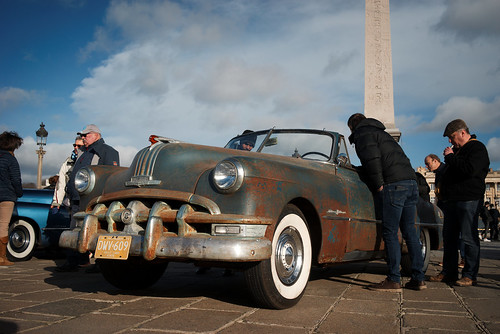
In late July 2023 la traversee de Paris estivale was run with 700+ old vehicles participating in the event.  After thinking long and hard, I decided that this time I wanted to explore flipping the idea of automobile on its head.

Most of the time it's the cars that are in motion. It's why we own them, right?  They get us from one place to another.  I've done a bit of work attempting to express that.  

I'm not sure how it came to me, but what if it were the cars that were at rest and what if the environment around them was what was in motion?  That was one of the ideas I wanted to explore.

Have a squint at this.  It shares what I was after.


la traversee de Paris estivale ~ 2023


Looking a little more deeply at this work of mine, I find I'm enjoying several things about it that for me "work" on several different levels.

The Alfa Romeo Spyder Veloce is needle sharp.  The red paint is pure and rich.  The wheels are as still as can be.  Automobile as sculpture.  And what a beautiful sculpture it is (to me, at least).

There is a passing bus that gives some part of the scene a sense of motion.  I can see through the windows of the bus to catch glimpses of street lamps and other architecture.  The effect is fun and unexpected.

There is a hint of a reflection of the Alfa in the passing bus, too.  The reflection looks to me as if the the spirit of the little Alfa is in motion, dreaming of a time soon to come. 

The ancient Egyptian obélisque is as still as the car.  It stands there, timeless, watching the passing histories being made.  The Alfa and obélisque feel like anchors in a world filled with motion.

Then there are the color relationships.  The blues along the side of the blurred bus are very similar to the blue on the following bus.  There's just a hint of blue in the sky, too, where the clouds are ever so slightly parted.

More subtly, the green tinted windows of the first bus seem to announce the arrival the greens on the second.  The green of the insurance tag in the window of the Alfa are similar to the greens of la traversee plaque seen just behind the windshield wipers.

Which leads, of course, quite obviously to the red.  There's the red of the car. There's the hint of red in the reflection of the Alfa on the bus.  There's the red hat of the driver.  And there's the red in the following double-decker bus behind everything.  Red seems to announce the Italian nature of the Alfa.

The photograph was done in one "take."  One exposure.  This is what I was looking for. I feel there is a certain success after spending so much time plotting and planning.  I find it all to be absolutely delightful. 

Monday, August 07, 2023

RawTherapee Color Management ~ validating a potential solution

Opening Comment: In talking with a friend, I realize I should mention how narrowly defined this color management problem and solution are.  I've limited myself to trying to get the colors to match between cameras with different sensors at the initial stage of image processing.  I have done _nothing_ to address the issues of display to display, nor display to print color variations.  Those two topics are equally thorny and well beyond the scope of this series of blog entries.

After uncovering a hole in the color management camera list, I worked on generating the needed .dsp color "offset" files.  Now I need to take a look at the results to see it's been worth the effort.

As an overview, I took DPReview RAW files for cameras I was interested in creating .dsp files for, ran the RAW files through a two application process, then transferred the results into a Linux system where the RawTherapee image processing application lives.  Have a read through the two blog entries linked in the prior paragraph for a more complete description.


In this blog entry I compare images of the XRite Color Checker Chart with different Color Management selections.  Without further ado, here are the results. 

[As always, click on the following image and have a look at the image at 100 percent resolution to see whatever there is to see.]


RawTherapee Color Management Comparison


Comments -

Starting with the "No Color Management" option we can see that the Sony A6300, A7, NEX-5T, and A7S images of the XRite ColorChecker Chart are a little "dull" looking and the colors don't look like what we'd expect them to.  They are "off" and not correct.

The RawTherapee "Camera Standard" selection helps the image colors appear brighter and clearer.  I know, these are non-technical terms, but I think they get the point across.  There are slight camera to camera color variations even though I did the very best I could to get the white and darkest gray patches to match between the images.  This is what I observed to begin with.  This is the arrow to the rabbit hole I fell down for these three blog entries.  It was this subtle camera to camera color rendition variation that made me wonder what was wrong.

Coming to the Custom DSP Color Management solution I see that the images align very closely.  These images use the files I generated based on DPReviews XRite ColorChecker RAW files.  The A6300 yellow patch looks just ever so slightly "dull" compared with the other Custom DSP images.  The difference is very very subtle.

The A6300 has a dual luminant .dsp file built into RawTherapee.  It includes Look Table and Curves options.  The base image with Look Table enabled yellow patch appears "duller" than in the Custom DSP Color Management A6300 image.

Enabling Curves brightened the yellow patch to a more vibrant state.  It's still very very slightly different than the Custom DSP Color Management images from the other cameras.

Yes, color management is a rather tricky business.  Just the slightest differences in setting image Curves outside the Color Management system changes colors surprisingly quickly.  Further, using the Curves function inside the Color Management system changes things yet again.

All this taken into consideration, I feel the Custom DSP Color Management "offset" files give a pleasingly consistent, common color rendition between various sensor outputs.  The Adobe and XRite software appear to work.  Further, I feel it's more consistent between different sensor outputs than, say, "Camera Standard", so, therefore, worth the effort.

For the cameras that are supported with dual luminant .dsp files, I think I can accept the slight color differences between them and the Custom DSP images on my unsupported by this higher color management specification cameras.

Truth be told, my color management requirements aren't that stringent.  However, if they were, and if it were for some reason critical that I get absolute color accuracy, I could do a couple things.  The first would be to buy an XRite ColorChecker chart and create my own dual luminant daylight/tungsten temperature files.  The second would be to include an XRight ColorChecker chart in my photographs.

As I'm happy with the current updated solution, I think I'm presently "good to go."


Resources -

Adobe Color Management System

RawTherapee Color Management System

How to get LCP and DCP files into RawTherapee

Creating dual luminant .dsp files

Saturday, August 05, 2023

RawTherapee Color Management ~ looking for solutions to a problem

Opening Comment: In talking with a friend, I realize I should mention how narrowly defined this color management problem and solution are.  I've limited myself to trying to get the colors to match between cameras with different sensors at the initial stage of image processing.  I have done _nothing_ to address the issues of display to display, nor display to print color variations.  Those two topics are equally thorny and well beyond the scope of this series of blog entries.

I use RawTherapee to convert SONY RAW and to do most of the image processing "heavy lifting".  

The software became my preferred image processing application after years of hoping the good people at the Gimp could expand the color space and add RAW support on file open.  A few years ago they successfully expanded the color space (up to 32bit floating-point), but continue to recommend using RawTherapee to open and convert RAW files.

Among many many wonderful features, RawTherapee comes with a very powerful Color Management system.  It uses single and dual luminant .dcp files, has a "Curves" option and an additional "Lookup Table" that can, when available, further refine image colors.  There is a default color scheme for cameras that aren't directly supported.

To recap, .dcp files are used to take whatever information the sensor stores for colors and luminosity and modifies them to a reference set of colors and luminances.  It's like using a well controlled set of "offsets" to go from the sensor colors in a RAW file to something that matches reality.  In this way, the colors across different sensors, camera models, and camera manufacturers can be corrected and matched.

My color management problems are several fold.

I do not use Adobe products.  They cost too much for not much additional benefit.  LightRoom and PhotoShop both use .dcp color management configuration files, which could be of benefit.  Adobe has to keep up with all the latest/greatest imaging devices so they tend to provide color management support as soon as cameras are available.  

On the downside, Adobe provides _single_ luminant .dcp support, only.  As we'll recall, single luminant .dcp files provide sensor corrections for daylight color temperatures only.  So the further a scene's color temperature wanders from 5500 to 5700 kelvin, the greater the chance that the .dcp file "offset" information is not as accurate as it could be.

Dual luminant capable RawTherapee can use files that specify color "offsets" at daylight and tungsten Kelvin temperature values.  These specify more accurate color "offsets" across a broader range of white balance temperatures.  Having two points on a slope is more accurate than having just one.

But, and this is my second problem, it turns out that RawTherapee does not come with as complete a set of .dcp files as Adobe products.  In my case, the Sony A7, NEX-7, NEX-5T, and A5000 cameras are not supported with their own .dcp files.  These cameras default to something called "Camera Standard."  "Camera Standard" is a generalized color "offset" corrector that attempts to make things "better" without knowing what a specific sensor requires.  Close, perhaps, but not "spot on" accurate.

There are at least two ways to resolve the .dcp RawTherapee problem  One would be to borrow the Adobe files.  I can't find an online resource for them, so that's completely out. The other solution would be to make them myself.  Fortunately someone posted a nice set of instructions on how to do this.

I followed the outline of the process.  The details are a bit different as the software listed have been updated.  Further, I tried doing all this using Wine on Linux, but failed.  So... here is specifically what I did.

Starting with an old Windows 7 box:

1) .dcp file generation requires two applications, Adobe DNG Converter and ColorChecker Camera Calibration.

  • Search for and download Adobe DNG Converter from Adobe's website
  • Install Adobe DNG Converter
  • Search for and download ColorChecker Camera Calibration software from XRite's website
  • Install ColorChecker Camera Calibration software

2) Downloading RAW files with XRite color chart embedded.

Repeat for the cameras you want to ultimately create .dcp files for.

3) .dcp file creation

  • Open Adobe DNG Converter
  • Select the directory the RAW file(s) is(are) downloaded to
  • Create DNG file(s)
  • Open ColorChecker Camera Calibration
  • Drag and drop one of the DNG files just created
  • Run "Create Profile" being sure to select an output directory you know how to get to

Repeat this for as many times as there are .dng files.

4) Write the .dcp file(s) somewhere/somehow that can be read by Linux.  Because I'm an Old Fart I used a thumb-drive.  You can just as easily send it to yourself as an email attachment or upload it somewhere on a cloud-drive.

Moving to Linux and RawTherapee -

  • Copy the .dcp file(s) to a location in the Linux file system that you can easily access (ie: easily remember where it is so you can grab the correct file when the time comes).
     
  • Open RawTherapee
  • Open desired image file
  • Click on "Color" tab (commonly found between "Detail" and "Advanced" tabs)
  • Scroll down to "Color Management"
  • Select "Custom"
  • Click on "Select your own DCP..." box what has a directory symbol on the right edge
  • Navigate the directory structure of your system and select the .dcp file for the camera that made the image

To confirm that the colors are indeed changing, you can click back and forth between "Custom" and "Camera Standard."  The differences may be subtle. 

What this implies is that for cameras that don't have out of the box .dcp support in RawTherapee, you'll need to specify the correct color management file each time you load images from the unsupported camera.

There are, of course, ways of making this easier to set up.  If you don't already know how to use the various image settings management tools, let me know and I'll try and point you in the right direction.

Which leaves us with one last question.  Does all this Monkey Motion yield better color correlated images?  That will be the topic of the next post.


la traversee de Paris estivale ~ 2023


Resources -

Adobe Color Management System

RawTherapee Color Management System

How to get LCP and DCP files into RawTherapee


Thursday, August 03, 2023

RawTherapee Color Management ~ a problem

Colors between identical scenes taken with different cameras vary from sensor to sensor.

I first noticed this when comparing the RAW file output of a Sony A7S to a Sony A7R.  The A7S was visibly "cooler" looking on my Linux-based RawTherapee system.  I had _assumed_ that colors were being correctly managed by the software and that what I was seeing was differences between the sensors.

This color difference therefore puzzled me as I thought a Sony sensor was a Sony sensor and the colors and luminance would match across their product line.  The software wouldn't need to do much, and if it did, there certainly would've been a decent correction applied.

Years ago when working with Canon 5D MkII RAW files that I made in the studio I could see they were visibly redder when selecting "Flash" color temperatures using Canon software than when I set the color temperature to 5500Kelvin (which is the temperature where many flash units operate).  Canon had made a color choice and I assumed (there's that word again) that all that had been baked into the system and was somehow "correct" by the manufacturer's standards.

For years I've read where one sensor gave a beautiful rendition that others couldn't match.  There's been a long and hairy discussion over the years about Sony's "color science" compared with Canon's.  Some fanboys adore Canon, while others point out certain strengths in Sony "color science."

I felt Sony cameras dealt with this out of the box "color science" much much better than Canon.  Honestly, I don't think all that much of Canon's often vaunted "color science."  I thought Sony and Nikon do a better job out of the box.  Well, it's actually not that easy and the babbling brawling masses who've taken it upon themselves to comment at length on the topic are, well, under-informed.

Recently I noticed subtle color and luminance variations between my various Sony cameras, such as between the early NEX-5T, NEX-7, A7 and the more recent A6000 and A6300.  It was never anything that stopped me from doing what I do, but it is something I noticed and wondered about.

Digging around a bit I had the opportunity to learn a lot.  For instance, there is no standard for colors and luminance.  It's up to the hardware and software designers to decide how to handle these things.  Image processing software does its best to make things look "good."

One of the ways Photoshop and Lightroom have done this is to take a known set of colors (think XRite, Panatone, etc) and to tune an image to match the colors in a chart.  The result is written to a file that is then referred to in the software's Color Management System.  The file type is specified as .dcp

In my case, I use OSS applications and rely heavily on RawTherapee for my RAW file processing.  It uses the .dcp filetype to tune the colors of an image.  So, in concept, RawTherapee could come with .dcp files from Adobe (assuming there are no sharing restrictions) and all the colors should be the same between the various sensors and camera models.

Interestingly, RawTherapee implements a broader set of color management specifications than does Adobe.  RawTherapee comes with three additional features that can be specified in a .dcp.  One is something called dual luminant.  Another is a lookup table the fine tunes colors.  A third is the specification of a luminance curve.  

The look-up table and curves capabilities should be self-explanatory.  The difficult sounding dual luminant spec, it turns out, is pretty easy to understand.  All it is the inclusion of two color management specs, one for daylight and the other for tungsten color temperatures.  It turns out that different sensors react differently to variations in color temperature.  The dual luminant specification allows color management software to more accurately place colors by interpolating color information using two color temperatures.

With these additional capabilities, RawTherapee could, if properly configured with all the right .dcp files, be more color accurate than the industry standard Lightroom and Photoshop applications.

So, what's the problem?  The Sony sensors I have vary from model to model in what I assumed (ack! that word again!!) was a fully color managed software.  To confirm this I went looking for the .dcp file list to see which cameras my version of RawTherapee supported.

On my system, .dcp files are in the following directory - 

/var/lib/flatpak/app/com.rawtherapee.RawTherapee/current/active/files/share/rawtherapee/dcpprofiles

Scanning the list I saw that several of my Sony cameras were not in the directory.  Specifically, there is no file for the NEX-7, nor the NEX-5T, nor the A5000, or, surprisingly, the Sony A7 (generation one) cameras.  This, then, pointed to the subtle color variance I was seeing.  It also explained how the old Canon 5D MkII and Canon 7D images looks differently from my Sony files.

The question quickly became, how do I solve the problem?  Can I find .dcp files pre-made that I could copy directly into RawTherapee?  If not easily acquired, how do I create them?  

Here are the topics for the next RawTherapee Color Management blog entry.  

Stay tuned.


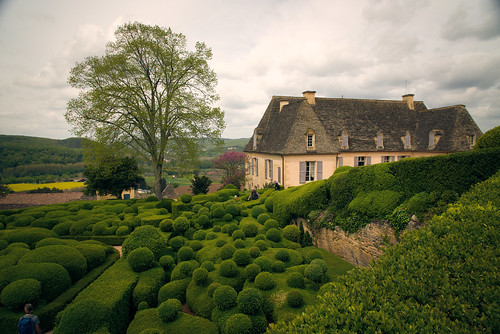
les jardins Marqueyssac ~ Perigord Noir 2023


Resources -

Adobe Color Management System

RawTherapee Color Management System

How to get LCP and DCP files into RawTherapee

Tuesday, August 01, 2023

Activites for 2023

As I have sometimes done in the past, here is a list of potentially fun car and motorcycle related things to do in 2023 should you find yourself around Paris...

Completed Events -

30 Juillet - la traversee de Paris estivale - Paris (Flickr album)

la traversee de Paris estivale ~ 2023


June 2 thru 8 - Rallye des Princesses, Paris (Flickr album)

Rallye des Princesses ~ Paris 2023


CANCELLED - June 17 thru 18 - Cafe Racer Montlhery

Did Not Attend - May 13 thru 14 - God Save The Car, Montlhery

April 16 thru 22 - Tour Auto - Zagato specialty year, though there weren't all that many Zagato in the flesh.

Red ~ Tour Auto 2023 ~ Paris


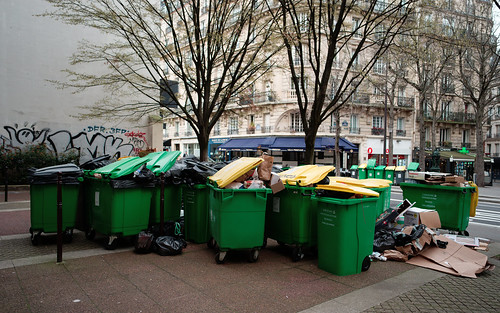
March 21 - La gréve des éboueurs (garbage haulers strike)

 La grève des éboueurs ~ Paris 17 March 2023

 As of 22 March the strike
appears to be continuing


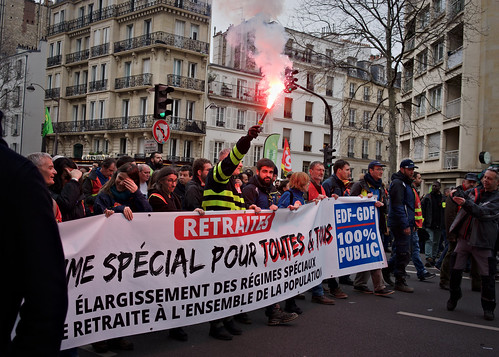
March 15 - Manifestation "...450.000 personnes ont défilé dans les rues de la capitale..." (protest march) through Montparnasse 

15 March manifestation ~ Paris

It was incredible to see hundreds of
thousands of people take to the streets
in protest


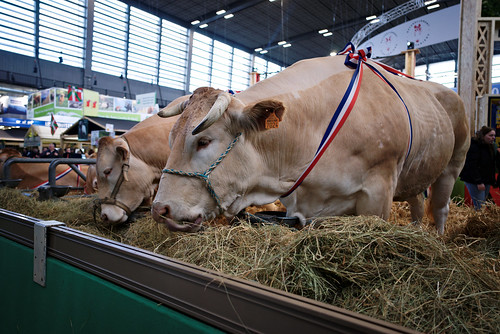
February 24 - March 3 - Salon International de l'Agriculture (Flickr album)

Salon International de l'Agriculture ~ 2023

Beautiful animals, one and all


February 1 thru 5 - Retromobile (Flickr album)

 Retromobile ~ 2023

Unexpected Renaissance Painting???


January 15 - la traversee de Paris (Flickr album)

la traversee de Paris ~ 2023

--------------------------------------------

With new photographic tools to play with, perhaps I'll get a decent shot or two and improve my output?  Regardless, I'll be looking to have as good a time as possible.

See you there!


Vintage Revival Montlhery ~ 2022

Saturday, July 29, 2023

Looking more deeply ~ Four

Taking my time and looking more deeply at photographs (see part 1, part 2, and parts 3.[1, 2, 3]) I've come to re-realize, re-appreciate the value of study, observation, and experience.

When it comes to study I used to live in a culture where people would often say things like study is for school children.  Only nerds do that.  Besides, it's boring.  Observation is for astronomers and bird watchers.  Experience is what we get from watching Disney movies where we learn important life lessons and are left with a feel good positive uplifting ending after an hour and a half.

Certainly not all of US culture is like that.  Some of the best philosophers, scientists, and thinkers come from there.  Though you'd never know it from what passes as public conversation.  You seldom hear anything accurate or correct about these kinds of people if you hear anything about them at all.

I experience this when I compare the content of media content in the US to, say, something like LCI here in France.  Even if you don't understand French a person can hear the tone of the presentation and know it's not stressed and pressed and out of breath in its delivery.  It's calm, centered, and well-reasoned.  It's not a passionate plea for attention.  It's a sharing of knowledge and information. For me LCI is like returning to the days of Walter Cronkite in the US.

Photography can be like that in the US, too.  Looking at social media feeds what do we see?  Billions and billions of selfies.  It seems like it's feeding a never ending insatiable narcissistic need.  I find the vast majority of images to be badly composed, badly lit, badly processed and completely banal.

Have none of the contributors to the World of Narcissism ever studied (!!!) how to make a good portrait?  Have they never looked at art history to observe the eye level of the viewer in relation to the subject and what it "means"?  Do people not understand the human psyche and how we interpret these kinds of things?  

If you want to make a person look good, intelligent, beautiful or strong, you place the point of view lower than the subjects eye level.  Sure, this is classic art, but it's classic for a reason. If your point of view is higher than the subjects eye level the subject will feel subservient, weak, vicitimized, and incapable.  Standing over someone implies very different things than looking up to someone.  Our reactions are built into us.

To understand this and to apply a decent solution might require education, study, observation, and experience.  Perhaps this is why so much of what passes for photography these days feels to me to be so damned insipid and banal.  People refuse to help themselves to freely, widely available knowledge.

It was something of a surprise, then, when I stumbled across a video about a NY-based street photographer.  His name is Reuben Radding.  Listening to him helped me realize there are some rather deep thinkers on the subject of photography in the US.  The first 10 minutes or so of the above linked video was like the heavens had parted and a seriously strong light had cast through.  It's inspiring to me to see what this guy does and how he's reacted to various cultural and societal challenges of photographic interpretation and experience.

There are similar voices of knowledge and understanding in all aspects of image making.  There are people like Reuben Radding in the fields of portraiture, still life, landscape, nude, and sports photography.  Depending on ones temperament and thirst for understanding, these photographers can be well worth seeking out and listening to.

I've found it helps me understand what I do photographically and why.

la Serres aux Papillons ~ la Queue-lez-Yvelines

Thursday, July 27, 2023

Looking more deeply ~ Three.Three

The history of the reclining nude in art is long and often honored.  Or, depending on the time and place, dishonored and denigrated as pornography.


Rome - 2022


In previous posts I followed a little of history and shared details surrounding one famous work.  

With this post I would like to look at the reclining nude as a subject in photography in four distinctly different styles.  I'll begin with the Pictorlialists.

In the early days of the 20th century USA censorship boards managed what the public could see and read.  This had an important impact on how the reclining nude was treated in photography.  It came down to this - if an image of a nude was clear and sharp, it would be censored.  If an image looked like "art", if it was shot with a soft focus lens, then the chances were that such a photograph would remain uncensored.

Clarence White and his friends and colleagues photographed reclining nudes.  The images made using a soft focus lens were shown publicly.  Sharp images were privately held until surprisingly recently.

Those photographers who made sharp images often disfigured or scratched away the face.  A prime example being the surviving works of E.J.Bellocq.  Many of his negatives have removed the models faces.  They are clearly scratched.  His images were censored.

So it's unsurprising to me that even now, images of the reclining nude are difficult for critics and viewers in the US.

Sally Mann's "Venus after school" is particularly problematic for the gatekeepers of morals in the public space.  In her autobiography "Hold Still" Mme Mann writes of her relief to learn the FBI wasn't going to treat her the way they had Jock Sturgess and raid her home to remove any and all "offending" materials.

For a couple decades there was a photographer who had quite an impact on nude photography around the world.  He was very famous, sold lots of books, made a few movies, and photographed ad campaigns for some of the biggest luxury goods houses on the Continent. David Hamilton is said to have been inspired by the works of Lucas Cranach the Elder, which indicates his approach and style were based in part on well established art forms.


Rome - 2022

Each time I visit the Galleria Borghese in Rome I climb the stairs and head to a room that's far away from just about everything.  It's there that one particular Cranach is found.  Displayed next to it are paintings in a similar style by other artists.  But it's the Cranach that holds my attention.  Every single time.  It's called "Venus and Cupid with a honeycomb."

It's now impossible for me not to see the parallels between the Cranach paintings and M. Hamilton's photographs.  Art informing photography.  And yet, that's not at all what the photographer is presently remembered for.

David Hamilton's choice of subject acted like a lightening rod for bad things to happen.  In 2005 in the UK a man was arrested for having a collection of images that included those made by the famous photographer.   In 2016 the photographer was accused of inappropriate behavior by four of his previous models.  He was shortly after found dead in his apartment in the 15eme Arrondissement in Paris.

The drama continued after M.Hamilton's death.  Olivier Mathieu wrote on his blog, in Defense of David Hamilton (a site that has recently been taken down) that it might have been a case of murder, not suicide.  Conversations about the merits of Hamilton's work as art have stopped, to be supplanted by many public figures taking a strong moralist stance against the dead photographer.

While David Hamilton's works from the 1970's and 1980's played a strong role in the conversation of "is it art or is it pornography", there was seldom any question about which side Playboy centerfolds came down on.

And yet, if we look at these images from the perspective of history, craft, lighting, and composition, I'm not so sure some of these works shouldn't be considered full blooded honest to gawd geez this is beautiful art.   

Ken Marcus, one of many now famous Playboy photographers, spoke about what it took to light, compose a scene, and expose a piece of film.  He talked about the importance of 1/3rd an f-stop and getting everything exactly correct.  Here is just one definitely NSFW image that illustrates how, as a photographer, Ken got everything, every detail, every nuance "correct."

Which brings me to something I hadn't fully considered before.  That is that I find myself living during a time of self-censorship.  I've said it before and I'll say it again; the subject of the reclining nude, while being a well-found, well-respected art form for at least 3 thousand years, it is something I could never bring myself to explore photographically.

I grew up in a time with the censorship boards were being shut down, but their influence remained strong.  I grew up in a time when a photo-lab would call the police if they found nude images on a roll of film you brought in to have developed.   I grew up in a time when American culture was calling into question any and all restrictions, limits, barriers, only to live to see the social pendulum swing in recent decades to the far right with the re-installation of restrictions, re-setting of hard limits, and the rebuilding of social and cultural barriers to artistic expression and appreciation.

Meanwhile, here in Europe things haven't (yet?) gone so hard right.  I have the opportunity to see, appreciate, and research some of the best expressions of any art form the world has ever seen.  One of the things that strikes me most these days is that history and time have a way of leeching away details that might be important at the time a work is created.

I'll give a couple examples of what I mean by that.

When we look at a work by Caravaggio, do we know, and if we do, do we care that he was a pimp and murderer?  Writing this exactly the way I just did exposes the moral, ethical, and cultural conditioning that I find myself subjected to.

Do we know and care that Fransisco Goya heard voices and was mentally ill?  Was his craziness a "good" thing or a "bad" thing?  Or is there "something" about his art that makes us feel as if he were actually and after all a great artist?

Much more recently, do we know or do we care that Salvador Dali supported the Spanish Fascist Franco?  Well, actually, I do.  It's partly due to the fact that Spanish Fascism still lays just below the cultural and political surfaces of Spain.  It's impossible to ignore, actually.  When Catalunya has the power to make kings (figuratively speaking) I have the opportunity to remember the role Franco played in murdering tens of thousands of people in and around Barcelona.  The wounds have not healed.

Similarly, do we know or do we care about how poorly Picasso treated the women in his life?  Or do we stress his "goodness" in remembering the role he played in saving the fabulous Prado art collection from certain destruction by advancing Franco Fascist and German Nazi forces in 1939?  Perhaps these two examples are too recent for time to have leeched away the disturbing sub-text of two large artistic bodies of work?

One last example and then I'll call an end to my ramblings on the topic.  This underscores how the ethics and morals of a time set the tone for how art is viewed, discussed, and appreciated.  Renoir's canonical work is receiving a lot of criticism for his nudes.  I don't understand it.  Why Renoir?  Why now?  Am I too dense to understand?  What's going on here?  And if people have "serious" problems with Renoir, why aren't they taking to task the works of Luis Ricardo Falero?

All this gives me some idea of what might happen to currently controversial photographic works.  I am certain that society and culture will do what society and culture has often done.  It will sift through the social-cultural dramas of the present time and get to the essence of what will by then be (perhaps dramatically) different socially and culturally views.  

I hope that someone, sometime, somewhere will see it good to rise the photographic reclining nude above the demeaning word of "pornography" to more fully appreciate excellence and stunningly beautiful images as an artistic expression that paintings already can be.

Monday, July 24, 2023

Looking more deeply ~ Three.Two

In the previous post I said... to illustrate the vastness of the treasure trove of art that I contend set the foundation for the reclining nude in photography, here is an extremely short list of works.

Mesopotamia 1800bc works depicting the human body

Ancient Greece 750-300BC works depicting the human body

Giorgione 1510 "Dresden Venus", Titian's teacher

Titian 1538 "Venus of Urbino" (aka Reclining Venus)

Bouchet 1743 "Pan et Syrinx"

Canova 1805 "Venus Cictrix"

Manet 1865 "Olympia"

Cabanel 1863 "Birth of Venus"

Modigliani 1917 "Reclining Nude"

There are more than a few interesting historical notes about this art.  I am choosing just one work to talk about, and that is "Olympia" by Eduard Manet.
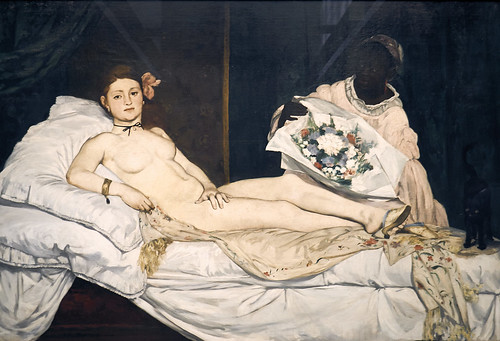
 

Manet's Olympia


Here's an easy one to begin my comments and observations.

I've read that "Olympia" is bold because this was the first painting in the history of reclining nude art where the primary subject is looking directly at the viewer.  

Um.  No.

For "boldness" of gaze, how do we evaluate Titian's earlier work?  Am I blind or is Titians model not looking directly as us, the viewers?


Titian's Venus of Urbino


Another story I've read about Manet's famous painting is that no one would buy it.  The first sale of one of his paintings was celebrated as a good beginning.  Except it wasn't. He sold rather few paintings during his lifetime.

Manet came from a wealthy family and did what he wanted.  He painted.  Economically his art was pretty much a failure.  His mother gave him a enough money he could rent and outfit a large place in Paris.  After she tired of waiting for Manet's career to develop so he could support himself she cut him off and had him move himself and his family in with her.

"Olympia" never sold and the Manet estate gave the painting to the France.  This is why it hangs in the musée d'Orsay and is not squirreled away in some private collection somewhere for no one to see.  There was something not quite right about it.  But yet it's now famous.  Why?

The painting was, in fact, shown at the 1865 Paris Salon.  The curators of the Salon hung it way up high so as to make it very difficult to see.  Though, from the sounds of things, this didn't prevent people from bringing binoculars to have a better look at things (as was common practice at the time for just about any controversial work).

This is where the myth of the poor oppressed "Impressionist" painters comes in.

When needing a special wine for a special occasion people often visit a specialist who purports to be able to help them untangle the mysterious web of tastes, choices, regions, and the broadcasting and impressing others with the subtle refinement tof "your" choice of beverage.  Seldom to people know for themselves which wines go "best" with whichever dish.  It takes time and desire to learn to reach the point of being able to comfortably select the "right" wine for the occasion.

Something similar happens in art.  We are _told_ what is famous.  The tellers are the supposed specialists and "know things" that we often don't.

With this in mind, it was easy for me to get caught up in the "myth" of Impressionists being outcasts from Parisian art circles. For the way the story is commonly told, it is difficult not to feel sorry for them.  

I think this is what the art specialists intend that I feel.  Oh those Bad Boy Academician snooty-patooty École des Beaux Arts Paris Salon curators kept the brilliant as of yet unsupported and definitely under-appreciated "Impressionnistes" from receiving their just accolades.  Or some such rot.  Many modern critiques tend to crow that the "Impressionnistes" won in the end.  

Yet... after looking not particularly deeply at the topic, I see where there was much more at play than what this rather simple-minded history retelling might suggest.

To begin with "Olympia" is that it's actually a very flat painting.  The skin treatment isn't anything near what I'd expected to see.  When I first looked at it in person I couldn't come to grips with its fame.  Why was this work promoted so strongly?  The skin tones and rendition are not all that appealing to me.

Could it be that by the standards of the day that the works of Manet, Renoir, Monet, and many others were simply not good?  Or do we not understand the influences that Manet and others were under?

Art critics tend to wax poetic when attempting to explain that Manet was influenced by Diego Velázquez or perhaps  Jusepe de Ribera.  Well, I've seen a fair amount of work by these two famous painters and Manet's "Olympia" might look something like what is described, but I remain unconvinced.

Perhaps more direct to the point was the influence of Japanese wood cut art.  Manet had studied then newly available wood cuts and adopted the style for his "Olympia."  If you have a close look, there is a subtle but obvious black outline around the primary subject.  This comes from his studies of Japanese woodcuts.  Further, the flatness of the subject's skin mirrors wood cut tone flatness, too.  

When viewed as a French adaptation of a Japanese wood cut, "Olympia" begins to reveal herself in unexpected ways.  I can see where subsequent artists, too, adopted the Japanese woodcut approach.  The list of these artists is long, that's just how strongly the Japanese art form impacted 19th century European art.  And yet, even knowing this, the Manet work falls far short of my expectations.

Am I such an art snob that no one can meet my expectations?  Am I such a dolt as to not appreciate what the specialists have worked so hard to teach me?

Up to the following point I felt that Renoir's skin tone renderings were the best of the best.  Manet's "Olympia" wasn't all that bad.  Japanese wood cut art was a "good thing."  

My appreciation and understanding of art changed in an instant when we visited a large, beautiful exhibition of Vigee le Brun's art at the Grand Palais some years back.  

Seeing le Brun's work showed how wrong I was, and seeing her art set me on a more informed and hopefully more enlightened path.  Suddenly the "Impressionnistes" failed to impress.

"Olympia" is currently hung on a wall all by herself at the Orsay.  She's the star of the show in the room.  She used to be upstairs near the east clock, but she's since been moved downstairs to the first level just off the main path that passes between sculptures.  The works around her are muted and she really stands out against everything else in the area.  People flock to see her and often stand for many minutes considering her.

I find it a curious fact that on the other side of the sculpture main aisle are a series of cramped, nearly private chapel-like rooms.  The entry to one is labeled "l'Academy."  Therein are found a small collection of paintings by William-Adolphe Bourguereau and Alexandre Cabanel.  Several paintings are hung side by side.  They are poorly lit.  There is little space to stand back and take in what is presented.  The whole experience, for me, is rather like trying to see something in a storage-room, it's that cramped.  This clearly is not art meant to be stars in the show.

Very interestingly, M.Bourguereau was a primary "gate-keeper" curator of the Paris Salon and in the current telling of "Impressionniste" history.  He was the one who, history tells us, tormented them the most.  Perhaps this is why his works are given so little space and encourage so little attention.

I try to visit the little room whenever we go to the Orsay (which is surprisingly often).  I try to find the time and space to take in the works on display.  I think they are absolutely glorious.  The two that grab my attention more than the others are the two "Venus" paintings.  One by Cabanel and the other by Bougurereau.

The little jpgs just linked fail to express the beauty and subtly of the skin renditions.  The poses and compositions are classic.  There is a balance in these paintings that is almost boring.  Seen in person, they are not boring at all.

Considering Bougurereau's other works showed me why he didn't understand the "Impressionistes."  How could he?  His own work is beyond reproach.  Any yet, history has forgotten him and many others for the work they did.  History has cast Bougurereau in an unkind light.

Photography is no different.  Certain people are lionized while others are forgotten.  I'll finally have a closer look at this in the next blog post.


Monday, July 17, 2023

Looking more deeply ~ Three.One

In two recent blog posts I've commented at length on my reactions to two photographs made by Jacques-Henri Lartigue.  I did this as an exercise in deepening my looking at and appreciation of photographs.  I've been catching myself skimming through images on the internet and not really taking any time to look at them.

Living where I do I get to see a lot of art.  Paris (!), Nice, Lyon, Lisbon, Madrid, Barcelona, Milan, Florence (!!), and perhaps the greatest of them all, Rome (!!!).  After awhile I feel I can begin to make sense of art, history, and my field of particular interest, photography.

One artistic theme in particular is seen everywhere.  It's the nude, or more specifically the reclining nude.  Often a subject of controversy in the US I was at first taken a little aback by the ubiquity of this artistic expression.  


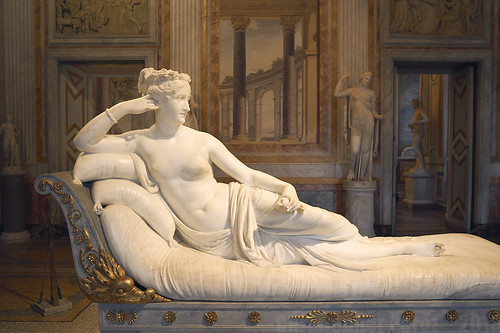
Antonio Canova's Pauline Bonaparte as Venus Victrix


While painting are more or less accepted, photographs of the reclining nude have generated more than a fair amount of controversy in America.  I'm thinking of Sally Mann's 1992 "Venus after school", Jock Sturges and his many images taken in France, David Hamilton and his work from the south of France, to the three or four decades worth of centerfold photography in Playboy magazine.

I remember in my lifetime when photo-processing folks could and would turn a photographer into the police if they found images of nudes on the film brought to a lab to be processed.  It is a potential subject I still steer clear of in my own work due to that early imprinting of fear, police, and moral judgment.

If feels to me that instead of thinking of works as art, the thought of a reclining nude in painting, sculpture, or photography is considered at best boarder line pornography.  Yet, if the Catholic Church herself in Europe can condone such imagery, what's wrong with the US that the nude has been for so long a taboo subject of artistic expression?  


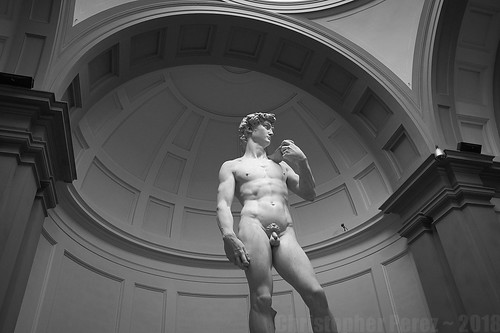
Accedemia ~ Florence, Italy 2018


To see the point I'm trying to make, walk into any church or museum in Rome where Gian Lorenzo Bernini's works are on display, particularly the three works found in the Galleria Borghese, and tell me what you think of the intersection of art, culture, and religion.

It made me smile to learn that recently the mayor of Florence had invited a former school principal to see David.  The principal had gotten into trouble with parents over the teaching of art history.  The subject was David by Michelangelo and from the press it seems the famous statue was unfit for certain human eyes without first passing it by their conservative snowflake parents.


Accedemia ~ Florence, Italy 2018


Such is the contrast between (some) American moral judgments and the artistic values of Europe.

To illustrate the vastness of the European treasure trove of art that I contend set the foundation for the reclining nude in photography, here is a terribly short list of works. 

Mesopotamia 1800bc works depicting the human body

Ancient Greece 750-300BC works depicting the human body

Giorgione 1510 "Dresden Venus", Titian's teacher

Titian 1538 "Venus of Urbino" (aka Reclining Venus)

Bouchet 1743 "Pan et Syrinx"

Canova 1805 "Venus Cictrix"

Manet 1865 "Olympia"

Cabanel 1863 "Birth of Venus"

Modigliani 1917 "Reclining Nude


Titian's Venus of Urbino


With the exception of Girgione's painting, I've seen much of the art on this list.  It's been quite an education.  I feel like my US-side education was seriously lacking.  The histories behind these works can be as fascinating as the art itself.  

In the next post I'll have a look at just one of the works, it's history, context, and current place in culture.  This I hope could be a decent lead-in to considering the reclining nude in photography.  There's a point I'd like to make and it will require me slogging through a bit more background before I get there.


Thursday, July 06, 2023

Looking more deeply ~ Two

In a previous post I talked about a famous image that Jacques-Henri Lartigue first took in 1913, and then started promoting in 1954.  

In the same Reporters Sans Frontier journal #66 as the bolide is a photo of Florette's hand.

The history of this photo is much less dramatic than the racecar.  Yet I read something interesting about how people react to the image that I would like to explore just a little in this post.

Considering the photograph itself, the gesture of hands of the "Lady Christian" model are mimicked by Florette.  There are obvious similarities in style, preparation, and beauty of the finger nails.  They are perfect. 

What I find interesting is how two people reacted to M.Lartigue's photograph.

In one case a woman said she hated it because it was a symbol of everything she would never have.  She came from a family of modest means and it was evident to her that the richer classes of people were, to her way of thinking, frivolously pampered.

A younger woman had a different response.  To her the photograph of Florette's hand represented an ideal and hope that she too could afford something as simple and beautiful as pretty finger nails.

In the US we don't often consider economic class status as being a defining element of art or photography response nor evaluation.  In Europe it most definitely can be _the_ defining element.  

In America we might feel that Jacques-Henri Lartigue was a great photographer and that we, too, might, if we work hard enough, emulate his style and success.  In Europe the democratization of various aspects of life and living is many times non-existant.  To some Europeans, M.Lartigue was born into the life he led.

I'll give an example of automobiles.  

I grew up thinking that if I worked hard enough that I might be able to afford an Italian supercar of some kind or other.  In Paris, the only people seen driving the streets in these kinds of toys are rich boys from the middle east who appear to be trying to impress strangers.  On my side it was for the enjoyment and appreciation of the design, engineering, and manufacturing.  On the middle eastern side it is more about being seen in a status symbol.

Not, certainly, that people in America don't try to impress strangers by showing off.  They often do.  I'm simply trying to point out that the barriers to acquisition are different in Europe and mean different things than they do to Americans.

This is what I believe Florette's hands can do for viewers.  It can expose our social, economic, and ideological differences.  Such is the power of a photograph if we look more closely at ourselves while viewing an image.

Friday, June 30, 2023

Looking more deeply ~ One

The other day I caught myself skimming through hundreds of images online. I stopped and felt it was useless.  My eyes were "consuming" images at a hellatious rate, and for what?  What was I actually seeing?  What was I doing?  Why was I doing it?  

I'd caught myself as a mindless, insensitive consumer.

Shortly afterward I was skimming through the Reporters Sans Frontieres journal #66 which contains 100 photos by Jacques-Henri Lartigue.  The images look good but I couldn't tell you what I'd looked.

I'd caught myself as a mindless, insensitive consumer.  Again.

Stuck in my mind was an interesting article written by someone named Sroyon on the site 35mmc.  The article talked about how to look more deeply at an image and to appreciate it for all the things that it is and all the things we bring with us as we try to look more deeply.

Taking a deep breath, I returned to the journal and a famous photograph that was made many years ago by Jacques-Henri Lartigue.  It is a unique image (or so I thought) in the way the subject is distorted one direction, and the background is distorted in another direction.

It was easy to wonder about how M.Lartigue had created the image.  Using the Force, I Duck Duck Go'd (I'm no longer using Google) and found something rather fun.  There is a lengthy discussion on the effect.  The discussion thread details what was done and how the effect was achieved. 

M. Lartique used an early focal-plane shuttered large format camera.  The shutter was slow to travel in front of the film plane giving time for the subject and background distortions to be generated. The photographer himself at first felt the image had "failed" because of the unintended distortions.  He hadn't panned the "bolide" (racecar to us 'mericans) at the proper rate.  It didn't look "right" and the image was set aside.

There was a 40+ year span of time between when the M.Lartigue photo was taken and when it was first widely shared.  The image was made in 1913 of the "bolide" of Rene Croquet but wasn't distributed in the wider world until 1954.  

What changed his M.Lartigue's mind?  It seems that a certain photo made by the American Paris-based photographer, Man Ray, was gaining a lot of attention. So M.Lartigue went back through his old negatives to retrieve his own version of a distorted racecar.

Further, this kind of distorted early racecar image is not the only image in this style.  It turns out that there are many examples of this kind of distortion.  Some show light distortions.  Other photographs show a stronger effect.  Photographers were having a difficult time panning with their subjects.  Their technique wasn't "perfect."

The attention Man Ray's image was receiving must have been significant enough to rise above the other distorted images to have ultimately captured the attention of M.Lartigue.

What makes the Lartigue image so remarkable is that the early part of the 20th century is it comes from a time preceding the industrialization and mass commercialization of cameras and film.  Photography as a craft was in the process of exiting a time when a good photographer was also a very good alchemist.  
Early photographers had to either understand or happen upon solutions to photographic problems  Lenses were still ground by hand.  Cameras were still somewhat unique.  Dry plate film could still struggle with batch to batch variations.  Photography had yet to be democratized across the upper and middle classes.

As icing on this exercise of looking more deeply at something, I never knew that the photographer wasn't actually a photographer.  He made his way through the world for many years primarily as an artist.  His paintings were exhibited and sold in galleries in Europe. 

It was after John Szarkowski at MoMA presented M.Lartigue's works in 1963 and after the enthusiastic Richard Avedon helped put on a show of the Frenchman's images that the world came to see Jacques-Henri as a photographer.

The shift from artist to photographer is by now complete.  Searching the name "Jacques-Henri Lartigue" produces links to only his photography.  I've tried this various ways using search engines and I've yet to come across a link to paintings by the artist.

This was fun and educational.  I got to learn about a photographer who wasn't really a photographer.  I got to learn about early photographic tools and their application.  I got to re-experience looking at a famous image.  I got to appreciate how the bolide's lines, including the brake handle, point one direction and the background sliding in the other.  

What a fascinating image.

I think I'll have to try this out on other works in the near future.


Monday, May 29, 2023

I am reminded...

[I'm boosting this post to the top of the heap - 29 May, 2023]

Photography isn't about lenses and cameras and test results and preparing and then photographing situations and events.  No.  The more important things related to photography are our sometimes shared human experiences.  All that other technical stuff is just understanding, preparing, and to getting ready to make something.

People.  Experiences.  They are what count.  Camera or no.  Am I right?

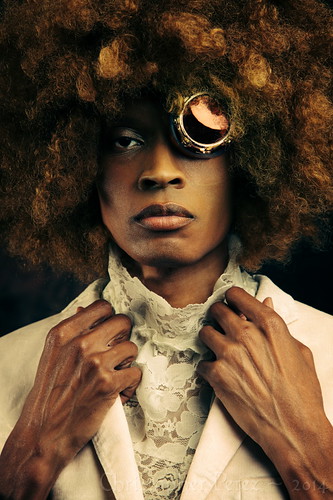
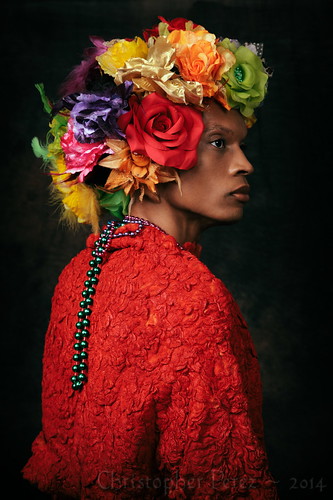
I learned yesterday that a creative person my wife and I worked with passed away 7 years ago.  We never knew.


Age of Steam ~ sean360x

Like so many creative people we've worked with, Sean360X was a wonderful person.  

I'm not sure how we found each other.  It could've been in response to some of the work I posted on-line.  Or it could've come word of mouth.  I just can't remember.  

The photo-session was fun, interesting, and it quickly and easily unrolled.  Everyone knew their role and everything just *clicked*.

We worked with Sean360X for only a few hours.  Yet, our paths had crossed and we left strong impressions on each others lives.  A friend of his confirms this.

It's difficult to accept the fact there is one less creative person in the world.  Sean360X died so young.


Sean360x ~ Gods (a series)

Friday, May 26, 2023

Soft Focus Pictorialist Effects ~ part Ten

If I bend the self-imposed rule about being done, finished, over with talking about soft images just a little I can sneak in another little missive about soft focus pictorialist effects, this on that does not involve optics nor filters.

I know I've written about this before, but in light of what I've recently learned about soft focus lenses, soft filters, and image processing, it might be good to make a clear comparison between the various approaches.

What if there was a way to create a "convincing" soft image from a sharp one?  I could avoid having to carry a soft focus lens or a soft filter.  I might have very good image processing flexibility, right?  Color.  Black and white.  Sharp.  Soft.  All from a single RAW digital image.

Back in the film days someone popularized an image softening technique that is known as the "Orton Effect."  Micheal Orton is the photographer.  His film technique is easily adaptable to digital image processing.

Though the previous links talk about the effect as it applies to landscape photography.  I'll take a short look at how it might work in portraiture.

Setup ~ 

  • Camera - 
    • Sony A7 100ISO, 2sec timer, "A" mode
  • Lens - 
    • Nikon Nikkor-S 50mm f/1.4
  • Bogen tripod
  • Image Processing - 
    • RawTherapee - to generate a low contrast image that is fed into...
    • The Gimp
      • Gaussian Blur - 
        • Open image copy in a new layer
        • 2 pixel radius
        • Hard Light blend mode
        • Opacity set by taste by balancing the effect against...
      • Gaussian Blur - 
        • Open image 2 copies in 2 new layers
        • 10 pixel radius
        • Soft Light blend mode
        • Opacity set by taste
  • RawTherapee - to add final imaging tones

Note: The image processing choices I made here are to my taste and are based on trial and error.  It's easy to add or subtract "softness" by varying the Gaussian Blur settings.  It's a little more difficult to balance the contrast, but I found that varying the Opacity gives me flexibility in this regard.  There is no specific "magic" in the fact I used Hard Light and Soft Light blend modes, except they add contrast (sometimes very quickly) at the same time they soften the scene.  I could just as easily have added a Normal blend mode layer that was Gaussian Blur'd to help manage the contrast.

Image Comparison ~

As always, click on the image and enlarge to 100percent to see whatever there is to be seen.

Here is the original sharp image -


Orton Effect Comparison


Here is the Orton Effect processed image -

Orton Effect Comparison


For additional comparison purposes, here are two more images.  The first is soft filtered and the second is using the Pentax 85mm f/2.2 Soft lens.

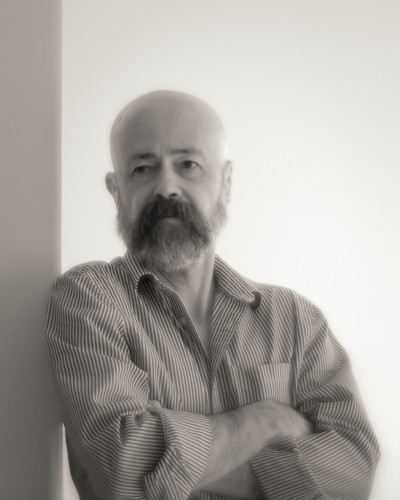
Nikon Nikkor-S 50mm at f/1.4 + Nose Grease on UV filter + Local Contrast

Autoportrait ~ Pentax 85mm Soft f/2.2 at f/4.8


It should be pretty obvious that each softening technique has it's own "signature" and are each unique in their own way.  I'm not sure there's any one "good" nor "correct" nor "proper" way of doing this.  It's good to have choices and flexibility in image making, isn't it?

I've enjoyed exploring this topic again.  It's something that I've tried to come to grips with over the years and it feels like I'm getting close to being able to fully control an outcome based on a more complete understanding of the underlying materials, science, options, and effects.

I imagine a person could choose an approach and stick with it until they'd mastered their chosen path.

Sunday, May 21, 2023

Pentax 85mm f/2.2 Soft ~ Instruction Manual in English

Chetworth del Gato sent me a link to an instruction manual in English for the Pentax 85mm f/2.2 Soft.

This was the very thing I recently groused about not being able to find.  Indeed, it contains rather interesting guidance.  Concerning the use of the 85mm Soft -

"... The picture taken with the Rear Converter combined is more uniform, better in quality and has a greater soft focus degree than that taken with the soft-focus lens only.  Combining the Rear Converter varies the focal length and speed..."

The Rear Converters are the Pentax 1.4x and 2x tele-converters.  Four of them are listed in a table found just below the quoted guidance.

I'm not sure what "a greater soft focus degree" means.  After having dug into the topic and trying a 1.4x teleconverter with the Pentax Soft perhaps what they were trying to say is that the degree of softness across the field of view is more evenly distributed than when the lens is used without a teleconverter.  That, at least, is what I found.

Have a look at the following image.  The softness of the scene at f/4.8 is quite nicely distributed.  When used without a teleconverter, the scene shows a strong sharp to soft transition zone.  It's something that I called a "resolution hole" in the series of nine blog entries I posted on the topic of soft focus Pictorialism starting here.

Using the Pentax 85mm f/2.2 with a teleconverter seems to do the trick.  It behaves rather nicely and reminds me a lot of the results that can be achieved using a Wollensak Verito on large format film.


Pentax 85mm f2.2 Soft at f4.8 with Sigma 1.4x Extender ~ USM + Contrast Curves + Toned + 100 Micro Contrast + Red filter Channel Mix + Liight Noise Reduction -1

Pentax 85mm f2.2 Soft at f4.8
+ Sigma 1.4x Extender ~ USM
RawTherapee Image Processing:
Contrast Curves
+ Toned
+ 100 Micro Contrast
+ Red filter Channel Mix
+ Noise Reduction -1

Thursday, May 11, 2023

Soft Focus Pictorialist Effects ~ part Nine

Here is my last blog entry on this topic, I promise.  I know.  I know.  There are so many things to be looked at, but enough is enough.  For now, at least.

It seems strange to me how I vacillate between extremes.  I recently sold most of my Nikon manual focus lenses because I'm reaching that age where AF isn't just a luxury.  My Nikkors were getting to be too difficult to use in fast changing situations.  So I now have three wonderful fixed focal length lenses for the Sony A7, three for my APS-C Sonys, and two zooms for the APS-C for when I'm out photographing motorsports.  I'm keeping several old Nikkors "just in case" I might wake up one day and find I "need" them.

One of the lenses I've had forsale for several years is a Nikon F mount Pentax 85mm f/2.2 Soft.  Recently I got frustrated at the lack of interest in the optic and decided to try and sort out how to use it once and for all time before I let it go.  Hence the Prime Mover of this entire series of blog entries.

Pictorialist Photo-Sessionist style images are sometimes built on soft focus lenses and their "interesting" properties.  So I thought it might be interesting to take one more look at this Pentax Soft from the perspective of Pictorialism.  Of course the style is just as importantly built on lighting, composition, subject, image processing and printing techniques.  I had the lens and that seemed the most reasonable place to start.

I have said little to nothing about lighting, composition, and printing techniques in this series.  But I was able to explore a little of what might be possible using image modifiers (lenses and filters) and current digital image processing tools.  The three tools I used were to try and reveal underlying sharpness of a soft lens.  The tools are global contrast, local contrast, and micro-contrast.

With softening filters (Cinebloom, Nikkor Soft, nose grease, hairspray, etc.) as well as with Soft Focus lenses I believe an image can benefit from carefully controlling global and local contrast.

In these ways, I believe from a technical, commercially available camera equipment perspective that current practitioners of the craft can rather closely emulate the Pictorialist style. 

What I would like to do with this one final blog entry is to look at completely piercing the "resolution hole" that meniscus lenses are prone to.  To do this I will now try a smaller format Sony A6000 APS-C camera and combine it with the Pentax 85mm f/2.2 Soft and the Sigma APO 1.4x teleconverter.  This makes it a rather long focal length setup, but this seems on some levels to be in keeping with the use of long Soft Focus lenses in large format film work.

Was you may recall, my Full Frame digital camera still showed a bit of uncontrollable sharp/soft transition zone effects near the edges of the frame.  With luck the narrower APS-C field of view might fit _inside_ the "resolution hole" and render scenes at any distance more easily controllable.

Setup ~ 

  • Camera - 
    • Sony A6000 APS-C, 100ISO, 2sec timer, "A" mode
  • Lens - 
    • Pentax 85mm f/2.2 Soft
    • Sigma APO 1.4x teleconverter
  • Bogen tripod
  • RawTherapee - 
    • Global contrast increased by image to taste
    • Local Contrast increased by image to taste


Image Processing Comparison ~

As always, click on the image and enlarge to 100percent to see whatever there is to be seen.

I now present two scenes.  Each scene was shot at multiple apertures - f/2.2, f/2.8, f/4, f/4.8, and f/5.6.  We can see how the veiling softness changes with aperture settings.  I tried to keep the image processing results similar to better evaluate the aperture, "resolution hole", scene rendering effects.  For this reason I used slightly different processing (heavier local contrast and different brightness settings) at f/2.2 and f/2.8 than I did with the other images.  The aperture progression should be fairly obvious.

Without further ado, and starting with f/2.2 down to f/5.6 -


Sony A6000 + Pentax 85mm f/2.2 Soft at f/2.2 + Sigma 1.4x + Contrast 80 + Local Contrast 1

Sony A6000 + Pentax 85mm f/2.2 Soft at f/2.8 + Sigma 1.4x + Contrast 40 + Local Contrast 1

Sony A6000 + Pentax 85mm f/2.2 Soft at f/4 + Sigma 1.4x + Contrast 40

Sony A6000 + Pentax 85mm f/2.2 Soft at f/4.8 + Sigma 1.4x + Contrast 40

Sony A6000 + Pentax 85mm f/2.2 Soft at f/5.6 + Sigma 1.4x + Contrast 40

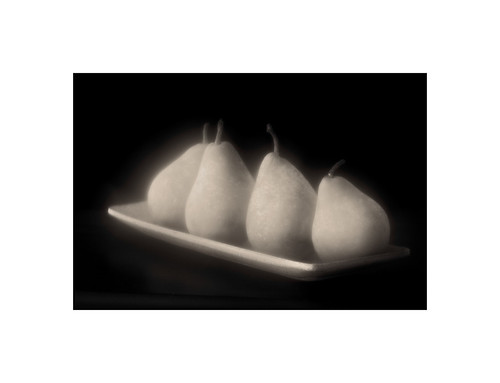
Scene One
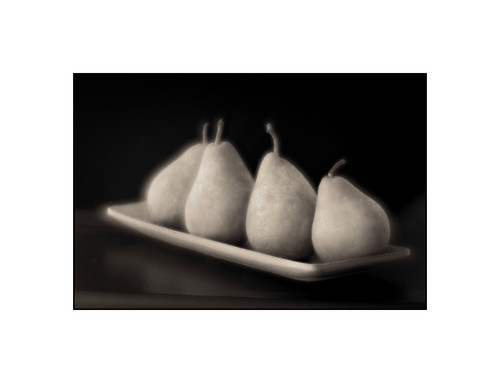
Light Pears against
a Black Background

Sony A6000 + Pentax 85mm f/2.2 Soft at f/2.2 + Sigma 1.4x + Contrast 40
 Sony A6000 + Pentax 85mm f/2.2 Soft at f/2.8 + Sigma 1.4x + Contrast 40
Sony A6000 + Pentax 85mm f/2.2 Soft at f/4 + Sigma 1.4x + Contrast 40
Sony A6000 + Pentax 85mm f/2.2 Soft at f/4.8 + Sigma 1.4x + Contrast 40

Sony A6000 + Pentax 85mm f/2.2 Soft at f/5.6 + Sigma 1.4x + Contrast 40

Scene two
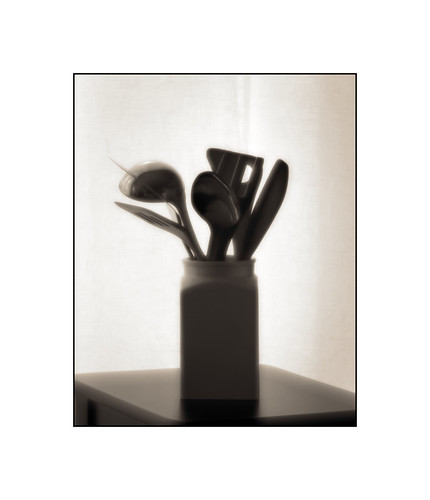
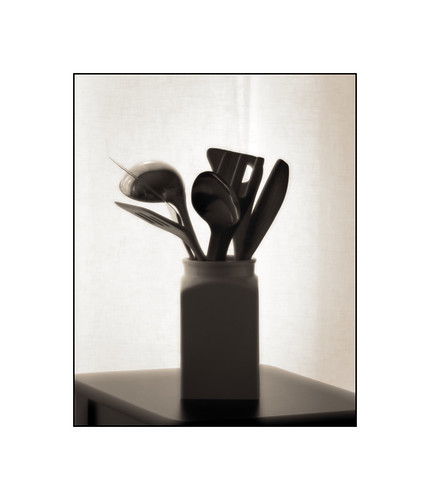
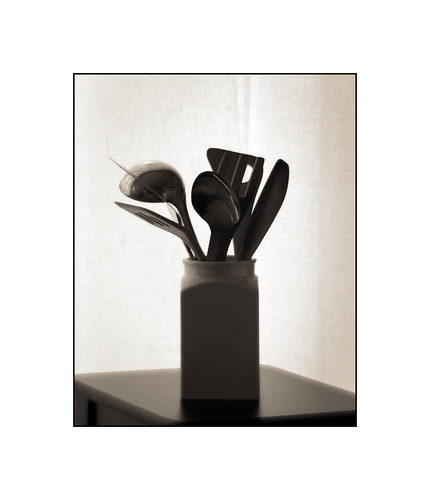
Light Kitchen Utensils backlit
against a Bright Background

What was important for me to verify is that the table front edge in both scenes remain "believable" toward the edges of the frame.  This it does.

After I'd run this series of images I realized I hadn't captured a landscape scene.  So I used the A6000's "magnifier" functions, put the focus point at the edge of the frame, and focused the Pentax/Sigma setup at infinity.  I was able to prove to myself that the edges of the frame remain optically correct and that the "resolution hole" has finally and completely been pierced.

To recap how I see best using a Pentax 85mm f/2.2 Soft and in believing the following also can apply to just about any meniscus-based soft focus lens of any focal length and any imaging format, here is what I found -

  • Control ~ subject matter distances
    • Close-up ~  
      • NOTE: put the subject dead center in the frame and crop accordingly in processing so as to avoid any "resolution hole" transition area effects as the aperture is stopped down
    • Portraiture ~  
      • NOTE: put the head of the subject dead center in the frame and crop accordingly in processing so as to avoid any "resolution hole" transition area effects as the aperture is stopped down
  • Control ~ aperture
    • Maximum under-corrected spherical aberration (veiling softness) is seen at f/2.2
    • Decreasing under-corrected spherical aberration in the center of the frame as the aperture is stopped down
    • Opening of a "resolution hole" in the center of the frame from f/4 thru f/5.6 - with attendant edge softness and harsh sharp/soft transition zone effects
  • Control ~ telextender/teleconverter
    • Enlarge the center of the field of view...
    • ... thus pushing the harsh sharp/soft transition zone to the edges of the frame
    • Useful for landscape work
    • Prediction has been proven to my satisfaction that a 2x telextender does indeed completely pierce the "resolution hole".  The behaviour is very similar to a designed for whole plate 11.5inch (292mm) Wollensak Verito f/4 shot on 4x5 inch film that completely avoids the "resolution hole" effect in that large format case.

  • Note: Nothing is being said about city scapes, street photography, large man-made objects, or technical applications were accuracy and clarity tend to be preferred.  I believe that people and nature may be the areas where soft focus lenses succeed most easily. YMWV.

I'm now satisfied that I'm able to control this previously nearly impossible to come to grips with Pentax 85mm f/2.2 Soft.  I'm happy to learn that controlling contrast can have a "improving" effect on soft focus images.  And I'm happy to have experienced a little more deeply the possibilities that lay in nose-greased/hairsprayed UV filters as image softeners.

My next project?  After a little "time out", I may try and buy a Pentax 85mm f/2.8 AF Soft to see how the extra lens elements modifies that soft focus lens' behavior.  Until then, have fun.  Go out and photograph.  Enjoy life.