Monday, February 02, 2015

Sony A6000 - a seven lens comparison

It seems that I'm still on a roll.

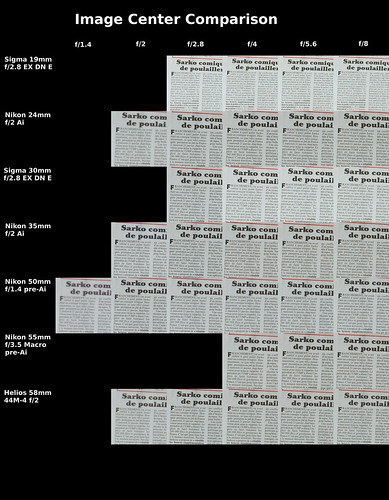
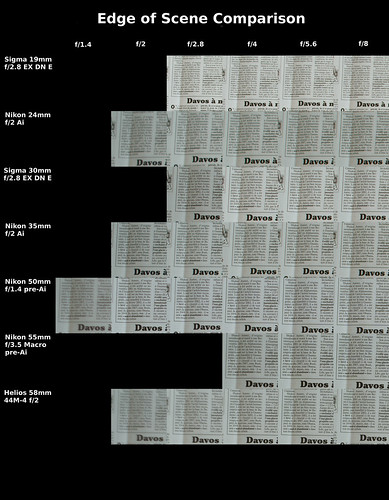
Since I already had the test setup in place, why not compare some more of my manual focus lenses against the modern Sigma EX DN E autofocus using the Sony A6000?  Why not look at the center of the scene as well as an extreme edge?  I'm retired and have nothing better to do, right?

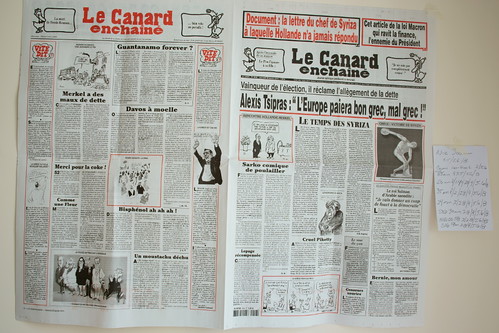
Scene setup ~ Sigma f/2.8 30mm at f/4

The comparison setup didn't change.
  • Sony A6000 camera, ISO100, "A" mode, "standard" image style settings, shot in RAW format
  • Big sturdy Manfrotto tripod
  • RAW images converted to jpg at 100percent quality using Sony's software - no image adjustments were made at the time of conversion
  • 600x600pixel segments were taken out of each file - no adjustments to the image were made during the cut/paste process
The following two comparison files are quite large.  So click on them and they'll take you to Flickr where you can download and view the full-rez images.

Sony6000-  Seven Lens scene center Comparison


Sony6000-  Big Lens scene edge Comparison


My comments on these comparisons should be obvious.  The new Sigma 19mm, 30mm, and 60mm (not shown here) f/2.8 EX DN E/Art lenses are incredible from wide open all the way across the field to the very edges of the frame.  These are "keepers".

I think I can see where the old Nikkors have a few challenges, even on the smaller than full frame APS-C sized sensors.  I'm not sure why the edges fall off as badly as they do when the lenses are shot wide open, but they're pretty obviously bad.  My conjecture is that either the lenses were designed for speed and resolution at the center (which is common for designs of that period), and/or there is a fair amount of field curvature that is throwing the edges of the frame out of focus in these 2D scene comparisons.

Sunday, February 01, 2015

Sony A6000 - Sony 16mm f/2.8 E, Sigma 19mm f/2.8 EX DN E comparison

I'm on a roll.

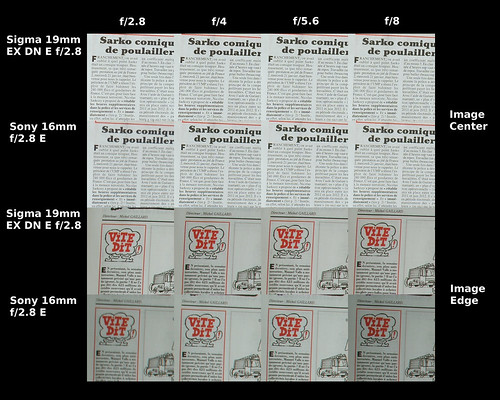
Since I had a comparison setup in place, I thought I'd take a look at the recently acquried Sigma 19mm f/2.8 EX DN E and see how it compared against a Sony 16mm f/2.8 E-mount lens.  The two lenses share a somewhat fast aperture, are nearly the same focal length, and sell for similar prices.  Could the performance be similar too?

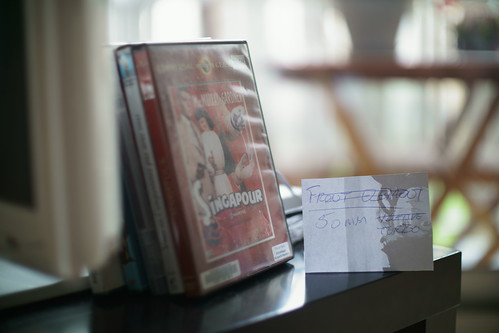
Scene setup ~ Sigma f/2.8 19mm ED DN E at f8

The comparison setup didn't change.
  • Sony A6000 camera, ISO100, "A" mode, "standard" image style settings, shot in RAW format
  • Big sturdy Manfrotto tripod
  • Sigma 19mm f/2.8 EX DN E shot at f/2.8, f/4, f/5.6, and f/8
  • Sony 16mm f/2.8 E-mount shot at f/2.8, f/4, f/5.6, and f/8
  • RAW images converted to jpg at 100percent quality using Sony's software - no image adjustments were made at the time of conversion
  • 600x600pixel segments were taken out of each file - no adjustments to the image were made during the cut/paste process 
The image is linked to my Flickr page.  View the image a full resolution to more clearly see the differences between the two lenses.

Sony A6000 - Sony 16mm - Sigma 19mm EX DN E comparision study

My observations include the obvious.  Either the 16mm Sony  is really awful or the Sigma 19mm is absolutely brilliant.  Differences between the two lenses should be clear.  To me, the Sigma is the superior optic from wide open and across the entire field.

Saturday, January 31, 2015

Sony A6000/Nikon 300mm f/4.5 H pre-Ai to Canon 100-400mm L f/4.5-5.6 comparison ~ le deuxieme part

When I took a look at the Sony A6000 - Nikon 300mm f/4.5 H pre-Ai and tried to compare it against the Canon 7D - 100-400mm f/4.5-5.6 L combination, I relied on the Canon's contrast detect AF system.  I also relied on the 7D's smaller sensor and stronger anti-aliasing filter.

I realized later that the comparison likely proved nothing.  If I was interested in seeing how the ancient (c.1972-ish) Nikkor really compared against the much more modern-flourite-element Canon100-400L, then I'd have to normalize my comparison conditions.  For this, I would use the Sony A6000 and the appropriate lens adapters.  I would also need to carefully manually focus both lenses, which would be my only option on the A6000 for the adapters and lenses I have.

Scene setup ~ Nikon 300mm f/4.5 H at f/8

With these things in mind, here is another look at the Nikon 300mm f/4.5 H pre-Ai and the Canon 100-400mm f/4.5-5.6 L.
  • Sony A6000 camera, ISO100, "A" mode, "standard" image style settings, shot in RAW format
  • Big sturdy Manfrotto tripod
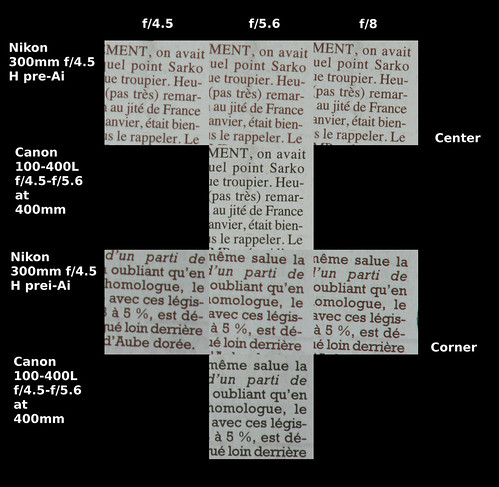
  • Nikon 300mm f/4.5 H shot at f/4.5, f/5.6, and f/8
  • Canon 100-400mm f/4.5-5.6L shot at f/5.6 and 400mm (to match the scene dimensions of the Nikkor)
  • RAW images converted to jpg at 100percent quality using Sony's software - no image adjustments were made at the time of conversion
  • 600x600pixel segments were taken out of each file - no adjustments to the image were made during the cut/paste process
This image will take you to the Flickr host site.  Look at "All Sizes" and select the largest file size to view at 100 percent.

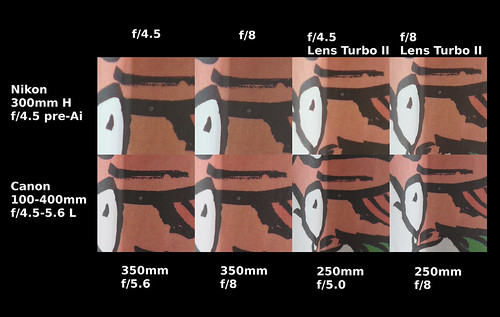
Sony A6000 - Nikon 300mm H f/4.5 vs Canon 100-400L

My observations remain similar to the ones I made in the previous post.

One thing that I've noticed about internal focusing lenses is that the image magnification is much less than the old rack-focus optics.  In this comparison the Canon needed to be set to 400mm to match the scene size of the Nikon 300mm focused to around 14feet.  I encountered a similar situation when I using a Canon 24-105L and Nikon 85mm on a near-distance subject.

The Nikon 300mm delivers a little less contrast to the sensor than the Canon 100-400L.  This can be easily accounted for during image processing.  As for resolution, it's very difficult for me to find any meaningful difference between the two lenses.  The Nikon might be slightly softer in the corners at f/4.5 (because of spherical aberrations?) than the Canon at f/5.6.  A light smart sharpening would bring the Nikkor image resolution right in line with the Canon's.

I find this interesting in light of the fact the Nikkor is 4 decades old and more than 1500USD cheaper than the Canon.

Sony A6000/Nikon 300mm f/4.5 H vs Canon 7D/100-400L

Sunday, January 25, 2015

Sony A6000/Nikon 300mm f/4.5 H pre-Ai to Canon 7D/100-400mm L f/4.5-5.6 comparison

The Madness has set firmly on the brain as the Camera Flu continues un-abated.

I was curious how a Nikon Nikkor 300mm f/4.5 H might compare against the much more recent and optically sophisticated Canon 100-400mm L f/4.5-5.6 super zoom.

Sony A6000/Nikon 300mm f/4.5 H vs Canon 7D/100-400L
 Comparison scene setup
[shot with Sony NEX5, Nikon 50mm f/1.4, Lens Turbo II]

Why the curiosity?  Well, because, on a whim I picked up one of the aforementioned Nikon 300mm non-ED lenses for 100Euro.  It's in tres bon etat and came with the proper caps for both ends and the original carrying case.  I'm a sucker and an easy mark for old manual focus lenses in excellent condition.

Checking the serial number of the lens I see that I was made during the early 1970's.  The H model optic preceded Nikon's introduction of their extra low dispersion glass example by at least 3 years.  Commenters across the 'net seem to rave about the 300mm ED, but not much enthusiasm is expended over the H.  Well, as I said, I'm a sucker for a good looking lens.

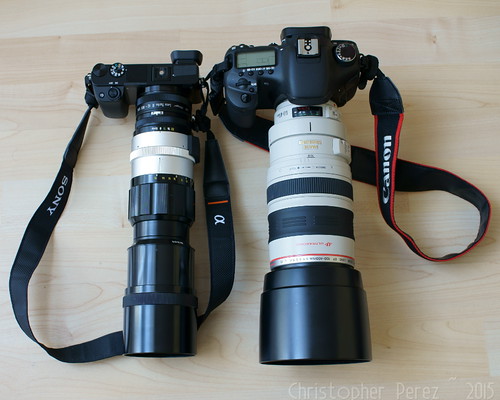
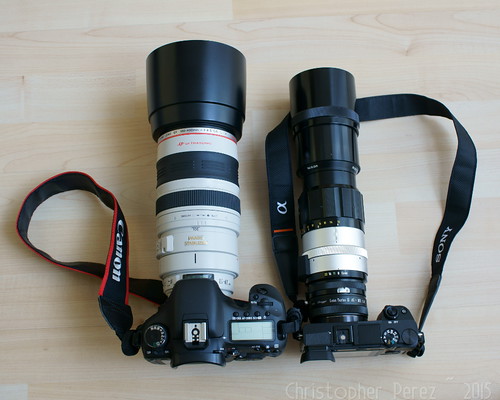
The old Nikkor is nearly as heavy as the Canon L, though this is nicely offset by the smaller diameter lens barrels.  I've found that a smaller lens size makes a lens easier for me to work with, even if the weight is similar to something with a large diameter barrel.

Being a fixed focal length lens, the Nikon is of course not as flexible the Canon zoom.   But, since the Sony A6000 is APS-C and since I have a Lens Turbo II focal length reducer and a standard straight-thru Nikon to E-mount adapter I have two focal lengths to choose from when using the Nikkor - 300mm f/4 and 216mm f/3.2.

Sony A6000/Nikon 300mm f/4.5 H vs Canon 7D/100-400L
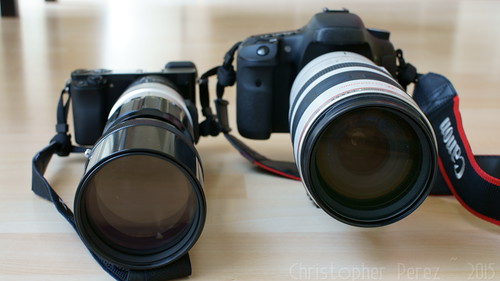
Size comparison
The Nikkor lens was set to it's closest focus point,
making the lens barrels extend to it's longest.
 [shot with Sony NEX5, Sigma 30mm EX DN E]

Assuming for a moment that Sony introduces an in-body IS APS-C camera that solves the no-IS problem in using old lenses, the biggest thing I in the Sony/Nikkor kit give up is AF.  I've come to love AF as it's most of the time more accurate than I am.  The question is how accurate can I be at focusing the Nikkor?  Would I be happy with the results?

The comparison setup was as follows -
  • A very stout tripod (a Manfrotto somethingorother)
  • Sony A6000 at 100ISO in "A" mode (aperture preferred)
  • Nikon Nikkor 300mm f/4.5 H c.1972-ish
  • Lens manually focused at 14x
  • Nikon shot in two ways - with a straight-thru adapter and with a Lens Turbo II focal length reducer
  • Canon 7D 18mpixel camera at 100ISO in "A" mode (aperture preferred)
  • Canon 100-400mm f/4.5-5.6 L super zoom set to a field of view that nearly matched those of the Nikkor/Sony setup
  • Canon contrast AF focusing in Live View
  • Both lenses shot wide open and at f/8 (to see if the IQ improved by stopping down)
  • 600x600pixel 100percent resolution image sections taken from the original scene (though I did not account for the file resolution differences between the 7D and A6000).
As we will see, Canon's AF wasn't as accurate as manual focusing at a high magnification.

The results are...

[The following image links to my Flickr page.  Look at this a full resolution to properly compare the various image sections.]

Sony A6000/Nikon 300mm H f/4.5 vs Canon 7D/100-400L

My observations include -

Nikon single-coated lens images are slightly lower contrast than the Canon zoom.  However, it was very easy to match the contrast of the Canon lens in processing.

Canon's Live View AF system was a rather hit-or-miss affair.  This is easily seen in the image comparisons.  To think I've trusted the Canon AF system in the over 5 years I've owned the 7D. Having said that, using a (mostly) accurate very high speed AF system tied to image stabilization and focal-length flexibility makes for a very powerful kit. 

If I can accurately focus my manual focus lenses the Sony A6000 offers 11fps burst rate whereas the 7D waltzes along at 8fps.  Am I good enough to track and accurately focus moving targets?  Time will tell.

The higher resolution Sony sensor (24mpixel vs Canon's 18mpixel) gives me a to be expected increase in the amount of information that can be used in the image file.  The Sony file details are gorgeous and easy to work with.  The sensor is the resolution limiting fact.  Lenses typically out-resolve a sensor from wide open down through f/11.

From wide open, the Nikon 300mm f/4.5 H pre-Ai single-coated ancient as the hills ray-trace designed and mathematically calculated by hand lens is every bit the resolution match of the computer designed fluorite element Canon super-zoom. 


Sony A6000/Nikon 300mm f/4.5 H vs Canon 7D/100-400L

Size comparison
The Nikkor lens was set to it's closest focus point,
making the lens barrels extend to it's longest.
 [shot with Sony NEX5, Sigma 30mm EX DN E]

Friday, January 23, 2015

Helios 44M-4 and Zhongyi Lens Turbo II comparisons

I recently caught a Camera Flu and acquired a couple new pieces of equipment.  To justify the acquisitions (guilty as charged) I wanted to see how things looked.

The first new piece of gear is a Helios 44M-4 that I traded a Takumar 50mm macro for.  I'd read where someone thought that altering the space between the first element and second lens group in a Gauss design lens could lead to more pronounced Petzval portrait lens-like effects.
[Read Jim Galli's comment here.]

The second new piece of gear is a new Zhongyi Lens Turbo II.  This takes full frame SLR lenses and acts as a reverse tele-converter.  It takes a full 35mm frame field and resizes it to fit APS-C or micro 4/3rd's, depending on the adapter.  Mine takes Nikon F-mount lenses and adapts them to the APS-C sensor'd Sony mirrorless series cameras.

This isn't really a test.  Nothing is being measured and any results are purely subjective.

Here is the image comparison setup.  It was made using a Sony A6000, Zhongyi Lens Turbo II, and a Nikon Nikkor 50mm f/1.4 pre-Ai shot wide open.

Sony A6000 Nikon Lens Turbo test setup

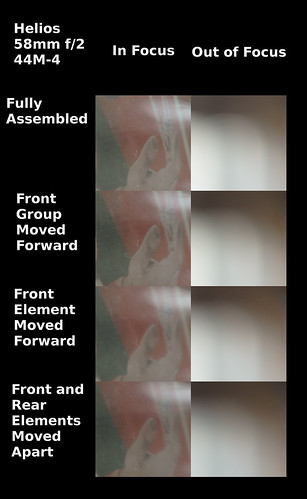
The first image comparison is of the Helios 58mm f/2 in various stages of lens element positions.  Starting with the lens properly and fully assembled, I then moved the entire front element group forward by unscrewing the group to the extent of the thread range (without the group falling out of the barrel body).  Next I moved the front element forward in the front group with the forward cell mount fully seated.  Finally, I tried moving both the front and rear elements in the front lens group apart and moved the cell mount to the front of the threaded range.

If you click on the image, it'll take you to my Flickr hosted image.  From there select full image size to look at this at 100% resolution.  Any differences between the various segments can be easily reviewed.

All comparison images were made with the Helios shot wide open at f/2. 


Sony A6000 Helios Disassembly Bokeh Test

My subjective observations are that there are indeed differences in how the image is rendered as the various elements are moved.  Interestingly, the out of focus rendition becomes smoother as the front element groups are separated and the front group mount is moved forward in their threads.  But, and this is to be expected, resolution suffers to varying degrees.

It appears a "dreamy" 1800's portrait lens effect is possible, though I'm not sure it's worth the effort.

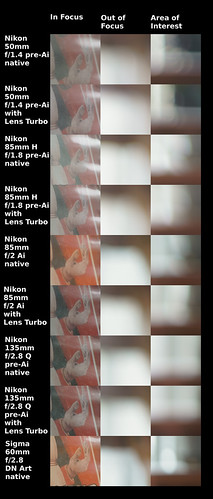
Which led me to a second set of image comparisons.  I'd read that the Zhongyi Lens Turbo II full frame to APS-C field reducer rendered the out of focus regions more softly than the native lens used with a straight-thru adapter.  Here's my look at the question.

If you click on the image, it'll take you to my Flickr hosted image.  From there select full image size to look at this at 100% resolution.  Any differences between the various segments can be easily reviewed.

All comparison lenses were shot wide open.  

Sony A6000 Nikon Sigma Lens Turbo Bokeh Test

I did my best to keep the primary scene composition similar between the various lenses and focal lengths.  The Lens Turbo II knocks 0.72x off the focal length and increases the aperture by the same amount.  More on this in a moment.

Considering resolution it appears the Lens Turbo adapter does not degrade image quality in the in focus areas for the lenses I used.  I once again see how difficult it is to get something in focus with wide aperture lenses.  This is partly due to the amount of spherical aberration I see in many old 35mm film-era lenses.  I'm not always certain where the best focus is.

The Sigma 60mm DN Art f/2.8 is obviously sharp.  It's a modern design.  Manually locating the focus point was easy and simple.  But it's maximum aperture is a stop or two under most of the lenses I tried.  How the old Nikkors would perform at f/2.8 against the Sigma has been left to a future comparison.

Looking at the out of focus regions I have to agree with whomever noted the smoother image areas when using the Lens Turbo II focal length reducer.  In every case I feel the out of focus rendition is "creamier" and "smoother" when compared with a native lens used without an adapter.  I rather like what it does to the 50mm and 85mm lenses.

So how does the Zhongyi Lens Turbo II work?  It's pretty simple, actually.  It optically reduces the image size from full frame 35mm to APS-C or micro 4/3rd's dimension.  Interestingly it seems to do this at no cost to resolution.

The Lens Turbo also _increases_ the effective aperture by approximately one stop.  In the case of the Nikon 50mm f/1.4, when used with the adapter it becomes a 35mm f/1.0 lens.

How is this possible?  Remembering optical physics, a lens' focal length divided by the front element diameter will give you the aperture.  When you take a 50mm lens and reduce it's field of view to, say, 35mm _without_ changing the front element diameter, you effectively increase the aperture.  In the case of the Lens Turbo II the aperture is increased by 0.72.

If you don't follow me, tell me and I'll have another "go" at explaining what's going on here.

What's important to note is that a 50mm f/1.4 lens on a full frame 35mm system as a 35mm f/1.0 does on APS-C and there is no change in the effective depth of field.

Again, if you don't follow me on this, let me know and I'll try to explain things a little better.

So... where does this leave me?

I see it's possible to carry a two lens, two adapter kit and cover four focal lengths.  For instance, I could carry a 24mm f/2 and a 50mm f/1.4 Nikkor.  Used on the APS-C Sony A6000 I would have the effective full frame focal lengths of 24mm f/1.4 (focal length reduced 24mm f/2), 35mm f/2 (effective focal length of a 24mm lens on APS-C), 50mm f/1.0 (focal length reduced 50mm f/1.4), and 85mm f/1.4 (effective focal length of a 50mm lens on APS-C) at my disposal.

The combinations and capabilities are now seemingly endless.


Wednesday, December 31, 2014

Photo-Opportunities ~ early 2015

If you're in or around Paris in early 2015 and are looking for things to photograph, here's a rather short list of potentially fun things to do.

4-8 February ~ Retromobile where old cars, parts, manuals can be found and that fabulous Baillon Garage Find will go up for auction
15 February ~ 18ème cortège du Carnaval de Paris de la place Gambetta à la place de la République en passant par l'avenue Gambetta, les boulevards de Ménilmontant et Belleville et la rue du Faubourg-du-Temple (text borrowed from Basil's email)

15 March ~  7ème cortège du Carnaval des Femmes, Fête des Reines des Blanchisseuses de la Mi-Carême - les femmes sont invitées à se costumer en Reines et les hommes en femmes, s'ils osent! (text borrowed from Basil's email)

23-24 May ~ Geekopolis at la Porte de Versailles

~ Completed ~ 

Charlie Hebdo murders ~ my images from the memorials can be found here -
https://www.flickr.com/photos/christophersoddsandsods/sets/72157650193734352/

11 January ~ La Traversee de Paris with 600+ ancient vehicles storming the streets - my images can be found here -
https://www.flickr.com/photos/christophersoddsandsods/sets/72157649823674257/


Passy ~ Paris ~ France

Monday, December 15, 2014

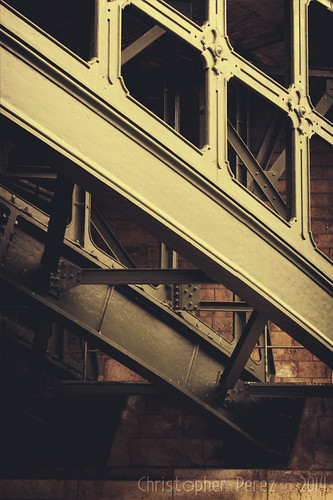
Spanning Iron Spaces ~ Image Portfolio ~ Electronic Distribution

This is to announce that I am releasing Spanning Iron Spaces.

The city my wife and I live in is filled with wonderful old iron structures.  I wanted to celebrate a very simple means of support found around the city.  I use the word support in both it's literal and figurative sense.  I wanted to look at how man has artistically used the base metal.  I wanted to create a series of images of iron, rivets, and the space around them.  I wanted to capture what some might see as the ordinary and reveal it's underlying beauty.

Spanning Iron Spaces, as with the previously released Hauntings of Gothic Ghosts, is offered in short form for free.  The full electronic PDF distribution is offered at 10USD.

Note: The difference in price between this release and the earlier portfolio reflects the fact the new work is yet to be published.  Should a publisher share portions of this work in a journal or book I will adjust the price upward to 25USD.


Scenes from a Walk

Friday, December 12, 2014

Re-learning old tricks...

Since moving to digital for all my serious work I've shot with heavy DSLRs and big zoom lenses.

This has recently changed.  Completely.

Passy ~ Paris ~ France

A Sony A6000 has climbed into my camera bag.  It's taken it's place alongside three Sigma fixed focal length DN lenses.  Everyone looks to be here for a long stay.

Many years ago I used a Leica and three lenses.  This was back when dinosaurs roamed the earth and my cameras were loaded with Kodak Tri-X or Ilford FP4 or Ilford HP5 and fixed focal length optics were the only reliably sharp option.  Hollywood was where I lived at the time and New Wave and Punk were the music styles in vogue around the LA basin.  My Fiat 124 Sport Coupe was a blast to drive Hwy 1 and 101.

Passy ~ Paris ~ France

My three lens photography kit consisted of a 35mm, 50mm, and 85 or 90mm lens.  The Leica wasn't the only kit I built like that.  I also owned Canon F1(original) and Nikon FM systems.  Each built on the basic three lens kit.  With the SLRs I added a 200mm or 300mm lens for wildlife and motorsports work.  This was the way I learned to "see".

When I moved into large and very large format film I built the kits, once again, on the three lens step of equivalent focal lengths to my old 35mm gear.  90/150/210mm in 4x5inch and 210/300/450mm in 8x10inch film.  Continuing to work this way was an extension of how I had learned to "see."

With the move to digital I learned to love the "flexibility" of high quality zoom lenses.  My kit contained zooms from ultra-wide all the way up to ultra-long.  The lenses that got the most use were the 24-105mm and 100-400mm.  The ultra-wide and medium-long zooms sat largely unused.

Passy ~ Paris ~ France

What I noticed is that my "seeing" became, for the lack of a better word, "lazy."  All I had to do was twist the zoom ring and re-frame the scene.  It was all very simple.  Though now that I look at things it seems like a lot of my work had taken on a "bland" appearance.  Not only had my "seeing" become "lazy", the "look" of my images were bordering on looking "lazy" too.

Moving into mirrorless for all my serious work has been like "backing the horse into the barn."  I've taken small steps.  Four years ago I bought two mirrorless cameras that I used for around-town and travel photography.  A month ago I bought a couple Sigma DN Art lenses and tried them out on my aging around-town/travel NEX5.  I liked how crisp and clear the images were on the small sensor.  A week later I bought a camera with more pixels than the Old Beast.

Wandering around the city and working in the studio has shown me what is possible.  Image quality is very important to me.  I did not want to take a step down in quality by moving to a smaller system.  As a measure of how happy I am with the results I now have all three Sigma DN Art lenses.

Passy ~ Paris ~ France

Which leaves me to wonder about the need for a high quality zoom.  The mirrorless kit lens is OK on smaller sensor cameras, but has obvious short-comings when mounted on the big-mpixel camera.  Zeiss offers a nice zoom, but would I use it?

A recent visit to Passy leaves me wondering if I really _need_ to spend Zeiss kinds of $$$'s.  I'm amazed at how quickly I've slipped back into the three lens kit way of "seeing."  In fact, I remember how to frame an image and select the correct focal length lens without thinking about things.  It's a natural movement.  Just like when I lived and photographed around Southern California.

Can Old Dawgs really ever _un-learn_ Old Tricks?  In my case it seems not.
 
Passy ~ Paris ~ France

Monday, November 24, 2014

Working with creative people...

My wife and I have worked with many people over the years.  She assists during a shoot and helps catch things I don't see.

One of the things she's noticed is how tired I am after three hours of shooting.  My arms, neck, back, and legs would ache for a couple days afterward.  It's been this way ever since we moved to France.  I've felt the big Old Beast (Canon 5D MkII/24-105L kit) weight was the source of my recent challenges.

I was interested to see if I could downsize my kit while improving the image quality at the same time.

Enter the new Sony A6000

French Steampunk


Last weekend Judith and I were visited by l'equipe de French Steampunk. Anne Delauney-Ladevèze, Alexandre Ls, Matthieu Van Weise came to our atelier to spend two and a half hours in front of the camera.  I love working with creative people like this.  Time flies and magic happens.  This is what I came to Paris to do.  Well, this and enjoy retirement, right?  :-)

Considering the camera-work, I've used the Canon zoom so much that I wasn't sure I could go back to a fixed focal length objective as my prime studio lens.  Would I miss the "flexibility" of the zoom?  Would I feel hindered by a fixed focal length?

I should've known and quickly realized that the A6000 Sony mated with a Sigma 30mm f/2.8 EX DN E is all this person really needs in the studio.  "Sneaker Zoom" (ie: physically moving to/away from the subject) is not nearly as bad as I feared.  I actually like it.  The zoom on the Old Beast gave my prior images an inconsistent "look".  The effect is very subtle, but I can begin to see this as I work with the new setup.

In the darkened room the AF would "hunt" a little.  But, and this is the important part to me, it hunted no more than my Old Beast did under similar conditions.  In fact, there were many times when the Old Beast would completely fail to lock AF.  With the Sony/Sigma kit it's only a short matter of time before the AF settles.

French Steampunk

 It's in fact better than this.  With the Sony's "face detect" capabilities I'm able to let the camera do what it was designed to do and come away with razor sharp eye-lashes 99 percent of the time.Selecting a focus point near the region where I wanted it to be seemed to enhance "face detects" ability to lock AF.  This is a Good Very Thing(tm). 

My last concern was with the electronic view finder (EVF).  On a Fuji I tried, when I panned the EVF had trouble keeping up with the motion and it scrambled my brain.  But... with the Sony I find lag time to not be a problem and my mind remained un-scrambled for the duration of the shoot.

I've already noted that at the pixel-peeping level that the Sony A6000 24mpixel APS-C sensor out-performs the six year old full-frame sensor in the Old Beast. What I haven't mentioned is that the A6000's increased dynamic range gives cleaner, less noisy shadow rendition than the Old Beast's output.  The increased dynamic range of the APS-C sized sensor gives me more information to work with (very slight, but noticable) and, therefore, more flexibility in image processing.  I know.  This is all counter-intuitive.  Can the APS-C really out-perform a Full Frame sensor?  In this case the answer is yes.

French Steampunk

 To sum up my experience with the new camera kit I find I LOVE the light weight and wonderfully small size.  The new setup fits my hands nicely.  And... I actually don't mind the EVF.  It's actually quite nice.  Further, the image quality is better than my old kit (see prior posts).  As a bonus, my arms and back don't ache the next day.  Life is good.

Using a fixed focal length lens has become my new approach.  I like it for it's simplicity and "direct-ness."  It feels like the Old Days when I wandered Los Angeles with a Leica M3 and (what I wished I still owned) a Summarit 50mm f/1.5.  I "see" differently and feel more engaged.

To sum up my experience with creative people here in France, I have to say that I spoke far too soon about Paris being conservative.  No, Paris is not as conservative as I first thought.  I just didn't know where to look.  I'm in Seventh Heaven, now that I'm discovering talented creative types who are willing to work with me through the kind help of a few good friends.

Merci, France.  Je vous aime beaucoup.  Let the creativity flow!

Wednesday, November 19, 2014

Tools of the Trade ~ Print Sizes ~ le deuxieme part

Someone asked how it was possible that I could make a 14.2mpixel Sony NEX5 image look as good as something coming from a Canon 5D MkII or MkIII.

Earlier I wrote about a way of making large prints from small-ish files, but I didn't really give a clear calculation for various sensor sizes and how file dimensions relate to maximum resolution maximum print size. I think it's time to further consider the question.

Here's the basic formula -

[print size in the long dimension] = [file size ~ choose the long dimension for consistency] / [print dpi you feel you can tolerate]

Using a Sony NEX5 14.2 megapixel as an example, here's how this works in the real world -


15 inches = 4592 image nodes in the long dimension / 300 dpi

If you head over the DPReview, they give the file dimensions of various cameras reviewed.  That's where the 4592 image nodes information comes from (or you can simply read the file dimensions if you already have the camera).

300 dpi comes from current common print practices.  Most labs and publications I've dealt with all specify 300 dpi.  This makes sense as young human eyes can resolve 5 line pair per mm.  So 300 dpi gives a printed image more resolution than most of us can with the naked eye.  This is imporant in my discussion here, and I will revisit this number shortly.

Using this approach let's look at several different cameras with a number of different sensor and file sizes to see how big a print we can make while giving more resolution than the naked human eye can see -
  • 15 inches = [4592 image nodes in the long dimension / 300 dpi] - Sony NEX5 14.2mpixel
  • 18 inches = [5616image nodes / 300dpi] - Canon 5D MkII 21 megapixel
  • 24 inches = [7360image nodes / 300dpi] - Nikon D800 36 megapixel
  • 34 inches =  [10380image nodes /300 dpi] - Phase One IQ180 80 megapixel medium format sensor 
If we consider 254 dpi as giving us EXACTLY the maximum resolution that the naked eye can perceive, then the formula tells us we can make an even larger print from a native file.  Here is what we can achieve -
  • 18 inches = [4592 image nodes in the long dimension / 254 dpi] - Sony NEX5 14.2mpixel
  • 22 inches = [5616image nodes / 254 dpi] - Canon 5D MkII 21 megapixel
  • 29 inches = [7360image nodes / 254 dpi] - Nikon D800 36 megapixel
  • 41 inches =  [10380image nodes / 254 dpi] - Phase One IQ180 80 megapixel medium format sensor
Very quickly one can see where a 14.2mpixel file printed at 254dpi can have the same print size at full human resolution as a Canon 5D MkII printed at 300dpi.

There's more to it than just this that I find rather interesting.  It's something I should've thought about more closely.

To double native image dimensions requires a four fold increase in sensor size.

We realize that to double the native print size at full naked human eye resolution can be costly.  To go from 15inches to 30inches would require going from a 14.2 megapixel Sony NEX5 file to printing an 80 megapixel Mamiya Phase One IQ180 file.  It requires going from a $500 camera to a $50,000 camera to double native file maximum print size.  So, if cost is an issue, couldn't you just stitch four images from the little $500 camera and "call it done?"

Looking at this from still yet another perspective, we can take the little 14.2 megapixel file, uprez it using a smart sharpening technique to Canon 5D MkII file dimensions, and print the little camera's image at 300dpi.  Taking this approach is not a stretch for the software technologies involved.  The up-rez step is not that large at all.

That is exactly why it's so easy to get 5D MkII print quality out of a small file, as you can see in the attached image.

Image Clarity Tests ~ Sony NEX5 vs Canon 5D MkII


Much of this up-rez technology is already built into software like the Gimp, Photoshop, and Lightroom.  Adobe goes as far as to say they've carefully chosen the algorithms they use so as to keep as much resolution as possible on the up-rez.

Why, then, would I go to all this trouble to explore a topic that's already handled by some software?  Curiosity.  I like to understand what's going on.  It's takes the magic and wishful thinking out of my processes and brings me to a place where I might be able to carefully tune my output to get the last ounce of information possible from a file.

Monday, November 17, 2014

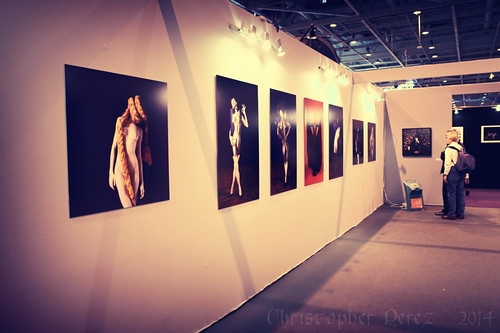
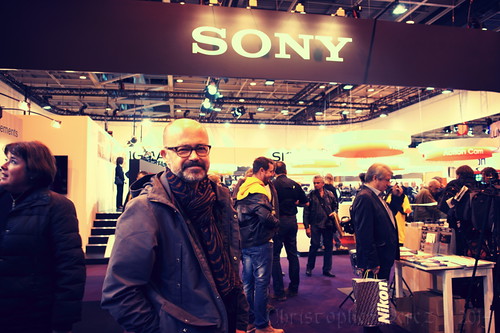
le Salon de la Photo ~ Paris ~ 2014

There are no doubt numerous "show reports" floating around out there regarding this year's Salon de la Photo.  What could I possible add?  Perhaps not much, but here it goes in any event.

Scenes from le Salon de la Photo ~ 2014


Arriving at opening time is a prime recipe for getting squashed in a righteous French-style queue.  You see, it's Madness and Bedlam as people wade or crowd-surf their way to one or two Gate Keepers.  The Gate Keepers are the ones with the scanners.

Ah... I see I need to explain something, so let me back up a bit.

Last year someone laughed at me when I asked where one buys a ticket to le Salon.  The way the game is played here is that you get an "invitation" to the event.  Unlike fashion runway shows, receiving an "invitation" is as easy as reading Paris Match.

Scenes from le Salon de la Photo ~ 2014

There's a "code" that specifies who's doing the "inviting".  These "codes" are widely available and it seems like any and all dogs, cats, critters, and companies issue them.  Chose a "code", any "code".  They're free.  As in No Charge.  Gratuit.  Zip.  Zero.

Enter a "code" into the Salon website in the right place and what you get is a PDF you can print.  The PDF has, among other things, a bar-code and this is your ticket into the show.

Easy.  Right?  When it comes to free, you don't know the lengths Parisians will go to make sure there is Egalitie, Libertie, and, well, forget the Fraternitie, OK?  You realize the pecking order of what's important once you're queued.  Any Fraternity comes from how closely packed you are, not from the level of conviviality you might imagine the word should have meant.

Close your eyes and try to envision hundreds of Old Farts of all sizes, shapes, and heights doing their level best to elbow their way to the front of the queue where two and only two men with bar-code scanners await to grant you entry.  Or not.

We'd chosen the wrong side of the scrum.  I mean, queue.  No.  I think scrum adequately describes the experience.  Two elderly gents had reached the front of the scrum and... their bar-codes were not scanning properly... they were arguing with the Bar Code Handlers... and the scrum was becoming as anxious as a herd of Zebras who smelled Lions in the brush...

Scenes from le Salon de la Photo ~ 2014

Our neighbor, Jude, and I skirted the scrum to the other side... et... voila!  After a 25minute surge forward we were having our "invitations" scanned and, as it was a tight squeeze past the Old Geezers Who Must Argue with a Bar Code Handler, it felt like we might be Watermelon seeds being squirted out into the rusting dented parts missing automobile strewn yard while... um... nevermind that.  It was a funny feeling to go from the scrum into the peaceful, calm area inside the barrier to the show floor.

Collecting ourselves (mentally) we found our directions and headed off to see a few nice photographs.  The camera gear portion of le Salon could wait until my wife and neighbor left the show 45 minutes later.

I find it fascinating that HUGE scrums of Fraternitie Loving French People are seen huddled around the camera equipment displays, fondling the latest, greatest, sometimes hugely expensive tools of image making... and you can almost hear the crickets chirping in the areas where the results of putting Image Making Tools to use are displayed.

Why is it that so many people love the tools and so few try to appreciate the art?

Scenes from le Salon de la Photo ~ 2014

Considering the art, one thing that impressed me and at the same time confirmed what I'd proven thru testing was a display of 20x30inch(approx) images made using 16mpixel micro-4/3rd's Image Making Tools.  They were lovely to look at.  They were well composed, well exposed, well printed, and looked every bit as good as photographs printed to the same size taken using 50mpixel medium format sensors.  Yes.  It might be difficult to believe.  To me the Truth was in the seeing.  I was blown away.  Which tool is less important than the results of your artistic process.

Kissing my lovely wife goodbye and telling her "I'll be home later" left me to my own (evil?) devices.  Ah, Libertie!

I wanted to experience the Egalitie of Sharp French Elbows by fondling a few Image Making Tools myself.  To get there I needed to Egalitie my Sharp American Elbows to a camera manufacturer's display of choice.  It had to begin with Sony.

Being on a Mission from the Muse of Photographic Arts meant I was looking to downsize my camera kit.  The older I get the bigger and heavier the Old Beast has become.  Unless it's gained weight eating all that light (which it hadn't) the issue rests with me.  I'm getting old.

I tried my version of Egalitie out on the poor French peoples, elbows and all, and found myself quickly at a Display Counter Filled with Dreams.

Scenes from le Salon de la Photo ~ 2014
Your Humble Servant
on a Mission from the Muse of Photographic Arts 

After a short disappointing look at a Dream A7R (size and weight challenges for me) a strange and eerie light beckoned. It was like First Love.  Or Last Love at First Light.  Um, maybe it was First Love at First Sight.  Whatever.  I could tell there were important differences between what I was holding and what I was looking at.

On the other side of the Sony counter sat a pair of A6000 mirrorless APS-C sized sensor mini-wonders.  I had to try them out and Egalitie'd my way around the Display Counter Filled with Dreams.

Cutting to the Chase, I bought a boitier nu from a Paris local store shortly after realizing my dreams had come true.

If interested, you can read my prior post on testing an A6000 against the Old Beast.

Scenes from le Salon de la Photo ~ 2014

The rest of the show was a haze of images, sounds, further Egalitie-Elbows and More Scrum.  Trade shows can be loud crazy affairs and the Salon to me borders on chaos.  If I hadn't been on a Mission from the Muse of Photographic Arts I'd like to think I would avoid the place.  But that's not true.

I find I love the Fraternitie scrum, Sharp French Elbow'd Egalitie, and trans-national-corporate-sponsored Libertie as only the French can deliver it.  Besides, le Salon is a free "code", a short walk, an elderly scrum, and a scanned bar-code away.

Saturday, November 15, 2014

Pixel Peeping and the Real World... le quatrieme part

To recap:  What's a guy to do when faced with a 100Euro instant rebate from Sony and offered a 4 year guarantee for free by the camera shop?  Kick the Canon 5D MkII to the curb?  Maybe.


After bringing my new pride and joy home from le Salon de la Photo I ran a very very quick test to see how the Sony A6000 performed.  Compared with the Canon 5D MkII (henceforth known as The Old Beast) it looked like I could match the 6 year old camera's image performance... but... I wasn't entirely convinced.

I stayed up half the night thinking about this.  Was the AF as accurate as I thought?  Did I use the correct settings on both cameras to produce a valid result?  Did I make a mistake in buying the Sony?  Afterall, DPReview showed images from the A6000 that I thought were clearly superior to a 5D MkIII's output (a generation Canon newer than the one I owned).  I wanted to see the difference "clearly" demonstrated.

So... after defrosting the freezer and cleaning the kitchen floor this morning I hauled out a test setup to see if I could find a different answer to the one I'd worried over the night before.

The heavy tripod mounted, 2second trigger delay test setup -
  • Canon 5D MkII/24-105L at ISO100, f/8, image style set to "Standard"
  • Canon output converted from RAW at two settings:  1) Zero in Canon's DPP software sharpening.  2) DPP sharpening slider set to 3, with no other manipulations out of the camera.
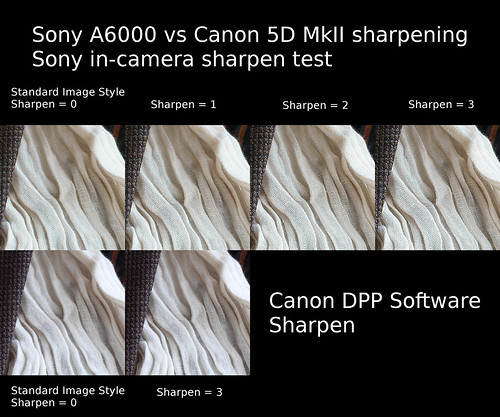
  • Sony A6000/Sigma 30mm, ISO100, f/5.6, image style set to "Standard"
  • Using Sony's in-camera sharpening at four settings: sharpening set to Zero, One, Two, and Three and converted without further manipulation using Sony's Image Converter software.
Here's the answer -

Image "sharpness" test - Sony A6000 vs Canon 5D MkII

Looking at this closely (ie: at 100%) you can see that Sony's "standard" image style default image sharpening set to Zero seems to match, if not slightly exceed, Canon's DPP processed image with sharpening set to 3.  Canon's 0 DPP sharpening is clearly softer than Sony's identical setting.

Further, Sony's in-camera image sharpening settings greater than 0 show increasingly "crisp", some might say "over sharpened" images up thru sharpening set to 3.

These findings are very important to me.  My default has been to use the 5D MkII "standard" image style with sharpening set to 3 and to use DPP to perform the conversion after initial processing.  I've used this approach for 6 years and love the large print resolution I've seen from The Old Beast.  I can enlarge images to 30x40inches and still see very pleasingly sharp images.  This was my baseline against which all other things were to be measured.

With the Sony A6000 it looks like I can use it's "standard" image style with image sharpening set to 0 and still easily exceed The Old Beast's resolution.  With a very light touch in Sony's Image Conversion software I can further enhance the appearance of sharpness/resolution without "over doing" the whole effect of resolution.

In short, I can clearly demonstrate that the Sony A6000 image quality exceeds The Old Beast's.

Onward to using the new, small, light tool for serious image creation.

Friday, November 14, 2014

Pixel Peeping and the Real World... le troisieme part

After the prior two posts a reader could probably have guessed it would come to this.

Size and mass differences?  What do you think?


How is the image quality?  Relying completely on the AF systems of each camera and making no allowances for best aperture or anything else that folks might feel is rather important, and not having taken any steps to "dial in" the image sharpening algorithms, have a look and let me know what you think.


Look at these at 100percent and tell me which is which.

Visiting le Salon de la Photo today I was met with a pleasant surprise.  In celebration (or promotion) of the show, the A6000 boitier nu was 100Euros off (not the anticipated 50Euros price drop) and came with a 4 year guarantee.  It's hard not to bite with those kinds of incentives.

Before I bit, however, I went over to Canon's stand to look closely at the SL1/100D micro-DSLR.  I had my NEX5/30mm Sig with me.  It struck me how the front to back length of the Sony setup matched the front of the SL1/100D viewfinder to back.  The Canon had no lens on it either.  I put the Dinosaur down and walked over to the in-show camera shops to find the one who had a boitier nu.

Next up: A serious test in the studio to make sure the A6000 performs as well as the Old Beast 5D MkII.

Friday, November 07, 2014

Pixel Peeping and the Real World... le deuxieme part

Third, ... well... I'll save this for another post... so stay tuned...

Or so I said in the prior blog entry.  Welcome, therefore, to the third thing that I've proven to myself after "testing" an old Sony NEX5 with a couple lenses against my Tried and True and Very Serious Pro-level Canon 5D MkII with a couple more lenses.

The first two things I proved to myself is that a small 14.4 mpixel sensor can still produce an amazing image and that image can be made with a little careful up-rezing/sharpening work to match the native image quality of a Canon 5D MkII (the Old Beast).

What, therefore, is the third thing I proved to myself?  Easy.  DSLRs are needlessly fat and bloated and heavy as boat anchors.  I say this in light of the Sony's image quality and overall performance when compared with my Old Beast.  I'm far from the first to realize this.  Yet...

It's Friday and nearly a week after I spent a Sunday afternoon photographing creative people at a local fair.  I'm still sore in a few places from working the Old Beast.  Hence the search for New Meaning and New Gear.

Here is what the Old Beast looks in my hand.  These images are of the Old Beast and the small, light weight Nikon 50mm f/1.4 pre-Ai.  The 24-105L lens I used last Sunday is much bigger and heavier then the beautiful Nikkor.

Keep in mind, I worked the Old Beast in one hand while holding the flash in my other.  Weight and size matter after a long day.  Yes, I'm getting old.  Yes, if I were younger none of this might matter.  I'm not young, so these things do matter.  Look at the size of my hand and compare it to the size of the camera/lens combo.


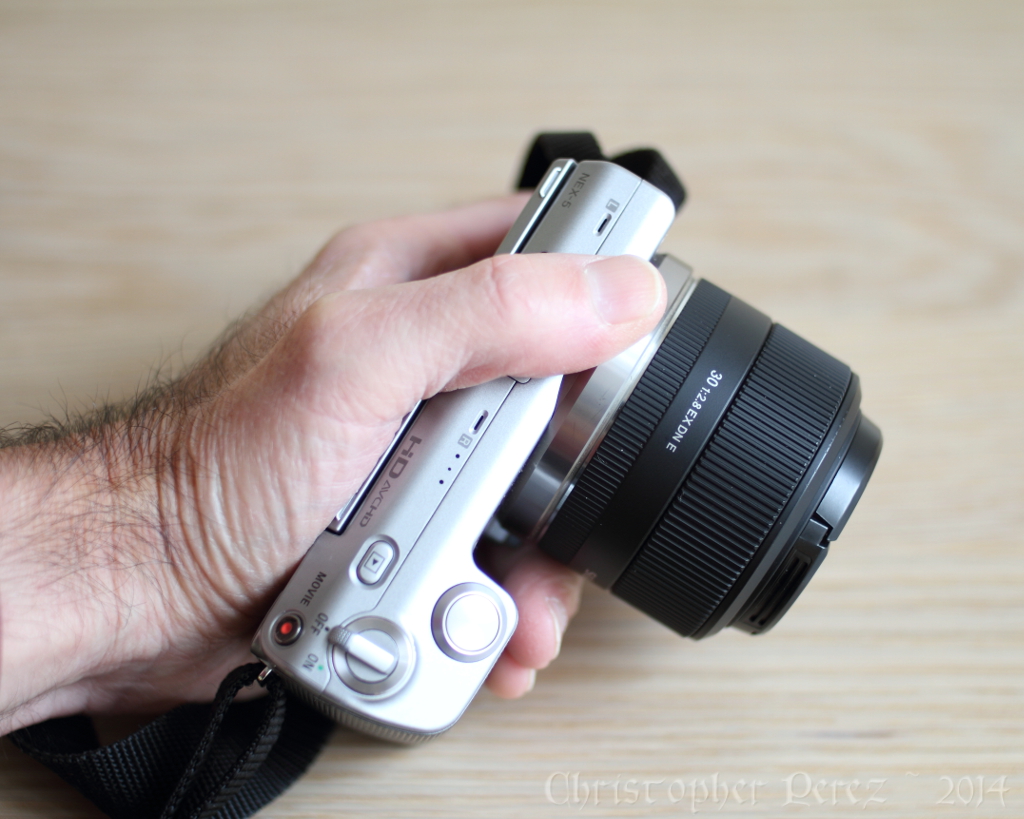
Here is what a Sony NEX5 with a Sigma 30mm f/2.8 EX DN looks in my hand.  I used the 50mm Nikkor f/1.4 pre-Ai and Sigma 30mm EX DN to illustrate relative sizes in equivalent effective focal lengths.


You no doubt have seen plenty of the following kinds of images.  For me, size comparisons really don't show, nor can they properly explain the differences in the feelings of mass.  Rest assured, it's in the area of mass that my hands find the Sony NEX much easier to hold and control all day long than the Old Beast.  It comes down to asking if a mirrorless can deliver DSLR image quality.


Viewed straight on you can clearly see the difference in sizes.


Viewed from the top, you can see how narrow the Sony NEX is.  The distance from the front to the back of the NEX is just a little longer than the distance from the front of the penta-prism to the back of the Old Beast.  Such is the size, weight, and mass of adding a mirror-box and trying to make a "pro"-level piece of gear.  You could kill Baby Seals with the 5D, it's that rugged and massive.  Add the 24-105L zoom to the 5D and things get nearly uncontrollable for This Old Man.


Remember that I showed the small Sony's image quality could be made to match the Old Beast's?
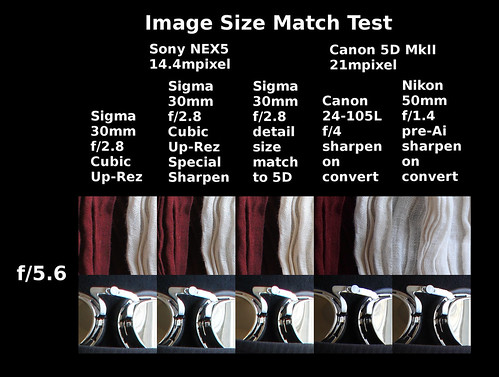
Image Clarity Tests ~ Sony NEX5 vs Canon 5D MkII


Given all these things, what might I be concerned about when considering downsizing?
  • Canon offers no small, light products with the flexibility and performance of Sony, Panasonic, Olympus, Fuji mirrorless systems
  • Canon offers a rich, deep lens selection where Sony continues to struggle and everyone else wants to charge a fortune (Panasonic.  Olympus.  Fuji.).
  • Sony is an electronics company, so how "invested" are they in selling imaging systems into an already saturated market?
  • Canon's reputation for longevity - 150,000 shutter life for the Old Beast, where Sony has not published shutter reliability figures for any of their equipment
Addressing each of these areas one at a time is leading me to the point of making a long term photographic tools decision.

Canon seems stuck in thinking they're still selling into legacy photography gear markets.  Their DSLRS are huge and bloated compared with most mirrorless systems.  Canon's EOS-M doesn't deliver the kind of performance I require.  My image-making requires something different than Canon's mirrorless can deliver. 

I can understand the momentum behind legacy systems and the design thinking that generates all this, but it presents a problem when faced with serious market disruptions.  In this case pro-level mirrorless systems are filling the niche where serious photographers want to play.  That is, smaller, lighter, and in increasingly numerous cases more powerful than DSLR and very much World Class image quality coming off World Class sensors.

How do legacy equipment suppliers (Canon, Nikon) leverage old, heavy, bloated products in an increasingly networked world where knowing how to make cameras function like a "pro" is no longer a requirement to creating amazing images?

Canon's lens selection is quite impressive.  Yet when I look at the lenses I actually use, I see other companies offer similar products.  The sole exception being long-teles for birding, airshow, and race photography.  I may, in the end, hold onto an 8FPS, ultra fast AF Canon 7D and two long-teles until mirrorless systems catch up.

Looking at Sony as a company one quickly realizes how small their imaging group is compared to it's gaming and cell phone organizations.  Though imaging is making money for Sony, it'll never, ever make as much money as the other two groups and they seem to be in financial trouble.  When markets appear to Sony to be unprofitable they seem to leave in a Big Hurry.  What if this happened to their camera division?  Well, it's not like the gear on hand would instantly dry up and blow away, right?  Transitioning to another system could happen as the existing gear started to fail.

So why not go with Olympus or Panasonic or Fuji?  Fuji is too big and expensive.  Olympus has too small a sensor and, well, was purchased by Sony.  Panasonic has too small a sensor (shared with Olympus).

Which leads me to asking what Canon provides that mirrorless systems do not.
  • AF performance?  Sony's A6000 AF system is pretty damned fast.  
  • HDR?  Canon only recently added in-camera image creation to their DSLRs where Sony has had this for years.  
  • Leading edge sensors?  Sony bests Canon in pixel density and whatever measurement the folks at DXOMark throw at them.  
  • System reliability?  I don't know.  One of my two Sony NEX5 has recently died.  Ugh.
  • Shutter reliability?  I don't know.  Sony does not published shutter reliability figures.
  • I'll add one more thing: In Studio performance.  For this the Sony mirrorless systems seem promising enough.  My NEX focus under normal room lighting conditions well enough.  My Old Beast occasionally hunts to find focus under low light.  Ugh and shame on Canon as far as I'm concerned.
Looking at this from a different perspective I had to think about the reliability questions for about 2 seconds.

For the price of one Canon pro-level 5D MkII/MkIII bodies I could buy 5 (yes, five) brand new Sony A6000 bodies.  If I was concerned about out of the box system failures, I could buy used gear from owners who've already taken the risk of OOB failure and, well, I could have 11 Sony NEX 5T cameras with kit lens (at around 250Euro each) and still beat the price of a single new Canon 5D MkIII.  Who needs 11 cameras?  But you get my point.

There are a lot of interesting blog entries and videos where people discuss the movement from DSLR to mirrorless systems.  For pros and avid amateurs it can be frustrating to watch Nikon and Canon continue to fail to respond to the market segment that needs smaller, lighter, and yet equally to DSLR powerful imaging equipment.  Maybe their (Canon, Nikon) vested markets are large enough they feel they can continue to make enough money to satisfy share holders?

Yes.  The Photographic World has changed (note: Past Tense).

I will leave the reader to imagine the direction I'm headed.  I'm getting old and there's no time to waste.
Thursday, November 06, 2014

Pixel-peeping and the real world...

Le Salon Fantastique is done and over. It was a great show and everyone seemed to have a good time.

I went on Sunday with my camera.  I hauled my Canon 7D/24-105L f/4 kit along with a strobe and umbrella.  It's nearly Friday and I'm still sore from holding what's becoming a heavy brick.  It's my age and I know it.

So... I've been thinking and researching a bit.  I need a small kit that can deliver outstanding resolution, control and performance like my big cameras.  To test the idea of downsizing I bought a pair of Sigma EX DN lenses.  I also wanted to see just how good or bad the Sony NEX kit lens is, particularly compared with the industry standard for overall performance, the 24-105L Canon.

Here is the test subject in all it's glory.  I was looking for very fine textures as well as shadow and highlight details.


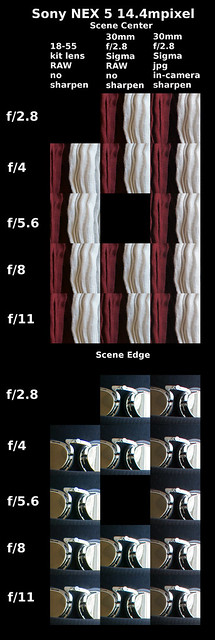
Test One - Sony 18-55SEL kit lens vs Sigma 30mm EX DN

Image Clarity Tests ~ Sony NEX5 vs Canon 5D MkII

Each 300x300 pixel section is real 100% pixel-level output.  This test was broken into two parts, where the first two columns of images are Sony RAW conversions to jpg without sharpening.  This is what the sensor and related electronics puts out.  The second part/third column shows in-camera jpg default sharpening using "standard" image tones.

Analyzing the images carefully I see that the Sigma 30mm EX DN is an outstanding lens and deserving of it's reputation.  It's nice and sharp and contrasty from wide open.  The Sony SEL 18-55 kit lens matches the Sigma at f/8, but that's just about it.  It's not a bad lens, considering it's price.  You can clearly see it's limitations.  Used carefully, however, it can help a photographer make amazingly crisp images.

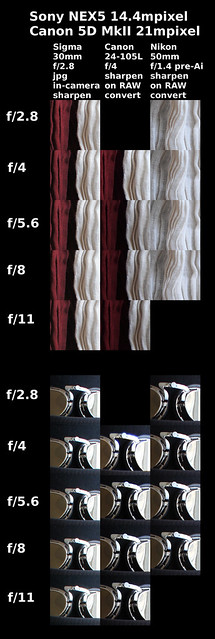
Test Two - Sony Sigma 30mm vs Canon 5D MkII 24-105L and Nikon 50mm f/1.4 pre-Ai

Image Clarity Tests ~ Sony NEX5 vs Canon 5D MkII

Analyzing the images carefully shows how good the Canon 5D MkII remains.  The only curious thing is how the L-glass treats the edge/off-center highlight areas at f/4.  It's a little strange.  What's going on here?

We also see how wonderful the Nikon Nikkor 50mm f/1.4 pre-Ai remains today.  I am convinced there is no reason not to use old glass on new cameras.  With focus peaking as found on many mirrorless cameras these lenses can be good values for the money.

The Sony/Sigma setup is quite good...  BUT... the scene size was the same in these three tests and the smaller sensor'd Sony gives slightly smaller 100% pixel images.  14.4mpixel files are 4/5ths the size of 21mpixel output.  I needed to move in closer to the subject by 1/5th the distance of the first setup.  Which leads to...

Test Three - Uprez'd and 1/5th closer Sony/Sigma vs Canon 5D MkII 24-105L and Nikon 50mm f/1.4 pre-Ai

Image Clarity Tests ~ Sony NEX5 vs Canon 5D MkII

This is where things get really interesting.

A straight cubic up-rez on the 14.4mpixel file to Canon 5D MkII file sizes shows things look pretty darned good in the old Sony camp.  These images show a little less "resolution" than moving the camera 1/5th the distance closer to the subject.

Images at 1/5th the distance seem to do well enough to illustrate that Sony pixels are as good as Canon pixels (if you follow the wrangling that goes on over on Canon Rumors, you'll understand what I'm talking about).  The Nikon lens'd images remain outstanding, as do the native 24-105L works.  Nothing changed in that part of the test.

What's amazing to me and what really has potential is that up-rezing the Sony NEX5(original) 14.4mpixel in-camera sharpened jpg image to 5D MkII file sizes... and then adding a little (not-so) Secret Sauce... et voila!  Can you really tell any difference between my NEX5 up-rez with Gimp/FX-Foundary Sharpening and my 21mpixel DSLR images?

Make sure you enlarge these to 100% to clearly see what's going on here.

So what have I proven?  Well, several things, actually.

First, an old APS-C 14.4mpixel sensor can still perform remarkably well.

Second, my thoughts on how Lightroom and Photoshop sharpen files at the print stage seem to play out.  You can take a small Sony NEX5 file and make it look good by carefully up-rez'ing it at or just before making a large print.  Yes, you will not have all the resolution "real" of a native sized-sensor, but... the eye can interpret local contrast as resolution and a good work can "appear" to be as good as something from a larger sensor, even when pixel peeping.  You have to be careful, but you can do it.  Using this approach on a Canon 5D MkII file can yield huge files of incredible quality.

Third, ... well... I'll save this for another post... so stay tuned.


Friday, October 31, 2014

It's alive!

My recently published Steampunk photographic work with Arthur Morgan and Etienne Barillier - French Steampunk Supremos/Authors/Editors - has been hung.

Le Salon Fantastique is ALIVE! from now through Sunday Sunday Sunday ONLY!!!

Come on down and check things out.  I'll be there again most likely Sunday afternoon.

Photoshow ~ le Salon Fantastique

Friday, October 24, 2014

Teaser ~ Salon Fantastique photo exhibition

This video is of still photos Arthur Morgan and I and a cast of very talented creative people worked to create.  Selections of this work have been published in Fiction #19 (France).  Original prints can be seen starting October 31st at the Salon Fantastique (Paris, France) - http://www.salon-fantastique.com/

If you're in town and happen to come by the show, please stop me and say "hi."  I'll likely be there Saturday and Sunday afternoons.

Friday, October 17, 2014

Hauntings of Gothic Ghosts ~ Portfolio

My work titled Hauntings of Gothic Ghosts is hereby released in electronic form.

This work was first publised in 2014 by Lenswork Magazine in Extended #119.

During the interview Brooks Jensen and I talked about electronic distribution of photographic portfolios.  We talked about how PDF files are easily distributable and offer a new way of experiencing the photographic arts.  Given the quality of the displays on traditional computers as well as portable tablets photographs can be enjoyed in beautiful glory without the need to store paper or to find a place on the wall to hang an image.

I am offering for free a 12 image distribution of Hauntings of Gothic Ghosts.  You can find it here.
On the first page of the distribution there is an invitation for people to send me money to gain access to the full 70+ image work.  The free version can be considered an introduction to the complete work.

I also offer individual prints for those who prefer to collect their archival images in a more traditional manner.

In the near future there will be two more projects that I will share electronically.  One has to do with iron, rivets, and glass.  The second is a visual exploration of alchemy education recorded in stone as taught by the 13th century Catholic Church.  Behind these two works are yet two more projects.

So, if you like what you see in the Hauntings of Gothic Ghosts, rest assured that more is coming soon.

As they say in the movies, stay tuned.

Light from Ghosts