Saturday, August 30, 2014

How I work...

I love working with creative people.  Absolutely love it.  In fact, I rely on you because I don't have the resources you might to create amazing outfits or to find wonderful settings.
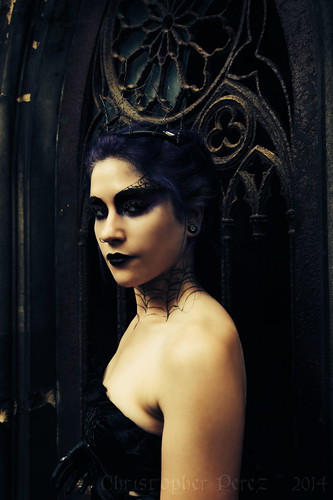
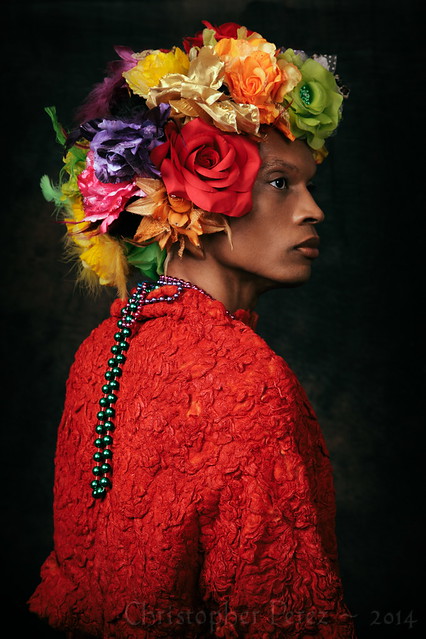
Darkness and the Black Muse ~ Nova (Marine Sigwald)

My wife and I (I include my wife in this as she is my assistant in the studio and on many location shoots) recently experienced something that made me realize it would be helpful to clearly articulate how I work in a collaborative setting.

I bought three hours of time in a studio hoping to get a couple solid hours of camera-work with a creative person.  I had several ideas and themes to explore.  Alas, our subject was a couple hours late.  I really wanted to work with this person but there was not time left.  Literally.  We needed to be out of the room within an hour and the subject was not camera-ready.

To avoid tears and drama here is how I work.
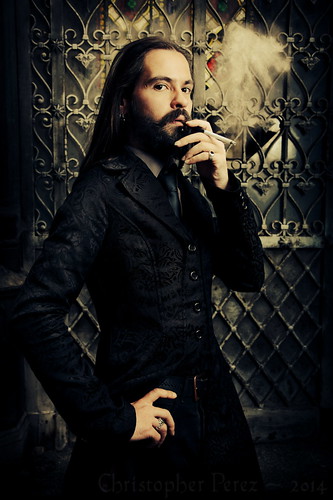
Aymeric Langlois

I like to trade my photography time for a subject's talent.  If money needs to change hands, I like to negotiate that well ahead of a shoot.

After talking through an idea and agreeing on a general theme I negotiate with you the time and place for creating images.

If we are working in a studio I need to make an appointment with the owner for a room.

I've found that three hours room rental works well for many shoots.  Once set, there is no changing as the studio is busy and it's difficult for them to accommodate last minute changes.  So I try to be as clear as possible when we negotiate time and place.  Additionally, I like to negotiate who will pay what portion of the studio rental.  Three hours is approximately 50Euros.
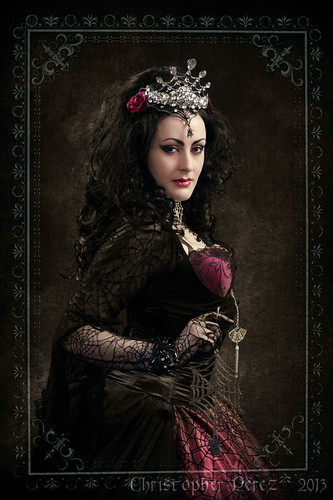
Into the Spider's Web ~ Fracture

We trade mobile numbers so we can text in the event something has changed at the last minute, or if someone needs help finding the location.

Upon entry into the studio space my wife and I take 15 minutes to get settled, to greet our subject(s) and to set up the portable studio (lights, backdrop, camera).  Once everything is in place (in 15 minutes) the shooting can begin.

I realize that some subjects require a little time to finish getting made up or getting into their outfits.  I can be pretty flexible about the time these kinds of things take, particularly for the more complex themes or extreme implementations, but I like to negotiate this too as I'm sensitive about the amount of time we can get actually shooting.

Once we're all "camera-ready" and the shooting begins it takes me in my artist's way of working about 20 minutes for everything to start "falling into place."  Within an hour of entering a studio space all parties are "rocking and rolling.

I've found that talented subjects can bring one and no more than two outfit changes.  It's a little tight, but after two+ hours of shooting, we have a lot of material to work with.

Which is another thing to point out: I like to shoot a lot.  It's how I think.  It's how I work.  It's how I begin to "see" a final result.  Again, this is why I tend to be sensitive about the amount of time we can spend together actually shooting.
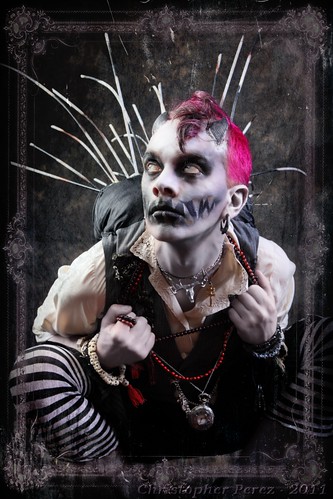
Jinn ~ Bogville

After we are done it takes my wife and I 10 minutes to knock down the studio.  For this we need to wrap things up no later than ten minutes prior to the end of our studio space rental time.

If any part of the team can't keep a commitment, it can really impact the success of a shoot.  This is why ahead of time negotiation is so important to me.  I rely on all team members to know what they are capable of and to be honest about what they can and cannot do.

These things hold true whether money changes hands or not.

Working this way allows all parties to come away with pretty amazing images.  It's taken me years to hone this approach, but it's pretty successful.  Professional results come from taking a professional approach with professional scheduling and professional execution.  It enables success in ways we seldom foresee.

I look forward to working with you.
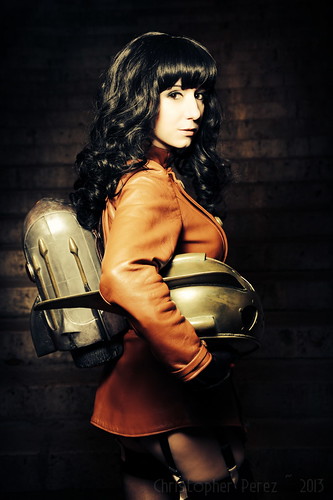
Betty Page Rocketeer ~ by Riddle

Friday, August 22, 2014

Our tools... viewed from the producer side...

It has been over one hundred years since photographers were required to control nearly all aspects of image making.

"Back in the day..." an artist could build his own camera, cut his own glass plates, mix his own chemicals, break eggs, coat the plate, process an image, make a hand coated print, and hope the negatives were safe from breakage in transportation.  The only thing not commonly produced by an artist of the era was an optic.  But even a lens could be ground by hand and mounted into a hand-turned brass barrel if the artist so desired.

Increasingly, photographers handed over control of their craft to manufacturers who could produce adequate tools.  Lenses and camera bodies could be mass-produced while achieving strict tolerances.  Light sensitive materials transitioned from wet to dry plate, and then from glass plate to celluloid flexible substrates.

Occasionally an artist may still build his or her image making system, but for the vast majority of us we have no desire nor need to build our own equipment.  Similarly, painters no longer commonly build their own brushes nor mix their own paints.  They also don't seem to talk about their equipment as much as photographers do, either.

Reading on-line forums one might believe that camera manufacturers "simply can't get it right."  So many people seem to be demanding so many things.  To my way of thinking it's all too easy to complain when you've not taken the responsibility of tool production.

Flipping things around, what do the equipment suppliers think?  What do they do?  How do they consider us as artists?

Someone posted an interesting article where two of Canon's leading designers talk about these and many other topics.  It's worth a close read.


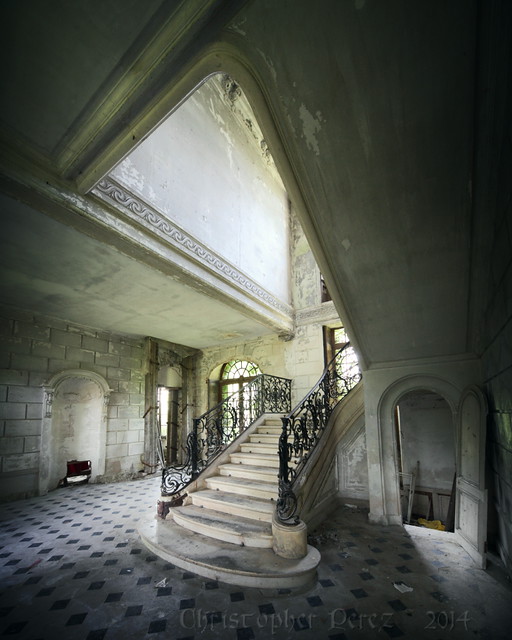
Abandoned Places ~ Staircase

Tuesday, August 12, 2014

One day. One location. One photograph.

Working with creative people here in France has opened up into being an incredible experience.

Sometime I would like to write about how and why creative expression is so different in France from what it is in the US.  For this post suffice it to say that once I gained access to the artistic community, finding subjects eager to work with me has become a lot easier.

I am forever grateful to Arthur Morgan for personally introducing me an amazing group of people.  After our work was published in Fiction #19 (France) my association with M. Morgan gave me an all important Stamp of Credibility.  There's a French word for this.  I need to ask a friend to remind me what it is.

Recently, a friend of a costume artist I'd work with contacted me with the suggestion that we shoot in an old abandoned chateau.  How quick to you think I was to reply "hell yes!!!"?  Indeed.  I was very excited to be involved in the project.

We plotted and planned.  The project coordinator wrote in excellent English.  The model had a few interesting costuming ideas.  The makeup artist turned out to be someone we'd worked with.  Her boyfriend was interested in lending a hand on the project too.  Jude, my wife, was thrilled to come along after looking at a few images of the location.

On the day of the shoot we had several inauspicious events.  Jude bumped her head against a cabinet door that I'd left open.  The weather was to turn sour during our prime shoot time.  The chateau turned out to be at least an hour out of Paris by donkey cart or TGV.  I was unhappy to leave Jude behind but she needed to rest after her accident.

I kissed Jude goodbye and met Niko (aka: Project Coordinator and Abandoned Building Safety Officer) at his waiting donkey that was standing in front of our apartment building.  Into the saddlebags/boot/trunk (depending on which side of the Pond you live) went a tripod, light stand, cheap Chinese flash (I really need to get a better piece of equipment as I _know_ this thing will leave me High and Dry some day soon), huge reflector, large umbrella light modifier, RF triggers, spare batteries, camera body, and three lenses.

Just outside of town we could see a huge black cloud that stretched from horizon to horizon.  From time to time the sky lit bright with streaks of lightning.  Things did not look good.

Passing through the first wall of water was unlike anything I'd ever experienced.  We couldn't see the road.  We couldn't see any of the cars around us.  We swore we could see salmon trying to swim up-stream.  We didn't like the fact that it was August and these kinds of things Just Don't Happen pendant les conges annuels.  The drenching went on for far too long.

Eventually the Big Black Cloud finished having it's way with us and decided to move on to Paris to give everyone behind us an Equal Opportunity Drenching.  The Big Black Cloud would trap the model, the MUA (make-up artist), and her boyfriend just as they were leaving Paris.  It produced a enormous embouchon (traffic jam).

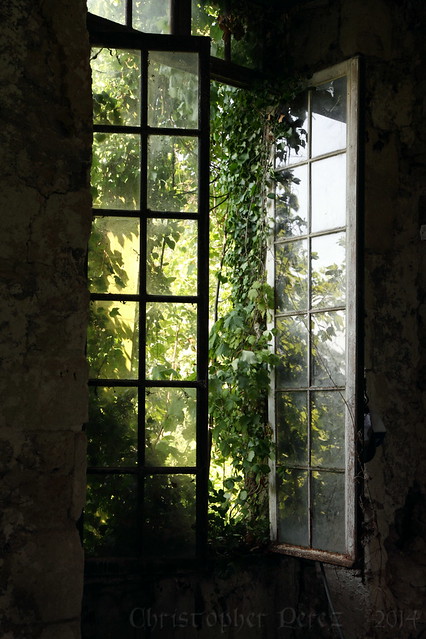
To me it was instantly obvious what needed to be done while awaiting the arrival of the rest of the team.  Exploring the site we learned from a man who used to live on the property (20 years ago) that the chateau had been sold and would be torn down in the next couple weeks.  Knowing this gave me a strong reason to get as much of it "on film" as I could.  It would be the first and last time I ever visited this most amazing place.

After working a couple hours with the model and team we packed up and headed back into town.  Greeting us over the Normandy horizon was the last of this year's Supermoons.  La lune hung in the evening sky guiding us back into Paris.

The following image is nearly straight out of the camera.  And this is just the Warm Up.  That's how good it was.  Magic.

Abandoned Places ~ Fenetre Ouverte

Wednesday, July 30, 2014

Tintypes in the Park

Here is a wonderful opportunity to experience good old fashioned photographic processes.  If you live in or around Portland, Oregon in the USA, check this out.

Saturday, August 9, 2014
11:00 a.m. to 4:00 p.m.

Near the Southwest Park Avenue entrance to the Museum's sculpture court
Portland Art Museum
1219 SW Park Avenue
Portland, Oregon 97205


Emogene ©Ray Bidegain

Own a unique keepsake tintype photograph of you, your friends
and/or your family made by Ray Bidegain Saturday, August 9,
during the Portland Art Museum's Plein Aire Paint Out. This is a
fundraising event for the Museum's Photography Council and a unique
experience in portraiture!

Ray and assistant Greg Bell will set up a complete wet-plate photography studio
and darkroom near the Southwest Park Avenue entrance to the Museum's
sculpture court from 11:00 a.m. to 4:00 p.m. Each unique, hand-made 4x5-inch
likeness is just $40.00.

Come and participate in an event that is as much performance art as it is
photography and walk away with an "instant print" that will last
for generations!

Funds raised by the Photography Council are used to purchase
photographic works for the Museum's photography collection.

Please click here for more information about the Photo Council: http://www.portlandartmuseum.org/page.aspx?pid=435

For more information contact Ray Bidegain.

Saturday, July 26, 2014

Confusion and doubt...

After a photoshoot where I wasn't entirely pleased with the results, I've thought long and hard about lighting and composition.

It helps to have a talented creative people to.  I rely on them, in fact.  Yet, if I don't my part, it doesn't matter how talented nor how creative a model is.

I was recently contacted by sean360x.  He was in town and was wondering if we could do a shoot together.  The theme would be steampunk.  We would share the studio rental costs so I said "sure."

The theme is one I'm familiar with.  It's my stock and trade these days.  In fact, my good friend Arthur Mogan asked me earlier this week for four more "steampunk-like" images for another Mook.  It will hit the streets on October 15th, 2014.  It's another wonderful opportunity and I can't wait!  The thought  of shooting more steampunk, however, left me feeling adrift as to how to proceed.

This year has been good for publications and my work.  For the past 12 month the latest work will put my publishing total at 5 (FIVE!) great opportunities.  First there was the LensWork #111 with my work on Paris cemeteries.  Then there were two issues of the Gimp Magazine where I gave tutorials and had a portfolio of work printed.  This was followed quickly by a large work of images that appear in Fiction #19 (a magazine book called a MOOK) here in France.  And now this newest prize.  Soon to be followed by gallery shows in Lille, Lyon, and Paris, yes, _that_ Paris!

Yet... and yet, I was not confident going into this latest shoot.

I worried about the lighting.  Some more.  I worried about composition.  Some more.  I worried about my ability to capture something shared between a talented creative person and myself in creating an image.  Some more.

As we started the shoot I shared these fears with sean360x.  He, as an Egyptian god, smiled, nodded, and we got down to the business of creation.

There was no firm creative ground to stand on.  I didn't feel at all confident about my abilities.  Which might explain many things about where I am with my art.  Constantly seeking, constantly trying to improve, and constantly studying the works of others while sorting out how to incorporate all these things into my own work stream makes for rather arduous going.

A rational question, the very first question that leaps to my mind, at least, is how to proceed in the face of uncertainty?

The answer?  I have no idea what the answer is.  Really.  I don't.

Perhaps the Magic comes of it's own accord?  Perhaps the Muse dictates what will happen and when?   It's very frustrating.

Whatever the reason, and very much in spite of myself, circumstances have conspired to confuse me even further.  A quick look at the results confirmed that we had come away with something amazing.  I can't wait to process more images from this most recent shoot.

Sean360x ~ Gods (a series)

Thursday, July 17, 2014

Inspiration ~ Kirsty Mitchell

I never believed it could be so easy to contrast the consumerist/techno-worship culture of camera collection against true artistic photographic image-making creativity.

I am moved by the stories of art creation and with the incredible images of John Wimberley, Christopher Burkett, and Bill Gekas.   I wonder at the technical talents of Sandy King and Kerik Kouklis.  I miss my talented friends, Ted Mishima and Ray Bidegain.  I try to understand what drives their vision, practice, and try to incorporate aspects of their approach.

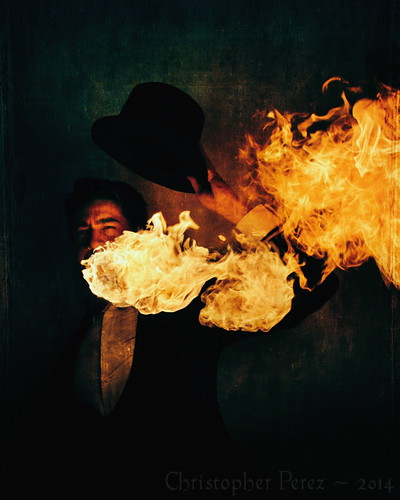
Going into a recent photoshoot with a fire breather and bellydancer I thought I had enough of a vision and image design to make the whole thing work.  Alas, I'm not sure of and am not yet convinced by the results.  It appears I need to pay more attention and to spend more time working on "seeing" images before picking up a camera.

Today I read Kirsty Mitchell's latest blog post about her last and final image in her amazing Wonderland series.  Here is a moving example of an artist exploring the depths of human emotion.  Photography is clearly the vehicle Mme Mitchell uses to express her feelings, and yet the tools of image creation are rather unimportant compared with her ability to design, craft, and create a fantastic world into which we're invited to step.

My creative world is rocked (as it is nearly every time Kirsty lets another image escape into the wilds).  My world is moved.  My vision thoroughly challenged.

How to apply what I appreciate and learn from her approach?


The Dragon

Monday, July 07, 2014

Inspiration ~ 1x.com interviews Bill Gekas

If, like me, you're interested in what motivates photographic artists, what they think about, and what they find important in their art, head on over to 1x.com and their interview with Bill Gekas.

I feel M. Gekas is one of the finest "classic" lighting strobists of present times.  It's well worth a read.

... and filed under the heading of shameless self promotion, the following image was made here in Paris of a friend who texted me to say he was in town for a few days, and, gee, it'd be fun to have a beer together.  Give me a small umbrella, a cheap Chinese strobe (seriously, I _must_ get a better strobe), and a camera with RF triggers and we can make just about anything into fine image.  IMNSHO, that is.

LOL!


Aymeric Langlois

Wednesday, June 25, 2014

It feels good!

A collaborative work between Arthur Morgan, Etienne Barillier, and myself and a cast of dozens of talented people has been released into the wild.  Fiction number 19, ete (summer) is a French fantasy/sci-fi mook (magazine-book).  It contains well written stories, articles, and, now, photographic portfolios of related subject matter.

Our series of images and words cover a range of ten characters and personages famous or infamous in French history and literature.  Arthur Morgan brought us together to recreate these people in a very Steampunk style.  We worked with talented creative costumers to bring the reinterpretations of history to life.  Everyone brought something rather special to the project.

From a photographic perspective, the effort covered a wide range of situations and possibilities.  We shot on location at the Palais Garnier (the old and still incredibly beautiful Paris opera house), Pont Alexandre III (of which more will be seen in my next major project), in the narrow streets of l'isle Saint Louis, Parc Georges Brassens, and in the studio.  We shot in the cold.  We shot in strong wind.  We shot in the rain.  We shot in small spaces.  We shot in vast landscapes.  All involved using strobe techniques to help isolate and properly light our amazing subjects.  Quickly followed by image processing (press ready) using the Gimp.

The entire project was shot and processed in three weeks in March, 2014.  That was the month before my wife and I returned to the US to clear out our "Plan B" storage unit.  We'd kept just enough furnishings and personal items to populate an apartment should Paris not have worked out.  This photo project was wedged into our lives and, well, the results are in the viewing.

Our work has been reviewed by Lorkhan et les mauvais genre.  Here is a translation of our portion of the review.

... And finally, the portfolio that struggled to convince in the previous issue is back, except that this time it is very successful! A collaboration between Stephen Barillier, Arthur Morgan and American photographer Chistopher Perez, offers us a gallery of the most famous characters from the imaginary (and also some real), the French, and the late nineteenth / early twentieth century, all mixed with a nice steampunk sauce. Fantomas, Dr. Mabuse Rouletabille, Arsène Lupin, Marie Curie, Mata Hari and so on, a real nice little collection, with an explanatory text for each of them, it is a real success!...

A real success, eh?  Right nice words, those.  Yes, we're thrilled.

I've put off posting outtakes from the project until September.  I'm doing this so that French readers have time to go away pour les vacances.  I'd like to share these images with as wide an audience as possible and feel I'll have everyone's attention after spending a relaxing month or two in the summer sun.

As has been said many times: Stay tuned!


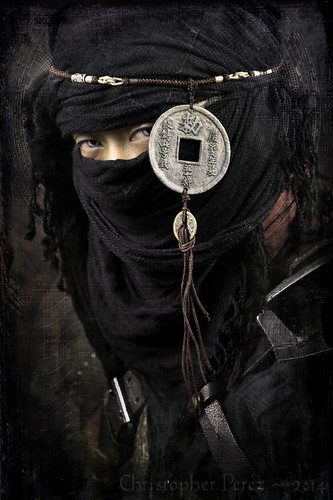
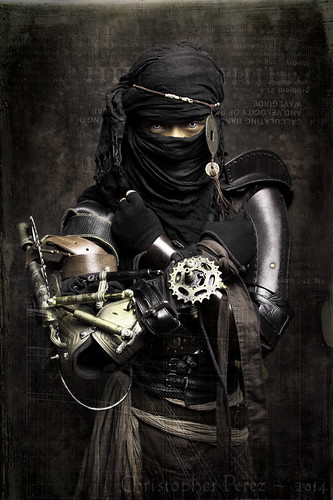
Ninja ~ out of the Age of Steam

Tuesday, June 24, 2014

Inspiration ~ Why do we photograph?

Something in a short conversation with Phillip Morgan triggered a cascade of questions and possible answers.  The primary question was why do we make photographs?

An easy answer to this question is to satisfy a desire to make a pretty picture.  For some photographers their answer is a bit deeper and a bit more complex.

Portland, Oregon is home to a photographic arts gallery that was inspired by Minor White.  It's called the Camerawork Gallery.  After a show of my palladium work was held there, my wife and I would occasionally attend other artist's "opening day" celebrations.  It was there that we first met Christopher Burkett and, later, John Wimberley.  They both had their own shows at Camerwork.

M. Burkett somehow found out that I tested camera systems for resolution and other image making properties.  The start of our conversation was given to talking about Zeiss, Nikon, and Schneider optics.  He was in love with his Zeiss APO-somethingorother that he just bought for his 6x6cm Hasselblad.  We also talked about his Nikkor enlarging lenses.  They are, apparently, incredibly rare.  He certainly valued high quality gear, but that is not what motivated him.

Christopher Burkett's reasons for making beautiful landscape images in color using an old film process is much deeper than simple camera collection.  His story is rather interesting.  One day, when he was a christian brother living in a monastery, he had an experience of all life being filled with light.  Seeing light in everything inspired him to express this realization in photographs.  He felt he had to make images.

Photography is for Christopher Burkett a way of sharing his deeply spiritual experiences.

John Wimberley is another photographer who has taken his art into the realm of the highly spiritual.

Looking at John's images of Native American rock art during his gallery opening led me to ask him a question that started an interesting conversation.  I asked if he understood the nature and purpose of Native American rock art? John's quick reply was a quiet but emphatic yes.

John told me that interesting symbols of animals, patterns, shapes, and people were created and used by Native American shamans for spiritual reasons.  If I understand the process correctly, when a shaman had a particular experience of passing from this world into another he would record something of that event by etching the related shapes and symbols into rock.  Later, the shaman could return to stare at the markings as a means of re-entering the original experience.  Native American rock art work acts as a gateway to the spirit world.

The beauty of John's photographs is undeniable.  He has taken years to hone his craft and to state exactly what he believes and knows in images.  Just as with Christopher Burkett, John Wimberly uses his photography to share deeply spiritual experiences.

Talking with photographers who have very clear reasons for doing what they do was, for me, infectious.  I too wanted "good" reasons for doing what I do.  Their conversations invited me to look deeply into why I take pictures.  What is my motivation?  What do I want to say?  What has to be revealed?  What do I do with the result?

Take an hour or two and watch M. Burkett's OPB video as well as M. Wimberley's interview video to see how they've grappled these kinds of questions.

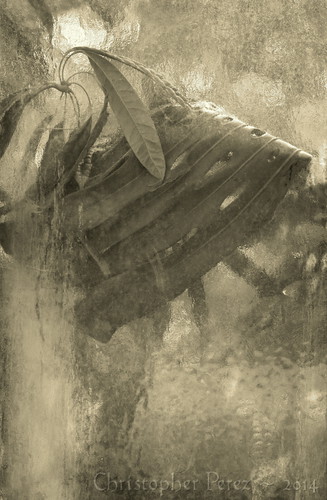
Botanical

Sunday, June 08, 2014

Bievres ~ Photo Fair

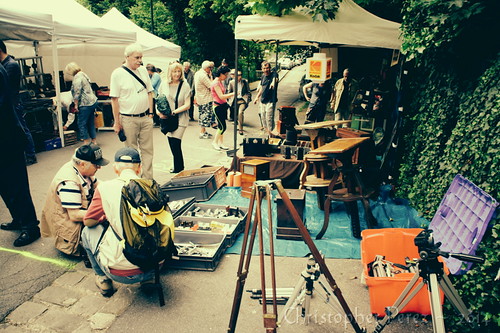
Every year the village of Bievres plays host to an International Photo Fair.  One of my students strongly suggested a visit would be required.

Bievres ~ a photoswap
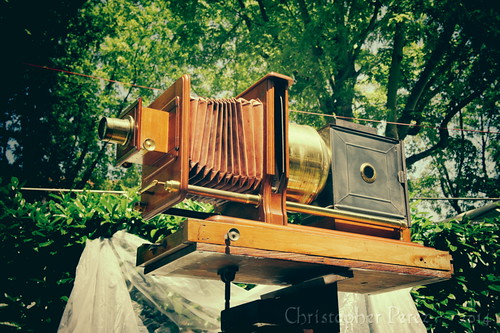
... sitting proudly on a tall tripod, welcoming guests to the show...

On Saturday morning we awoke to the sound of rain.  This on a day that supposedly had zero percent chance of the Wet Stuff.  There was nothing to do but gird the loins, leave the sun hat at home, and set off.

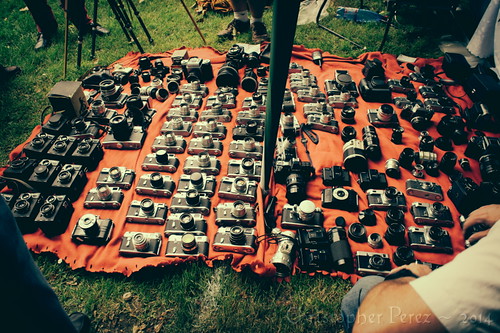
On arriving at the station, the Weather Gods had figured we'd had enough dampness for one day and the Bright Yellow Orb shown down bright and surprisingly hot.  The fair is held up the hill from the RER C Bievres drop-off-point.  The hilly center of the village is given over to the fair.  Simply following the crowds led me to a narrow lane filled with vendors of old and ancient appareil photo.

When we lived in the States I sometimes manned a table at our local photo-swaps.  So it was with great interest that wandered the aisles to see what the Europeans had on offer. 


Bievres ~ a Photo Fair
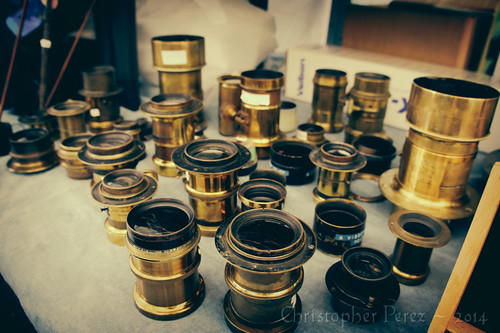
 Brass lenses of several designs -
Objects of Serious Desire of former times, these

The advertising suggests the event is international.  A quick listen to who was saying what revealed that in addition to the expected French vendeur there were tables and booths strongly manned by Swedes, Italians, Germans (my gawd! yet another invasion?), and British (oh good lawd! how did so many get here? are the maps these days that accurate??).

What was on offer Blew My Little Mind.  Brass Lenses.  Stacks and stacks of Brass Lenses.  Lenses the likes of which some photographers might believe would add "something special" to their images.  Bit Brass Lenses.  Little Brass Lenses.  Convertable Brass Lenses.  A Brass Lens to Fit Any Size.  Most were ground by Parisian Opticien.  Some by the English.  Gawds!  If only I were a wet plate collodion practitioner...

Bievres ~ a photoswap
 ... oh, so much to pick through... looking for... 
well... what, exactly?... what do we need today?...

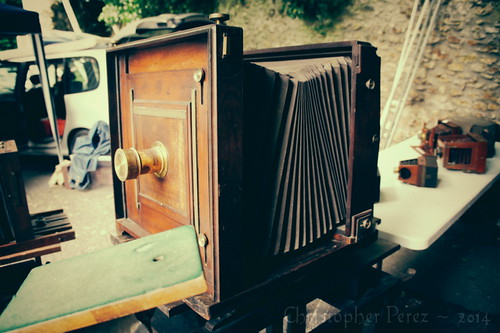
... and if I were interested in ether and egg-whites, there were a great many chambre to choose from. I saw everything from fairly recent Linhof 4x5 rail cameras all the way back to ancient and sometimes Very Large format wood photographic tools.  Many of the oldest cameras came with holders ready to take your hand-coated glass plates.

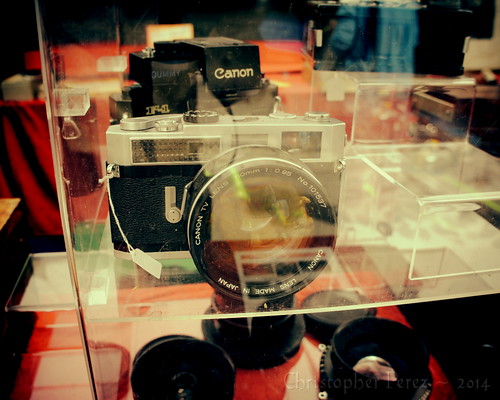
Then there were the several Canon 7 rangefinder cameras avec f/0.95 lentille.  I'd only ever see one of these In The Wild.  Now I saw three.  In one day.  Putting that Chuck of Glass on a mirrorless body would dwarf the poor thing.

Bievres ~ a Photo Fair
 How many of these Rare Beasts can on show offer?
This one was listed at 1900Euro.

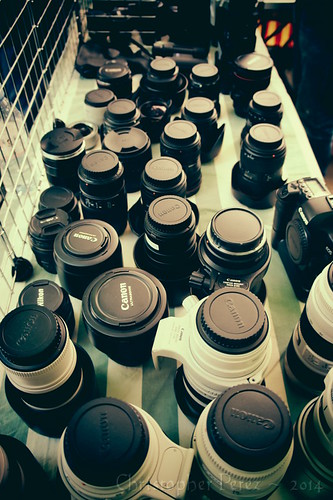
I was surprised by the shear volume of Nikon film-era gear.  Camera bodies.  Lenses.  My my! the lenses.  Some in perfect condition.  Much in a Well Worn State.  I spied a pretty Ais 28mm f/2 and a late Ai 85mm f/1.8 K in mint condition sitting amoungst absolute junk.

Similarly, the Germans and (to me rather surprisingly) the Italians laid out a feast of Leica equipment.  Yes, there was the expected rangefinder gear (bodies and lenses) good and great.  Yet there was a fair amount of "R"-series SLR stuff, too.  If I were susceptible to such things, there were more than a few tasty R-glass optics to be had.

As I wandered the aisles I couldn't help but notice that not much was selling.  Not the big ticket items at least.  So I visited as many tables as I could to get a sense of why this might be.  Well, one answer was immediately at hand.  Price.  With only two exceptions, I found people pricing their gear over the top end of What the Market Would Tolerate.

Here are a few examples, and don't forget to multiply these prices in Euro by 1.36-ish to get the actual costs in USD.

Bievres ~ a photoswap
 ...just a few of the many steeply priced lenses 
to be seen at the show...

Well used Nikkor 50mm f/1.2 for 375Euro.  Ancient Saphire Paris LF lens (I'm not convinced it was a complete optic) for 1000Euro.  Three Canon 50mm f/1.8 EOS with non-working AF for 79Euro each.  Canon 50mm f/1.4 EOS for 290Euro.  Linhof Kardan 4x5 for 1200Euro, and this thing was thrashed.  Pentax Takumar 85mm f/1.9 (you know the one) for 250Euro, and this too was completely knackered.  Leica M-bodies in battered condition started at 800Euro and jumped into the stratosphere from there as condition improved.

I met Dan The Man From WICE and his girlfriend on the lower lane of the swap.  I was reminded by Dan's Parisienne friend that "... in France, one must barter.  It's expected..."  Considering that she might be right, I went back to the table with the EOS 50 f/1.4 on it to see if I could get a better price quoted.  On arrival I found the lens mounted on a little Japanese woman's Canon.  As she played with it, taking photos of nothing and everything, she asked if he'd take 270Euro for it.  His immediate replay was "Non!"  So much for that idea.

The two tables where things were reasonably priced against current market expectations (using eBay as just one source of comparison) not much was moving there either.  One guy had a nice collection of 8 or 9 condition Nikkor manual focus lenses.  I was sorely tempted by his 50Euro 100mm f/2.8 E, 50Euro mint 50mm f/1.4, 100Euro mint 85mm f/2 Ais, and 50Euro gorgeous 28mm f/2.8 Ai.  Since I already have many of these, why duplicate things with more glass I'd never use?  Still, what struck me was that these wonderful optics were still sitting on the man's table unsold.

Bievres ~ a photoswap
 ... there is simply no way to haul this home on the RER... 
no way...  really... there isn't... OK?...

So perhaps the lack of sales wasn't just about price?

On my way out I walked the aisle dedicated to old and ancient photographic images.  Tin plates. Albumin.  Platinum/palladium.  Early silver.  All manner of subject, too.  Travel.  Studio portraits.  Street scenes.  As I picked through a few stacks of images I was reminded of the Real end product of the photographic endeavor could be.

On reflection I'm curious as to why there were so few images compared to the Boat Loads of cameras and lenses.  Maybe it has something to do with how people feel the creative spirit is activated?  You should've heard the conversation in French/English between a Japanese visitor who's black mint condition Leica M4 sported an early chrome Leitz lens of some kind or other.  The Frenchman went nuts as he recognized it as being something Incredibly Rare.   After-all, if you have Just the Right Lens and the Perfect Camera, maybe you too will make a fabulous photo?

Bievres ~ a Photo Fair
 ... a table?  Who needs a table when a blanket a wee-bit-o-open- lawn will do...?

Riding the RER C back to Versailles-Chantier to jump the next N-line back into Monstparnasse Bienvenu I couldn't shake the feelings I had for a photograph I saw.  It was, perhaps, 6.5x8.5inches in size and printed on heavy double weight paper.  It was of a nude from behind.  The print was obviously late 19th or very early 20th century.  The blacks were not clinically black, nor were the whites brilliantly white like modern works might strive to (easily, these days) achieve.  No, this image had a subtlety of illumination, composition, and tonal range that really appealed to me.  The light, ah the light, seemed to drip, slide, and ooze down the model's body.  Wasn't this what photography was about, making a fabulous image?

That one single beautiful print was the Very Best Thing I saw all day.

Friday, May 23, 2014

Leica ~ from BBC Magazine

Leica cameras were unique, strong, and very capable photographic tools.

Years before the Flapping Mirror of SLR became the industry standard (ie: Nikon, Contax, Zeiss, Canon), Oskar's cameras came with a rangefinder to focus lenses and a nearly silent shutter.  The shutter was so good that the cameras could be used in US courts of law where nothing else was allowed.  Who needed ultra-wide or super-long lenses when "real" reporters/photographers entered the fray and became part of the action?

I owned two M3 with a 5cm f/1.5 and a 35mm f/3.5.  I got some great photos with those old hockey pucks and only recently sent some of the old negatives to be recycled.  They were fun cameras.

With the advent of digital, Leica has struggled to recreate it's former Film Days Dominant Differentiation from the strongest players (Canon, Nikon, Sony, Fuji, Sigma, etc).  Image quality is no longer Leica's strongest suit.  Product pricing is, it seems to me.  They can charge whatever they want and Leica cultists willingly shell it out.  This, even as image makers costing a fraction of a Leica are demonstrably better.

Price.  Such is the lasting power of "brand."  The brand is, yes, rather Long in the Tooth, now.  We've Turned a Corner and it's fun to see retrospectives and historical essays on the topic old camera gear.  It's easy to wax nostalgic, me-thinks.

BBC Magazine is running a visual article on their site just now, wherein you can see how it enabled very creative photographic expressions.  Leica cameras remain one of the strongest icons of the Film Age.  Here in Paris Henri Cartier-Bresson posters are plastered about and he's holding a IIIf (or somesuch).

I wonder if BBC Magazine will run a similar article on Rolleiflex twin-lens cameras?  There too was a unique, strong, and very capable image making tool.  How hard it would be to demand equal time for other creative imaging tools?


Sunday, May 18, 2014

Summer 2014 ~ Things to Do in and around Paris

Have a camera?  In or around Paris this summer?  Here is a short list of fun things to do:

7 to 8 June -
14 to 15 June -
2 to 6 July -
  • Japan Expo 2014 ~ Anime, Manga, Cosplay, Lolita.  It's how France's youth "puts on the dog."
4 to 6 July -
3 August -
Year round -


la traversee de Paris ~ hivernale ~ 2014

...and from the first half of the year...

Couldn't attend as we were headed back to the States to clear out Plan B, our storage unit - 30 March -
  • Carnival of Women ~ Men and women dressed up as royalty, queens, and other femininity.
Couldn't attend as we were deep into a Mook project with M.Morgan - 2 March -
  • Retromobile ~ Old cars, motorcycles, and motor memorabilia at la porte de Versailles.

Thursday, May 15, 2014

Considering macro work...

I recently stumbled on a few seriously beautiful images by

The way the background and foreground elements are thrown out of focus, as well as the lighting and of course the sharpness of the central subject all attracted my attention.  He seems to have used a Sigma 150mm f/2.8 macro shot at f/2.8 (if the EXIF info is accurate).

This made me wonder what was in my own kit that might do something similar should I ever find the right combination of bugs and light.  So I threw a couple New Yorker Magazines on the table, set up the tripod, hauled out the Canon 7D, opened it up in Live-View to v.carefully focus the bunch of lenses I had on hand.  Here's what I took a look at -
  • Pentax Takumar-Macro 50mm f/4
  • Nikon Nikkor Micro 55mm f/3.5
  • Nikon Nikkor-H 85mm f/1.8 with cheap Chinese extension tubes
  • Canon 24-105mm L f/4 at 105mm
  • Nikon Nikkor-Q 135mm f/2.8 with cheap Chinese extension tubes
  • Canon 70-200mm L f/4
Be sure to enlarge the attached image to 100 percent and scroll around the screen to see comparisons at different apertures.


A couple things to note -

  • Cheap Chinese extension tubes do NOT hold EOS mount lenses securely.  The lens tilts from it's own weight.  I'm thinking of throwing mine into the recycle and buying something more properly made.
  • Lenses not designed for macro work seem just as sharp as those made for the task.  Look at everything at f/4 and f/5.6.  There's nothing _not_ brilliant in the bunch.  At f/2.8 the 85mm and 135mm Nikkors are very nice optics indeed.
  • The Honeywell Pentax Takumar Macro racks out to 1:1 _without_ the need for extension tubes.  The Nikon Micro 55mm only goes to 1:2.  Yes, all the non-Canon optics are old manual focus and require an EOS adapter and careful work to get decent results.
  • Short lenses need closer working distances to a subject.  In this case I was around 12 inches from the subject when using the short lenses.  I can see why folks who photograph bugs like the longer macro optics.  They'd give the photographer work to work with.
  • The Canon L-lenses are great and focus rather closely.  I'll have to see when I get into the field, but at first blush, these are sufficient for the task.  If not, the Takumar or Micro Nikkor are very light and small and won't be any problem carrying with me "just in case."
  • If you don't have the dosh for a new-wowy-zowy AF macro, old manual focus lenses can be rather inexpensive.  Things start selling around 25USD for early f/4 50/55mm lenses to 300USD for the "high end" multi-coated 100mm f/2.8 stuff.  I see that Olympus' 90mm f/2 Macro from the old OM series still fetches north of 500USD.  Which means either it's a brilliant optic or it contains just the right amount of "un-obtainium" to keep the prices higher than even new AF macros.

Monday, May 12, 2014

Mook Release! - working with writers in France...

In the month leading up to our short return to the US we were very busy.  With the help of my wife, Judith,  I worked to create a series of images for a mook (magazine/book) called Fiction - la revue qui defie la gravite.  French writers Étienne Barillier and Arthur Morgan provided the story-lines. 

We worked with a crowd of models that M.Morgan organized.  Images were made around the streets of Paris and in the studio.  It was quite the mix of serious "strobist" situations.

Here is Fiction's blog.

M.Morgan has scheduled an apero for later this month where we get to see the finished product.  I can't wait to see how it all came out.

Ninja ~ out of the Age of Steam

Sunday, May 11, 2014

Hasselblad...

This is just in from Sony Rumors.  It's a piece about how Hasselblad might be folding.  As in: Closing it's doors.

If true, all I can say is Wow!

I owned a 500CM/80Planar/150Sonnar kit for a short time.  It took nice images.  But it kept breaking on me.  The springs in the rear light trap doors kept bending for no good reason.  The light traps in the film backs kept the light out for a year or two before needing to be replaced.  The in-lens shutters started to slow, even after recent CLA's by the factory.

That was years ago when I preferred my Rollei TLRs and Mamiya 7 systems.

Still, as far back as I can remember, Hasselblad was a seriously Class Act.  Saint Ansel used one.  Many fashion and wedding photographers used them.  Some of the best photos of several generations were made using Hasselblads.

When I worked in a Black and White photo lab on Sunset Blvd, we could always tell a 120 negative print from a 35mm print.  It didn't matter the film nor the subject nor the final print size.  The medium format advantage was always clear.

When digital came to town, Hasselblad offered backs that worked on their old 500-series cameras, and entered into an agreement with Fuji to sell the H-system.  Like whomever owned the Rollei name, Hasselblad continued to offer film cameras too, perhaps for those Luddites who weren't ready to Jump Ship.

The world had changed out from under these great marques.  Rollei stopped making cameras and Hasselblad tried to expand their market by offering small-ish rather odd Lunar and Stellar cameras.

The days when Rollei, Hasselblad, and Leica could show clear advantage over other image making systems are long gone. For me, the first nail in Hasselblad's coffin came when a rather famous photographer held two large prints up and asked a working pro-photographer audience which camera had made which print.  One print came from a Canon 5D MkII.  The other from a medium format digital camera with more pixels. 

Any advantage medium format had during film days had been lost in the digital era.  The proof was in the print.  A 35mm full frame digital camera could turn out an image every bit as technically brilliant as the larger "medium format" sensored, much steeper priced Hasselblad/Mamiya/PhaseOne systems.

I doubt Hasselblad is really finished.  Not yet, at least.  They recently announced an H-series camera that will now carry a new CMOS sensor.  If Hasselblad is able to sell these in sufficient volume I'm sure they'll keep their doors open for business, even if it continues to be Fuji building the cameras and now Sony (not Kodak) providing the sensors. 

Stiff competitive "head winds" continue to arrive with the announcement of Pentax's lower priced cameras that carry the very same Sony "medium format" sensor.  To add gas to the Hasselblad funeral pyre, Sony is rumored to be working on their own MF camera system that may look and feel a lot like that old lovely Mamiya 7.

The Hasselblad brand, at least, still may mean something to some people.  For how much longer?  It's difficult to tell.


Thursday, May 08, 2014

... so many words... [2]

I found this over on Canon Rumors in the Forum section.  Check out what he says around the 3 minute mark and see if it doesn't strike a nerve or a cord or say a truth of some kind or other.

I'm glad folks are thinking seriously about their "needs" as compared with their "desires."


Wednesday, May 07, 2014

... so many words...

I try to write about the contrast between marketing and equipment fan-boy perceptions, the reality of photographic equipment and it's capabilities, and the art of photographic expression.  It's far too easy for me to get wrapped up in the minutiae of trivialities.

Every now and then I come across something that helps Clarify Things.

Today, Bill Gekas posted a link to an article through his Facebook page that really caught my attention.

If you are passionate about photography as an avenue of creative self-expression, take a moment and read DEDPXL Dispatch::CUBA.


Oregon Rail Heritage ~ the new shed

Sunday, April 27, 2014

Looking for "goodness" wide open in Nikon Nikkor 85mm lenses...

OK.  So I was in the market for a fast old manual focus 85mm lens for the Canon 5D MkII.

I've owned several wonderful 85mm lenses since moving to digital.  I put an old Nikon Nikkor-H 85mm f/1.8 up against an 85mm f/2 Nikkor Ai and an early Takumar 85mm f/1.9 (Pentax).  The Nikon f/2 and Takumar f/1.9 wide open were indistinguishable at 100 percent resolution from a Canon 5D MkII file.  That isn't saying much about resolution as the 5D's sensor can only resolve 75-ish line pair per mm.  The Nikkor-H was a distant second.  It was visibly softer wide open than the other lenses, so I sold it before moving to France.  I also sold the Takumar and sorely regret this equipment pruning.

Fast forward 5 years and I'm thinking that my 85mm f/2 Ai isn't all that great, particularly after reading stuff on the 'net about the original Nikkor-H.  Maybe I had a bad copy?

A comment that really struck me was one made by "RidingWaves" over on APUG who said "...I won't go into KR mental fantasyland but I own all of the MF Nikkor 85's including two of the F2's and I can assure you from testing many times both film and dig that while the F2 is a fine lens the 1.8 is better. Better wide open, better 1 stop down..."

I trust Ken Rockwell.  He used to sell highly technical engineering electronic test and measurement equipment by a company I used to work for.  His tests are objective, so I wondered what RidingWaves had seen in his lenses that he'd have such a strong response to Ken's comments.

My wife and I were in our old home town clearing out a storage unit that contained our "Plan B" items should Paris not have worked out as well as it has.  While posting a ton of stuff on Craigslist, I came across an inexpensive well used Nikkor-H.

Using a 118 line pair per mm resolution Canon 7D APS-C sensor I knew if resolution were an issue that I'd be stressing any lens I put on the body.  118 line pair per mm matches the resolution of Kodak's great B&W TMax100 film when shooting a 6:1 contrast scene and souped in D76.  I wanted to have another "go" at getting at the truth.

For my little "look-see" I compared my recently acquired Nikkor-H against my Nikon Ai, and, just to keep things interesting, against my also recently acquired Canon EOS 70-200 f/4 L non-IS set at 85mm.

My conclusions?  If Ken Rockwell said the f/2 is sharper than the f/1.8-H, well, he is right.  In my experience, at least.  I've now owned and tested two of these 85mm Nikkor-H lenses.  My test results are consistent. My second "H" lens is better than the first I had.  Still, the f/2 Ai Nikon is a better lens wide open than the earlier Nikkor.

Look very carefully at the in focus wavy blue background regions of the cover of a recent New Yorker Magazine.  It's close, but the difference between them can be seen.  If you need absolute resolution wide open the Nikon 85mm f/2 Ai is the resolution winner between the two optics, even at f/2.8.

Where the old Nikkor-H does incredibly well is in rendering the out of focus regions of an image.  It's wide aperture spherical aberrations yield a creamy smoothness that is hard to deny.  So the Nikkor-H will remain in my kit.  It will make for some beautiful portraits of a certain style that I've had in mind for some time now.

Lastly, as I've demonstrated several times here on this blog, by f/4 old vs new lenses are indistinguishable.  I use old manual focus optics for wide aperture work.  The ease of use of the AF EOS lenses allow me to work more quickly and accurately.  So my manual focus lenses are used when I want limited depth of field.

Put a different way, if all you had was $100 to spend on a lens, early manual focus optics can be the match of anything made today.  Certainly by f/4 this is true.  There is no need to spend several K-dollars for fancy L-glass if you can live with manual focus and all that it implies in the world of modern hyper-reactive AF systems.

Be sure to enlarge the attached image to 100 percent resolution.


Tuesday, April 01, 2014

Ninja ~ Out of the Age of Steam [troisieme part]...

 I watch 500px.com and 1x.com and watch their "Popular" streams.  Ideas sometimes occur to me.

One day rather recently I stumbled across two images that made me stop and go "hmmm..."  For whatever reason, my being tired or stressed with an up-coming return visit to the States, I felt I couldn't make a decent image.

Jude (my wife) noticed and mentioned something about being a perfectionist.  That's probably the way it is for me.

I knew with the way I was feeling that I needed to give image processing a day or two of rest.

Thinking very long and hard about how the two images I liked were made, I wanted to improve my own approach to image processing.  A little research using The Force (google) lead me to the realization that the image styles I liked were approaches that I myself had been taking for a few years.

Armed with this understanding, I revisited a series of images I made with Tithann Thanh as part of a steampunk effort with Arthur Morgan and a French publishing house.  Yes.  That was more like it to my way of seeing things.  Watch this full screen in 1080p or 720p (whichever your computer monitor is best at).


My continued and many thanks to Arthur Morgan for connecting me to the Paris Steampunk community.
 

Saturday, March 15, 2014

... Ninja out of the Age of Steam... [deuxieme part]

The work for the mook with Arthur Morgan appears to be complete.  So, in my not so spare time I've turned to working a few images.  These are works unrelated to the mook project.

I can't wait to share what we've done with the incredible steampunk community here in Paris.  I'm blown away and very happy with the results.  Patience was never my strong suit, but patience is what is required.

Now that I've met a few great artists here, I hope the future will be filled with wonderful collaborations.

Ninja ~ out of the Age of Steam
Ninja ~ Tithann Thanh

Check out the growing set of images from this shoot.  It's amazing what a strobist can do in a rather small apartment space (our's).