Monday, December 18, 2017

Lens Stories ~ Nikon Nikkor 28mm f/3.5 Perspective Control

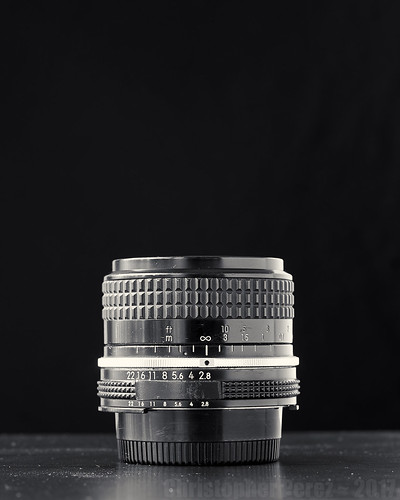
Nikon Nikkor 28mm f/3.5 PC


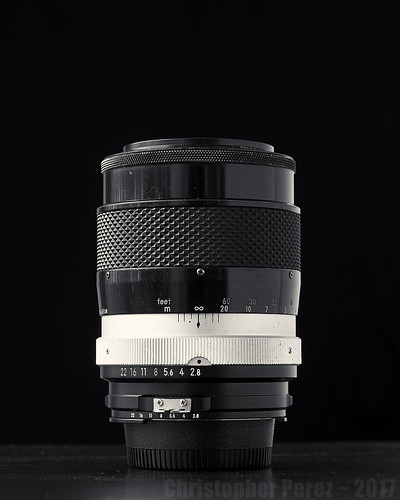
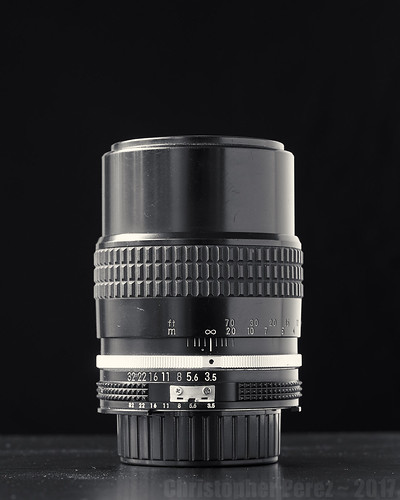
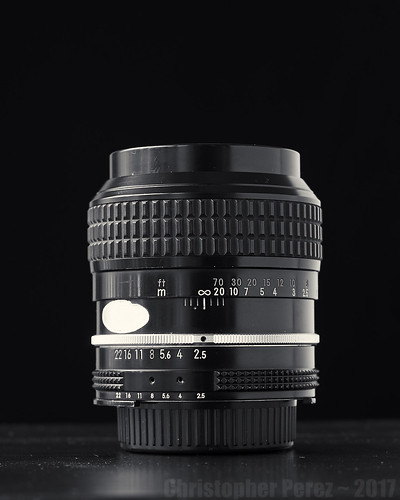
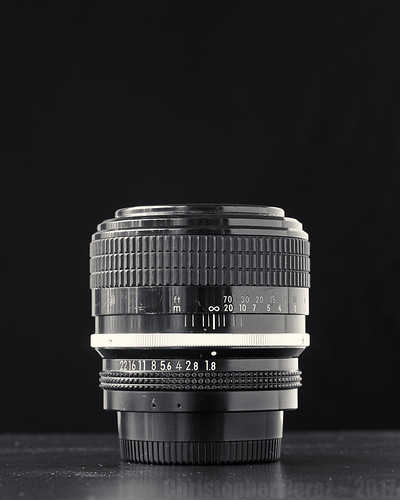
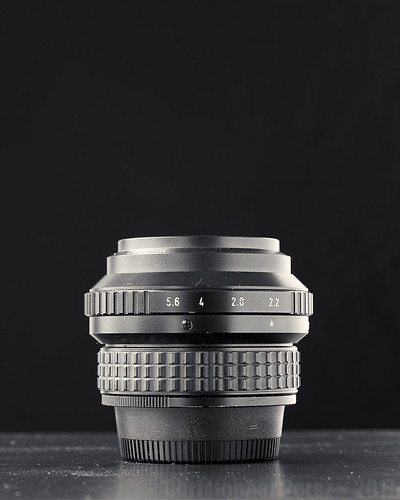
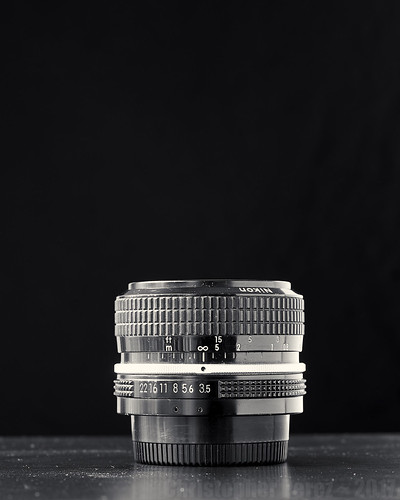
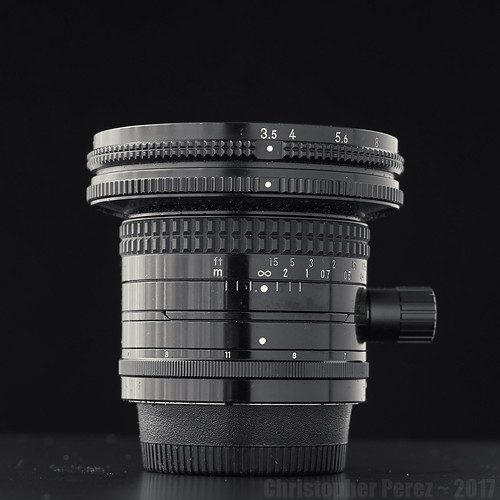
Here's something of an albatross.  It's a Nikon Nikkor 28mm f/3.5 PC (perspective control) lens.  I bought it years ago for around 550USD back when I thought it would be just the ticket for taking photographs of buildings.  Yet over the now many years it's been shot in anger very few times.  It followed me to Europe and, even now, rests peacefully in the Toy Box as a rather expensive testament to my lack of impulse control.

What makes this lens "special" is it's vast field of view and unique barrel construction.  It covers a much broader area than is normally required by a 35mm full frame lens.  The lens barrel allows sliding movements of up to 11mm's.  This is a shift lens.

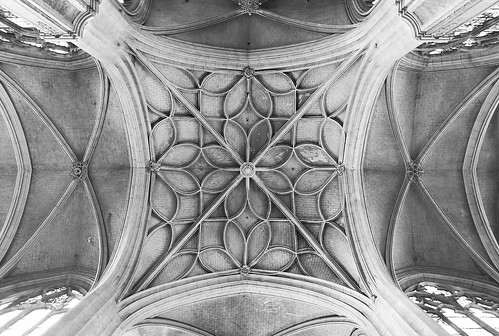
Shift lenses are great for situations where you want to avoid "keystone" optical effects when photographing subjects such as tall buildings.  If you level the camera where the plane of focus is parallel to the plane of the subject you can shift the lens to include more of a building (for example) and less of the foreground.  Looking at this image the vertical lines remain parallel and I was able to eliminate a lot of the uninteresting foreground but shifting the lens up.

This lens is not a tilt/shift.  In those kinds of lenses you can not only shift a lens (decenter it) you can also tilt the plane of focus.  Because of the more complex barrel mechanism these tend to be rather expensive (and well out of my price range, particularly these days).  Tilt/shift lenses provide imaging flexibilities similar to an old fashioned large format film camera.  Changing the alignment of the focus plane to the subject allows a user to manage what portions of the scene are in focus and which are not.

The reason my lens sits largely unused and unloved is that modern image processing software usually have "keystone" correction functions.  You can make vertical lines parallel very quickly and easily on a computer.  This, in turn, removes the "need" for a specialized lens and has put downward pressure on prices of these old shift optics.

Other than when deliberately used because I feel guilty, I don't really know what to do with it, so this pretty Nikon Nikkor 28mm f/3.5 PC Albatross sits in the Toy Box.  I wonder if someone would like to trade with me for another "interesting" lens?

Thursday, December 14, 2017

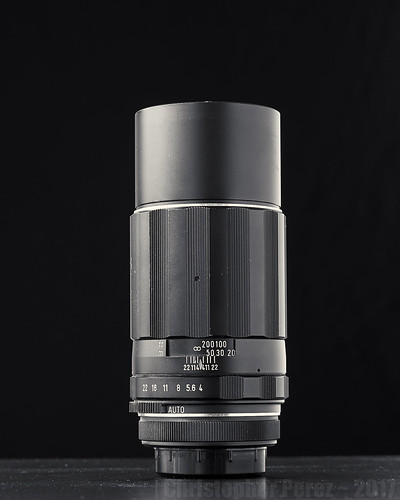
Lens Stories ~ Asahi (Pentax) Super-Takumar 200mm f/4

Lens Stories ~ Asahi Super-Takumar 200mm f/4


Just when I thought I'd seen the bottom of the old manual lens market prices I bid crazily low and rather late in an auction on a mint with sunshade, back bouchon, and original case 200mm lens.  I fully expected someone to snipe this out from under me.  Seriously.  My bid was that low.

Do I really need another 200mm lens?  No.  I have the pair of Nikon Nikkor 80-200mm f/4.5 N Ai lenses and they seem plenty sharp on the long end.  Do I need to add a different lens mount (m42 in this case) to my normal all Nikon F-mount line up?  No.  Not really.  Though adapters are cheap (4Euro thru Amazon plus shipping).  Do I really have room for another lens in the Toy Box?  Um.  Isn't there always room for something fun and interesting?

Well, as the Lens Gawds would have it, I now have another beautiful optic to add to the Toy Box.  Bid welcome to a very lovely Asahi (Pentax to many of us mortals living in the West) Super-Takumar 200mm f/4 lens.

After successfully rationalizing my insanity I compared it to the Nikkor zooms.  What I see is that the Super-Tak is narrower in diameter, of similar overall length, and lighter than the Nikons.  As it typical of nearly every Takumar I've ever handled the focus ring action is very smooth and silky where Nikon lenses sometimes feel "gummed up", sloppy (as on certain well used zoom lenses), and sometimes not quite as precise.

As for resolution, the Takumar and Nikkor lenses perform similarly in the center from wide open down through the f-stop range.  At the extreme edges where the Nikkor's fall off dramatically in terms of resolution the Super-Tak remains sharp.  Starting around f/8 I notice that chromatic aberrations tend to increase in the Asahi, however.  It's nothing that a little anti-CA fringing function in processing can't handle, but I was surprised to see it.  Perhaps there's a good reason manufacturers switched to ED glass once such things became available?  In any event, f/4 or f/5.6 and be there, says I.  It's a very sharp optic at those two apertures across the field.

OK.  So what the [blank] am I going to do with this lens?  I have no idea at this point.  Maybe I'll take to the track to photograph the MotoGP at le Mans in the spring.  Perhaps I'll take it back to le Mans to photograph the vintage races during la classique.  We shall see what we shall see.  I may need to secure a press pass so I can get closer to the track.

... and before I forget, I should tell you what this wee-beasty set me back.  How about 11Euro?  Might that do the trick?

Wednesday, December 13, 2017

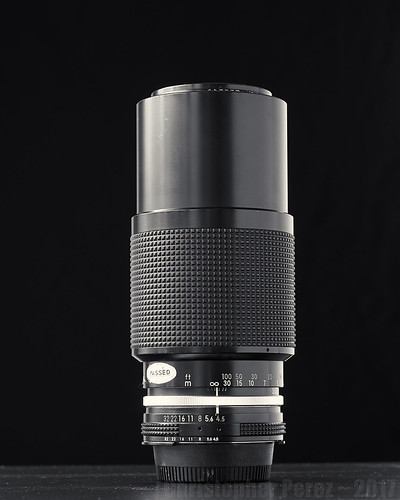
Lens Stories ~ Nikon Nikkor 80-200mm f/4.5 N Ai (in better condition)

Lens Stories ~ Nikon Nikkor 80-200mm f/4.5 N


As I've said before, I'm old, retired, and don't have too many safe things to do other than surf the 'net and find old unloved lenses and cameras.

There's not much to tell about this lens that I haven't already said about the other.  The Nikon Nikkor 80-200mm f/4.5 N Ai is sharper than it has any right to be.  It's large-ish and unwield-ish in that it can be a handful for this Old Man with shooting in fast changing situations.  It doesn't have a tripod mount so I've rigged up a way of resting in on a wood L-bracket I made.  In the hands of a younger person I can't imagine there being any problem using the optic and coming away with wonderful images.

What makes this lens different than my first copy is that I found this one after the prices on many old manual focus lenses had dropped through the floor.  Where something like this might've been tagged at 150Euro just a year or two ago, I picked this one up off eBay point fr for a whopping 40Euro.

The lens is in mint condition throughout.  It never seems to have bumped around someone's camera bag, nor does it look like it was much used.  Like my 75-150mm Nikon E-series zoom this lens looks like it was purchased and then ignored.  I couldn't believe it when I opened the box and found this 'beaut inside.

Thinking of the potential impact of owning two copies of the same lens, perhaps I need to start a new club or group of some kind?  Maybe I could call it the Unloved Secret Lens Society.  I'm not sure what we'd do, except sit around and talk about all the old great glass found for very few pieces of silver.  Oh, and to compare work we've made using these wonderful optics.  Over beer, of course.  Into the wee-hours of the afternoon, of course.  Before heading to home and hearth for a nice dinner, of course.

I have to admit I'm a True Sucker for pretty, old, cheap, sharp lenses.

Tuesday, December 12, 2017

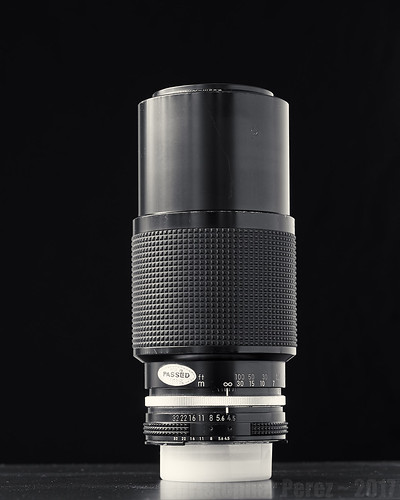
Lens Stories ~ Nikon Nikkor 80-200mm f/4.5 N Ai

Lens Stories ~ Nikon Nikkor 80-200mm f/4.5 N


Being old, retired and having not much to do but surf the 'net and get into trouble, I stumbled across an article by Ken Rockwell.  His comments were about a Nikon Nikkor 80-200mm f/4.5 N Ai.  It got me to thinking back to the time I bought a then new pre-Ai version out of Japan and had to sell it immediately because, honestly, I couldn't afford it, even at the then cheap Japanese prices.  I never got to shoot it so have no idea how it performed.

Returning to near present time and flush with money from the sale of one thing or another I surfed leboncoin point fr and found the zoom version M. Rockwell described.  It wasn't in great condition, but the glass seemed clean and clear.  The exterior showed that the lens had beat around someone's camera bag unused for years.

Of course I didn't realize the bottom was about to fall out of the market on these.  Up to this point I saw them sell for around 100Euro in good condition.  A the Photo Foire down in Bievre I'd see these sitting on the table for as much as 150Euro.  I paid 80Euro for the lens and hoped it would perform well.

A quick comparison  between this and a couple other lenses shows that, yes, Nikon's reputation is justified and that Ken Rockwell is correct.  This Nikkor is sharp from wide open across the field to about 7/8th's of the way out (when used with a Lens Turbo II focal reducer).  In the extreme corners the lens obviously falls off rather badly.  If I remembered to account for this I could easily get around the problem with a slight crop of the image.  If I avoid using the Lens Turbo II the Nikkor is sharp to the very edges of the frame (because the scene is cropped on APS-C compared to Full Frame).

In practice the lens is bigger and heavier than the cheap kit-zoom Sony 55-210mm f/4.5-6.3 SEL OSS.  Used on my much liked Sony APS-C mirrorless cameras the Nikkor can be a little unwieldy, particularly as I age.  The older I get the shakier I'm becoming, so a fast shutter speed and sufficient time to focus are necessities.  Since the zoom has a combined focus/zoom ring, focusing and not changing the field of view (zoom) can be a little challenging.  The more I use the lens, the fewer problems I have operating it.  Old Dogs can still learn, or so it seems.

One of the first times I took it out I went to la traversee de Paris.  This is where 600+ vintage and classic vehicles drive around Paris, kick up a bit of dust, and make themselves seen.  For me it's always a complex environment.  People are coming and going.  Cars are driving around.  Using an old manual focus lens can be very challenging, indeed.  Seeing something interesting, framing, focusing, and tracking as something changes position isn't easy.  Yet I feel I was able to come away with a few good things.
[example1, example2, example3, example4]

Monday, December 11, 2017

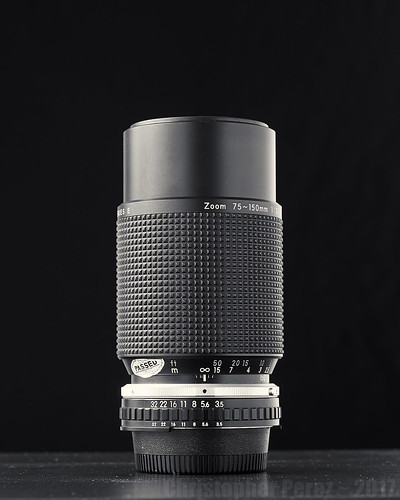
Lens Stories ~ Nikon 75-150mm f/3.5 E-series AiS

Lens Stories ~ Nikon 75-150mm f/3.5 E


I read somewhere that the much unloved and often ignored Nikon 75-150mm f/3.5 E-series AiS was actually an underground unsung favorite amongst fashion photographers.  The article suggested that the lens was just "unsharp" enough to smooth models skin and yet sharp enough to capture important details.  It was supposed to be one of those Goldie Locks lenses; it was reputed to be just right.

There had been a couple of these at the Photo Foire in Bievre over the years.  Remembering what I read I'd pick one up, look at it, move the zoom ring around, think, ponder, cogitate, and then sit the lens back on the table.  Asking prices seemed to be around 50Euro regardless of condition.  Most seemed more worn from bumping around a shop or a photographer's closet than from actual use.  That seemed the true measure of being unloved.

Finding one on eBay is easy.  The auction site is lousy with 75-150mm manual focus lenses of varying manufacture, too.  Everyone seems to have made their version, including Canon, Nikon, Kiron, Vivitar, Tamron, Tokina, etc.  Prices are nearly always low and it's not uncommon that a lens goes un-bid and gets relisted.

Just how unloved are these old 2x zooms?  I just found a Solitel for 6Euro Buy It Now. Makinon, Osawa and Hanimex are all under 12Euro Buy It Now.  I won't suggest that the optical designs and manufacturing are up to Nikon standards.  They are not.  If you look at cross-sectional drawings of the various 75-150mm lenses you'll see differences in design that may be visible in the way each lens renders an image.  Unloved equals cheap, or so it seems.  Bottles of no-name wine cost more than these lenses.

The subject of this story showed up on eBay point fr with very few lowball bids.  It was listed as being in excellent condition.  So, as is my usual habit when I'm interested in something, I bid late and bid low, fully expecting that someone would come along and snipe the auction out from under me.

Surprise! yet another lens won for the Toy Box.  This one set me back 35Euro.

When the lens arrived it was indeed in mint like new condition.  What a happy surprise.  When I compared it against Nikon Nikkor lenses of similar focal length I was very happily surprised.  Here is what I found.

Wide open the 75-150mm Nikon is less sharp than the 135mm Nikkor f/3.5 Sharpness King and less sharp than the 85mm f/1.8 K.  From f/5.6 on down through f/11, though, this cheap 75-150mm matches anything in the Toy Box.
[example1, example2, example3, example4]

So what was the comment about fashion photographers preferring the cheap E-series 75-150mm Nikon?  Where did it's underground cult status come from?  Did they really shot the lens wide open all the time?   I think I've stumbled on something rather interesting.

If you look at the aperture shape you'll notice a rather angular, ugly set of aperture blades.  But, there's Magic in this thar lens!  From wide open the out of focus rendition matches the performance of the 105mm and 85mm Nikkors.  In some ways as you stop it down the zoom exceeds the performance of the two fixed focal length optics.

That aperture is an ugly nasty shaped hole.  How is it possible, then, that the out of focus rendition might be better stopped down than the fixed focal length Nikkors?  What did Nikon do?  Surely they didn't deliberately design it this way.  It _has_ to be a fluke.

But there it is.  The out of focus highlights are amazingly absolutely flat disks.  No Funky Bubble Bokeh here.  Nope.  Not one iota of that weird stuff.  Magic, I tell you.  Serious juju.  Very serious juju.  All this for a rather modest price.

Friday, December 08, 2017

Lens Stories ~ Nikon Nikkor 135mm f/2.8 Q Ai

Lens Stories ~ Nikon Nikkor 135mm f/2.8 Ai


This story begins almost three decades ago.  It involves moving to Oregon, it involves a large company that no longer exists, it involves lunchtime conversations with people who became friends, and it involves a certain Ducati 860GT that swallowed a valve, bent a rod, and ended up in my hands after many years sitting idle.  This tale involves a lens, too.

I was on my way to Seattle to, hopefully, work for Boeing in their passive sensor group.  But before I could get there Tektronix, a company that used to be the center of what was called the Silicon Forest, made me a job offer.  Newly married and looking for a nice place to raise my first wife's children we ended up buying a house in the Portland area.

While my first wife's health slowly failed my work life was challenging in its own way, but it kept food on the table and a roof over our heads.  The division of Tektronix I worked for was sold and I interviewed very poorly at the new company and didn't make the transition.  Instead, I stayed at Tek and finally found a slot in the mid-range logic analyzer division.  Over the course of the five years I worked out at Walker Road where I made many new friends.

One of the guys I had lunch with on a regular basis talked about owning a Ducati that broke a valve, swallowed it, and bent a rod.  I was intrigued by the story of a decent motorcycle that was sitting untended.  My colleague didn't have the time to repair it.  So I paid him a visit.  In fact, I paid him many visits over the years.  Each time I'd pay homage to the Badly Wounded Ducati.

It must've been the alignment of the stars and planets, but one day my friend offered to sell the Ducati.  I jumped at the chance to own something I'd wanted ever since the very first time I rode a 1978 900SuperSport at 130mph down the Ortega Highway in southern California.  That bike belonged to an editor of one of the motorcycle magazines that I sometimes took photographs for.  The handling and pace of the Italian bike really captured my attention.

Granted, the 860GT didn't have the desmo valvetrain of the 900SS, and it had a two step ignition timing advance (instead of a proper curve that advanced the timing as the revs increased).  Still, this 860GT retained it's original Conti pipes which guaranteed it would sound glorious in a Concrete Jungle as I blasted thru.

A little more time, a new piston sleeve, a real 900SS crank set and the bike roared to life.

The former colleague and I have remained friends over the years.  Much of what we talk about, when we aren't talking bikes, is about cameras and photography.  He remains an absolute Camera Freak, even to this day.  In fact, he recently picked up a new Nikon D850.  Just because.  Oh, and he picked up a really nice Zeiss 135mm f/2 lens to go with it.  Which brings us back to photography and this Lens Story.

I lamented to my friend that I very much regretted letting a mint condition 135mm f/2.8 Q Nikon Nikkor go for practically little money.  I'm still not sure what got into me the day I sold it so cheaply.  Mint optics of just about any vintage can be difficult to come by.  Some days I'm stupid.  Other days I'm less stupid.  On that day I was particularly stupid.

Next thing I know, a nice little 135mm f/2.8 replacement ended up in the boite au lettre.  My friend explained to me that since he'd acquired the Zeiss he had no need for the Nikkor and he sent me his old lens.  For free.

That was rather kind of him, but I need to find a way to repay his kindness one day soon.

Thursday, December 07, 2017

Lens Stories ~ Nikon Nikkor 135mm f/3.5 AiS

Lens Stories ~ Nikon Nikkor 135mm f/3.5 Ai


Scrolling through videos on YouTube can pose a danger to the wallet.  Though, in this case, it's only mildly dangerous.  It's more of a mosquito bite on the wallet, not a full-blown black-adder poisoned-fang lethal bite, if you know what I mean.

Here's the video I watched that caused the mosquito bitten wallet.

Scanning the eBay point fr uncovered quite a few of the f/2.8 Nikkor 135mm lenses.  Indeed, they cost about what the Angry Photographer said they do.  For an old retired living off a fixed income kind of guy such things are way too much money.

The Angry Photographer has a different video where he talks about the Asahi/Pentax Super-Takumar 135mm f/3.5.  Those remain cheap, but that's not what caught my attention.  The thing that I paid particular attention to was that the Super-Takumar 135mm f/3.5 are four element in four group lenses and they are very small and light.  The only problem for me is that I have a Lens Turbo II focal reducer in Nikon F mount, and not in Pentax m42.  So I couldn't use a Super-Tak as anything but a 200mm full frame equivalent lens on my Sony APS-C mirrorless cameras.

I've had very good experiences with four element four group lenses.  For years I used a couple Kodak 203mm Ektars on 4x5 inch film.  They were incredibly sharp and very very contrasty, even though they are simple single coated lenses.  I also had and enjoyed several early Red Dot Artar lenses.  Same optical configuration, very similar results, that is to say they were very sharp and very contrasty.

When I found out that the Ai and AiS versions of the Nikon Nikkor 135mm f/3.5 lens implemented a four element four group design, I felt I had to give it a try.  But only if I could find one in my price range.  So the hunt began.

These days I've set my ceiling for lenses at 50Euro.  I feel I can live with the mosquito bite sized prices.  Anything more expensive than that bites into the Beer Budget.

Continuing my scan of eBay point fr I found one f/3.5 AiS Nikkor that looked to be in pretty good shape.  People weren't bidding it up, either.  It had a small dent on the side of the retractable lens shade and I wondered if that was scaring people off.  Normally a thrashed/well-used early pre-Ai version can sell for as little as 75Euro.  This multi-coated lens wasn't any where near those kinds of prices, so I bid late and bid low.

Et voila!  Scored for around 40Euro and another lens was added to the Toy Box.

I compared it against some of my other lenses and found that from wide open on down through the f-stops that this little, somewhat light-weight, multi-coated AiS 135mm f/3.5 lens is really the Cat's Meow.  It is amongst the sharpest lenses I own.
[example1, example2, example3, example4]

A bonus is that the out of focus rendition is really quite satisfactory, too.  It gives me nice flat out of focus highlights with none of that ugly, busy, nasty "bubble bokeh" that lesser lenses are prone to. 

This is quite an amazing lens.

Wednesday, December 06, 2017

Lens Stories ~ Nikon Nikkor 105mm f/2.5 Ai

Lens Stories ~ Nikon Nikkor 105mm f/2.5 Ai


I mentioned that I once had too many 85mm Nikon Nikkor manual focus lenses.  To solve the problem I put two up for sale.  Instead of selling the 85mm f/1.8 H I traded it for a Nikon Nikkor 105mm f/2.5 AiS.

Over the years I've tended to prefer 85mm over 100mm lenses.  The 85mm focal length felt somehow "natural" to me, where the 100mm lenses I owned never did.  The 100mm lenses felt too "tight" on a subject and didn't feel like it had much "depth".

It's only 20mm longer than an 85mm, but that small difference in focal length made this a challenging lens for me to use.  I constantly needed to take a few steps more steps away from my subject and, of course, I found myself in spaces with little room to move.  In the cases where there was enough room to step away from the subject the perspective was slightly, but visibly flattened.

So why this 105mm Nikkor in my Box of Toys?  With too many 85mm lenses and after having already sunk the original investment costs I thought it could be interesting to add another focal length to the kit for no monetary outlay. It would give me the opportunity to see once and for all if there was any magic in this lens, to see if there was that special "something" that I'd missed over all the years of using lenses and cameras.

In the history of 35mm lenses the 105mm f/2.5 Nikkor is legendary.  Steve McCurry used this kind of lens to make his famous image of the Afghan Girl.  Some folks on the internet consider the 105mm to be one of the best portrait lens ever made.  There seems to be a lot to recommend it.

In practice the lens is slightly sharper wide open than any of the 85mm Nikkors I've owned.  Stopped down, of course, there is no difference in resolution between most lenses as the sensor is the limiting factor until you reach the limits of optical diffraction around f/11 or f/16 (depending on sensor site size).  The field is flat and unlike the 85mm K Nikkor there are no Petzval-inspired "swirls" in the out of focus regions.

The lens might have felt critically sharp, clinically modern except for one thing.  The no-Petzval-inspired out of focus regions are incredibly smooth and creamy.  It looks like something from another age by the way it balances nice resolution against the way the sharpness falls off.    Perhaps the effect is a result of the simple four element three group design?

Modern computer generated optical designs are commonly much more complex than the 105mm Nikkor.  For example, Sigma's new 85mm f/1.4 Art implements fourteen elements in twelve groups.  While the Sigma is no doubt outstanding in nearly every measurable way, I'm finding I prefer the "look" of old simple classic optics.

I used to think the best out of focus rendering lens in my current collection of optical tools was the 85mm f/1.8 K.  Reconsidered, I find I'm wrong.  Of all the lenses I currently have and all the 35mm lenses I have ever owned this 105mm Nikkor f/2.5 AiS has the best out of focus rendition.  It's simply marvelous.
[example1, example2]

Tuesday, December 05, 2017

Lens Stories ~ Nikon Nikkor 85mm f/1.8 K pre-Ai

Lens Stories ~ Nikon Nikkor 85mm f/1.8 K


Lenses as tools of photography can gain status in various ways that enable or enhance the imaging process.  Some lenses are legendary for their resolution (Kodak Ektar, Schneider, Zeiss, Leica all come to mind).  Some lenses are prized for the way they "render" a scene.  Some people claim they can tell a lens "signature" which would be a give-away as to which lens was used in the making of an image (and on this point I've put a few of these people to the test and I think their claims are nothing more than bunk).  Other optical effects are more obvious.

A number of years ago a small part of the community of photographers re-awakened to the "swirling" out of focus area rendition given by old Petzval lenses.  In search of this effect eBay prices for the original 1800's lenses as well as lenses for much smaller formats like the Helios 40 and Contax Biotar lenses started climbing through the roof.  Even now when someone finds a lens that gives a Petzval-like effect eBay prices rapidly climb.  I'm thinking of old Russian slide projector lenses.

All this seeking for that "special" effect seems to me to be like looking for magic.  Maybe you can find it and buy it, but how does one use it?  In all my years of photography I have come across very few artists who create magical images using the magical effects of the Petzval.  One of these artists is named Alex Timmermans.  He uses the real thing and I find his images to be, well, magical.

Recently I looked in my Box of Goodies and found I had three 85mm Nikon Nikkor lenses.  One was a newer design f/2 Ai.  Another was an old pre-Ai single-coated f/1.8 H.  And the last is the subject of this article.  It's a Nikon Nikkor 85mm f/1.8 K (multi-coated) pre-Ai.  The first two lenses have found new homes, but the K is still with me.

This lens came by way of leboncoin here in France.  Someone offered it for what was at the time a rather fair price.  Normally I wouldn't see one for less than 250Euro, and at those prices the lenses were usually pretty beat up.  These lenses reputedly had that certain "magic" about them. They are legendary (or at least they were).  So I snapped this one up almost as soon as it had been posted.  And this is where I was reminded of carefully checking any piece of camera gear before hauling out my wallet.

The moment I returned home and had it mounted on a camera I realized that while the man who sold the lens might well have bought a f/1.4 Nikkor and had no need for the f/1.8, it one had sand in the focusing mechanism!  Ugh. The lens had spent too much time in the desert (though the glass is perfect - which reminds me of a story about a lens I bought years ago that had be sand blasted during a windstorm somewhere out in the desert southwest of the USA).  It meant I needed to disassemble the optic, clean it, and put it all back together.  I couldn't believe the amount of sand in the focusing mechanism.

Lesson learned; ALWAYS check ALL aspects of a lens before buying.

I went through all the effort required to get this lens in proper shape because this series of 85mm lenses is known for it's Petzval-like out of focus rendition.  It can give a "swirl" effect.  You see, I too had been infected by this weird photographic tool virus and the various claims to magic.

Using the old single coated H version of the lens showed that, indeed, the out of focus areas swirl on these Nikon Nikkor 85mm f/1.8 manual focus lenses.  But for learning how to use the effect, I have to work on it.  It seems that I have no talent for these kinds of special effects.
[example1, example2, example3, example4]

However, and this is indeed a very nice "however", when used on a Sony APS-C mirrorless and Lens Turbo II focal reducer, the Nikon Nikkor 85mm f/1.8 K gives almost the smoothest, creamiest out of focus rendition of any small format lens I've ever owned.  It's absolutely glorious.
[example1, example2, example3, example4]

Monday, December 04, 2017

Lens Stories ~ Pentax 85mm f/2.2 SMC Soft

Lens Stories ~ Pentax 85mm f/2.2 Soft


When I saw this lens come up on eBay recently I needed to ask the seller a question.  I wanted to confirm that this Pentax lens came in the Nikon F mount as it was listed. Pentax lenses come either in m42 thread mount or K bayonet.  I've never seen one with the Nikon mount before.

The Buy It Now price was less than they typically sell for (typically north of 200Euro) and the lens had failed to sell after several listing cycles.  While not exactly super cheap, it seemed somewhat reasonable to me so I picked it up for the BIN price.

I knew that if it really was a Nikon F-mount adapted lens that it would work on my Sony APS-C mirrorless cameras using a Lens Turbo II focal reducer and that it could be fun to work in a very different imaging mode.

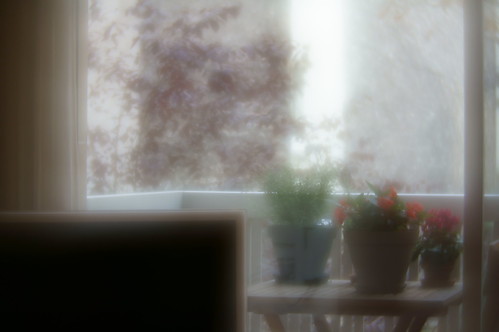
The "look" of this optic is unlike anything I've ever used.  Certainly it shares the soft focus effects of a class of lenses that have come in and out of vogue over the years.  But it is strikingly different in one key area.

While not exactly well practiced in the arts of using soft focus lenses, I'm not unfamiliar with the concept, either.  In the past I've owned several soft focus lenses for large and medium format film cameras.  These included a 180mm Fuji "soft", both the 250mm and 180mm Rodenstock "soft" (with strainer disks), a Portland Portrait single element lens (I wish I still had this one) that covered 8x10inch film, a Wollensak Verito (which I also wish I still owned), and the surprisingly beautiful 150mm Mamiya SF (with strainer disks).

Nearly the very first thing I noticed with the Pentax 85mm f/2.2 SMC Soft is that there is significant depth of field carried _behind_ the point of focus.  Indeed, a critical point of focus does indeed exist, but the out of focus rendering does not drop off anywhere near as quickly as other lenses.  It's a rather strange effect and one that takes some getting used to.

I asked folks on a couple lens discussion forums how the phenomenon is possible.  Alas, no one seems to know, though a couple people say they've observed the same effect.

Playing around a bit with where I focus the lens and where I set the aperture (which determines to some extent the amount of spherical aberration is put to the sensor) I think I've stumbled on a rather nice solution.  I've found that if I focus well in front of the subject the scene can be rendered beautifully and the background drops into a pretty haze of soft blur.  [example1, example2, example3, example4]

Several projects come to mind where this lens might be just the tool to be applied.  I love the way it takes shapes and light and shadow and makes them look like a painting.

Saturday, December 02, 2017

Lens Stories ~ Nikon Nikkor 50mm f/1.8 AiS "pancake"

Lens Stories ~ Nikon Nikkor 50mm f/1.8 AiS


Moments after I acquired the Nikon Nikkor 50mm f/2 H pre-Ai at the Photo Foire in Bievre I spied this little jewel tucked away almost under larger and longer lenses on another seller's table.

At first I thought it was the cheap, plastic, and commonly available series E Nikon.  I've owned several of those and while they are OK lenses, they failed to thrill me.  There was something about the images that failed to "pop", if you know what I mean.

The lettering on the lens that I dug out had it's front ring painted flat black, so it took a moment for me to sort out what it was I was looking at.  It was certainly a "pancake" lens.  And in this way it reminded me very strongly of the series E I originally mistook it for.  The lettering said "Nikkor", however.  No series E Nikon lens was ever labeled "Nikkor."  The moniker was reserved for Nikon's "pro" lenses, or so the story goes.

Thinking a bit more about what I was looking at I realized this must be a fairly late model Double Gauss lens.  I remembered seeing it on a lens chart somewhere.  It was certainly small and light.  So I asked the man behind the table combien?  40Euros came the reply.

Well, why not, then.  Even if I couldn't get the black matt paint off the label ring, it could still be fun to try.  Certainly it might be interesting to compare it against Nikon's much earlier implementation in the 50mm f/2 H that I already had in pocket.

Out whipped two more 20Euro notes and my wallet was getting lighter, but not by too much.  How often does a Lens Nut find a decent lens for 40Euros, let alone two at that price?  OK.  OK.  Indeed, a patient person can find these lenses for a single 20Euro note.  I guess I'm not exactly patient.

It took some time, a little ETOH (denatured), and a lot of scrubbing and rubbing with Q-tips but the gross matt black is mostly gone, now.  While the lens will never be as pretty as the day it left the factory, it's certainly not bad to look at and it's image quality is a surprise.

Comparing it against its older brother, the f/2 H, I see that Nikon re-implemented the Double Gauss design.  That is, the implementation seems to be an update.  Perhaps they used different glass?  Perhaps they reshaped the lens elements?  Whatever they did, this f/1.8 AiS is a very different animal.

To start with, while not as wickedly wickedly sharp wide open as the f/2 H, the f/1.8 is merely wickedly sharp and has a much flatter field from wide open.  What it ever so slightly misses in terms of resolution at f/1.8 compared to the older f/2 is not easily seen, even when pixel-peeping.  Wide open the resolution differences are very subtle.

Considering the out of focus rendition, the AiS "pancake" is on a level of it's own.  It's down right gorgeous for a 50mm lens.  I've owned far too many 50mm lenses in my life and have always felt they suffered from "jittery", "ugly", over-corrected out of focus renditions.  Not this lens.  It's surprisingly wonderful.  It is smooth and creamy where the old f/2 H is "soap-bubbly", "jittery", and "ugly". [example1, example2, example3, example4]

Stopped down the f/1.8 AiS is every bit as sharp and contrasty as a modern aspherical objective.  I'm not sure if what I heard is correct, but perhaps the old f/1.8 AiS continues to be manufactured in the form of Nikon's 50mm f/1.8 AF.

Coupled with a Lens Turbo II focal reducer adapter this Nikon Nikkor 50mm f/1.8 AiS practically lives on my Sony APS-C mirrorless cameras.  It was my "go-to" lens during a recent trip to St Malo, Dinand, Dinard, and Mont St Michel.

In fact, I like the overall rendering so much that my newer aspherical AF lenses are presently sitting unused.

Friday, December 01, 2017

Lens Stories ~ Nikon Nikkor 50mm f/2 H

Lens Stories ~ Nikon Nikkor 50mm f/2 H


Visiting this year's Photo Foire out in Bievre turned out to be a very dangerous thing to have done.  I found this lens for 40Euro.

The lens in question is a Nikon Nikkor 50mm f/2 H pre-Ai.  I bought it after the man showed me a nice minty Ai version, but wanted 80Euro for it.  When I balked at the price he handed me this one and said 40Euro.

OK.  That's fine.  Two 20Euro notes lighter and I had this very small very light weight lens in my pocket.  Yes.  I know.  These can be had for just one 20Euro note.  Impatience will do that to a guy an make his wallet lighter quicker.

The reason I looked for this kind of Nikkor is that it was first built in the late 1950's and implements the by now very classic Double Gauss six element in 4 groups design.  The Double Gauss design itself dates to the latter part of the nineteenth century and was a modification made by Bausch and Lomb to an original Carl Zeiss design from the early part of the nineteenth century.

The design has given rise to some of the finest lenses ever made.  Zeiss, Schneider, Nikon, Mamiya, and nearly all photographic lens manufacturers have built something to this specification.  Plasmat, Xenotar, Biotar, Dallmeyer Super Six, Xenon, Ultron, Ektar, Super Speed Pancro, and Summicron are just a few of the Double Gauss design trade names sold to photographers over the years.  I loved my old Xenotar lensed Rolleiflex TLR's.  The image quality is world renowned.

The Nikon Nikkor 50mm f/2 implemented the classic design with minor modifications.  The forward three elements are slightly larger than the rear groups.  I read somewhere that this was done to compensate for the mirror of the Nikon F series SLRs the lens was made to fit.

Faster versions of the design (ie: f/1.4, f/1.2, f/1.0) are all derivatives of the basic layout.  But the faster versions break from the six element four group implementation by splitting various groups into more, separate elements.  That's why these faster lenses are more complex and seem to have more trouble controlling the various aspects of scene rendition.  Wanting to avoid the increased optical complexities of very fast lenses I sought out the f/2 for it's simpler, basic, classic implementation.

In practice and when used with a Lens Turbo II focal reducer on my Sony APS-C mirrorless cameras the lens is wickedly sharp in the center and contrasty across the field from wide open.  It's sharper wide open than the f/1.4 pre-Ai version at f/2.  The corners are a soft wide open, but some of this comes from field curvature.  In any event the corners clean up fairly well by f/4 or f/5.6 where the field flattens out.
[example1, example2]

The only fly in the ointment is that the highlights are soap-bubble shaped in the out of focus regions.  This is commonly referred to as "bad bokeh".  If memory serves, a Zeiss whitepaper I read some years back suggested that soap-bubble out of focus highlights are caused by over correcting a lens in the out of focus regions.  While I'm not crazy about soap-bubbles, there are lenses that sell for a great many pieces of silver which specialize in soap-bubble effects.

Disaster struck one day when I went to remove a camera from a bag.  The camera strap caught this little lens and flung it across the closet.  Even though the lens was wrapped in a protective cloth and even though the drop wasn't all that far, and even though the lens cap was the first thing to hit, the front rim of the 50mm f/2 was slightly turned.

I checked the resolution after the fall.  There seems to be no change in sharpness nor in overall optical alignment.  Still, I feel ill thinking about having dropped this wee-beasty.  It's only the second lens I've ever dropped.

The first lens I ever dropped was a Canon 200mm f/3.5 FL which I stupidly let slip off my shoulder during an F1 practice session back in the day when the Circus ran at Long Beach.  But that's another story for another time.

Thursday, November 30, 2017

Lens Stories ~ Nikon Nikkor 28mm f/3.5 Ai

Lens Stories ~ Nikon Nikkor 28mm f/3.5 Ai


After the arrival of the 24mm Nikkor I re-realized that Photographic Tool Acquisition is a rather slippery slope.

I say re-realized because hundreds and hundreds of lenses and cameras have passed through my hands over the years.  Hundreds, I tell you.  It's either something to laugh about or to be suspicious of.  What on earth have I done with all that glass?  When I think of the beautiful pieces of gear I've owned, sometimes I nearly weep for not having kept them.

After picking up a few lenses for around 40Euros the Lens Acquisition Bug hit.  Again.  For the 'um-teenth time.  It's a recurring illness.  It's Madness.

This time the parameters of my buying and buying and buying is based on a simple principle: Find the very finest manual focus lenses I can for less than 50Euros.

Recently I've noticed that the bottom of the old lens market has started falling out.  There are some brilliant things to be had for just a few shiny pieces of silver.

My current system is built around Sony APS-C mirrorless cameras.  Manual focus lenses are fitted by way of either a Nikon to NEX straight-thru adapter or a Lens Turbo II focal reducer.

The focal reducer keeps the field of view that a lens would have on a full frame camera by reducing it to fit an APS-C sensor.  In this way I can achieve the full frame 35mm imaging "look and feel" on the smaller sensor system.  But as I've previously noted, not all lenses behave well in the corners when adapted using the Lens Turbo II.  There are limits to this Madness.

Trolling eBay point fr one day I found a 28mm Nikon Nikkor f/3.5 Ai.  It seemed to be in good condition, but folks weren't bidding much on it.  As the clock ticked down I jumped in with a rather low bid.  It stuck.  Now I'm stuck (happily, it turns out) with a 50-ishEuro lens.

I never considered the 28mm f/3.5 as it's an old old design.  It's so old that it is perhaps the first retrofocus design implemented by Nikon for the F-series SLRs.  While Nikon is proud of its achievement, I wasn't sure if it would be sharp.  The maximum aperture was rather slow, too.  A few 'netizens have suggested the f/2.8 and f/2 versions are better.

For so little money it didn't seem like it was such a bad thing to see how it worked.  If I didn't like it, I could flip it and not be out much (if anything) on the deal.  Ah, the Glories of Rationalization.

Once in hand I took a fairly close look at it.  This lens is wickedly sharp from wide open in the center.  And the corners clean up nicely by f/8 or f/11 when used with the Lens Turbo II.  It seems like it's every bit as good as a modern aspheric design lens of similar field of view that I own.  This out of lens design that dates to the late 1950's.

I like the lens well enough that it's become the primary optic for a series of images I'm currently working on.  Here's an example of what I'm doing with this sweet little optic.


Heavenly Music ~ Paris, France

Wednesday, November 29, 2017

Lens Stories ~ Nikon Nikkor 24mm f/2.8 AiS

Lens Stories ~ Nikon Nikkor 24mm f/2.8 AiS


When we moved to France I brought a number of old manual focus Nikon lenses.

One of the lenses in the batch of Fun Things was a 24mm f/2 Nikon Nikkor Ai.  I never used it and sold it.  The reason is I didn't like it.  It was soft wide open and I wasn't convinced that it could match the image quality of the inexpensive AF lenses I used at the time.

After watching a Joel Grimes portrait lighting video I saw that he used a 24mm lens to great effect.    The idea of using an old manual focus lens for portraiture was suddenly attractive.  I felt the desire to try another 24mm full frame lens.

I have two autofocus wide angle lenses that I could use but don't like using AF lenses with their manual focus function "focus by wire."  Justification and rationalizing comes easy to me.

Scanning le bon coin one day I stumbled on a 24mm f/2.8 Nikkor.  The price seemed correct when compared against eBay completed auctions.  After firing off an email to the lens' seller we made arrangements to meet so I could view the object en vente.

The Nikon Nikkor 24mm f/2.8 AiS is a pretty little thing.  It's relatively small and light for a lens that comes mounted in real metal (as opposed to plastic that tends to be used in current AF optical implementations).

The f/2.8 version of the Nikon 24mm lens is most definitely sharper and more contrasty in the center than the f/2 I sold.  But, and this is a huge "but", the corner performance suffers to the extent that it is unusable on my APS-C Sony mirrorless cameras when mated to a Lens Turbo II focal reducer.  Stopped down to f/8 and f/11 the lens never cleans up in the corners.

Ugh.

Mounting the 24mm Nikkor on a straight-thru adapter turns the effective focal length into a 35mm f/2.8 lens on my tiny Sony APS-C mirrorless.  This isn't exactly what I intended.  If I wanted a 35mm lens, I'd prefer to have my old Nikkor 35mm f/2 back.  I foolishly sold the 35mm when I went through a fit of "downsizing" my Collection of Photographic Tools.  Though, I suppose, I could wait until full frame Sony mirrorless prices descend from un-obtainable to somewhat affordable and use the 24mm lens on that.  Someday.  Maybe.

I feel "stuck."  Again.  This is a lens I really want to love.  Yet, here is another 24mm Nikkor that, for one reason or another, I can't use as I intended.


Sunday, November 26, 2017

When everything conspires to succeed...

My father and brother were scheduled to come to Europe on vacation.  Unfortunately my father broke a leg as he was "buttoning up" his home before the trip and they couldn't come.

My wife and I were left with train tickets and hotel reservations to deal with.  We canceled what we could, but we prepaid several things we couldn't back out of.  So we decided to use what we'd already paid for.

Our destination was the beautiful town of St. Malo which is out on the western edge of France in celtic Bretagne.  We'd been there once before, but I was sick that time and wasn't able to fully enjoy the adventure.

It'd been over a year since I'd acquired my French driver's license, so we decided to test it out by renting a car.  Usually we take public transportation everywhere.  We get to see things in relative comfort and ease.  But renting a car would require my attention be diverted and directed in a very different and stressful way.

The day after we arrived we set off for Dinan.  It's an incredible little village that still retains much of its medieval character.  The next day we visited the nearby town of Dinard.  It's a place rich in big old houses that the rich built to create a seaside playground for themselves.  On our final full day, we drove to Mont Saint Michel.

The old monastery is well known for the way it sits on top of a granite rock island.  Iconic photos of place at dusk or sunrise are easily found all over the internet.  Our visit was in broad daylight and I hoped to find a way to share a different perspective of the place since we'd be lacking the drama of the edges of the day kind of light.

Once inside the cathedral at the top of the hill I saw the windows were ablaze with sunlight.  Standing toward the back I took a series of images in the hopes of stitching them together later.  Unable to see the final result in-camera and on-site reminded me of the many years I shot film.  I would have to wait to see if what I saw and felt had been adequately captured.

Once home I opened Capture One and worked on the cathedral images.  I tried to match the exposures and curves between each of the image segments.  I've found taking care of such things sometimes helps in the stitching step.  Files were written out as 8 bit TIFFs and opened in Hugin.

Hugin is an open source image stitching and alignment software.  I recently experienced several failures using Hugin in that it doesn't always align all elements of a scene correctly.  So you can imagine my surprise when the resultant file from Mont St. Michel turned out to be perfectly aligned across the entire file from the very first stitching attempt.

Next I opened the Gimp (another open source software and one that I've been using for over a decade), added a little vignetting, and lightly modified the luminosity of various regions.  As I wrote the final image out to a new file I realized the long dimension was well over 12,000 pixels.  There is a lot of useful and beautiful information in the image.

I feel I have successfully captured something unique.  No, it's not the iconic view of the medieval community, but it is uniquely mine, what I saw, and I think it's beautiful.

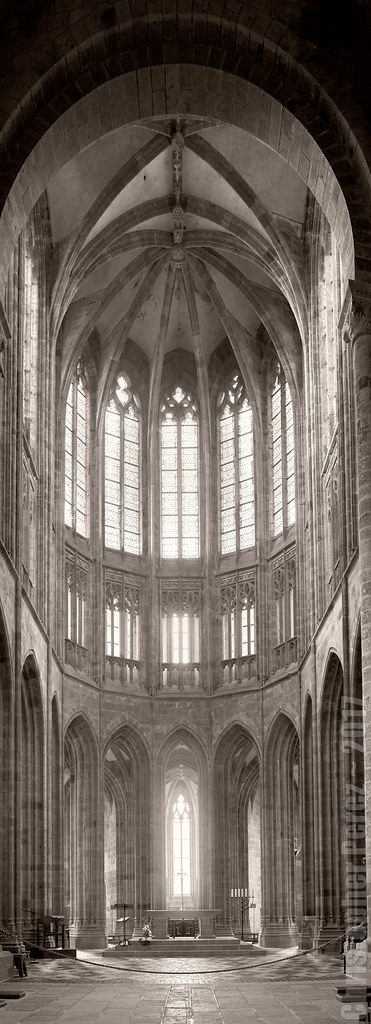
Mont Saint Michel ~ France ~ 2017

Friday, November 24, 2017

Other Optical Properties ~ contrast between new and old lenses

There is, of course, much more to lenses in photography than just resolution (what we usually call "sharpness").  I've spent many many blog posts sharing what I've found in that regard.  It is time to look at a different aspect of optics, cameras, and photography as tools.

Recently I've taken to working with Nikon lenses that in some cases are more than 50 years old. The resolution of the lenses match that of my modern lenses.  They are all manual focus and change my approach to image making by slowing me down.  After seeing some initial images, I was thrilled.

Without any direct evidence I felt the old Nikkors were more "contrasty".  Again without any direct evidence and without understanding how such a thing could be possible I felt that new lenses somehow gave lower overall "contrast" but better "micro-contrast" than the old optics.

Thinking about this a bit, I devised a small comparison.  Here is what I did.

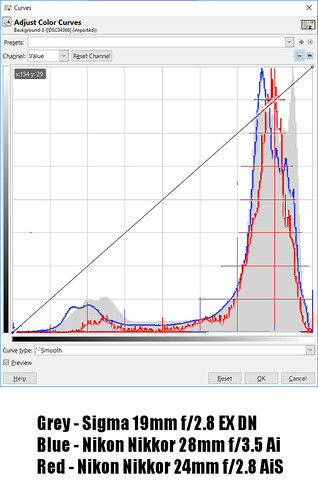
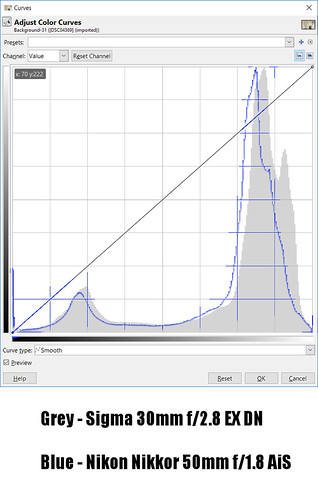
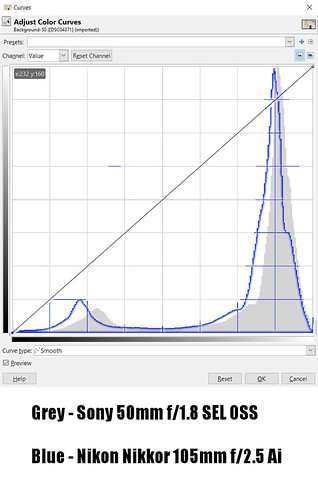
I photographed the same scene with matching in-camera cropping using new and old lenses.  Then I found a way to overlay the RGB/Luminosity "curves" to  compare how lenses handled the light range.

The lenses I looked at were -
  • Sigma 19mm f/2.8 EX DN
  • Sigma 30mm f/2.8 EX DN
  • Sony 50mm f/1.8 SEL OSS
  • Nikon Nikkor 24mm f/2.8 AiS
  • Nikon Nikkor 28mm f/3.5 Ai + Lens Turbo II
  • Nikon Nikkor 50mm f/1.8 AiS + Lens Turbo II
  • Nikon Nikkor 105mm f/2.5 Ai + Lens Turbo II
All lenses were shot at f/5.6.

After photographing the scene I found I needed to match where the top and bottom of the "curve" touched the data recorded by the camera.  I needed to do this because the exposure system in the camera never exactly matched lens to lens, frame to frame.  This step is also rather important to my understanding of what's going on, as we will soon see.

Here are the results -

Curves Overlays ~ various lenses

Curves Overlays ~ various lenses

Curves Overlays ~ various lenses

To begin with, the old manual focus lenses seem to in general place image information slightly lower than modern optics.  The highlight and shadow peaks are consistently behind where the new Sigma and Sony lenses place them.  Could the be an effect of the camera system taking a slightly different path to calculating exposure?  Instead of balancing aperture, shutter speed and ISO, with manual focus lenses only the shutter speed and ISO are directly controllable by the system.

Additionally, I see is that with the shorter focal length lenses there is a slight difference in how the highlights are rendered.  The highlight portion of the curve is broader with the new Sigmas than it is with the old Nikkors.  The longer lenses, on the other hand, appear to have nearly identically shaped curves.  Are the differences in curve shape in the highlights due to optical properties or by the way the camera system, again, calculates exposure by moving the highlight peak up the curve and thereby "spreading" the peak?

Then when I think about how I generated these illustrations in the first place (trying my best to match where the tops and bottoms of the curve first encountered recorded information).  I quickly understand that it is entirely possible to more precisely match the shapes of the curves between any of the lenses.

Even without answering my questions about how the Sony NEX/Alpha cameras calculate exposure with fully automated and old manual no-aperture controlled lenses, I think I can safely share an interesting outcome of little comparison:  After processing there is no meaningful difference in how new and old optics send light to a sensor.  Said another way, in terms of "curves" shape I feel it is very likely possible to make a new lens "look" like and "old" one, and vice versa.

As for what started me down this path, that the old Nikon Nikkor lenses were more "contrasty" than modern optics, and that modern optics were somehow better able to render "micro-contrast", I see no evidence to support my feelings and earlier thoughts.

This is why I take the time to look at these kinds of things.  I learn something nearly every time I take a deeper look at photographic tools.

Wednesday, October 18, 2017

Optical vs Filter "softness"

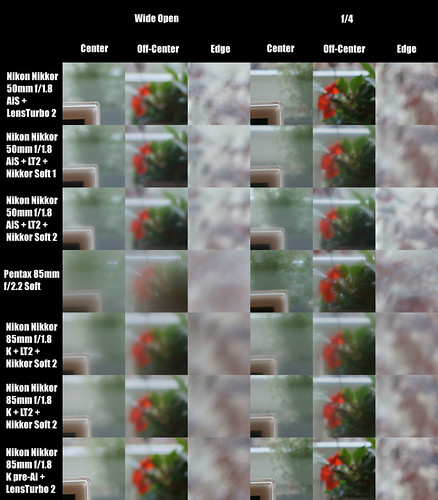
As I'm still somewhat obsessed with the topic of "softness" and trying to learn what I can, I thought I'd take a look at comparing the optical "softness" rendered by the Pentax 85mm f2.2 SMC Soft to the Nikon Nikkor 50mm f/1.8 AiS and 85mm f/1.8 K pre-Ai with two Nikkor soft filters numbers 1 and 2.

Here is the comparison (as always, follow the link, find the all sizes images, and look at this at 100 percent to see everything there is to see).  Please note that the second to last comparison should read "... Nikkor Soft 1".  The comparison will make more sense.

Pentax Soft and Nikkor Soft Filters


What I see is that the Nikon lenses with the Nikkor soft filters simply add softness to the image, just as we would expect.  The number 2 Soft filter is, again as expected, gives a stronger softness than the number 1 filter.  In terms of softness, the number 2 filter more closely approximates the Pentax lens when both lenses are shot wide open.

It may not be entirely clear by looking at the above comparisons that the Pentax 85mm f/2.2 SMC Soft distorts the image in ways that the Nikkors deliberately avoid.  I should, however, be clear that changes in the aperture affects the "sharpness" of the subject focused on to a greater degree than it does out of focus areas around the edges.

Further, as previously noted, the depth of field of the Pentax lens does not appear to change with aperture changes.  This behaviour is dramatically different from the Nikon lenses where the depth of field changes as the aperture changes.  This difference in depth of field behaviour should be clear in the above comparison.

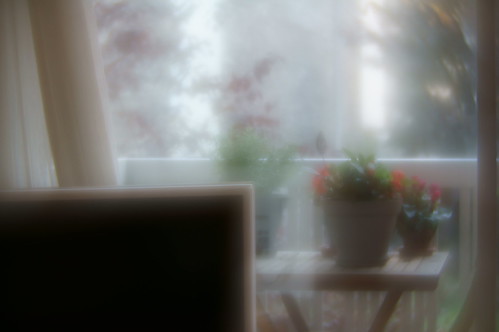
To illustrate what I mean when I say the Pentax lens distorts the scene, here are two photographs that show the difference between the Pentax 85mm f/2.2 SMC Soft and the Nikon Nikkor 85mm f/1.8 K pre-Ai with a Nikkor number 2 Soft filter mounted on the front.  The level of "softness" is similar, but the way the images are rendered are very different.

Nikon Nikkor 85mm K f/1.8 Soft Filter #2
Nikon Nikkor 85mm f/1.8 K pre-Ai at f/1.8
with Nikkor #2 Soft filter


Pentax 85mm Soft f/2.2
Pentax 85mm f/2.2 SMC Soft at f/2.2

Wednesday, October 11, 2017

Out of Focus Rendition ~ a quick look at a few Nikkors and one Sony

Before the Strange Beasty Pentax 85mm f/2.2 Soft landed on my doorstep, I took a look at the out of focus rendition (OFFR) of various lenses that I have on hand.

Here is the incredibly boring but sufficient to the task scene.  It was taken with a Nikon Nikkor 85mm f/1.8 K pre-Ai shot wide open.

Nikon Nikkor 85mm f/1.8 K


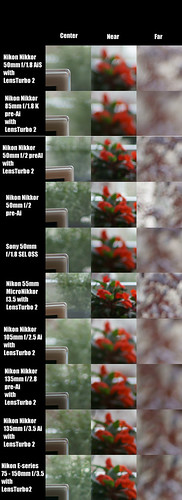
Here is the comparison (follow the link and head to the files to select the largest, and then view it at 100 percent to clearly see what I will describe in just a moment).  All lenses were shot wide open.

Bokeh Studies


Organizing my comments by ranking these lenses from doughnut shaped OOFR to the smoothest -

  • Nikon Nikkor 50mm f/2 H pre-Ai
    [huge gap in OOFR]
  • Nikon Nikkor 50mm f/1.8 AiS
  • Nikon E-series 75-150mm f/3.5 AiS
  • Nikon Micro-Nikkor 55mm f/3.5 pre-Ai
  • Nikon Nikkor 135mm f/3.5 AiS
  • Nikon Nikkor 135mm f/2.8 pre-Ai
  • Sony 50mm f/1.8 SEL OSS
  • Nikon Nikkor 85mm f/1.8 K pre-Ai
  • Nikon Nikkor 105mm f/2.5 AiS
Looking at the old double gauss 50mm f/2 H OOFR I see what a Zeiss whitepaper on optical design described as over-corrected rendition.  Before I say the OOFR is "horrible" I would like to note that some people love the soap-bubble rendition.  Recently a manufacturer started selling lenses that deliberately give this effect, so who am I to judge?

What's interesting to me is that the more current implementation Nikon Nikkor 50mm f/1.8 AiS gives a much smoother OOFR (hence the previous note about a "huge gap in OOFR").  Looking at cross section diagrams of the two lenses (the f/2 vs the f/1.8) I see the classic double gauss implementation.  They look to be identical and I would've thought their performance to be more comparable, yet it's clearly not.

Further, if I'm correct in thinking about the cross section diagrams of the other lenses I compared here, all but one (the 75-150 E-series zoom) are in one form or another derivative double gauss designs.

If the goal is to find lenses that give smooth OOFR (that is to say, lenses that melt the OOFRs into creamy smoothness), then all but one (the Nikkor 50mm f/2 H) meet the criteria of "goodness".  The standout of the short, "standard" focal length lenses is the 50mm f/1.8 AiS.  It's OOFR is the best of any 50mm lens I've ever owned.  This one is a "keeper."

One surprise is the performance of the Micro-Nikkor 55mm f/3.5.  Yes, the aperture is somewhat small at f/3.5 so the depth of field is not razor thin when shot wide open.  Yet the OOFR is creamy smooth.  It's really quite interesting to see and might be very usable for shooting portraits where the nose and eyes are in focus.

Another surprise is the 75-150mm f/3.5 E-series zoom.  I read somewhere that this lens used to be a favorite of fashion photographers back in the day.  It was considered a "sleeper" lens, and I can see why.  This is a great lens for OOFR at _all_ apertures.  I don't understand it.  The aperture blades do not form a circle, yet the OOFR remains creamy and smooth all the way down thru f/11.  I'm not convinced Nikon designed the lens this way (it's cheap and not otherwise widely regarded), but the effect is clear.

The sharpest lens in the group when shot wide open is the 135mm f/3.5 Nikon Nikkor AiS.  Period.  There are not enough superlatives to explain just how brilliant the lens is.  The OOFR, however, is not quite as buttery-smooth as it's sister the f/2.8 135mm Q.

Stuck in the middle of all these Nikkors is a little Sony 50mm f/1.8 SEL OSS.  The link has disappeared, but there was a page out on the 'net that showed the Sony to be the equal of new Leica lenses.  Well, it's true (in my experience, at least).  The OFFR, too, is really quite outstanding.  For portraiture on APS-C Sony mirrorless this lens is a "keeper."

The 85mm f/1.8 K gives very nice OOFR and lightly "swirls" the background (ala Petzval).  I would've claimed it the winner in my OOFR comparison except for one lens.  And that lens is the 105mm f/2.5 AiS.  It is the smoothest-butteriest (how's that for making up  new words?) OOFR lens I currently own.  It's reputation appears to be well founded.

Prices on old manual focus lenses seem to be dropping.  Perhaps the market is finally saturated with lenses, new and old?  In any event, to stock up on optics to perform this comparison cost me very little.  The 50mm f/2 and f/1.8 lenses are commonly found for between 25Euro and 50Euro.  The 75-150mm E-Series, the 135mm f/3.5, and the 80-200mm f/4.5 lens (not compared here) were _all_ picked up in mint condition off eBay for around 40Euro each.  The 105mm f/2.5 AiS came as a trade for an 85mm f/1.8 H I had and cost me nothing.  The 135mm f/2.8 was very kindly given to me by a friend who picked up a Zeiss 135mm f/2.

In the end, this comparison is about finding many great lenses with wonderful OOFR, while, at the same time, costing next to nothing.

Monday, October 09, 2017

The Case of the Curious Optical Effect...

Something strange happened on the way to experiencing "softness" nirvana.  I've stumbled across an optical effect that I can't explain.

In optical designs I'm familiar with, "depth of field" increases as an aperture size is decreased (stopped down, as it were).  That's the commonly expected effect and is partly why lenses often come with aperture controls.

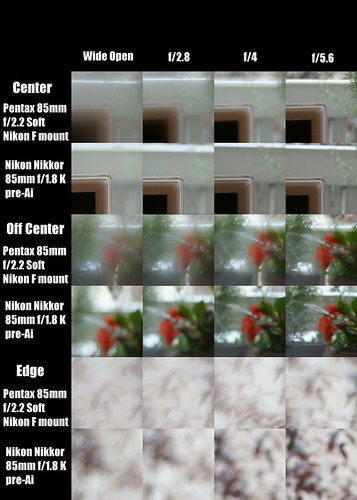
After looking at Jim Galli's soft focus large format images and thinking about how I might achieve similar effects in APS-C digital without returning to large format film, I stumbled across a small Pentax 85mm f/2.2 Soft in a Nikon F mount.  I'd never seen this lens in Nikon F, so I picked it up for not a huge sum of money.

Today I performed a quick comparison between the Pentax and my Nikon Nikkor 85mm f/1.8 K pre-Ai.  I was looking forward to shooting the Soft wide open and controlling the depth of field by stopping the aperture down a bit.

Looking at the comparisons and after the noting that the spherical aberrations decrease with aperture size (as expected), I noticed that the circle of confusion (said another way, the out of focus rendition) did not seem to change with the aperture.

What's going on here?  I have a mystery on my hands.  Perhaps one of my readers can help explain the optical effect?

Pentax 85mm f/2.2 Soft, Nikkor 85mm f/1.8 K Comparison


Here is a Nikkor "control" image where the 85mm f/1.8 K was shot wide open.

Nikon Nikkor 85mm f/1.8 K


Here is the Pentax 85mm f/2.2 Soft at f/2.2.  As you scroll through the images, look at the "size" of the out of focus bright area situated between the green plant in the center and the red flower just to the right.  You can also look at the "size" of the leaves in the background (upper left region).

Pentax 85mm Soft at f/2.2

Here is the Pentax 85mm f/2.2 Soft at f/2.8.

Pentax 85mm Soft at f/2.8

Here is the Pentax 85mm f/2.2 Soft at f/4.

Pentax 85mm Soft at f4

Here is the Pentax 85mm f/2.2 Soft at f/5.6.

Pentax 85mm Soft at f5.6

Thursday, September 28, 2017

Black and White ~ in portraiture

After learning about how to correctly emulate black and white film using a digital file, I've been wondering about all the different ways of applying this new (to me) knowledge.

One of my favorite subjects is people.  I've worked with creative costumers in Steampunk, Tribal Fusion, and Victorian Gothic communities in the US and Europe over the past 15 years and enjoy it.  While most people I work with are wanting something "unique" (meaning colors and textures and "interesting" lighting), I've had it in the back of my mind that I'd like to explore the late 1800's imaging esthetic.  A good example of the goal I would like, someday, to shoot for is the style of the work of Alex Timmerman.

Taking an image from a series of photos I did recently with Hua Costumes, I set about seeing how a black and white treatment might be approached.

Here is a processed color version of the image in question.

Vampire photoshoot ~ Hua Costumes


And here is the black and white conversion.

Hua Costumes ~ in B&W

By desaturating the color file, making sure the blacks are deep enough and that there is plenty of detail in the highlights, I simply moved the center of the "curve" up a little.   That is to say, I made the mid-tones lighter.

I could have combined this technique with the black and white filter selections to lighten or darken the skin (red/yellow to lighting, blue to darken).  In this case lightening the skin seemed to ruin the effect I was looking for and darkening the skin seemed to turn it to mud.

The reason I mention skin lightening/darkening is that this is what I was required to pay close attention to when I worked in a photo lab making black and white prints in Hollywood.  The images were used in the local parade of the stars tabloids and lightening the skin-tones hid many of the star's natural blemishes.  High-key skin tones were all the rage at the time and the approach seems to be well entrenched in image making, even today.

Which brings me to another point about converting color digital files to black and white for portraiture.  The skin tones do _not_ need to be high-key for an image to be effective.  In fact, I rather like having tone and texture in the skin.  It can give an image a sense of depth and dimension (roughly the saying the same thing, isn't it?).

Here is an example of deep skin tones.


This image was made during la Traversee de Paris Estivale 2016.  The gent was driving a very early deDion Bouton and he was well dressed for the part.  I shot this against a very bright sky using an old manual focus (therefore rather difficult to focus in rapidly changing situations) and extremely sharp Nikon Nikkor 80-200mm f/4.5 that was mounted on a Sony A6000 body.  The camera metered for the highlights (fortunately) and this kept the sky from "blowing out."

Once again using the technique of raising the mid-tones when converting a color digital file to black and white I was able to bring the darker areas of the scene up to what you see here.  The skin is obviously darker than in the images from the Hua Costumes vampiress shoot.  Yet to my way of looking at this image, the darker skin tones don't seem at all out of place.

In summary, it appears that deep, richblack and white portraiture that emulates the beauty of film can be achieved.  The more I work at this, the more I'm liking what I see.