I haven't said much about the importance of digital sensor size in my little look-see into soft focus lenses and filters. I've been measuring everything up to this point using a Full Frame Sony. As a spot-check I had a look at how things measured up on Sony APS-C.
Returning to a pretty little Ricoh Auto-Rikenon 50mm f/2.8 four element three group tessar design first element focusing lens for a moment, I find the optic is sharp from wide open and is well-corrected across the field. It's really difficult to use first and second element separation to induce and control softness in this one. I believe it to be a Cosina re-badge as it appears to be found under any number of 3rd names. If you can't afford a Carl Zeiss Jena Tessar 50mm f/2.8, try one of these. It's simply brilliant for normal work.
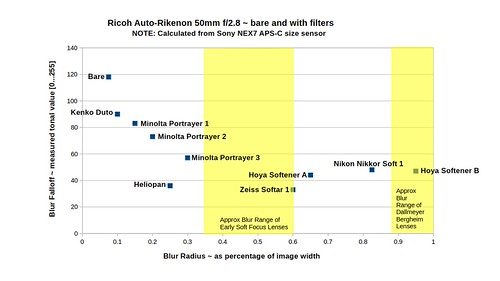
Here's how to read the following graphs. Please keep in mind that these are for Full Frame digital. APS-C is slightly different from Full Frame, as we will now see.

Comments ~
There are (at least) two things I note.
First, Blur Falloff tracks between Full Frame and APS-C, but, as expected, Blur Radius does not. APS-C Blur Radii measure larger than Full Frame. The radius difference is easily calculated based on the physical sensor size differences and is verified in practice (direct measurement).
Second, Blur Radius vs Blur Falloff slide left on my graphs as the aperture is stopped down. This, too, is to be expected. The scene sharpens up and the depth of field increases, reducing optical imperfections and changes soft filter contribution.
This lens is perhaps a little too well corrected for trying to match early Pictorialist era print softness.

No comments:
Post a Comment