Sunday, February 27, 2022

Rawtherapee "Capture Sharpen" ~ showing my homework

Here is the second of my "show your homework" assignments.  

This time I look at Rawtherapee's "Capture Sharpen" function.  

I recently wrote -

"... the Lens Turbo II induced field curvature "feels" very mild in this setup.  If I applied "Capture Sharpen" to the Lens Turbo II ...  it would appear to be sharper than the native Sony A7 full frame image out of the camera...."

The above is a quote from my  post that looked at field flatness of a Sony A6000+Lens Turbo II+Nikon Nikkor 85mm f/1.8 Ai K setup.

Relatedly, I'll repeat something:  

Image processing can be as important to how "sharp" a photograph appears as just about anything else we consider.  This includes "lens resolution", which is really, for most of us, system resolution where sensor size, lighting, subject all influence the result.  Rarely are we able to consider a standalone optics true resolution, unless you're Roger Cicala at Lens Rentals.

Using a set of images I'd taken with a rather nicely preserved Nikon Nikkor-P 105mm f/2.5 Xenotar pre-Ai lens I hope to illustrate by sharing my homework of my reasoning behind the first quote at the beginning of this blog entry.  

In addition to using Rawtherapee's Auto-Matched Tone Curve set the image levels, I applied "Capture Sharpen."   I will look at the effects of Rawtherapee's "Capture Sharpen" function on apparently "sharp" images (ie: Sony A7 and lens) and apparently slightly less "sharp" images (ie: Sony A6000, Lens Turbo II, and lens).
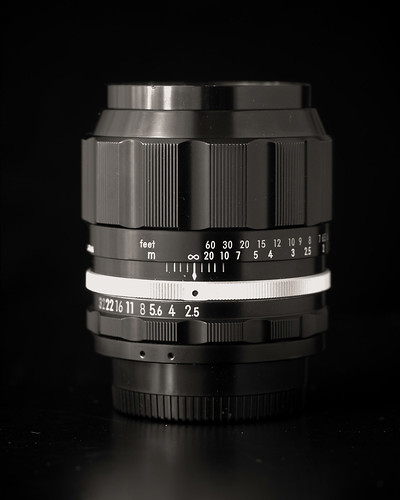
 

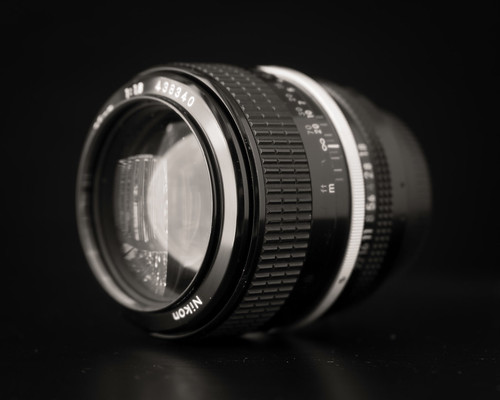
 Lens Stories ~ Nikon Nikkor-P 105mm f/2.5


If I understand things correctly, this is very similar to Lightroom's "Enhance Details" function.  These functions try to overcome the effects of strong AA filters (see: Canon digital sensors) and slow shutter speed image blurring.  I find it interesting that this function can/should(?) be applied prior to any additional sharpening (ie: UnSharp Mark, etc).

Rawtherapee's website says -

"... The Capture Sharpening tool helps recover details lost due to in-camera blurring, which can be caused by diffraction, the anti-aliasing filter, or other sources of Gaussian-type blur.

It is applied to the raw file immediately after demosaicing and modifies the data in linear gamma to limit halo generation. This means that it will only work on raw files..." 

Perhaps this will turn out to be a "crazy good" function in the cases where you're looking for absolute over the top kind of image "sharpness."  It could be useful when combined with another function or two.  Perhaps I'll write about that?

In the meantime, take a look at the following and see what you think.

Showing my homework -


Nikon Nikkor-P 105mm Xenotar - A6000 + A7 Capture Sharpen Comparison


Friday, February 25, 2022

Contrast matching between APS-C/Lens Turbo II and Full Frame ~ showing my homework

 Earlier I said something that likely needs a little proof.

"...Though the A6000 images show less contrast and appear "softer" than the A7 center images, the Nikon Nikkor 24mm f/2.8 Ai looks reasonably sharp in the center wide open and at f/8.  When contrast is matched with the A7, the A6000 24mm images look fairly comparable..."

This is a quote from my  post that looked at field flatness (or the distinct lack thereof) of a Sony A6000+Lens Turbo II+Nikon Nikkor 24mm f/2.8 Ai setup.

When I wrote that comment I knew I'd have to come back to it in the future.  Well, the future is now.

Image processing can be as important to how "sharp" a photograph appears as just about anything else we consider.  This includes "lens resolution", which is really, for most of us, system resolution where sensor size, lighting, subject all influence the result.  Rarely are we able to consider a standalone optics true resolution, unless you're Roger Cicala at Lens Rentals.

Using a set of images I'd taken with a beautiful Nikon 75-150mm f/3.5 E-series lens I illustrate by showing my homework my reasoning behind the above quote.


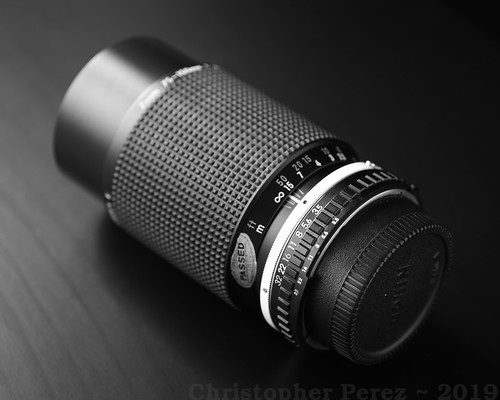
Nikon 75-150 f/3.5 E ~ Lens Stories


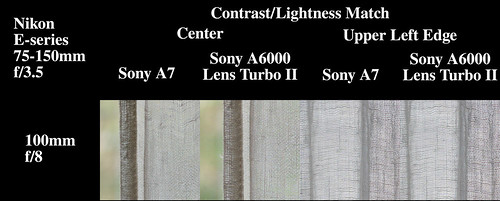
In the following image I "matched" the look of an APS-C sensor'd Sony A6000 + Lens Turbo II + Nikon E image to a Sony A7 Full Frame image I took moments before using the same focal length and aperture.

I did nothing to the Sony A7 image other than let Rawtherapee's Auto-Matched Tone Curve set the image levels.

For the Sony A6000/LT2/Nikon image I went back into Rawtherapee, opened the A7 image in a photo viewer, and went between the two applications until the A6000/LT2/Nikon image looked the same as the A7. 

In Rawtherapee what I needed to do to get the images to match was to set the Auto-Matched Tone Curve'd APS-C A6000 image to +25 Contrast and +3 Lightness.  

The histograms are very nearly identical in the following comparison. 

Showing my homework -


Sony A7, A6000 LT2, Nikon E at 100mm at f/8 ~ Contrast Matched

Thursday, February 24, 2022

Nikon Nikkor-P 105mm f/2.5 Xenotar-type ~ Lens Turbo II APS-C vs Full Frame

Today I look at an old Nikon Nikkor-P 105mm f/2.5 Xenotar-type pre-Ai lens.  This is the last in this series of field flatness comparisons.  

The original question came up when I realized the Lens Turbo II focal length reducer was introducing field flatness issues.  The matter has come down to determining which lenses are most effected so I can avoid using them focal reduced on APS-C Sony mirrorless.


 Nikon Nikkor 105mm f/2.5 (Xenotar version) ~ Lens Stories


I've owned several of 105mm Nikkors over the years.  Currently I own two.  One was sent to me by a friend back in the States.  The lens is the earlier Sonnar design and it is very sharp from wide open.  It suffers from just a hint of field curvature wide open.

A couple years ago there was a newer design pre-Ai Xenotar version that came up on That Auction Site.  No one bid on it.  The opening bid was low enough I could ask "why not?"  For not much money I scored another pretty little lens.

Wide open the Xenotar version is not as razor sharp as the early Sonnar version, though the field is in my case flatter than the older design.  Stopped down (from f/4, on) I can't tell anything between them.

A different friend says that owning lenses can be like owning shoes.  Who wants to own just one pair?  It's a form of madness, I'm convinced.  I can't help myself.

Setup

  • Sony A7 with straight-thru adapter - ISO100, 2 second timer, in-camera levels used to square the whole plot up
  • Sony A6000 with Lens Turbo II focal reducer - ISO100, 2 second timer
  • Manfrotto tripod - it's capable of securing an 8x10inch view camera, so it's sturdy enough for this
  • Nikon Nikkor-P 105mm f/1.8 pre-Ai - shot at two f-stops - f/2.5 and f/8
  • Rawtherapee RAW to jpg conversion - Auto-Match function (no "Capture Sharpen")


Comparison

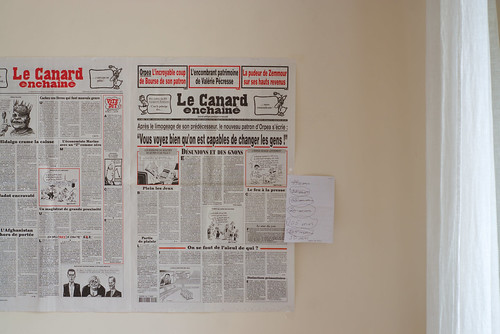
Here is the scene setup.  As you can see, I moved away from using the apartment scrims (curtains) to shooting a copy of le Canard Enchaine' tapped to a flat wall.  I'm looking more carefully at field flatness, right?  Even given the all-too-often shoddy work standards around Paris, this wall is sufficiently flat for my purposes.


Scene Setup ~ A6000 + Lens Turbo II+Nikkor-P 105mm


[As always, click on the image and look at it to 100percent file size to see whatever there is to be seen.]


Niion Nikkor-P (Xenotar) 105mm f/2.5 pre-Ai


Comments

The Nikon Nikkor-P 105mm f/2.5 pre-Ai is sharp in the center wide open and at f/8 on both the A6000 APS-C with Lens Turbo II and the Sony A7 full frame cameras.

The extreme lower left corner of the scene at f/2.5 the Lens Turbo II APS-C image looks a tiny bit soft, but unlike other lenses, this combo looks very good at f/8.  

The Sony A7 with straight-thru adapter at the very corners are quite sharp wide open and stopped down.

Finishing up this sequence of comparisons with a bang! the 105mm Nikkor looks pretty darned good on both Lens Turbo II focal reduced APS-C and Full Frame.

Monday, February 21, 2022

Nikon Nikkor 85mm f/1.8 K pre-Ai ~ Lens Turbo II APS-C vs Full Frame

I'm continuing to work with various Nikon lenses to see if I can answer the question of which lenses when used in conjunction with a Lens Turbo II focal length reducer exhibit unacceptable field curvature.  Here is a look at an old Nikon Nikkor 85mm f/1.8 pre-Ai lens.


 Nikon Nikkor 85mm f/1.8 K ~ Lens Stories


Another sad tale to tell, but this one has a relatively happy ending. 

I had a single coated 85mm f/1.8 H and thought I _needed_ a multi-coated version of the optic.  So I sold the H and found what I thought was a reasonably priced K.

Normally I put a lens through all the paces before I shell out the bux.  This time I checked everything _but_ the focus ring action.  Yes.  This time I got bit.  Or, should I say, I bit myself for not paying full attention to what was in play.

When I got home I realized there was sand in the focus mechanism.  It's the first time I have ever encountered such a thing. Hundreds and hundreds of lenses have passed through my hands over the years.  Yet, there I was.  Sand.  How it got there and did _not_ sand-blast the elements is beyond me.  Maybe someone dropped it in the sand when they were at the beach?  I'll never know and by now it doesn't matter.

So I did the expected and disassembled the lens, re-greased the threads, and now all is good.  Still, I should've checked more thoroughly.  I should have been able to pick up this lens for practically nothing, given the sand-packed problem.

My H version of this focal length was brilliant from Day One.  The focus was as smooth as any Nikkor I've ever own.  Further, the more I thought about it the more I liked the idea of single coated optics.  Something to give the highlights a little "sparkle."  Yes, I regret selling the H. I may have to find another one.  Someday.  But only at the "right" price.  And you can be sure I'll be checking for any consequences from trips to the beach.

Setup

  • Sony A7 with straight-thru adapter - ISO100, 2 second timer, in-camera levels used to square the whole plot up
  • Sony A6000 with Lens Turbo II focal reducer - ISO100, 2 second timer
  • Manfrotto tripod - it's capable of securing an 8x10inch view camera, so it's sturdy enough for this
  • Nikon Nikkor 85mm f/1.8 pre-Ai - shot at two f-stops - f/1.8 and f/8
  • Rawtherapee RAW to jpg conversion - Auto-Match function (no "Capture Sharpen")


Comparison

Here is the scene setup.  As you can see, I moved away from using the apartment scrims (curtains) to shooting a copy of le Canard Enchaine' tapped to a flat wall.  I'm looking more carefully at field flatness, right?  Even given the all-too-often shoddy work standards around Paris, this wall is sufficiently flat for my purposes.


Scene Setup ~ A6000 + Lens Turbo II+Nikkor-P 105mm


[As always, click on the image and look at it to 100percent file size to see whatever there is to be seen.]


Nikon Nikkor-K 85mm f/1.8 pre-Ai


Comments

The Nikon Nikkor 85mm f/1.8 pre-Ai is sharp in the center wide open and at f/8 on both the A6000 APS-C with Lens Turbo II and the Sony A7 full frame cameras.

The extreme lower left corner of the scene at f/1.8 are equally soft between the Lens Turbo II APS-C image an the A7 full frame with straight through adapter.  In the past I've tested to see if refocusing the corners helps, and it does, but as expected the center then goes slightly out of focus. 

As with other lenses I've used in this way, the Nikkor 85mm f/1.8 K on my A6000 with Lens Turbo II in the corners at f/8 don't fully "clean up".  On the other hand, Sony A7 with straight-thru adapter f/8 images at the very corners are quite sharp, just as we would hope.

As I've said before with a few other lenses, the Lens Turbo II induced field curvature "feels" very mild in this setup.  If I applied "Capture Sharpen" to the Lens Turbo II f/8 image it would appear to be sharper than the native Sony A7 full frame image out of the camera.

Saturday, February 19, 2022

Nikon Micro-Nikkor 55mm f/3.5 pre-Ai ~ Lens Turbo II APS-C vs Full Frame

Working with various Nikon lenses to see if I can't answer the question of which lenses when used in conjunction with a Lens Turbo II focal length reducer exhibit unacceptable field curvature, here is a look at an old Nikon Micro-Nikkor 55mm f/3.5 pre-Ai lens.


 Nikon Micro-Nikkor 55mm f/3.5


Said tale to tell, when I was walking over to the port de plaisance in Saint Laurent du Var one early morning to take photographs of old cars, the Sony A6000 with this Micro-Nikkor slipped off my shoulder and hit the concrete sidewalk.  The camera took the brunt of the fall.  I couldn't believe it and didn't even feel the camera slipping down my arm.

Fortunately the camera only fell hard a foot or two.  One of the dials is a bit dodgy, now.  But other than a few dings on the camera, and one small chip on the focusing ring of the lens, there doesn't seem to have been much damage.  Both remain usable.

I bring this up in the event that the lens is now out of alignment.  I don't think it is as all my images remain clear and sharp across the field.  What's certain is that it's no longer absolutely pristine as it was before the accident.  *sniff*


Setup

  • Sony A7 with straight-thru adapter - ISO100, 2 second timer, in-camera levels used to square the whole plot up
  • Sony A6000 with Lens Turbo II focal reducer - ISO100, 2 second timer
  • Manfrotto tripod - it's capable of securing an 8x10inch view camera, so it's sturdy enough for this
  • Nikon Micro-Nikkor 55mm f/3.5 pre-Ai - shot at two f-stops - f/3.5 and f/8
  • Rawtherapee RAW to jpg conversion - Auto-Match function (no "Capture Sharpen")


Comparison

Here is the scene setup.  As you can see, I moved away from using the apartment scrims (curtains) to shooting a copy of le Canard Enchaine' tapped to a flat wall.  I'm looking more carefully at field flatness, right?  Even given the all-too-often shoddy work standards around Paris, this wall is sufficiently flat for my purposes.


Scene Setup ~ A6000 + Lens Turbo II+Nikkor-P 105mm


[As always, click on the image and look at it to 100percent file size to see whatever there is to be seen.]


Nikon Micro-Nikkor 55mm f/3.5 pre-Ai


Comments

The Nikon Micro-Nikkor 55mm f/3.5 pre-Ai is sharp in the center wide open and at f/8 on both the A6000 APS-C with Lens Turbo II and the Sony A7 full frame cameras.

Looking at the extreme lower left corner of the scene at f/3.5 we see the edges are slightly out of focus.  It looks like they are equally soft between the Lens Turbo II APS-C image an the A7 full frame with straight through adapter.  

As with other lenses I've used in this way, the A6000 with Lens Turbo II corners at f/8 don't fully "clean up".  On the other hand, Sony A7 with straight-thru adapter f/8 images at the very corners are quite sharp, just as we would expect for the flat field macro design lens.

The Lens Turbo II induced field curvature "feels" very mild in this setup.  If I applied "Capture Sharpen" to the Lens Turbo II f/8 image it would appear to be sharper than the native Sony A7 full frame image out of the camera.

Friday, February 18, 2022

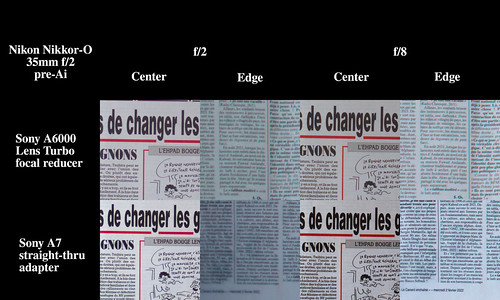
Nikon Nikkor-O 35mm f/2 pre-Ai ~ Lens Turbo II APS-C vs Full Frame

Continuing to work through the question of which lenses when used in conjunction with a Lens Turbo II focal length reducer exhibit unacceptable field curvature, here is an old and still rather pretty Nikon Nikkor-O 35mm f/2 pre-Ai lens.


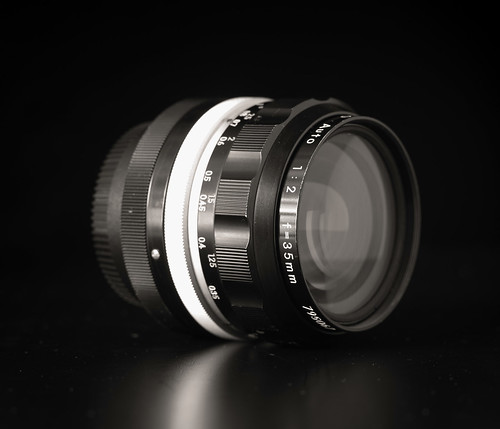
 Lens Stories ~Nikon Nikkor-O 35mm f/2


I recently confirmed that this 50 year old Nikkor-O can, on the surface of things at least, keep up with newer current Wowy-Zowy optics.  If you think about it long enough, there is really no reason why old lenses can't produce images indistinguishable from the modern stuff.  As a bonus, old lenses can be purchased many times inexpensively.  If memory serves, I paid less than 50Euro for this 35mm f/2.


Setup

  • Sony A7 with straight-thru adapter - ISO100, 2 second timer, in-camera levels used to square the whole plot up
  • Sony A6000 with Lens Turbo II focal reducer - ISO100, 2 second timer
  • Manfrotto tripod - it's capable of securing an 8x10inch view camera, so it's sturdy enough for this
  • Nikon Nikkor-O 35mm f/2 pre-Ai - shot at two f-stops - f/2 and f/8
  • Rawtherapee RAW to jpg conversion - Auto-Match function (no "Capture Sharpen")


Comparison

Here is the scene setup.  As you can see, I moved away from using the apartment scrims (curtains) to shooting a copy of le Canard Enchaine' tapped to a flat wall.  I'm looking more carefully at field flatness, right?  Even given the all-too-often shoddy work standards around Paris, this wall is sufficiently flat for my purposes.


Scene Setup ~ A6000 + Lens Turbo II+Nikkor-P 105mm


[As always, click on the image and look at it to 100percent file size to see whatever there is to be seen.]


Nikon Nikkor-O 35mm f/2 pre-Ai


Comments

The Nikon Nikkor-O 35mm f/2 pre-Ai looks sharp in the center wide open and at f/8 on both the A6000 APS-C with Lens Turbo II and the Sony A7 full frame cameras.

Checking the extreme lower left corner of the scene at f/2 we see they are out of focus.  I believe this is minor field curvature in both the straight-thru and Lens Turbo II adapters.  If I focus the edges, they are sharper than they appear here.  

The A6000 with Lens Turbo II corners at f/8 don't fully "clean up".  There is still a small amount of field curvature.   On the other hand, Sony A7 with straight-thru adapter f/8 images at the very corners are quite sharp.

The Lens Turbo II induced field curvature "feels" relatively mild in this setup.  It certainly is nothing nearly as bad as the field curvature seen when the Nikon Nikkor 24mm f/2.8 Ai is used with the Lens Turbo II focal length reducer.

Wednesday, February 16, 2022

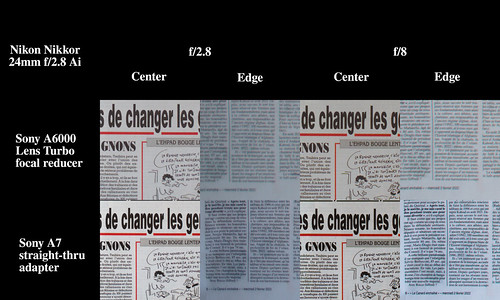
Nikon Nikkor 24mm f/2.8 Ai ~ Lens Turbo II APS-C vs Full Frame

I've begun this latest round of "let's have a look at things" by considering a well-used Nikon Nikkor-UD 20mm f/3.5 pre-Ai objective.

It's now the turn of a Nikon Nikkor 24mm f/2.8 Ai.

Lens Stories ~ Nikon Nikkor 24mm f/2.8 Ai


This is the very optic I complained suffered from field curvature.  At least this was the case when I used it with a Lens Turbo II focal reducer on my APS-C format NEX-5T, A5000, A6000, and NEX-7 cameras.

This blog entry is to confirm or deny that the field curvature is the fault of the lens.


Setup

  • Sony A7 with straight-thru adapter - ISO100, 2 second timer, in-camera levels used to square the whole plot up
  • Sony A6000 with Lens Turbo II focal reducer - ISO100, 2 second timer
  • Manfrotto tripod - it's capable of securing an 8x10inch view camera, so it's sturdy enough for this
  • Nikon Nikkor 24mm f/2.8 Ai - shot at two f-stops - f/2.8 and f/8
  • Rawtherapee RAW to jpg conversion - Auto-Match function (no "Capture Sharpen")


Comparison

Here is the scene setup.  As you can see, I moved away from using the apartment scrims (curtains) to shooting a copy of le Canard Enchaine' tapped to a flat wall.  I'm looking more carefully at field flatness, right?  Even given the all-too-often shoddy work standards around Paris, this wall is sufficiently flat for my purposes.


Scene Setup ~ A6000 + Lens Turbo II+Nikkor-P 105mm


[As always, click on the image and look at it to 100percent file size to see whatever there is to be seen.]


Nikon Nikkor 24mm f/2.8 Ai


Comments

Though the A6000 images show less contrast and appear "softer" than the A7 center images, the Nikon Nikkor 24mm f/2.8 Ai looks reasonably sharp in the center wide open and at f/8.  When contrast is matched with the A7, the A6000 24mm images look fairly comparable.

Checking the extreme lower left corner of the scene we can see what I observed years ago.  For me it's the Smoking Gun (as it were, I'm really a peaceful kind of guy).  Right here is why I questioned the focal reduced 24mm Nikkor.  

Even stopped down, the corners at f/8 remain out of focus.  When used with a Lens TurboII the 24mm's field is very strongly curved.  It is so strongly curved, in fact, when the center is focused at infinity the corners of the frame remain out of focus.

On a straight-thru adapter on a Sony A7 the lens is beautifully sharp across a nicely flat field.

The Nikon Nikkor 24mm f/2.8 Ai does not work well when mated to a Lens Turbo II Nikon F to Sony E focal length reducer. 

I observed something very similar with a 35-105mm f/3.5-4.5 AiS that I briefly owned.  Not realizing what was going on, I blamed the extreme field curvature on the cheap little zoom and quickly sold it.  Could it be that I jumped too soon?  Maybe that zoom's field, too, isn't curved under normal circumstances?

Which raises yet another question - does the Lens Turbo II work better with some lenses and not very well with others?

In the meantime, I freely admit that I was rather slow to realize that field curvature I'd observed in an otherwise beautiful Nikon Nikkor 24mm f/2.8 Ai was the fault of the Lens Turbo II focal length reducer and not the Nikkor lens.

Tuesday, February 15, 2022

Nikon Nikkor-UD 20mm f/3.5 ~ Lens Turbo II APS-C vs Full Frame

I recently groused about how slow I was to realize that field curvature that I'd observed in an otherwise beautiful Nikon Nikkor 24mm f/2.8 Ai was the fault of the Lens Turbo II focal length reducer and not the Nikkor lens.

Once I worked through more than a few "DUH!!!! How stupid can I be?" moments, I thought I'd confirm my updated understanding and have a careful look at several lenses of various focal lengths to see how the Lens Turbo worked.

I'll begin by looking at a well-used Nikon Nikkor-UD 20mm f/3.5 pre-Ai objective and in future blog posts work my way up to 105mm's.


Setup

  • Sony A7 with straight-thru adapter - ISO100, 2 second timer, in-camera levels used to square the whole plot up
  • Sony A6000 with Lens Turbo II focal reducer - ISO100, 2 second timer
  • Manfrotto tripod - it's capable of securing an 8x10inch view camera, so it's sturdy enough for this
  • Nikon Nikkor-UD 20mm f/3.5 pre-Ai - shot at two f-stops - f/3.5 and f/8
  • Rawtherapee RAW to jpg conversion - Auto-Match function (no "Capture Sharpen")


Comparison

Here is the scene setup.  As you can see, I moved away from using the apartment scrims (curtains) to shooting a copy of le Canard Enchaine' tapped to a flat wall.  I'm looking more carefully at field flatness, right?  Even given the all-too-often shoddy work standards around Paris, this wall is sufficiently flat for my purposes.


Scene Setup ~ A6000 + Lens Turbo II+Nikkor-P 105mm


[As always, click on the image and look at it to 100percent file size to see whatever there is to be seen.]


Nikon Nikkor-UD 20mm f/3.5 pre-Ai


Comments

The Nikon Nikkor-UD 20mm f/3.5 pre-Ai looks sharp in the center wide open and at f/8 on both the A6000 APS-C with Lens Turbo II and the Sony A7 full frame cameras.

Checking the extreme lower left corner of the scene, however, reveals that the Sony A6000 with Lens Turbo II focal reducer does introduce a focus shift.  The corners at f/8 don't "clean up" as well as they do on the Sony A7.

The induced field curvature "feels" minor in this setup.  I'm not sure how obvious the induced field curvature would be in "real life", but based on years of using Lens Turbo II adapters I doubt there would be much of a problem.

Monday, February 14, 2022

Nikon 75-150mm f/3.5 series-E Ai ~ Yet Another Look

Having looked at Nikon Nikkor 24mm f/2.8 Ai, an old Nikon Nikkor-O 35mm f/2 and a Nikon Nikkor 50mm f/1.8 AiS for field flatness on full frame Sony A7, here is a look at a Nikon 75-150mm f/3.5 series E AiS.


Nikon 75-150mm f/3.5 E ~ Lens Stories


Setup

  • Sony A7 - ISO50, 2 second timer, in-camera levels used to square the whole plot up
  • Manfrotto tripod - it's capable of securing an 8x10inch view camera, so it's sturdy enough for this
  • Nikon 75-150mm f/3.5 AiS - shot from f/3.5 through f/8
  • Rawtherapee RAW to jpg conversion - Auto-Match function, but nothing further (ie: NO Capture Sharpening)

Comparison

Here is the scene setup.  It's just a pair of closed gaze scrims in our apartment.  The details are interestingly small, so therefore useful for this kind of "wee look-see."  The center section, upper left corner, and lower right corners were used in the comparison.


Nikon Nikkor-O 35mm f2 Scene


[As always, click on the image and look at it to 100percent file size to see whatever there is to be seen.]


 Nikon lens comparison - 55mm to 150mm

Comments

I know I'm beginning to sound like a broken record, but, wide open the 75-150mm Nikon is a bit soft.  

At f/5.6 and f/8 this un-loved under-appreciated ancient 2x good-for-nothing $25 lens is plenty "sharp" to my eyes, even though I think I see just a hint of field curvature at the extreme edges.  

I think there might be a bit of magic in this cheap optic. 

After having worked with manual focus Nikon lenses for many years I think I finally understand that this softness is deliberate.  I think it's how the Japanese express their sense of "delicateness" in photographic images.

Nikon's "Thousand and One Nights" says -

"...Although the E 75-150mm f/3.5 was manufactured as a popular lens for use with the Nikon EM, the finished lens was, in fact, sufficiently well executed as to find favor with the experts...

... the background blur is delightful, and makes the lens suitable for portraits... -–in line with the original concept for the lens. As on the AI Nikkor 135mm f/2 lens, the secret behind this is the deft use of close-range aberration fluctuations-–the correction for spherical aberration being slightly attenuated at close range in order to smooth the background blur...

What I think I see is that Nikon has developed a lens design approach that favors under-corrected spherical aberration behind the point of focus when a lens is shot wide open.  They seem to do this as a way of lending an image the Japanese "delicateness" I mentioned at the top of this section.

Sunday, February 13, 2022

Nikon Nikkor 50mm f/1.8 AiS ~ Yet Another Look

Having looked at Nikon Nikkor 24mm f/2.8 Ai and an old Nikon Nikkor-O 35mm f/2 for field flatness on full frame Sony A7, here is a look at a Nikon Nikkor 50mm f/1.8 AiS "pancake".


Lens Stories ~ Nikon Nikkor 50mm f/1.8 AiS


Questions of field flatness arose when I used a Nikon Nikkor 24mm f/2.8 Ai in conjunction with a Lens Turbo II focal reducer on Sony APS-C mirrorless cameras.  I couldn't find a way to get that combination sharp in the corners, even stopped down and I couldn't believe that Nikon would ever design a lens with that much curvature.  

After moldering around for four or five years, the idea finally hit me that maybe the problem was the Lens Turbo II focal reducer and not the Nikkor.  Duh.

For completeness, I mounted a Nikon Nikkor 50mm f/1.8 AiS "pancake" on my low-mileage Sony A7 using a straight-thru adapter and pointed the lens at a fine-detailed subject.  The fine-detailed subject just happened to be our daylight back-lit apartment gaze curtains.

Setup

  • Sony A7 - ISO50, 2 second timer, in-camera levels used to square the whole plot up
  • Manfrotto tripod - it's capable of securing an 8x10inch view camera, so it's sturdy enough for this
  • Nikon Nikkor 50mm f/1.8 pre-Ai single coated - shot from f/1.8 through f/8
  • Rawtherapee RAW to jpg conversion - Auto-Match function, but nothing further (ie: NO Capture Sharpening)

Comparison

Here is the scene setup.  It's just a pair of closed gaze scrims in our apartment.  The details are interestingly small, so therefore useful for this kind of "wee look-see."  The center section, upper left corner, and lower right corners were used in the comparison.


Nikon Nikkor-O 35mm f2 Scene


[As always, click on the image and look at it to 100percent file size to see whatever there is to be seen.]


Nikon Nikkor 50mm f/1.8 AiS


Comments

Wide open the 50mm Nikkor is a bit soft.  What was important to me was to confirm there was a similar level of softness across the field from the center all the way to the edges.  This appears, in fact, to be the case.

From f/2.8 on down through f/8 this little "pancake" lens is plenty "sharp" to my eyes.

I believe the Nikon Nikkor 50mm f/1.8 AiS "pancake" is the same design as the Nikon 50mm f/1.8 series-E and the more recent Nikon Nikkor AF-D 50mm f/1.8.

Nikon's "Thousand and One Nights" says -

"...the Series E 50mm f/1.8, sold in some regions including the U.S., and the AI Nikkor 50mm f/1.8S were actually sister lenses designed with the same basic optics, but different outward appearance and coatings...

What's more the same basic optical design was reborn as the AI AF Nikkor 50mm f/1.8S (coatings and such were modified), and is still available today (2016) in the AI AF NIKKOR 50mm f/1.8D. When this lens was reborn as an AF lens, it lost its slim, pancake design, but its rendering characteristics remain the same...

I've owned several series-E 50mm f/1.8 lenses over the years, and they performed for me the same way the AiS Nikkor version does.  All were/are slightly soft wide open and with a pleasing out of focus rendition.

This compares with my experience of using a Nikkor f/2 pre-Ai and Ai 50mm.  These are wickedly sharp wide open, but the out of focus rendition can be very harsh "soap bubble."  For those who believe that lens formulas hold the secret to great out of focus performance, both the harsh f/2 and beautiful f/1.8 50mm lenses are the exact same 6 element, 4 group plasmat layout.  The difference is in the calculation of the curves of the various lens elements.

Coming back to the original question, I don't recall seeing field curvature issues with the 50mm Nikkor f/1.8 AiS lens when combined with a Lens Turbo II focal reducer.  So, for whatever reason, there might not be the set of circumstances that lead to the effects I saw clearly with a Nikkor 24mm with a Lens TurboII.

In any event, this confirms the 50mm Nikkor is respectably flat field across the field and very sharp when shot on full frame.

Saturday, February 12, 2022

Old vs New ~ Nikon Nikkor 50mm f/1.8 AiS vs Sony 50mm f/1.8 SEL OSS (APS-C)

Continuing in the style of recent posts and asking a question about how old lenses compare with current day computer designed optics, I take a quick look this time at a Nikon Nikkor 50mm f/1.8 AiS "pancake" lens and compare it against an APS-C format Sony 50mm f/1.8 SEL OSS.

Setup

  • Sony A7 - ISO50, 2 second timer, in-camera levels used to square the whole plot up
  • Manfrotto tripod - it's capable of securing an 8x10inch view camera, so it's sturdy enough for this
  • Lenses -
    • Nikon Nikkor 50mm f/1.8 AiS - shot from f/1.8 through f/8
    • Sony 50mm f/1.8 SEL OSS (APS-C) - shot from f/1.8 through f/8 shot Full Frame which shows the edge of the frame clipped due to the lack of FF coverage
  • Rawtherapee RAW to jpg conversion - Auto-Match function
    • "Capture Sharpen" used on the f/1.8 images to see how they compare with other apertures without "CS"

Comparison

Here is the scene setup.  It's just a pair of closed gaze scrims in our apartment.  The details are interestingly small, so therefore useful for this kind of "wee look-see." 


Nikon Nikkor-O 35mm f2 Scene


[As always, click on the image and look at it to 100percent file size to see whatever there is to be seen.]


Nikon Nikkor 50mm f/1.8 AiS, Sony OSS SEL 50mm f/1.8


Comments

At f/1.8 the Nikkor 50mm is slightly softer than the Sony.  I figured this might be the case based on a webpage that has long disappeared that compared the Sony against Leica's latest 50mm and won.  Though I see nothing wrong with the Nikkor, this Sony optic is very special.

From f/2.8 on down through f/8 I have a difficult time telling the difference between the Nikkor 50mm lens and the Sony 50mm.

This comparison includes "Capture Sharpen"'d f/1.8 images.  It's interesting to see how much "crisper" these images become with a simple push of a button.

As I've suggested in the past, I suspect "Capture Sharpen" removes the character of a lens when shot wide open.  It's at the widest apertures where I've seen the designed-in effects of spherical and chromatic aberrations of old Nikkor manual focus lenses.

After seeing a large show of Steve McCurry's glorious images at the Musee Maillol where I studied his images with an eye toward such things, I may have more to say about "Capture Sharpen" and optical effects in the future.

Thursday, February 10, 2022

Old vs New ~ Nikon Nikkor-O 35mm f/2 vs Sigma 30mm f/2.8 EX DN E

From a recent post, the Nikon Nikkor-O 35mm f/2 pre-Ai looks pretty good, regardless of age.  For me an obvious question is how it compares with current day computer design optics?

I have a Sigma 30mm f2.8 EX DN E that is wickedly sharp from f4 on down.  So I mounted the Sigma on my Sony A7 and shot it in full frame mode (no APS-C cropping).  I did this to keep things more or less equal between the newer and old lenses.  All I needed to do was move the tripod to account for the 5mm focal length difference.

Setup

  • Sony A7 - ISO50, 2 second timer, in-camera levels used to square the whole plot up
  • Manfrotto tripod - it's capable of securing an 8x10inch view camera, so it's sturdy enough for this
  • Lenses -
    • Nikon Nikkor-O 35mm f/2 pre-Ai single coated - shot from f/2 through f/8
    • Sigma 30mm f/2.8 EX DN E - shot from f/2.8 through f/8 shot Full Frame which shows the edge of the frame clipped due to the lack of FF coverage
  • Rawtherapee RAW to jpg conversion - Auto-Match function, but nothing further (ie: NO Capture Sharpening)

Comparison

Here is the scene setup.  It's just a pair of closed gaze scrims in our apartment.  The details are interestingly small, so therefore useful for this kind of "wee look-see." 


Nikon Nikkor-O 35mm f2 Scene


[As always, click on the image and look at it to 100percent file size to see whatever there is to be seen.]


Nikon Nikkor-O 35mm f/2, Sigma 30mm f/2.8 EX DN E Comparison


Comments

At f/2.8 the Nikkor-O is just a touch softer than the Sigma.  Not by much, mind you, but just enough that I can see it pixel-peeping.

From f/4 on down through f/8 I have a difficult time telling the difference between the 50+ year old Nikkor-O 35mm lens and the 10 year old Sigma 30mm.  In terms of how I "see sharpness", the images are equivalent.

Though I don't show it here, by applying Rawtherapee's "Capture Sharpen" to any of the images, Nikon or Sigma, the "apparent sharpness" will visibly increase.

Coming to subtle differences between how the Nikon and Sigma lenses "render" an image, I found it interesting the way the tree in the background appears to be "softer" and "smoother" with the Nikkor-O than with the Sigma.  I could've predicted this based on earlier comparisons of point light sources out of focus.  Nikkor lenses, historically, have been designed for this kind of smooth out of focus rendition behind the point of focus.

So what, if anything, has been gained in commercial optics between the time of the Nikkor-O seen here and the Sigma Art DN?  Not much optically, maybe.  Additionally, perhaps not all lens manufacturers have Nikon's sensitivity to how the out of focus regions are rendered, either, but, a lot of other closely related things _have_ changed in 40 years.

We now have autofocus, as well as very small, sharp lenses like this little 30mm f/2.8.  It weighs all of 140grams compared with the Nikon 35mm f/2 at one aperture stop wider and 285grams, which comes without autofocus (of course).  

I'm certain that vast improvements have been made in "manufacturability" over the years.  It takes fewer steps to make a lens these days and with higher assembly accuracy (though I have a Sony 16mm f/2.8 SEL that might suggest otherwise).

Sunday, February 06, 2022

Nikon Nikkor-O 35mm f/2 pre-Ai single coated ~ yet another look

After recently reconsidering what turns out to be a brilliant little Nikon Nikkor 24mm f/2.8 Ai, I thought it might be time to have yet another look at my old Nikon Nikkor-O 35mm f/2 single coated optics.


Lens Stories ~Nikon Nikkor-O 35mm f/2


For this look at things, I wanted to confirm the field of this focal length lens is as flat as the newer 24mm Nikkor.

I mounted it up on the Sony A7 using a straight-thru adapter and pointed the lens at a fine-detailed subject.  The fine-detailed subject just happened to be our daylight back-lit apartment gaze curtains.

Setup

  • Sony A7 - ISO50, 2 second timer, in-camera levels used to square the whole plot up
  • Manfrotto tripod - it's capable of securing an 8x10inch view camera, so it's sturdy enough for this
  • Nikon Nikkor-O 35mm f/2 pre-Ai single coated - shot from f/2 through f/8
  • Rawtherapee RAW to jpg conversion - Auto-Match function, but nothing further (ie: NO Capture Sharpening)

Comparison

Here is the scene setup.  It's just a pair of closed gaze scrims in our apartment.  The details are interestingly small, so therefore useful for this kind of "wee look-see."  The center section, upper left corner, and lower right corners were used in the comparison.


Nikon Nikkor-O 35mm f2 Scene


[As always, click on the image and look at it to 100percent file size to see whatever there is to be seen.]


Nikon Nikkor-O 35mm f/2 pre-Ai


Comments

Borrowing from my Comments on the 24mm Nikkor, nearly everything I saw with that lens can be applied to this Nikkor-O 35mm f/2.

The Center images at f/2 looks a bit soft.  Is it the lack of contrast?  Or perhaps a bit of spherical aberration?  Both, probably, as it's certainly softer and less contrasty than at f/2.8 or anything further south than that. 

From f/2 down to f/8, the extreme corners clean up incrementally.  The corners are certainly not bad, even at wide open, but the improvement as the lens is stopped down is apparent.

Thinking about this, isn't it remarkable how a lens manufactured in the early 1970's, is single coated, and designed sometime in the 1960's can still look half way decent on modern digital cameras?  Standing alone without a reference, the lens looks nice.

It makes me wonder what useful gains have been made in optical design between then and now?  I'll consider this quesion more fully in a future post.

Tuesday, February 01, 2022

Nikon Nikkor 24mm f/2.8 Ai ~ AA filter "sharpening" effects

Writing a recent entry on rediscovering the Nikon Nikkor 24mm f/2.8 Ai and the fact it actually has a flat field afterall, I stumbled on something that I'd like to consider here.

Capture Sharpening.

This is something that Lightroom and Rawtherapee provide.  It is a function that attempts to offset the effects of Anti-Aliasing filters.  AA filters are used to combat moire in digital sensors.  Canon is famous for using strong AA filters.  Sony, from what I understand, has much lighter AA filters in many of their mirrorless camera offerings, including the NEX/A6xxx and A7 products.

I've been using Rawtherapee's Capture Sharpen without really thinking about it.  My images are "sharper", so what's not to like, right?

A couple years ago I acquired a very low mileage (ie: <700 click) Sony A7 full frame light grabbing mirrorless monster.  While this is only the Mark I version of a long line of great Sony 24 mpixel cameras it really performs.  The sensor is very quiet (ie: no noise) and is far sharper than any Canon DSLR I ever used (and I used a lot of them). Do I really "need" Capture Sharpen to crisp images up???

Using images from a prior post I applied Capture Sharpen to images at two apertures to see what effect the function had on the basic off the sensor image.

Setup

  • Sony A7 - ISO50, 2 second timer, in-camera levels used to square the whole plot up
  • Manfrotto tripod - it's capable of securing an 8x10inch view camera, so it's sturdy enough for this
  • Nikon Nikkor 24mm f/2.8 Ai - shot at f/2.8 and f/8
  • Rawtherapee RAW to jpg conversion - Auto-Match function plus Capture Sharpen

Comparison

Here is the scene setup.  It's just a pair of closed gaze scrims in our apartment.


Nikon Nikkor 24mm Ai F-stop Comparison


[As always, click on the image and look at it to 100percent file size to see whatever there is to be seen.]


Nikon Nikkor 24mm Ai Comparison


Comments

Looking at the images at f/2.8 we can see where Capture Sharpen function lives up to its name.  Capture Sharpen'd images at f/2.8 are "sharper" looking that images out of the camera at f/8.  And at f/8, Capture Sharpen takes images yet another step further into "sharp."

I am "good" with all this, until I start looking at the contrast in the out of focus regions (that little peek between the scrims).  It's there that something interesting is taking place.  The "soft smoothness" of the out of focus rendition is starting, to my eyes, become a little harsh.  The light/dark transitions have become rather "steep" and "contrasty."

Now I'm confronted with a reality of software processing "enhancements."  I ask myself several things - 

  • Is this really how I want my images to appear?
  • Does software intervention go some ways toward eliminating optical effects?
  • What if native lens rendering, defects and all, are what attracted me to a set of lenses in the first place, only to be removed by software?

That last question is something rather interesting.  

For instance, let's say a lens manufacturer like, oh, let's take Nikon as an example, _deliberately_ designed their old manual focus lenses to be soft wide open and sharpen up as the aperture is stopped down.  

Let's say Nikon knew their Japanese customers _loved_ soft rendering under certain circumstances to create a "delicate" look.  

Let's say Western customers know little to nothing about any of this and just want "sharp", "sharp, "sharp" at all costs and at _all_ apertures.  Or, let's say that modern AF systems require a certain level of resolution wide open to focus accurately.

Which leads me to a related conversation made some years ago around the photo-forums.  That was the subject of "focus shift" between wide open and stopped down.  In particular, I remember comments about Nikon Nikkor 50mm f/1.4 lenses being prone to this dastardly defect.  Oh the horror.  Oh the hopelessness.  Oh the hand wringing.

Only... if a lens is designed to be deliberately soft wide open it will give the Japanese markets desired "delicate" effect.  It will exhibit under-corrected spherical aberration behind the point of focus.  One of the things about under-corrected spherical aberration is that there is a region, not just one point!, where an image will appear to be in focus.  

The implications of this are several fold and it might take several tumblers of the "Good Stuff" to think through all this and to come to an enlightened understanding of what's really going on.  I'll comment a bit more on these things in a future post.

Coming back to the effects of Capture Sharpen on softer images shot wide-open, I see where it's possible to make such an image appear as "sharp" as anything shot at other apertures.

The questions are: Is this really what I want?  Or do I want to retain the "character" of a lens as it was originally designed?


Saturday, January 29, 2022

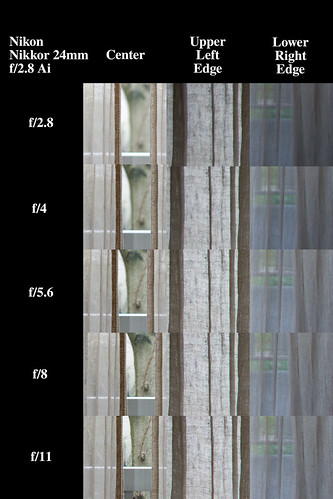
Nikon Nikkor 24mm Ai ~ a reconsideration

Four years ago I wrote a little entry where-in I bemoaned field curvature that I found in a pretty little Nikon Nikkor 24m f/2.8 Ai.  This was "confirmed" in images shot at or near infinity that were distinctively soft in the extreme corners of the frame.


Lens Stories ~ Nikon Nikkor 24mm f/2.8 AiS


Since then I've thought a lot about that blog entry and the pretty optic in question.  I couldn't believe that Nikon would design a lens with that much field curvature.  Certainly, there had to be some "reasonable" explanation, or so I posited.

Some time between then and now I acquired a very low mileage (ie: <700 click) Sony A7 full frame light grabbing mirrorless monster.  While this is only the Mark I version of a long line of great Sony 24 mpixel cameras it really performs.  The sensor is very quiet (ie: no noise) and is far sharper than any Canon DSLR I ever used (and I used a lot of them).

If I weren't already wedded to the super small very light NEX/A5000/A6000 APS-C series of Sony cameras (which also outperform any Canon DSLR I ever used), I think I'd be sorely tempted to trade it all in on more Sony Full Frame Insanity.

Which leads me back to the Nikkor 24mm.  I finally found time to mount it up on the Sony A7 using a straight-thru adapter and point the lens at a fine-detailed subject.  The fine-detailed subject just happened to be our daylight back-lit apartment gaze curtains.

Setup

  • Sony A7 - ISO50, 2 second timer, in-camera levels used to square the whole plot up
  • Manfrotto tripod - it's capable of securing an 8x10inch view camera, so it's sturdy enough for this
  • Nikon Nikkor 24mm f/2.8 Ai - shot from f/2.8 through f/11
  • Rawtherapee RAW to jpg conversion - Auto-Match function, but nothing further (ie: NO Capture Sharpening - that will be in a future blog entry)

Comparison

Here is the scene setup.  It's just a pair of closed gaze scrims in our apartment.  The details are interestingly small, so therefore useful for this kind of "wee look-see."  The center section, upper left corner, and lower right corners were used in the comparison.


Nikon Nikkor 24mm Ai F-stop Comparison


[As always, click on the image and look at it to 100percent file size to see whatever there is to be seen.]


Nikon Nikkor 24mm Ai Capture Sharpen Comparison


Comments

Considering just the Center images, f/2.8 looks a bit soft.  Is it the lack of contrast?  Or perhaps a bit of spherical aberration?  It's not bad to my eye, but it's certainly softer and less contrasty than at f/4 or anything further south than that.  I'll have more to say about this, too, in a future post.

Looking at the question of field curvature, I feel I learned an important lesson. From f/2.8 I can see that the extreme corners of the frame are sharper than they ever were with the APS-C systems used with a Lens Turbo II focal reducer.  The corners get sharper from there on down through f/11.

So, what did I learn?  I learned that I can't just slap a lens on a focal reducer and expect it behave the same way a 35mm manual focus lens would on Full Frame.  There may be important changes to the way an image is rendered.  It's worth the time to test and evaluate something without drawing any early, hard, fast conclusions.

I need to update that old post to point out that "field curvature" is not necessarily a question of the lens.  In this case, the Lens Turbo II focal reducer induced field curvature when used with the Nikon Nikkor 24mm f/2.8 Ai lens.


Saturday, January 15, 2022

Looking Forward to 2022

Even as Omicron is surging wildly out of control around the world I can't help but dream, hope, and wish the following events actually get to see the light of day.

These are all motorsport related photo-opportunities -

Retromobile - 16-20 March

Foire Photo - Chelles - 20 March *ADDED 27 January*

la traversee de Paris - 27 March *ADDED 27 January*

Tour Auto - 25-30 April

Vintage Revival Montlhery - 7-8 May

Rallye des Princesses - 14-19 May

Paris - Rambouillet avec les Teuf-Teuf - 28, 29 May *ADDED 3 March*

Cafe Racer Montlhery - 18-19 June

le Mans Classic - 30 June, 3 July


With luck, I will see you there!


*UPDATED 27 January* It appears that Europe will be opening up in two weeks.  So all these events and MORE will be on schedule.  It'll be a very busy year after all.

la traversee de Pari estivale ~ 2021 redo

Sunday, January 02, 2022

Someone who performs outstanding optical testing...

I've known of the Lensrentals blog for some time, now.  Yet it's only very recently that I came to more fully understand and appreciate what Dr. Roger Cicala has to say. 

I enjoyed reading Dr.Cicala's comments on prime lenses and think his conclusions are interesting.  Of course I'm now considering adding a Sigma 30mm f/1.4 DC Contemporary lenses to my always too long list of optics that I might _have_ to have.

Dr. Cicala's conclusions were based in this article on traditional MTF measurements.  That is, contrast measurements were made along a single 2D line.  No attempts were made to account for optical field curvature in a 3D space.

Then I came across a current article and it really caught my attention.  Roger writes about integrating MTF information in a way that goes beyond simple flat field measurements.  

This is wonderful in the way the information helps one "see" how lenses behave in three dimensions. I think what Dr. Cicala & Co are now doing is ground breaking. I love it!

Additionally, I appreciate is that he clearly states that he is _not_ testing for out of focus rendition.  His tests might at best remotely hint at how out of focus regions can be rendered, but that is an area he is currently leaving to others.

Which leads me to something I read some years ago.  This was something that David Duncan Douglas wrote about when he first encountered Nippon Kogaku lenses.  His story, in general, is very well known.

M.Douglas' colleague made a nicely sharp image and was asked what lenses he was using.  M. Douglas' glass was designed and manufactured by Leitz and Zeiss and he was finding his lenses were rather soft and unremarkable compared with the photo his colleague had made.

On his first visit to Nippon Kogaku (now Nikon) they used a display method where one could clearly see and evaluate the performance of a lens.  A lens projector was the display method.  The way it worked was to have a grid image projected onto a screen through a lens.  As a lenses focus ring was turned a person could judge for themselves not only resolution, but _how an optic transitioned from out of focus into focus and back out of focus_.

There is a standard, albeit subjective, method for considering out of focus rendition of optics as well as "sharpness". Lens projectors are still used today for evaluating lenses used in cinema.  In fact, at least one testing lab has added out of focus rendition information to their web pages. 

Coming back to Dr. Cicala's lens tesing, I wish I had access to the kinds of equipment he uses.  Lens Rentals looks at the latest generation lenses.  I'd like to see how the old manual focus Nikon Nikkors behave.  There would be a lot for me to learn.

Both methods (MTF in 2D/3D and grid image projection) do not take into account the image recording materials.  These methods consider only the lenses.  I will leave the pros and cons of this for perhaps another time.  

Until then, and only if you're really interested in the subject and haven't already encountered Lens Rentals blog, consider what Dr. Cicala has written.


Nice Port ~ 2021


Thursday, December 09, 2021

... from a time long before...

I was cruising through my Flickr site and stumbled on an image.  

It was entered in one of David Hobby's Strobist contests and surprisingly to me it won forth or fifth place.

Did I really do this?  Wow.


Radiant Bones - All Hallows Eve

Tuesday, December 07, 2021

Do lenses matter as much as we're lead to believe they do?

Here I am, staying for yet another three months in Nice, France.  After this year is said and done we'll have been here 6 months.  Half a year.  Extraordinary year, this.

There's not been much time this trip to consider photography, the craft, the art, the tools, nor the techniques.  Yet I snapped a couple images recently that reminded me of something that I've thought about posting.

I wanted to call into question the little matter of lenses and how much importance we place on them.


Cimiez Nice ~ 2021


Sure, most people who make images couldn't work without at least one lens.  As we know, and without cutting things too fine, there are plenty of photographers who use pinholes and zone plates.

No.  That's not my point.  My point is lenses and the minutiae of optical performance and image rendering are largely subjective and up to the image maker.  

Outside of ourselves as photographers, who really cares what lens made which image?  The viewer?  I think not.

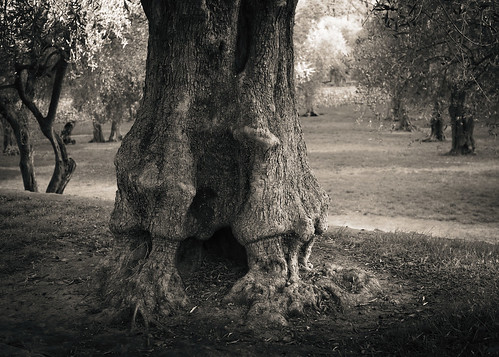
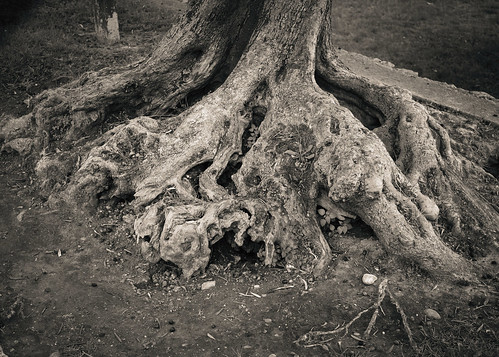
Without looking at the EXIF data, here's what I mean.  These ancient olive trees are found in the park where they used to play jazz into the wee-hours of the morning during a Nice summer give me pleasure.

I'm happy I had a camera and a lens.  I don't think these could be any better to me had I used my "favorite" optics that stayed home back in Paris.

And yet I fret and look and explore and ponder and search and am ready to buy yet another little optic that will somehow make my photographic life "perfect."

I'm a strange being.  Really.  I am.


Cimiez Nice ~ 2021

Saturday, October 02, 2021

Image Creation ~ "Ecosystems"

It looks like The Online Photographer may be changing the frequency of Mike's posts.  Putting food on the table is, of course, the most important thing, right?  Sounds like Mike is taking up writing.  It'll be interesting to see what he comes up with.

I have followed Mike's blog for years and I've been very happy to have learned as much as I have from reading his posts.  His insights into how digital files can be made to look good in black and white are particularly instructional.

Alas, the knowledge of what it takes to convert color into black and white, how to make very large prints from small digital files, how lens designs that influence out of focus rendition, all these things and much much more, when done properly, have been subsumed by and "baked into" the underlying software in current digital systems.

Color grading selection defaults can be set to ensure consistency from image to image.  Human perception modeling color to black and white conversion might be the very thing software is based on (and not based on simple color de-saturation).  Image stacking for noise reduction, image "up-rez"ing, and resolution improvement now can happen without us even knowing nor caring about what it takes to make the magic happen.

Over on Thom's website, he shared some thoughts on how small the standalone camera photography "ecosystem" has become.  The points he makes are, to me, quite valid and relate directly to the "baked into" comment I just made.

Back in film photography days the "ecosystem" was very large.  We had the camera and lens makers. We had the film manufacturers.  We had photo-labs and camera shops that sold chemistry for film development.  We had print paper manufacturers and companies that made enlargers and lenses for enlargers.  We had negative and print processor machines we could buy if we could afford them.  We had a gallery system and a vast book and magazine publishing engine.

The "ecosystem" was not dominated by a single manufacturer.  It couldn't be.  The "ecosystem" was simply too large.  For all its size and weight, the infrastructure each piece of the system integrated into was complete.  Everyone needed everyone else for the whole thing to work.

Today?  Things are, quite obviously, different.

Cell phone cameras have become the epicenter of a no-film, no-chemistry, low-overhead, all-electronic "ecosystem."  Cameras.  Lenses. Network connectivity.  Image sharing platforms. Communications.  Sharing.  Everything is well integrated, even down to having direct connections with the original film-era hold-overs of print making and book and magazine publishing.  The number of suppliers that it takes to create this "ecosystem" are substantially fewer than during the film era.

Several short years ago I watched as a tethered camera captured images of a fashion model along the Seine River here in Paris.  The images were edited by a small team of people on a laptop computer, color-graded on-site and posted directly to the 'net.  All in realtime.

Today I no longer see tethered cameras.  Sure, you can take just about any digital stand-alone camera and tether it to a power laptop computer, but why take on that level of overhead when you can do everything from a single device?

Everything can now be shot with a cellphone, by-passing the need for a laptop computer.  The team of people is downsized to just one or two people.  Everything is transmitted straight across the network to its destination.  The distance from idea to final results and distribution can now be incredibly short.

All this leaves me wondering what to do, if anything, with the old, traditional, stand-alone camera/optics systems?

Over a decade ago I mused that wouldn't it be interesting if someone integrated Linux as the base operating system into a camera?  Samsung tried this using the Linux derivative, Android, but the project was something of a disaster.

More recently, as in something less than ten years ago, I commented that Sony, the electronics company who should know well how to do this and how to market it, should take the Android OS, throw away the old embedded OS they currently use in their Alpha-series cameras, and create a fully networked, fully integrated, fully connected camera system.

I feel the opportunity is still there for the taking.  Except, as Thom notes, there might not be the "vision" of stand alone camera manufacturers to make the logical (to me, at least) leap into the cellphone present.


Musee des Arts et Metier ~ Paris 2021


Wednesday, September 01, 2021

RIP "Don't Take Pictures"

I'm sure everyone already knows, but "Don't Take Pictures" has shuttered its publication.  Perhaps you've read their announcement.

"Dear Readers,

Don’t Take Pictures will cease publication on September 1, 2021. When we launched in the fall of 2013, my Editor’s Letter explained the magazine’s mission as a space to celebrate the thoughtful, creative act of making photographic art. The following year, we launched online to include more timely features about the photographic community. We found that our online and print components needed one another in order to survive. 
 
The world has changed a lot since 2013 and our consumption of print media has evolved as well. In print, our writers and designers spent six months diving deep into the issue’s theme and each artist’s work. Without the distractions of a screen, our readers were encouraged to focus on photography on paper. Online publishing has changed as well. It is time to rethink the purpose of a magazine in the age of social media. For all that is gained by the ability to find photographers with a few clicks of a mouse, much of the grandeur and magic of their artwork is lost when viewed in slideshows, as thumbnails, or as part of an infinite stream of images. The demands of the internet era require a churning of content that is both unfeasible for Don’t Take Pictures’ staff and antithetical to our mission.
 
The decision to close Don’t Take Pictures was difficult, but its ending should not be mourned—change is not a bad thing. As the art world continues to evolve, our team is constantly rethinking how best to engage with photography in print and digital spaces. We are very proud of our past eight years, 16 beautifully designed print issues, and hundreds of online articles that exemplified what Don’t Take Pictures is about—great photography and great writing. We would like to extended a special thanks to the 90 artists we were honored to feature in print. 
 
Readers whose print subscriptions included an issue this September have been refunded. The Don’t Take Pictures website will remain online as an archive and resource for the foreseeable future, with all previous issues available as PDFs. It has been an absolute honor to share the work of emerging photographers and arts writers in print and online for the past eight years. We appreciate everyone who read our articles online, engaged with us on social media, or read Don’t Take Pictures in print.
 
Sincerely,
Kat Kiernan, Editor-in-Chief
"

I feel at the bottom of all this is an important point. The purpose of a photograph has changed dramatically in recent time. How we consume images, how we look at them, why we look at them, and what they mean to us has little relation to how we engaged images just a decade ago.

This is why I've scaled back my online presence. I now have just this blog and my Flickr page.  That's it. Nothing more.

Us older folk who tend to "remember when" are dying off. Photography had its day in the sun. Now the experience of image making is, for me, reduced to sharing what I still find interesting and pleasurable. I do this regardless of if there is an audience or a group of photographers I can share with, or not. 

Someday I may feel differently, but for now, that is how it is. 


Château de Fontainebleau ~ 2021
 

Tuesday, August 31, 2021

Super Resolution ~ research

Super Resolution, where you take a small image and increase its spacial dimensions and try to retain as much detail as possible, has been an interesting topic for photographers over the years.

Google recently published something related to two different approaches.  

They used an artificial intelligence to learn and then apply results.  

 "...diffusion models, originally proposed in 2015, have seen a recent revival in interest due to their training stability and their promising sample quality results on image and audio generation. Thus, they offer potentially favorable trade-offs compared to other types of deep generative models. Diffusion models work by corrupting the training data by progressively adding Gaussian noise, slowly wiping out details in the data until it becomes pure noise, and then training a neural network to reverse this corruption process. Running this reversed corruption process synthesizes data from pure noise by gradually denoising it until a clean sample is produced. This synthesis procedure can be interpreted as an optimization algorithm that follows the gradient of the data density to produce likely samples..."

I wonder how well it might work for amateur and professional photographers?  Perhaps we'll get a chance to see some day.


Château de Fontainebleau ~ 2021

Sunday, August 15, 2021

The size of things...

The older the I get the more important the size and weight of camera gear has become.

In fact, there was a time about seven years ago when I started doing push ups to build up my arms.  The Canon 5D MkII and 7D cameras owned then, along with two or three L-glass lenses were becoming too much for me to carry for a long time.  I would come back from a la traversee de Paris event exhausted.

One of the conversations folks were having online at the time was how nice it would be to have a full frame digital camera that had dimensions and weight similar to the old Canon AE-1.  If I remember correctly, Canon was saying they considered that to be the "perfect" camera size.  I can't recall their reasoning, but looking at the 1D and 1Ds I wondered why they felt they had to make those cameras so huge.

Not too long after I bought a new Sony A6000.  At first I didn't use it much as I thought the full frame Canon 5D _must_ have better image quality than the smaller APS-C A6000.  I caught on to the truth soon enough.  Sony sensors were and are nothing short of brilliant and I soon sold all my Canon gear.

I'm not sure why I thought about this recently.  Perhaps it has to do with the sizes of the Nikon and Canon mirrorless offerings.  They're still quite large and I wondered why that could be?

In any event, I thought I'd put down sizes and weights just to compare various cameras, new and old.  So, starting with the shortest base-length camera body and ending with the longest -

*Sony NEX-5T - 111mm x 59mm x 39mm - 329grams with 16mm f/2.8 pancake lens

*Sony NEX-5T - 111mm x 59mm x 39mm - 392grams with 16-50mm kit lens

*Sony NEX-5T - 111mm x 59mm x 39mm - 421grams with 30mm Sigma EX DN lens

*Sony A6000 - 120mm x 67mm x 45mm - 468grams with kit lens

*Sony A7 - 127mm x 94mm x 48mm - 769grams with kit lens

Nikon Z7 - 134mm x 101mm x 68mm - 1175grams with kit lens

Leica M4 - 138mm x 77mm x 38mm - 550grams body only

Canon R5 - 138mm x 97mm x 88mm - 738grams body, battery, CF card

Canon AE-1 - 141mm x 87mm x 47mm - 590grams body only

*Sony cameras were weighed with batteries and memory cards.

A quick glance at the list re-confirms for me that Sony continues to meet my lightest/smallest camera goals. 


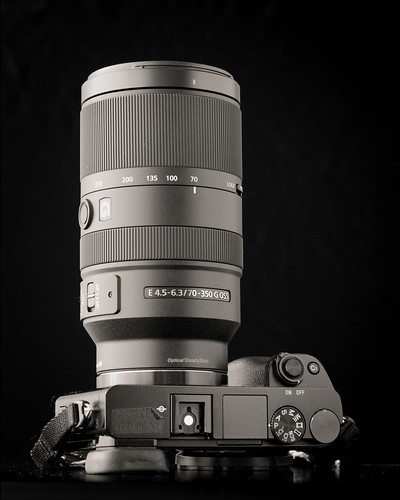
Lens Stories ~ Sony 70-350mm G-Master